

Leptodactylodon bicolor
Amiet, 1971
GBIF:127667045
ABOUT
Descriptions(1)
Leptodactylodon bicolor Amiet, 1971
We examined nine tadpoles from several sites on Mount Manengouba and the South-West Province of Cameroon: ZMB 78452 (four tadpoles, Gosner stages 25–26, Ebonemin, 5°1’27.6”N, 9°45’53.2”E, 1417 m, 15 August 2011); ZMB 78453 (one tadpole, Gosner stage 26, Nkikoh, 5°5’26.34”N, 9°48’24.36”E, 1319 m, 5 December 2010); ZMB 78457 (one tadpole Gosner stage 25, Pola, 5°3’26.6”N, 9°50’10.2”E, 1788 m, 20 October 2011); ZMB 78458 (two tadpoles, Gosner stages 25–26, Pola, 5°3’27.9”N, 9°49’39”E, 1719 m, 20 October 2011); ZMB 78461 (one tadpole, Gosner stage 35, Fotabong, 5°28’46.44”N, 9°55’53.22”E, 1221 m, 1 November 2011). The tadpoles were all found in small to medium-sized streams with farmbush vegetation on river banks (Fig. 2). They inhabited slowflowing parts of fast flowing streams with rapids in 1221–1788 m
The description of L. bicolor is predominantely based on three (ZMB 78452, 78453, 78458) genotyped individuals of Gosner stage 26. Body length/total length ratio and description of tail tips was based on nongenotyped specimens of the same developmental stage.
Morphology. Long slender tadpole with narrow and long muscular tail; body elliptical in dorsal view, slightly depressed in lateral view (Fig. 4 a, b); body shape in lateral view either slightly convex, extending level of tail axis (Fig. 4 a) or flat, in line with tail axis (Channing et al. 2012); body length 28.1 ± 2.1% (N= 7) of total length; body height 42.6 ± 4.2% (N= 3) of body length; body width 54.0 ± 4.3% (N= 3) of body length; maximum body width on the level of spiracle insertion; snout nearly rounded to truncate in dorsal view; nostrils oval, positioned laterally, opening slightly pointed ventrally; nostrils equidistant from eye and snout tip; eye diameter 13.1 ± 1.8% (N= 3) of body length; inter-orbital distance slightly exceeds inter-nostril distance; tail fins narrow; dorsal fin originating posterior to tail base (1.7 ± 0.3 mm; N= 3; Fig. 102 in Channing et al. 2012 and ZMB 78461: at level with tail base), equal to slightly deeper than ventral fin, reaching deepest point at about mid-tail, fin edge almost parallel to tail axis; ventral fin originating on level with tail base, narrow and almost parallel to tail axis; tail axis muscular, only slowly converging towards tail tip; tail tip rounded; body height 78.1–100% (N= 3; flatter individuals possibly due to preservation artifact) of total tail height; maximum height of tail axis 62.5–75.0% (N= 3) of total tail height; vent tube dextral; lateral sacs present, extending from spiracle to end of body, covering lower two thirds of flanks; short spiracle, sinistral, translucent, opening lateral, not visible in dorsal view, originating slightly posterior to midbody; mouth opening frontal; labial tooth formula 0/0; both jaw sheaths fully keratinized and of narrow almost rectangular shape; upper jaw distinctly serrated, serrations uniform; lower jaw U-shaped, serrated, lateral pair of caniniform projections (“fangs”; Fig. 4 d), median part with six to seven needle-like cusps (Channing et al. 2012: 8); three distinct serrations abaxial to fangs; large almost semicircular posterior lip covered with 20 papillae; papillae symmetrically arranged along body axis; most papillae arranged in two semicircular rows, one near the lower jaw sheath, the second closer to posterior margin of lower lip (Fig. 4 c); almost straight skin fold on lower lip, just posterior to lower jaw sheath; oral disc width 33.9–45.4% (N= 3) of body length; mouth width 22.2–33.3% (N= 3) of oral disc width.
The largest tadpole at Gosner stage 25 (ZMB 78462) measured 48.8 mm total length (body length: 11.9 mm; tail length: 38.9 mm). The most developed individual (ZMB 78461, Gosner stage 35) measured 45.6 mm total length (body length: 12.8 mm; tail length: 32.8 mm). Amiet (1980) reports tailed metamorphs measuring 13.5 mm SVL.
Coloration in preservation. Dorsal body parts and tail axis irregularly speckled dark brown on brown ground; mottling on tail axis strong, less pattern towards tail tip; anterior part of tail with longitudinal black line; ventrum clearer with very little dark speckling; dorsal fin brownish with darker spots or translucent; ventral fin predominantly translucent cream-white with few darker spots.
Coloration in life. Light brown with dark brown speckling, some dots being lighter; venter light grayishreddish; dark intestinal loops shining through skin; some individuals with cream-white snout.
Export occurrence data
Darwin Core Archive (ZIP)
CLASSIFICATION
Taxonomic Classification Tree

MULTIMEDIA
Media Files(2)
FIGURE 2. Habitats of Leptodactylodon tadpoles; a: small forest fragment behind Manengouba-Village, habitat of L. mertensi and L. ornatus ornatus, Mt. Manengouba, N 4 ° 57 ' 12.6 " E 9 ° 51 ' 33.36 ", 1093 m; b: mountainous forest, habitat of L. erythrogaster, Mt. Manengouba, N 4 ° 57 ' 12.6 " E 9 ° 51 ' 33.36 ", 2100 m; c: strongly degraded farmbush area, habitat of L. bicolor, Mt. Manengouba, near Pola N 5 ° 3 ' 27.78 " E 9 ° 50 ' 8.88 ", 1742 m; d: small forest fragment between farms, habitat of L. mertensi, Mt. Manengouba, near Nkack, N 5 ° 0 ' 46.5 " E 9 ° 46 ' 5.82 ", 1372 m. The tadpoles were caught hiding under stones in river parts with little current.
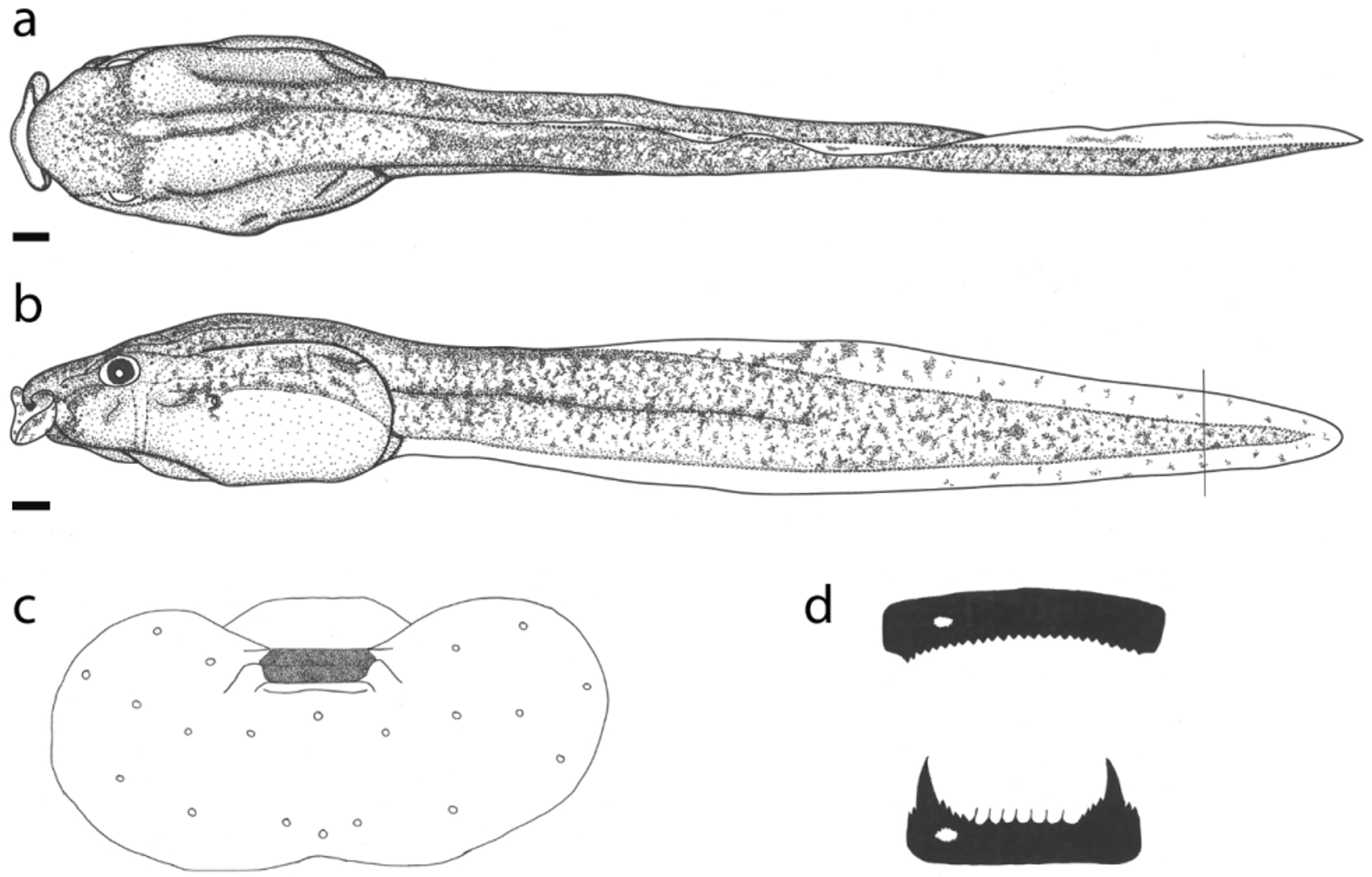
FIGURE 4. Dorsal (a) and lateral view (b) of Leptodactylodon bicolor, fin tips added from morphologically corresponding individuals, sketches of the mouthpart in frontal view (c) and jaw sheaths with caniniform projections (d); scale bars: 1 mm.
IMAGES