
AnimaliaNot EvaluatedacceptedspeciesAccepted
Hydrodendron chilense

Hydrodendron chilense

Galea & Schories

GBIF:127669456

0

Synonyms

ABOUT

Descriptions(5)

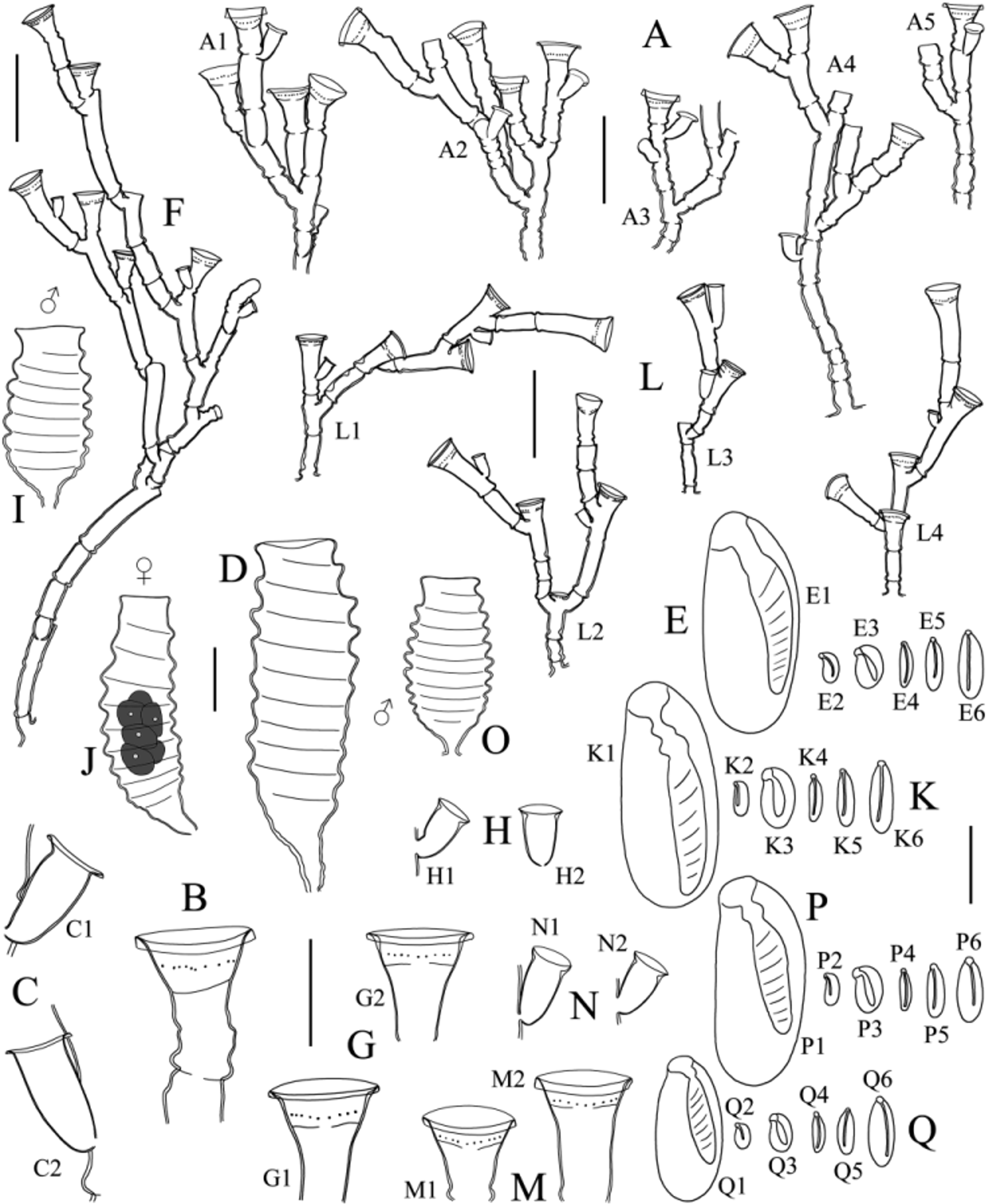
Description. Colony arising from a creeping, branching, anastomosing hydrorhiza; perisarc with irregular, thick, internal projections. Hydrocauli upright but small, not surpassing ca. 3 mm in height. Stems monosiphonic, divided into internodes by transverse constrictions of the perisarc. Internodes broadly cylindrical, of varied length, each with a proximal bulge, with or without a lateral apophysis supporting the following internode or a hydrophore, and with or without a nematotheca; perisarc moderately thick, surface smooth to locally wrinkled. Branching pattern clearly sympodial, with additional internodes or hydrophores given off at acute angles from the apophyses of preceding internodes; apophyses not in one plane, but arising from any side of the stems. Hydrophores of varied length, with a basal bulge, widening gradually distally to merge into hydrotheca; both separated by a thin diaphragm projecting into the lumen of hydrophore. Hydrotheca tronconical, obviously deep, rim flaring, margin conspicuously everted. Ring of desmocytes irregular, placed at a fair distance above diaphragm. Hydranths reduced to mere buds, possibly due to reproductive exhaustion. Nematothecae irregular and scarce, given off from both the stolon and some stem internodes or hydrophores; beaker shaped, rather large and deep, with a distinctly everted rim; nematophores long (up to ca. 2 mm) and slender, with solid core and a large, distal capitulum. Gonothecae, male in the present material, borne abundantly on the stolon; elongated tubular for most of their length, tapering abruptly proximally into a short, indistinct pedicel; truncate distally above a narrowed neck; walls provided with 7 – 8 distant, spiral grooves.
Galea, Horia R., Schories, Dirk, Försterra, Günter, Häussermann, Verena (2014): New species and new records of hydroids (Cnidaria: Hydrozoa) from Chile. Zootaxa 3852 (1): 1-50, DOI: 10.11646/zootaxa.3852.1.1
Remarks. The new species is characterized, among others, by the presence of spirally twisted gonothecae. Four congeners, namely H. alternatum (Fraser, 1938), H. expansum (Fraser, 1948), H. mirabile (Hincks, 1866), and H. sympodiformis Millard & Bouillon, 1974, share the same character. Both H. alternatum and H. expansum were described from the eastern Pacific. Similarly to H. chilense, the internodes of the former are given off sympodially at sharp angles from the preceding internodes, but there is reportedly a characteristic alternate arrangement of the hydrothecae along both sides of the stems and, when present, side branches (Fraser 1938), a situation not met in the new species. In addition, H. alternatum is further distinguished through the apparently exclusive and abundant occurrence of nematothecae on its stems [“ commonly one to each pedicel ” (sic)], and its uncommon ability to give rise to gonothecae, not only from the stolon, but also from the hydrophores and the stem internodes. Unlike H. chilense, H. expansum is a species with polysiphonic stems, collinear internodes delimited by oblique nodes, and large gonothecae with strongly ringed walls, which are given off “ from the fascicled portion of the stem, projecting at right angles to it ” (Fraser 1948).
Galea, Horia R., Schories, Dirk, Försterra, Günter, Häussermann, Verena (2014): New species and new records of hydroids (Cnidaria: Hydrozoa) from Chile. Zootaxa 3852 (1): 1-50, DOI: 10.11646/zootaxa.3852.1.1
Distribution in Chile. Only known from Corral. 15. The stems of H. mirabile were originally described as “ rudely annulated at the base, and jointed at intervals throughout ”, with the “ branching […] usually consisting of a single division of the stem ”, at most two (Hincks 1866). A modern illustration of the neotype (BMNH 1899.5.1.169) is given by Cornelius (1995 a, Fig. 73 C), who showed the characteristic sympodial growth pattern of the colonies. The description and illustration of the gonotheca goes back to Hincks (1868). It is worth underlining that the description of H. mirabile provided by Cornelius (1975) resulted undoubtedly from pooled data based, among others, on material dealt with earlier by Ritchie (1908, as Ophiodissa caciniformis) and Millard (1957, 1966 b). In Cornelius’ (1975, 1995 a) view, widely held by subsequent authors, H. caciniformis represents not more than a junior synonym of H. mirabile, and it appears that he mainly focused his attention to the similarities between them, rather than to certain, though not less important differences that are related to their respective growth patterns. Indeed, his illustration (Cornelius 1975, Fig. 14 A) of the paralectotype of O. caciniformis shows a species with almost collinear internodes delimited by slightly oblique nodes, thus differing from the sympodial growth pattern characteristic of Hincks’ species. In addition, the type material of H. caciniformis is sterile. A careful check of the relevant literature shows that specimens with both sympodial [e. g. Babić (1913), García Corrales et al. (1978), Rho & Park (1980), Hirohito (1974, 1995), Ramil Blanco & Iglesias Diaz (1988), Altuna (1994), Peña Cantero & García Carrascosa (2002)] and alternate [e. g. Millard (1957, 1966 b), Ralph (1958), Vervoort (1959), Gili (1986), Medel et al. (1998), Vervoort & Watson (2003)] growth patterns were equally included in either H. mirabile or H. caciniformis. It therefore becomes obvious that some of the records cited above, especially certain based on sterile material, are either incorrect or belong to unidentifiable species. - total length 1350 – 1720 (♂) 830 – 855 (♂) 670 – 830 (♂) 630 – 800 (♀) – ca. 1120 (♀) FIGURE 6. A, B: Sertularella asymmetra sp. nov. — colony fragment (A); hydrotheca in lateral (B 1) and apical (B 2) views. C: Sertularella blanconae El Beshbeeshy, 2011 — colony fragment. D, E: Sertularella curta sp. nov. — colony fragment (D); hydrotheca in lateral (E 1) and apical (E 2) views. F, H: Sertularella pauciramosa sp. nov. — colony fragment (F), and comparison with S. polyzonias (Linnaeus, 1758) (G); four hydrothecae (H). Scale bars: 200 µm (B, E, H), 1 mm (A, C, D, F, G). FIGURE 7. A: Sertularella asymmetra sp. nov. — female (A 1) and male (A 2) gonotheca; B: Sertularella blanconae El Beshbeeshy, 2011 — male gonotheca. C: Sertularella curta sp. nov. — male gonotheca. D: Sertularella pauciramosa sp. nov. — male (D 1) and female (D 2) gonotheca. E, F: Symplectoscyphus flexilis Hartlaub, 1901 — colony fragment (E 1) and hydrotheca (E 2); gonotheca (F). G ‒ J: Symplectoscyphus semper sp. nov. — stem fragment with beginning of side branch (G 1), and portion of cladium (G 2); hydrotheca (H); gonotheca (I), and details of the distal part (J). K ‒ M: Symplectoscyphus cf. subarticulatus (Coughtrey, 1875) — colony fragment (K); hydrotheca (L); gonotheca (M). Scale bars: 200 µm (H, L), 500 µm (A ‒ D, F, I, J, M), 1 mm (E, G, K).
Galea, Horia R., Schories, Dirk, Försterra, Günter, Häussermann, Verena (2014): New species and new records of hydroids (Cnidaria: Hydrozoa) from Chile. Zootaxa 3852 (1): 1-50, DOI: 10.11646/zootaxa.3852.1.1
Etymology. The new species is named after the country of its origin.
Galea, Horia R., Schories, Dirk, Försterra, Günter, Häussermann, Verena (2014): New species and new records of hydroids (Cnidaria: Hydrozoa) from Chile. Zootaxa 3852 (1): 1-50, DOI: 10.11646/zootaxa.3852.1.1
Material examined. Corral, Chaihuin / Huiro, lat. - 39.95000, long. - 73.61667, 17. x. 2011, 8 ‒ 12 m, sample 36: a male colony on seaweed (holotype: MHNG-INVE- 86227). France, Port d’Alon creek, lat. 43.146369, long. 5.707545, 20. v. 2009, 0.5 m, sample HRG- 0020: a female colony of H. mirabile (Hincks, 1866) on seaweed. France, Cap Taillat, lat. 43.174040, long. 6.640635, 09. vi. 2011, 0.5 m, sample HRG- 0567: a male colony of H. mirabile on seaweed. France, Martinique, Anse Dufour, lat. 14.527162, long. - 61.090033, 12. i. 2014, 0.5 m, sample M 277: several colonies, some fertile, of H. mirabile on seaweed.
Galea, Horia R., Schories, Dirk, Försterra, Günter, Häussermann, Verena (2014): New species and new records of hydroids (Cnidaria: Hydrozoa) from Chile. Zootaxa 3852 (1): 1-50, DOI: 10.11646/zootaxa.3852.1.1

Export occurrence data

Darwin Core Archive (ZIP)

CLASSIFICATION

Taxonomic Classification Tree

NOMENCLATURE

Synonyms(1)

MULTIMEDIA

Media Files(4)

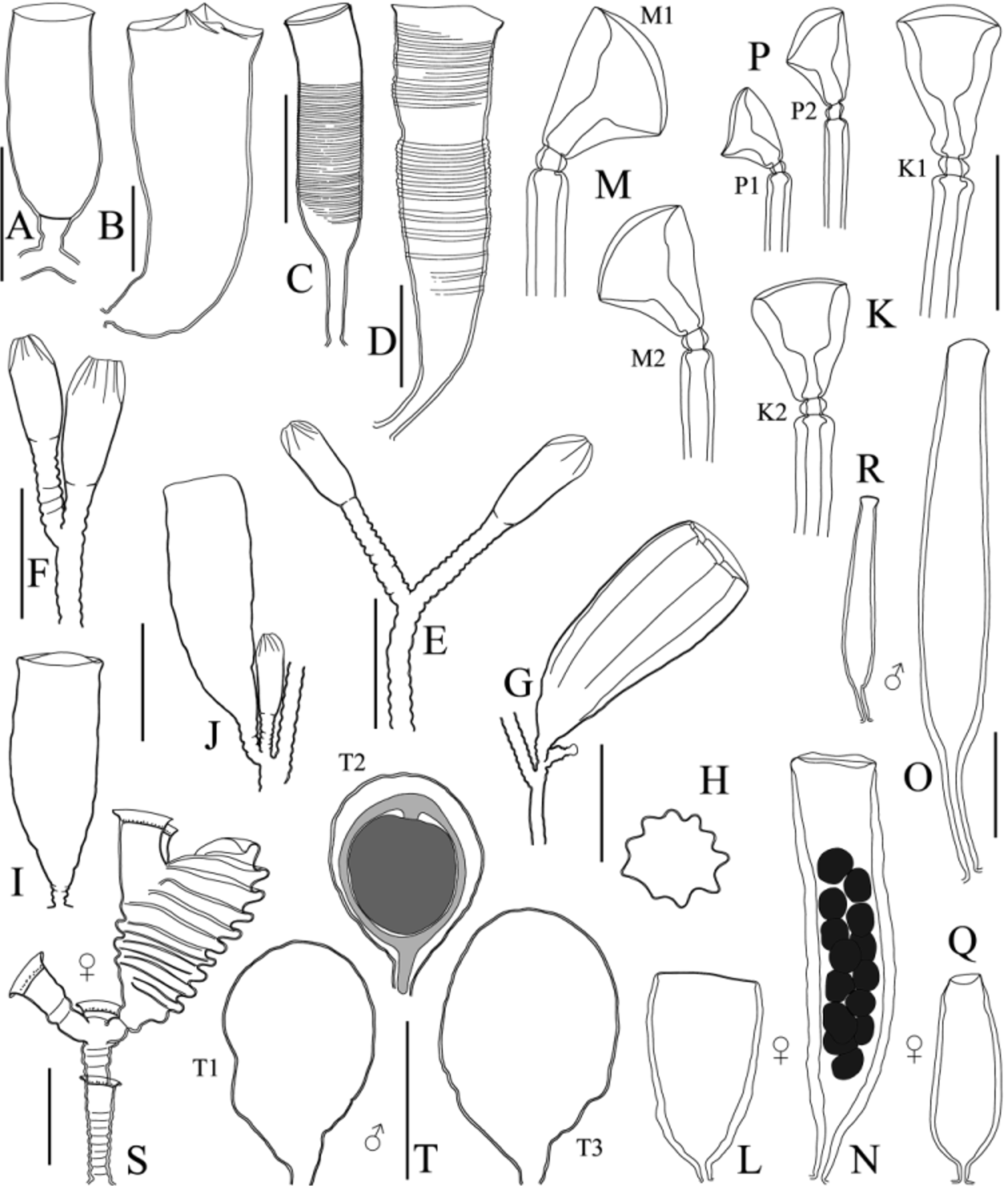
FIGURE 1. A, B: Hebella cf. scandens (Bale, 1888) — hydrotheca (A); gonotheca (B). C ‒ D: Hebella striata Allman, 1888 — hydrotheca (C); gonotheca (D). E, G, H: Phialella? falklandica Browne, 1902 — portion of erect stem (E) compared with that of P. quadrata (Forbes, 1848) (F); gonotheca seen laterally (G) and apically (H), compared with those of P. quadrata (I, stolonal; J, borne of stem). K, L: Silicularia? bilabiata (Coughtrey, 1876) — two hydrothecae (K); female gonotheca (L). M ‒ O: Silicularia rosea Meyen, 1834 — two hydrothecae (M) compared with specimens from Tristan da Cunha assigned to S. hemisphaerica (Allman, 1888) (P); female (N) and male (O) gonothecae, compared to homologous gonothecae (Q and R, respectively) from Tristan. S: Halecium corrugatissimum Trebilcock, 1828 — small stem with female gonotheca. Scale bars: 300 µm (A, B, E, F, S), 500 µm (C, D, G ‒ J), and 1 mm (K ‒ R).

Imageimage/png© Galea, Horia R.;Schories, Dirk;Försterra, Günter;Häussermann, VerenaGalea, Horia R.;Schories, Dirk;Försterra, Günter;Häussermann, Verena

FIGURE 2. A, B: Halecium flexile Allman, 1888 — portion of stem (A) compared with H. balei Fraser, 1911 (C); detail of hydrophore and renovated hydrotheca (B), and comparison with H. balei (D). E, F: Halecium humeriformis sp. nov. — stem fragments (E); hydrophore and renovated hydrotheca (F). G, H: Halecium maximum sp. nov. — stem fragments (G); hydrophore and renovated hydrotheca (H). I ‒ L: Halecium modestum sp. nov. — stem fragments (I ‒ K); hydrophore with hydrotheca (L). M, N: Halecium platythecum sp. nov. — stem fragment (M); hydrophore and renovated hydrotheca (N). Scale bars: 300 µm (B, D, F, H, L, N) and 1 mm (A, C, E, G, I ‒ K, M).

Imageimage/png© Galea, Horia R.;Schories, Dirk;Försterra, Günter;Häussermann, VerenaGalea, Horia R.;Schories, Dirk;Försterra, Günter;Häussermann, Verena

FIGURE 4. A ‒ F, M: Cnidomes of some Halecium species discussed herein— H. flexile Allman, 1888 (A); H. balei (B); H. humeriformis sp. nov. (C); H. maximum sp. nov. (D); H. tristaniensis sp. nov. (E); H. modestum sp. nov. (F). G: Halecium pallens Jäderholm, 1904 — female gonotheca. H ‒ M: Halecium tehuelchum (d’Orbigny, 1842) — fragments of colonies (H), primary hydrophore and renovated hydrotheca (I); female gonotheca (J) and shape variation (K); male gonothecae (L); cnidome (M). Scale bars: 10 µm (A ‒ F, M); 300 µm (I, J, L), 500 µm (G, K), 1 mm (H).
Imageimage/png© Galea, Horia R.;Schories, Dirk;Försterra, Günter;Häussermann, VerenaGalea, Horia R.;Schories, Dirk;Försterra, Günter;Häussermann, Verena

FIGURE 5. A ‒ E: Hydrodendron chilense sp. nov. — colonies and fragments (A); hydrotheca (B); nematothecae (C); male gonotheca (D); cnidome (E). F ‒ K: H. mirabile (Hincks, 1866) from the Mediterranean—colony (F); hydrothecae (G) and nematothecae (H); male (I) and female (J) gonothecae; cnidome (K). L ‒ P: H. mirabile from Martinique—four colonies (L); hydrothecae (M) and nematothecae (N); male gonotheca (O); cnidome (P). Q: Hydrodendron sp. from Guadeloupe—cnidome. Scale bars: 10 µm (E, K, P, Q), 200 µm (B, C, G, H, M, N), 300 µm (D, I, J, O), 500 µm (A, F, L).

Imageimage/png© Galea, Horia R.;Schories, Dirk;Försterra, Günter;Häussermann, VerenaGalea, Horia R.;Schories, Dirk;Försterra, Günter;Häussermann, Verena

IMAGES

Gallery(4)

See Gallery

Occurrences with images

Source Information

New species and new records of hydroids (Cnidaria: Hydrozoa) from Chile

checklist

This dataset contains the digitized treatments in Plazi based on the original journal article Galea, Horia R., Schories, Dirk, Försterra, Günter, Häussermann, Verena (2014): New species and new records of hydroids (Cnidaria: Hydrozoa) from Chile. Zootaxa 3852 (1): 1-50, DOI: 10.11646/zootaxa.3852.1.1

Abstract

A large collection of shallow-water hydroids from various Chilean provinces, ranging from Taltal (25° S) in the North, to the Strait of Magellan (53° S) in the South, was studied, and a total of 30 species are discussed in the present report. Of these, eleven are new to science: Candelabrum valdiviensis, Halecium erratum, H. humeriformis, H. maximum, H. modestum, H. platythecum, Hydrodendron chilense, Sertularella asymmetra, S. curta, S. pauciramosa, and Symplectoscyphus semper. The nominal species Halecium flexile Allman, 1888, included for many decades in the synonymy of H. delicatulum Coughtrey, 1876, is resurrected based on distinctive features displayed by its newly discovered female gonothecae. A thorough discussion is provided on several morphologically related species of the genus from various localities around the world, and data on the nematocyst complement are emphasized, allowing the distinction of an as yet undescribed species, H. tristaniensis, from Tristan da Cunha, South Atlantic, and the resurrection of H. balei Fraser, 1911 from southern Australia. Halecium tehuelchum (d’Orbigny, 1842), a poorly known species considered as of doubtful validity, is redescribed based on fertile material of both sexes. A discussion on the taxonomy of several members of the genus Hydrodendron Hincks, 1874, including the first comprehensive account of their cnidome, is provided. The male and female gonothecae of Halopteris plumosa Galea & Schories, 2012 are described for the first time. A discussion on the genus Silicularia Meyen, 1834 is provided, and three subantarctic species are provisionally recognized based on the material in hand, viz. S. bilabiata (Coughtrey, 1875), S. rosea Meyen, 1834, and S. hemisphaerica (Allman, 1888). Four hydroids are new records for Chile: Halecium corrugatissimum Trebilcock, 1928, Parascyphus simplex (Lamouroux, 1816), Symplectoscyphus unilateralis (Lamouroux, 1824), and Aglaophenia divaricata Busk, 1852, the last two being accompanied by comments on their synonymy. Two additional hydroids are only tentatively identified, viz. Hebella cf. scandens (Bale, 1888) and the allusive benthic stage of Phialella falklandica (Browne, 1902).

Key words: Hydrozoans, taxonomy, new species, South America, southeastern Pacific

Galea H R, Schories D, Försterra G, Häussermann V, plazi (2014). New species and new records of hydroids (Cnidaria: Hydrozoa) from Chile. Plazi.org taxonomic treatments database. Checklist dataset https://doi.org/10.11646/zootaxa.3852.1.1 accessed via GBIF.org on 2026-06-18.

CC0Published 12/31/2014View dataset
GBIF Usage Key
127669456
Dataset Key
2fb83006-f93c-4492-aed0-f5f0707f553e
Origin
source
Backbone Key
7845053
Taxon ID
03D92A2C4770FFC5FF51868358E0A1C1.taxon
Last Crawled
6/11/2026
Last Interpreted
6/11/2026