
Halecium corrugatissimum
Trebilcock, 1928
GBIF:127669492
ABOUT
Descriptions(3)
Export occurrence data
Darwin Core Archive (ZIP)
CLASSIFICATION
Taxonomic Classification Tree

MULTIMEDIA
Media Files(2)
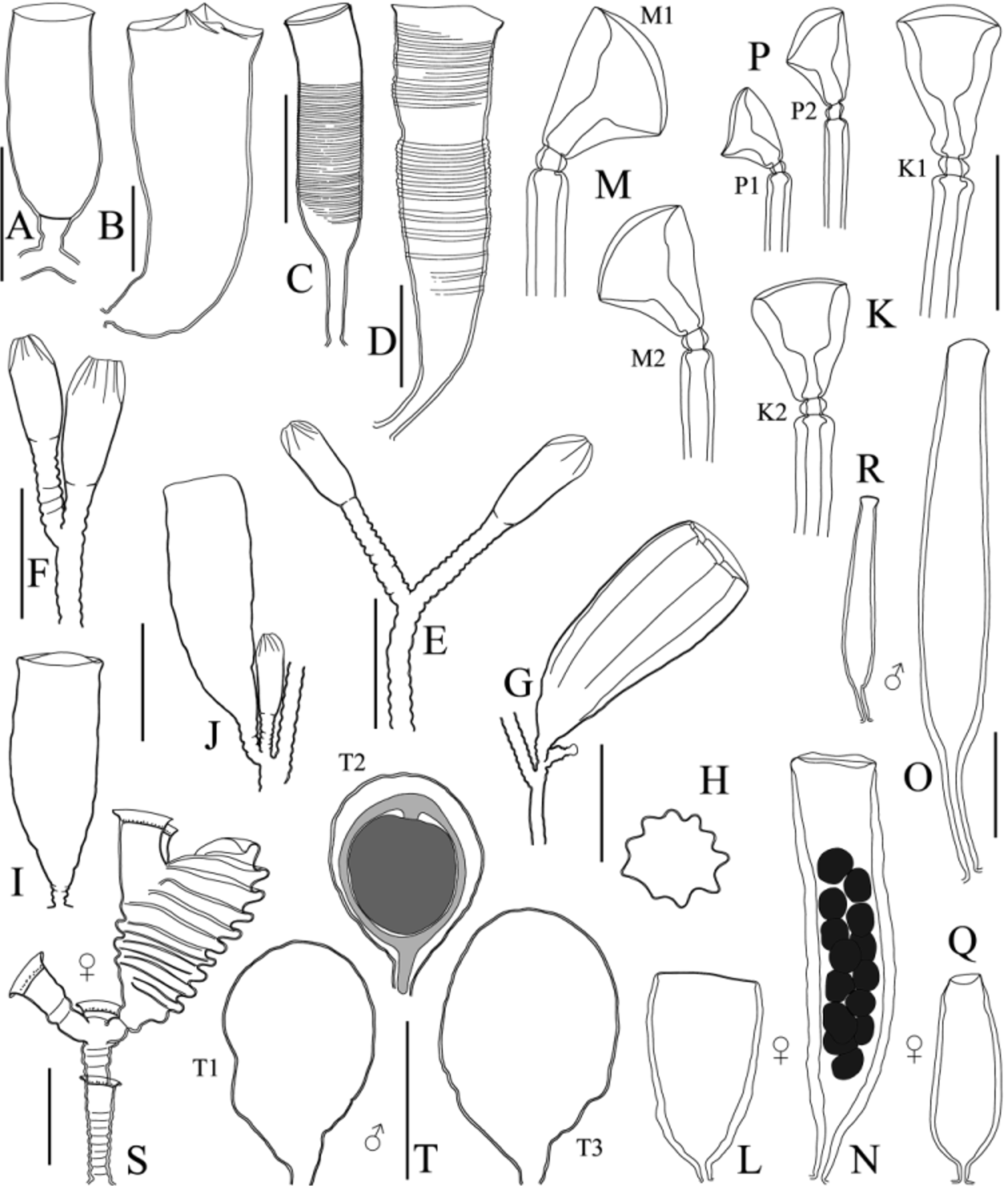
FIGURE 1. A, B: Hebella cf. scandens (Bale, 1888) — hydrotheca (A); gonotheca (B). C ‒ D: Hebella striata Allman, 1888 — hydrotheca (C); gonotheca (D). E, G, H: Phialella? falklandica Browne, 1902 — portion of erect stem (E) compared with that of P. quadrata (Forbes, 1848) (F); gonotheca seen laterally (G) and apically (H), compared with those of P. quadrata (I, stolonal; J, borne of stem). K, L: Silicularia? bilabiata (Coughtrey, 1876) — two hydrothecae (K); female gonotheca (L). M ‒ O: Silicularia rosea Meyen, 1834 — two hydrothecae (M) compared with specimens from Tristan da Cunha assigned to S. hemisphaerica (Allman, 1888) (P); female (N) and male (O) gonothecae, compared to homologous gonothecae (Q and R, respectively) from Tristan. S: Halecium corrugatissimum Trebilcock, 1828 — small stem with female gonotheca. Scale bars: 300 µm (A, B, E, F, S), 500 µm (C, D, G ‒ J), and 1 mm (K ‒ R).

FIGURE 4. A ‒ F, M: Cnidomes of some Halecium species discussed herein— H. flexile Allman, 1888 (A); H. balei (B); H. humeriformis sp. nov. (C); H. maximum sp. nov. (D); H. tristaniensis sp. nov. (E); H. modestum sp. nov. (F). G: Halecium pallens Jäderholm, 1904 — female gonotheca. H ‒ M: Halecium tehuelchum (d’Orbigny, 1842) — fragments of colonies (H), primary hydrophore and renovated hydrotheca (I); female gonotheca (J) and shape variation (K); male gonothecae (L); cnidome (M). Scale bars: 10 µm (A ‒ F, M); 300 µm (I, J, L), 500 µm (G, K), 1 mm (H).
IMAGES