
AnimaliaacceptedgenusAccepted
Silicularia

Silicularia

GBIF:127669504

ABOUT

Descriptions(2)

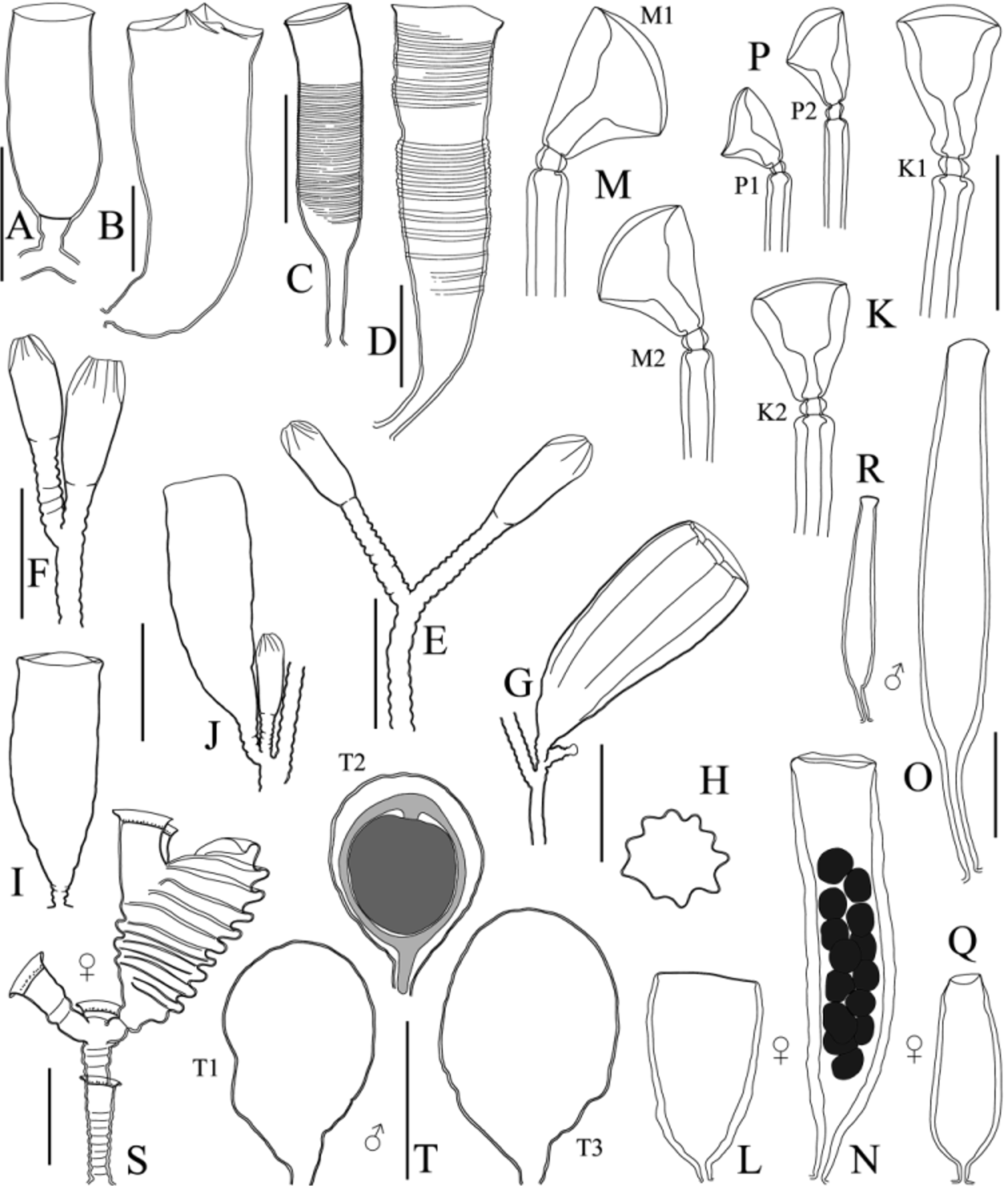
Remarks. A small colony (sample 58) with immature (likely female) gonothecae occurs in the present collection and corresponds in every respect to the material assigned earlier (Galea et al. 2009, MHNG-INVE- 62833) to S. rosea Meyen, 1834. Both specimens exhibit laterally flattened hydrothecae with equally developed walls, and their gonothecae are comparatively wider with respect to those in the material described below, that we are now assigning to Meyen’s species. In spite of the opinion expressed by Vervoort & Watson (2003, p. 444), stating that “ there are no reliable characters that separate Silicularia rosea Meyen, 1834 from Campanularia bilabiata Coughtrey, 1875 ”, the peculiar position of the hydrothecal rim (compare Fig. 1 K with 1 M) and the comparatively broader gonothecae (compare Fig. 1 L to 1 N; see Table 2) set the present material apart from the typical concept of S. rosea, as illustrated through the redescription of the type by Hartlaub (1905, p. 573, Fig. T 1). However, owing to the scarcity of specimens in hand, it is impossible to ascertain the degree of morphological variation of the hydrotheca, especially regarding the position of its aperture. Though all specimens inspected had the plane of the aperture perpendicular to the long axis of the theca, thus resembling to the original illustration provided by Coughtrey (1875, Pl. 20 Fig. 46), it was already shown (Hilgendorf 1898, Bale 1924) that it may be inclined to one side, exactly as in S. rosea. Since the present identification is provisional and not intended to clarify the taxonomy of this nominal species at this stage, it should be taken with care, pending the re-examination of the syntype of Campanularia bilabiata designated by Ralph (1956, p. 287). The relationships between S. bilabiata and both Eucopella campanularia von Lendenfeld, 1883 and E. reticulata Hartlaub, 1905, all provided with broad, ovate, laterally flattened gonothecae, are unclear at present. Distribution in Chile. South of Chiloé (Galea et al. 2009), and Corral (present study). World records. The lack of knowledge on the specific limitation of S. bilabiata prevents us from establishing an exhaustive list of distributional records.
Galea, Horia R., Schories, Dirk, Försterra, Günter, Häussermann, Verena (2014): New species and new records of hydroids (Cnidaria: Hydrozoa) from Chile. Zootaxa 3852 (1): 1-50, DOI: 10.11646/zootaxa.3852.1.1
Material examined. Corral, Chaihuin / Huiro, lat. - 39.95000, long. - 73.61667, 30. xi. 2011, 8 ‒ 10 m, sample 58: small colony with immature, most probably female gonothecae. HF 6, “ Inio 5 ”, lat. - 43.40000, long. - 74.08333, 24. ii. 2008, 8 m, sample A 504: colony with incompletely formed female gonothecae, on seaweed (MHNG-INVE- 62833).
Galea, Horia R., Schories, Dirk, Försterra, Günter, Häussermann, Verena (2014): New species and new records of hydroids (Cnidaria: Hydrozoa) from Chile. Zootaxa 3852 (1): 1-50, DOI: 10.11646/zootaxa.3852.1.1

Export occurrence data

Darwin Core Archive (ZIP)

CLASSIFICATION

Taxonomic Classification Tree

MULTIMEDIA

Media Files(2)

FIGURE 1. A, B: Hebella cf. scandens (Bale, 1888) — hydrotheca (A); gonotheca (B). C ‒ D: Hebella striata Allman, 1888 — hydrotheca (C); gonotheca (D). E, G, H: Phialella? falklandica Browne, 1902 — portion of erect stem (E) compared with that of P. quadrata (Forbes, 1848) (F); gonotheca seen laterally (G) and apically (H), compared with those of P. quadrata (I, stolonal; J, borne of stem). K, L: Silicularia? bilabiata (Coughtrey, 1876) — two hydrothecae (K); female gonotheca (L). M ‒ O: Silicularia rosea Meyen, 1834 — two hydrothecae (M) compared with specimens from Tristan da Cunha assigned to S. hemisphaerica (Allman, 1888) (P); female (N) and male (O) gonothecae, compared to homologous gonothecae (Q and R, respectively) from Tristan. S: Halecium corrugatissimum Trebilcock, 1828 — small stem with female gonotheca. Scale bars: 300 µm (A, B, E, F, S), 500 µm (C, D, G ‒ J), and 1 mm (K ‒ R).

Imageimage/png© Galea, Horia R.;Schories, Dirk;Försterra, Günter;Häussermann, VerenaGalea, Horia R.;Schories, Dirk;Försterra, Günter;Häussermann, Verena

FIGURE 4. A ‒ F, M: Cnidomes of some Halecium species discussed herein— H. flexile Allman, 1888 (A); H. balei (B); H. humeriformis sp. nov. (C); H. maximum sp. nov. (D); H. tristaniensis sp. nov. (E); H. modestum sp. nov. (F). G: Halecium pallens Jäderholm, 1904 — female gonotheca. H ‒ M: Halecium tehuelchum (d’Orbigny, 1842) — fragments of colonies (H), primary hydrophore and renovated hydrotheca (I); female gonotheca (J) and shape variation (K); male gonothecae (L); cnidome (M). Scale bars: 10 µm (A ‒ F, M); 300 µm (I, J, L), 500 µm (G, K), 1 mm (H).

Imageimage/png© Galea, Horia R.;Schories, Dirk;Försterra, Günter;Häussermann, VerenaGalea, Horia R.;Schories, Dirk;Försterra, Günter;Häussermann, Verena

IMAGES

Gallery(2)

See Gallery

Occurrences with images

Source Information

New species and new records of hydroids (Cnidaria: Hydrozoa) from Chile

checklist

This dataset contains the digitized treatments in Plazi based on the original journal article Galea, Horia R., Schories, Dirk, Försterra, Günter, Häussermann, Verena (2014): New species and new records of hydroids (Cnidaria: Hydrozoa) from Chile. Zootaxa 3852 (1): 1-50, DOI: 10.11646/zootaxa.3852.1.1

Abstract

A large collection of shallow-water hydroids from various Chilean provinces, ranging from Taltal (25° S) in the North, to the Strait of Magellan (53° S) in the South, was studied, and a total of 30 species are discussed in the present report. Of these, eleven are new to science: Candelabrum valdiviensis, Halecium erratum, H. humeriformis, H. maximum, H. modestum, H. platythecum, Hydrodendron chilense, Sertularella asymmetra, S. curta, S. pauciramosa, and Symplectoscyphus semper. The nominal species Halecium flexile Allman, 1888, included for many decades in the synonymy of H. delicatulum Coughtrey, 1876, is resurrected based on distinctive features displayed by its newly discovered female gonothecae. A thorough discussion is provided on several morphologically related species of the genus from various localities around the world, and data on the nematocyst complement are emphasized, allowing the distinction of an as yet undescribed species, H. tristaniensis, from Tristan da Cunha, South Atlantic, and the resurrection of H. balei Fraser, 1911 from southern Australia. Halecium tehuelchum (d’Orbigny, 1842), a poorly known species considered as of doubtful validity, is redescribed based on fertile material of both sexes. A discussion on the taxonomy of several members of the genus Hydrodendron Hincks, 1874, including the first comprehensive account of their cnidome, is provided. The male and female gonothecae of Halopteris plumosa Galea & Schories, 2012 are described for the first time. A discussion on the genus Silicularia Meyen, 1834 is provided, and three subantarctic species are provisionally recognized based on the material in hand, viz. S. bilabiata (Coughtrey, 1875), S. rosea Meyen, 1834, and S. hemisphaerica (Allman, 1888). Four hydroids are new records for Chile: Halecium corrugatissimum Trebilcock, 1928, Parascyphus simplex (Lamouroux, 1816), Symplectoscyphus unilateralis (Lamouroux, 1824), and Aglaophenia divaricata Busk, 1852, the last two being accompanied by comments on their synonymy. Two additional hydroids are only tentatively identified, viz. Hebella cf. scandens (Bale, 1888) and the allusive benthic stage of Phialella falklandica (Browne, 1902).

Key words: Hydrozoans, taxonomy, new species, South America, southeastern Pacific

Galea H R, Schories D, Försterra G, Häussermann V, plazi (2014). New species and new records of hydroids (Cnidaria: Hydrozoa) from Chile. Plazi.org taxonomic treatments database. Checklist dataset https://doi.org/10.11646/zootaxa.3852.1.1 accessed via GBIF.org on 2026-06-18.

CC0Published 12/31/2014View dataset
GBIF Usage Key
127669504
Dataset Key
2fb83006-f93c-4492-aed0-f5f0707f553e
Origin
source
Backbone Key
2268355
Taxon ID
03D92A2C476FFFD1FF5182D25B7AA684.taxon
Last Crawled
6/11/2026
Last Interpreted
6/11/2026