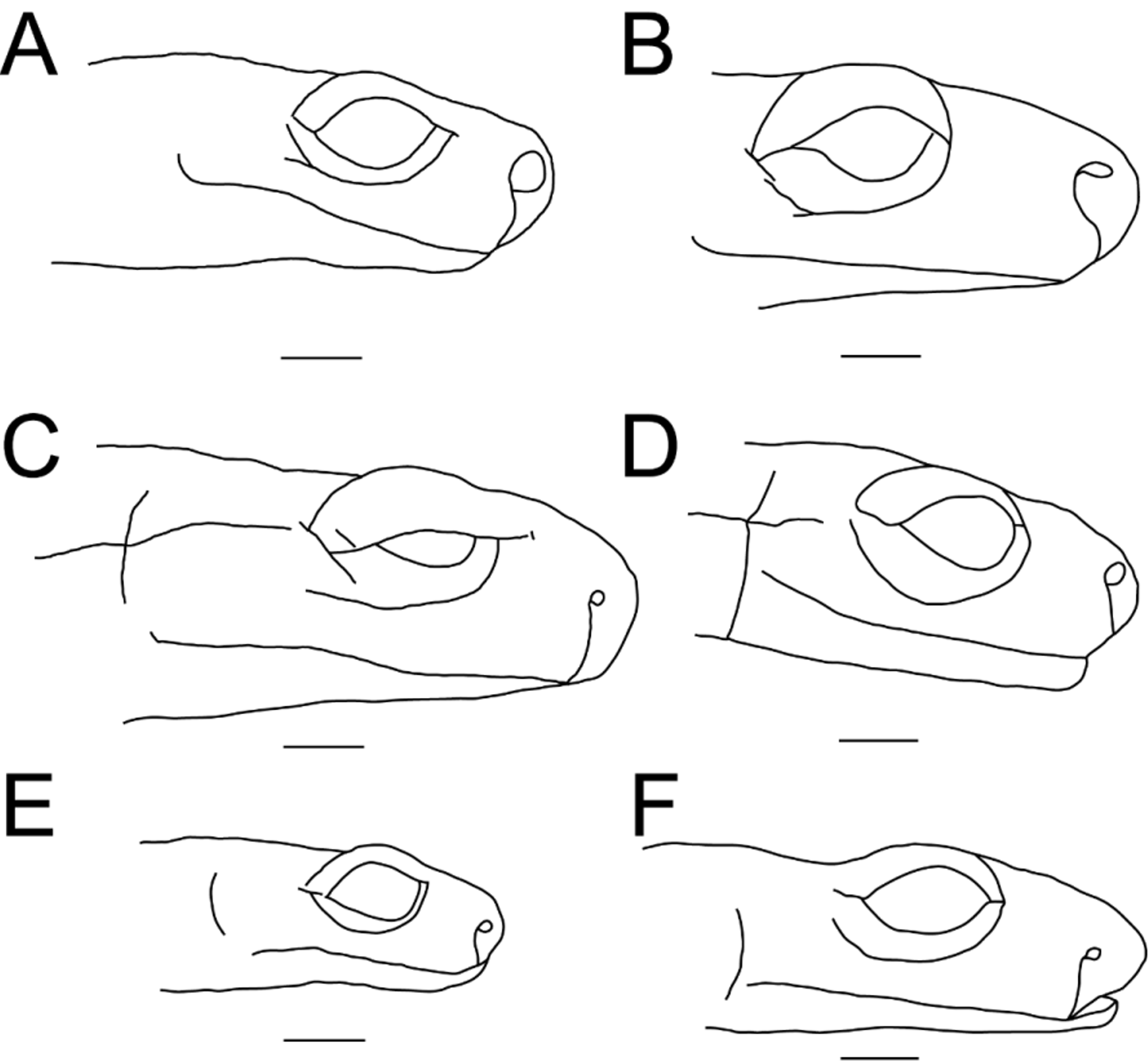
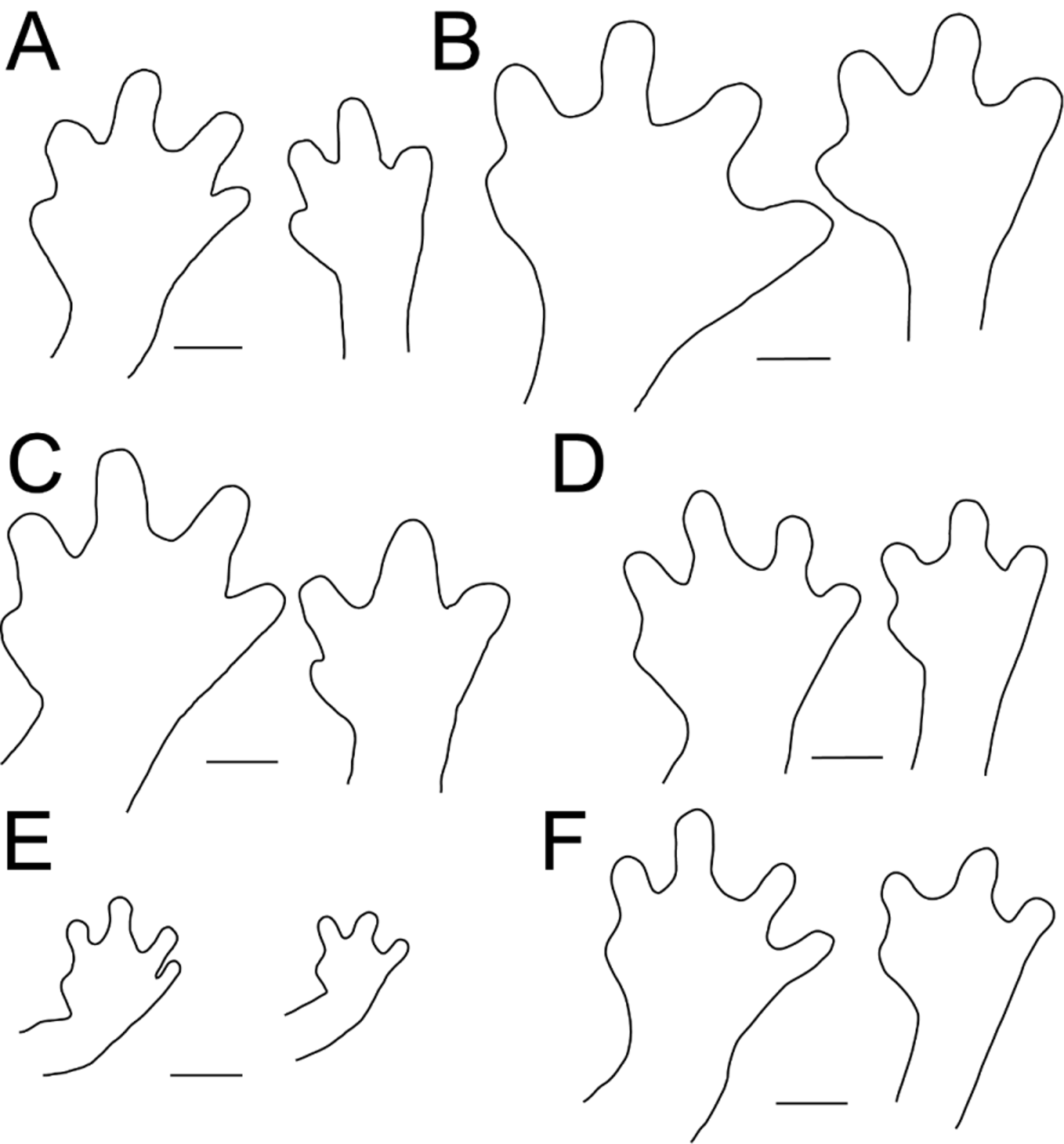
Description of the holotype. Moderately sized (SVL 33.8 mm) adult male with relatively long tail (TL / SVL 1.09), thin, approximately round at base, tapering toward end. Relatively wide head (HW 4.8 mm), with eyes protruding just beyond margin of jaw when viewed from above. Head relatively flattened, nostril moderately sized and oval shaped (NL / NW 1.37), snout blunt, nasolabial protuberances well developed. Relatively large, nearly circular mental gland present. Premaxillary teeth (2) pierce upper lip. Vomerine teeth (11) extend in a line nearly to outer margin of choanae. Limbs relatively long (LI 0.5), hands and feet moderately sized with well-developed interdigital webbing. Webbing extends just onto penultimate phalanx. Toe tips bluntly rounded with well develop subterminal pads. Phalangeal formulae: manus 1 - 2 - 3 - 2, pes 1 - 2 - 3 - 3 - 2. Digits in order of increasing length: manus I-IV-II-III, pes I-V ~ II-IV-III. Measurements (in mm), limb interval and tooth counts of the holotype. SVL 33.8, TL 36.8, AX 17.7, HL 6.7, HW 4.8, head depth at posterior angle of jaw 2.4, snout projection beyond mandible 0.4, IO 1.8, EN 1.5, IN 1.7, eyelid length 2.2, eyelid width 1.4, horizontal orbit diameter 1.9, FLL 8.2, HLL 9.0, snout to forelimb 9.7, width of right hand 2.1, FW 3.2, T 3 1.4, T 5 0.7, snout to anterior angle of vent 30.2, tail width at base 1.9, tail depth at base 2.1, shoulder width 3.75. NL 0.26, NW 0.19. Adpressed limbs separated by 0.5 costal folds. Premaxillary teeth 2, maxillary teeth 24, vomerine teeth 11. Variation. One of the male paratypes is slightly larger than the holotype (36.1 mm); this specimen (IBH 28182) has a much longer tail (48.1 mm) and longer limbs than the holotype. The nostril shape in this species appears to vary from oval (NL / NW 1.4) to elongated elliptical (NL / NW 2.0). Several of the paratypes have substantially more premaxillary-maxillary teeth than the holotype, up to 56 premaxillary-maxillary teeth in female paratype MVZ 158571. Coloration of the holotype in life (from photos). Dorsal surface of head and dorsum Ferruginous (35) with extensive Cream Yellow (82) speckles. Dorsal surface of tail same colors with fewer, more scattered speckles. Upper side of limbs Ferruginous with some Cream Yellow speckles. Gular region Light Russet Vinaceous (246). Venter and underside of limbs immaculate Cinnamon Drab (259). Ventral side of tail pale Raw Umber (280). Underside of toe tips Crimson (65). Iris Light Yellow Ocher (13). Coloration of the holotype in alcohol. Dorsum and dorsal surface of tail uniform medium brown. Dorsal surface of head slightly lighter brown, eyelids dark brown, dorsal coloration extends to lateral midline where it changes to pale grey brown. Dorsal surface of limbs light yellowish brown extending to onto upper side of hands and feet. Gular region ventral surface of tail and ventral side of limbs pale yellowish cream color with uniform scattering of tiny dark brown flecks. Underside of hands and feet pale yellowish brown. Habitat and distribution. Chiropterotriton cieloensis is known only from moderate to higher elevations (approximately 1000 – 1860 m elevation; Martin 1958) of the El Cielo Biosphere Reserve in Tamaulipas, Mexico. This mountain range is known as the Sierra de Guatemala (Martin 1958). The species is found in broadleaf cloud forest and has been taken from arboreal bromeliads and caves, and has been found occasionally under the bark of rotten logs (Martin 1958). It occurs in sympatry with C. cracens, which is also endemic to the El Cielo Biosphere Reserve. Chiropterotriton cieloensis appears to be more common in bromeliads than C. cracens, and the latter does not occur in caves (Martin 1958). Aquiloeurycea scandens is commonly found in caves and occasionally in bromeliads with C. cieloensis, and a member of the Aquiloeurycea cephalica group and Isthmura bellii are also found in sympatry with C. cieloensis. We also assign specimens to this species from a lower elevation cave (420 m elevation) at Aserradero El Paraíso, in tropical deciduous forest (Martin 1958; Rabb 1958). The species is unlikely to occur more widely. Chiropterotriton multidentatus is found in highland areas to the southwest, and C. miquihuanus and C. infernalis are found to the northwest. El Cielo is near the northern limit of cloud forest in Mexico, so the species is unlikely to occur further north.
Rovito, Sean M., Parra-Olea, Gabriela (2015): Two new species of Chiropterotriton (Caudata: Plethodontidae) from northern Mexico. Zootaxa 4048 (1): 57-74, DOI: 10.11646/zootaxa.4048.1.3