
AnimaliaNot EvaluatedacceptedspeciesAccepted
Botryllus flavus
GBIF:127696475
0
Synonyms
ABOUT
Descriptions(5)
Botryllus sp. Sanamyan, 2000: 76.
Sanamyan, Karen, Sanamyan, Nadya (2017): Shallow-water Ascidians from Matua Island (central Kuril Islands, NW Pacific). Zootaxa 4232 (3): 301-321, DOI: 10.11646/zootaxa.4232.3.1
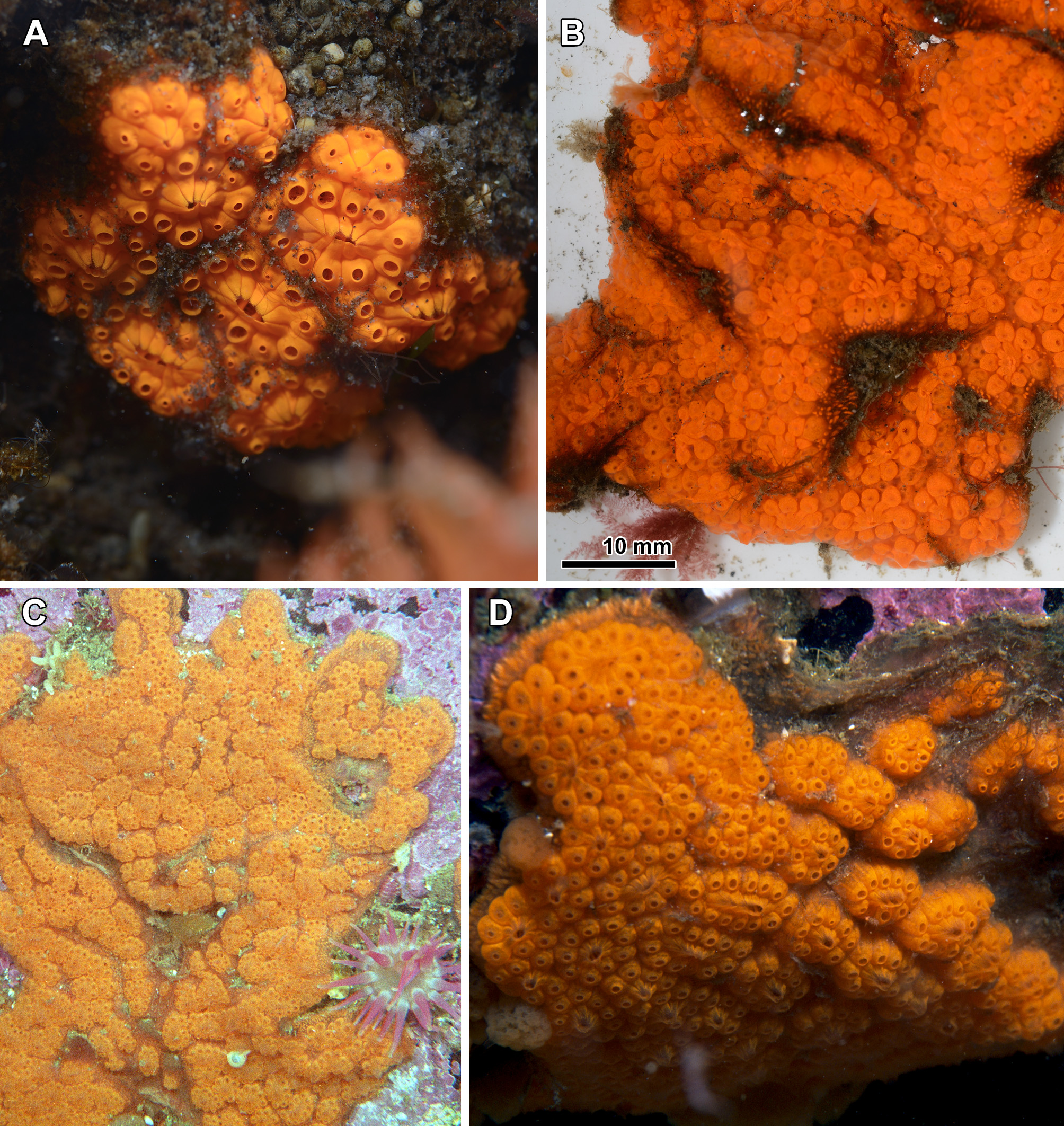
Description. The species forms extensive sheets encrusting stones. The colony of the holotype is 8 x 5 cm in extent and from 5 to 10 mm thick (preserved). The surface is clear, sometimes with some sediment attached on the periphery of the colony or between the systems, but usually free from foreign matter (Figure 6). The common tissue of the colony may be depressed between some systems, or even completely reduced between some groups of systems, so that the colony usually is not represented by one large continuous sheet but looks rather like a group of several large and small sheets joined together (Figures 6 C, D). Numerous elongated crowded ampullae are present on the periphery and, in a lesser quantity, between the systems in colonies from Kamchatka (Figure 6 C, D); in the colonies from Matua Island (the type material) they are sparse. The colouration of live specimens is very constant. All recorded colonies are yellow with a reddish tint underwater. The colour is monotonous, there are no any colour markings over zooids, etc., as often seen on some other Botryllus species. Upon collecting, on the air, live colonies quickly become deep-orange or bright red probably because of oxidation of the pigment they contain. In formaline they also become red, then the red pigment is washed out, and during several weeks the fluid become deep dirtyreddish and the colony loses deep colour. Perfectly preserved, not contracted zooids are somewhat larger than 3 mm in height (in holotype). They are upright, standing perpendicular to the surface of the colony. The systems are circular or oval, of " schlosseri " type (see Brunetti, 2009), clearly visible on the surface of colony, each may contain as many as 13 or 14 zooids, but often the number of zooids in a system is less than ten. Branchial openings are on short circular (not lobed) siphons which in live colonies arise slightly over the surface of the colony (Figure 6 A). Atrial orifices are small, on the end of sometimes rather long atrial siphon. Atrial siphons of all zooids belonging to one system open independently into a small central cloacal cavity. The oral tentacles are eight in number, four of which are longer (two lateral, dorsal and ventral) and four shorter (Figure 7 B). The branchial sac has 15 or 16 rows of stigmata, often 15 on the right and 16 on the left. The second row of stigmata, on both sides of the branchial sac, is not complete. An example of distribution of stigmata between three internal longitudinal vessels, counted in the middle of the branchial sac is follow: 12 - 9 - 6 - 6 - DL- 7 - 6 - 7 – 10. The stomach is short, cylindrical, both its ends (pyloric and cardiac) are of about the same diameter. Longitudinal stomach folds are prominent, not swollen on the cardiac end, run diagonally, ten in number (the typhlosolis not counted), of which fold # 9 (see Figure 7 C) is always short and does not reach cardiac end of the stomach, and the fold # 10 is rudimentary and not always present. The typhlosolis extends over the pyloric end of the stomach. The caecum, arising from the typhlosolis on the level of pyloric end of the stomach is rather long, about half length of the stomach, bent, and swollen into a spherical ampulla at the end. The secondary loop is widely open, the short straight rectum makes an obtuse angle with the intestine. The anus is bilobed, with the smooth margin. In all colonies examined the zooids of the first (filtering) generation contain no gonads. In the holotype the colony contains also small zooids of the second, and attached to them minute zooids of the third generation. The latter contain up to five ova on each side of the body. Male gonads were not detected. Colonies contain no larvae.
Sanamyan, Karen, Sanamyan, Nadya (2017): Shallow-water Ascidians from Matua Island (central Kuril Islands, NW Pacific). Zootaxa 4232 (3): 301-321, DOI: 10.11646/zootaxa.4232.3.1
Several botryllids were described or are know from more southern and warmer waters along Pacific coasts of Russia and Japan, but none of them is similar with B. flavus n. sp., and none of them occurs in central Kuril Islands or in Kamchatka waters.
Sanamyan, Karen, Sanamyan, Nadya (2017): Shallow-water Ascidians from Matua Island (central Kuril Islands, NW Pacific). Zootaxa 4232 (3): 301-321, DOI: 10.11646/zootaxa.4232.3.1
Remarks. This is the only known Botryllid species occurring in the region from east coats of Kamchatka to north and central Kuril islands. It was reported previously from Pacific coast of Kamchatka by Sanamyan & Sanamyan (2010) as Botryllus magnus and from Paramushir Island (north Kuril Islands), as Botryllus sp. by Sanamyan (2000).
Sanamyan, Karen, Sanamyan, Nadya (2017): Shallow-water Ascidians from Matua Island (central Kuril Islands, NW Pacific). Zootaxa 4232 (3): 301-321, DOI: 10.11646/zootaxa.4232.3.1
Material examined. Holotype: KBPGI 1449 / 1, Kuril Islands, Matua Island, Point Kluv, 17 m, 25.08.2016. Paratypes: KBPGI 1450 / 2, Matua Island, Point Kluv, 15 m, 26.08.2016, one colony. Additional material examined. Pacific coast of Kamchatka, Starichkov Island, 28.07.2004, 19 m, one colony (Figures 6 C, D); 21.09.2004, 20 m, one colony; Kuril Islands, Atlasova Island, 17 m, 26.07.1989, one colony.
Sanamyan, Karen, Sanamyan, Nadya (2017): Shallow-water Ascidians from Matua Island (central Kuril Islands, NW Pacific). Zootaxa 4232 (3): 301-321, DOI: 10.11646/zootaxa.4232.3.1
Export occurrence data
Darwin Core Archive (ZIP)
CLASSIFICATION
Taxonomic Classification Tree

NOMENCLATURE
Synonyms(1)

IMAGES