
AnimaliaNot EvaluatedacceptedspeciesAccepted
Styela clavata
(Pallas, 1774) Pallas, 1774
GBIF:127696477
0year
0
Synonyms
ABOUT
Descriptions(3)
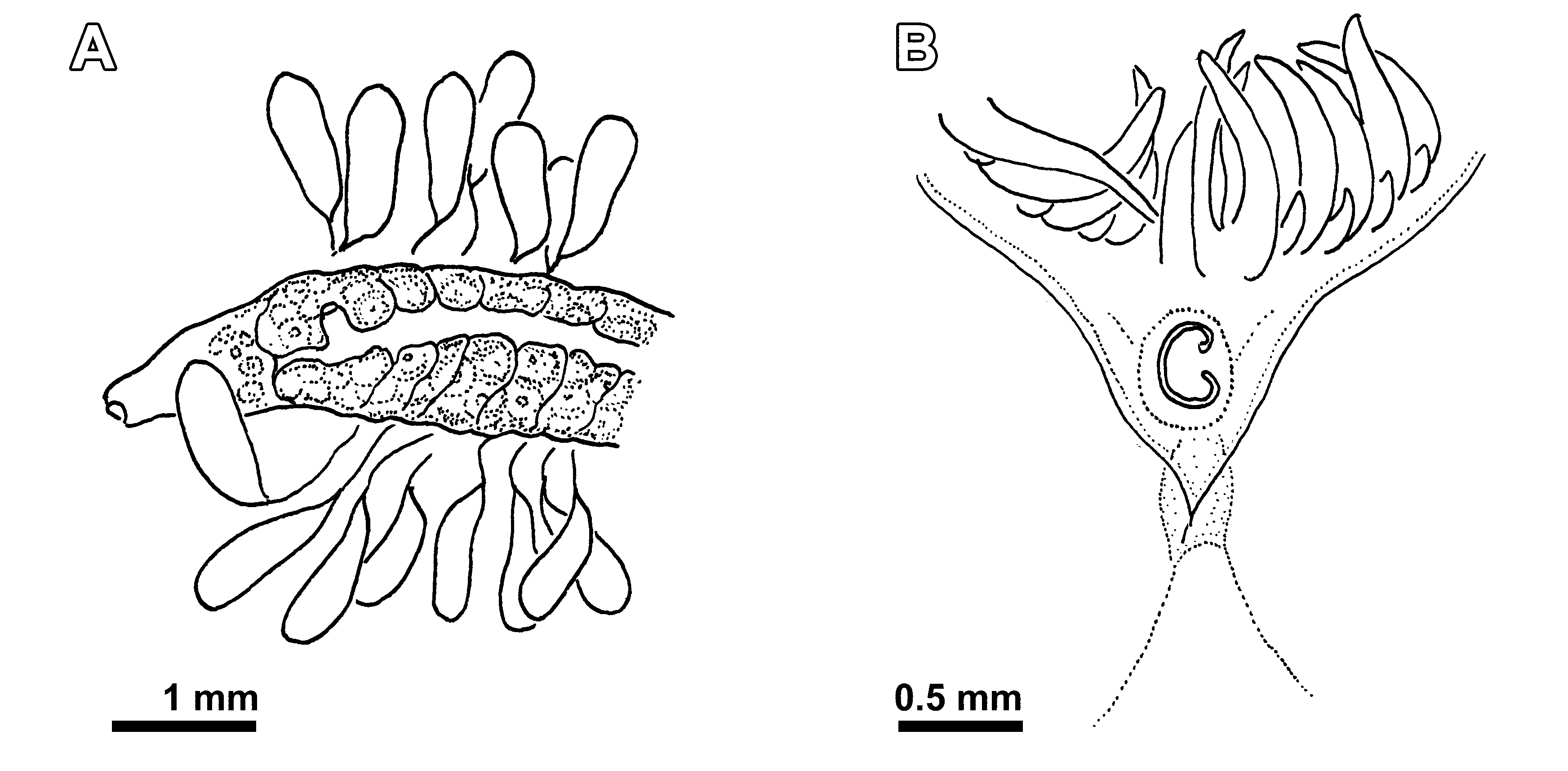
Description. Collected specimens range from several millimeters to about 8 см long (Figure 4 A). The elongated cylindrical body tapers either gradually, or rather abruptly, to a thin firm stalk attached to substratum. In general the stalk attains about a half length of the body, but may be much shorter or much longer in some specimens. The test is firm, leathery, in the preserved specimens typically longitudinally wrinkled and furrowed. Epibionts (mostly bryozoans and algae) may present on the test, especially on older individuals and especially on the stalk, but usually not in great quantity. Living specimens are uniformly red, the colour is retained in formaline for years. Branchial and atrial apertures are on the short siphons located on the top of the body, close together. The branchial siphon is directed upward, the atrial curved down and opens downward. The test on the inner surface of the siphons is covered by crowded spines. The spines are narrow and elongated, with sharply pointed tips and with flat oval base, about 50 µm long and 10 µm wide at the base (Figure 4 E). Thin parallel longitudinal lines are visible inside each spine. Body wall is muscular, almost opaque (Figure 4 B). About 15 large branchial tentacles regularly alternating with the same number of small tentacles are present. The dorsal tubercle slit is C shaped directed to the left and with the horns rolled inside (Figure 5 B). The prepharyngeal band consists of a single lamina running in a close proximity to a ring of tentacles and making shallow V around the dorsal tubercle. The neural ganglion is close to the dorsal tubercle. High dorsal lamina has plain edge. The branchial sac has four rather low folds, the internal longitudinal vessels in dissected specimen are distributed as follow: EN 2 (7) 4 (12) 4 (8) 3 (17) 1 DL (14) 4 (8) 4 (7) 5 (7) 3 EN. Stigmata straight and long, each row is crossed by a parastigmatic vessel. Gut forms vertical S-shaped loop (Figure 4 C). The short oesophagus, at the posterior end of the body, is curved at almost 180 ° before to enter the stomach. The stomach is cylindrical and large, somewhat shorter than a half of the body length. It is lying more or less parallel to the longitudinal axis of the body, its internal wall has at least 30 well defined regular parallel longitudinal folds. Intestine bends posteriorly, forming tight closed primary loop. The secondary loop is open anteriorly, the rectum is long and straight. Anal border has well defined round lobes, about 15 were counted in dissected specimen. Two gonads are on the each side of the body. Ovaries are straight, not long, with ventrally bent distal ends. They are parallel to each other and to the longitudinal axis of the body. On each side of the body one ovary lies along the longitudinal midline and is located in the posterior half of the body, while another ovary, lying closer to the endostyle, is located more anteriorly (closer to siphons). The oviducts are short. Numerous male follicles surround each ovary from the sides and posteriorly. They are long, cylindrical, sausage-shaped, not branched, freely projecting for their whole length into the peribranchial cavity being attached to the body wall, on some distance from the ovary, by their narrow distal ends only. Wide common sperm duct runs along the mesial surface of each ovary and ends in a short male papilla in the anterior part of the ovary (Figure 5 A). The endocarps are numerous. In the form they resemble male follicles (sausage-shaped, attached by narrow ends) but are smaller. The specimens occurs solitarily or in groups of several individuals, but do not form dense settlements.
Sanamyan, Karen, Sanamyan, Nadya (2017): Shallow-water Ascidians from Matua Island (central Kuril Islands, NW Pacific). Zootaxa 4232 (3): 301-321, DOI: 10.11646/zootaxa.4232.3.1
Remarks. Although original description of this species lacks any information on its internal features there is no doubt in its identity, the exterior of this species is very characteristic and it is the most common solitary ascidian on the east coasts of Kamchatka (type locality of the species). In NW Pacific Styela clavata has been mistaken several times with another species, Styela clava Herdman, 1881 (e. g. by Redikorzev, 1941). These two species have similar appearance and similar names but nothing in common in their internal features, and, contrary to the statement of Redikorzev (1941), based on erroneous identification (see remarks under S. clava in Sanamyan, 2000) their geographical ranges do not overlap. The distribution of S. clavata is probably limited by Bering Sea, east coast of Kamchatka, and extends to the south to at least to central Kuril Islands.
Sanamyan, Karen, Sanamyan, Nadya (2017): Shallow-water Ascidians from Matua Island (central Kuril Islands, NW Pacific). Zootaxa 4232 (3): 301-321, DOI: 10.11646/zootaxa.4232.3.1
Material examined. Matua Island, Point Kluv and Point Crocodile, several tens of specimens in eight lots, collected from intertidal zone to 16 m.
Sanamyan, Karen, Sanamyan, Nadya (2017): Shallow-water Ascidians from Matua Island (central Kuril Islands, NW Pacific). Zootaxa 4232 (3): 301-321, DOI: 10.11646/zootaxa.4232.3.1
Export occurrence data
Darwin Core Archive (ZIP)
CLASSIFICATION
Taxonomic Classification Tree


IMAGES