
AnimaliaacceptedgenusAccepted
Aplidium
GBIF:127696482
ABOUT
Descriptions(2)
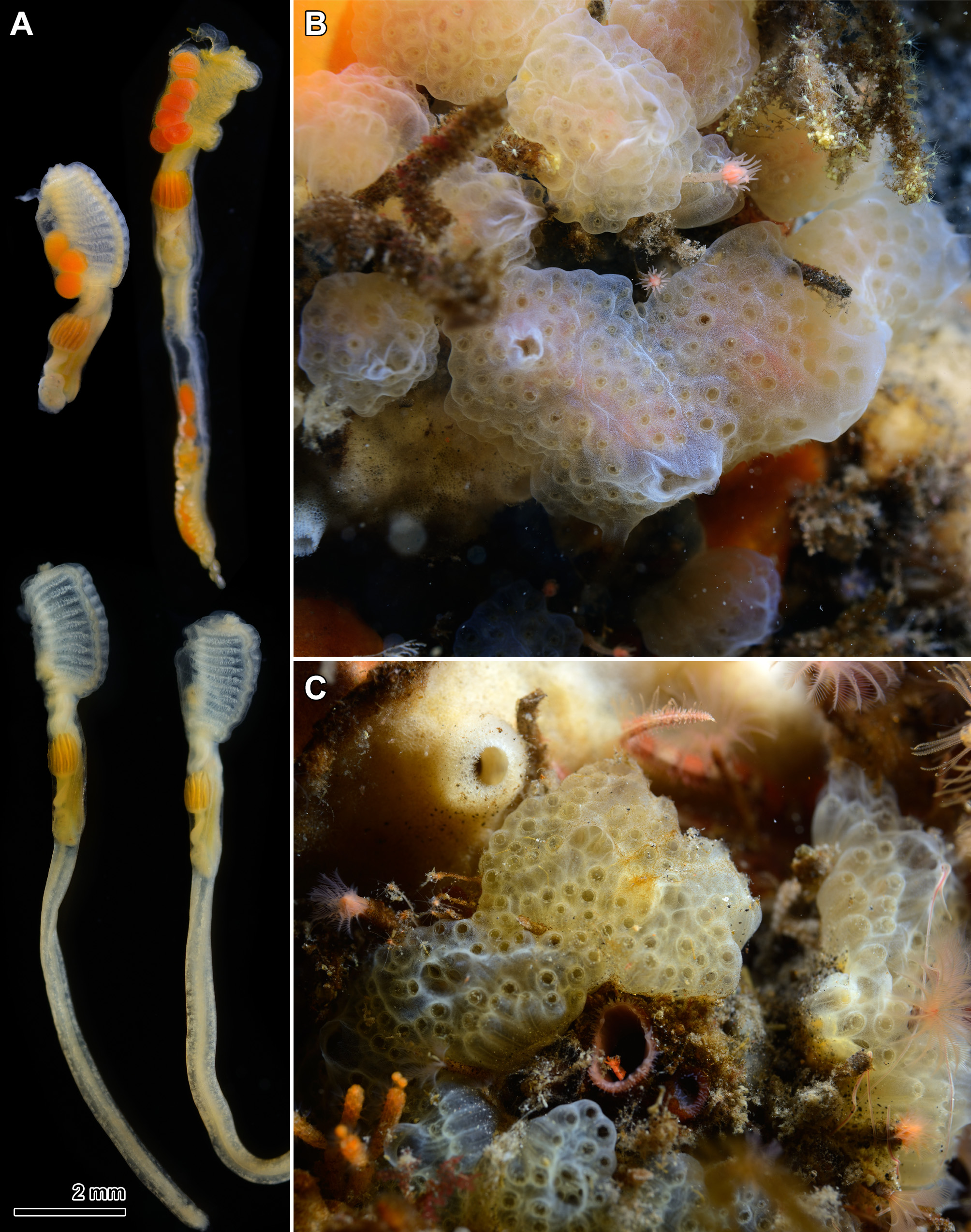
Remarks. All colonies are very small and zooids are strongly contracted and the species cannot be identified precisely. The general shape and colour of the colony on the underwater photograph (Figure 10 C) reminiscent those of Aplidium eborinum. The zooids have about 11 or 12 rows of stigmata and 9 or 10 prominent longitudinal stomach folds. They are much smaller than those of A. eborinum but this may be because they are too strongly contracted. The preserved colonies resemble the specimens from Kamchatka identified by Sanamyan (1998) as A. sagamiense (Tokioka, 1967), but zooids have more rows of stigmata. Aplidium sagamiense: Sanamyan (1998) is, most probably, wrongly identified, this species inhabits warmer waters, (originally described from Sagami Bay, Japan) and it is hard to believe it may occur in cold waters around Kamchatka and north and central groups of Kuril Islands.
Sanamyan, Karen, Sanamyan, Nadya (2017): Shallow-water Ascidians from Matua Island (central Kuril Islands, NW Pacific). Zootaxa 4232 (3): 301-321, DOI: 10.11646/zootaxa.4232.3.1
Material examined. Matua Island, Point Kluv, 15 m, 25.08.2016 and 26.08.2016, two colonies and fragments (# 163, 179); Point Crocodile, 15 m, 19.08.2016 one colony (# 158).
Sanamyan, Karen, Sanamyan, Nadya (2017): Shallow-water Ascidians from Matua Island (central Kuril Islands, NW Pacific). Zootaxa 4232 (3): 301-321, DOI: 10.11646/zootaxa.4232.3.1
Export occurrence data
Darwin Core Archive (ZIP)
CLASSIFICATION
Taxonomic Classification Tree

IMAGES