
AnimaliaNot EvaluatedacceptedspeciesAccepted
Aplidium macrenteron
GBIF:127696484
0
Synonyms
ABOUT
Descriptions(3)
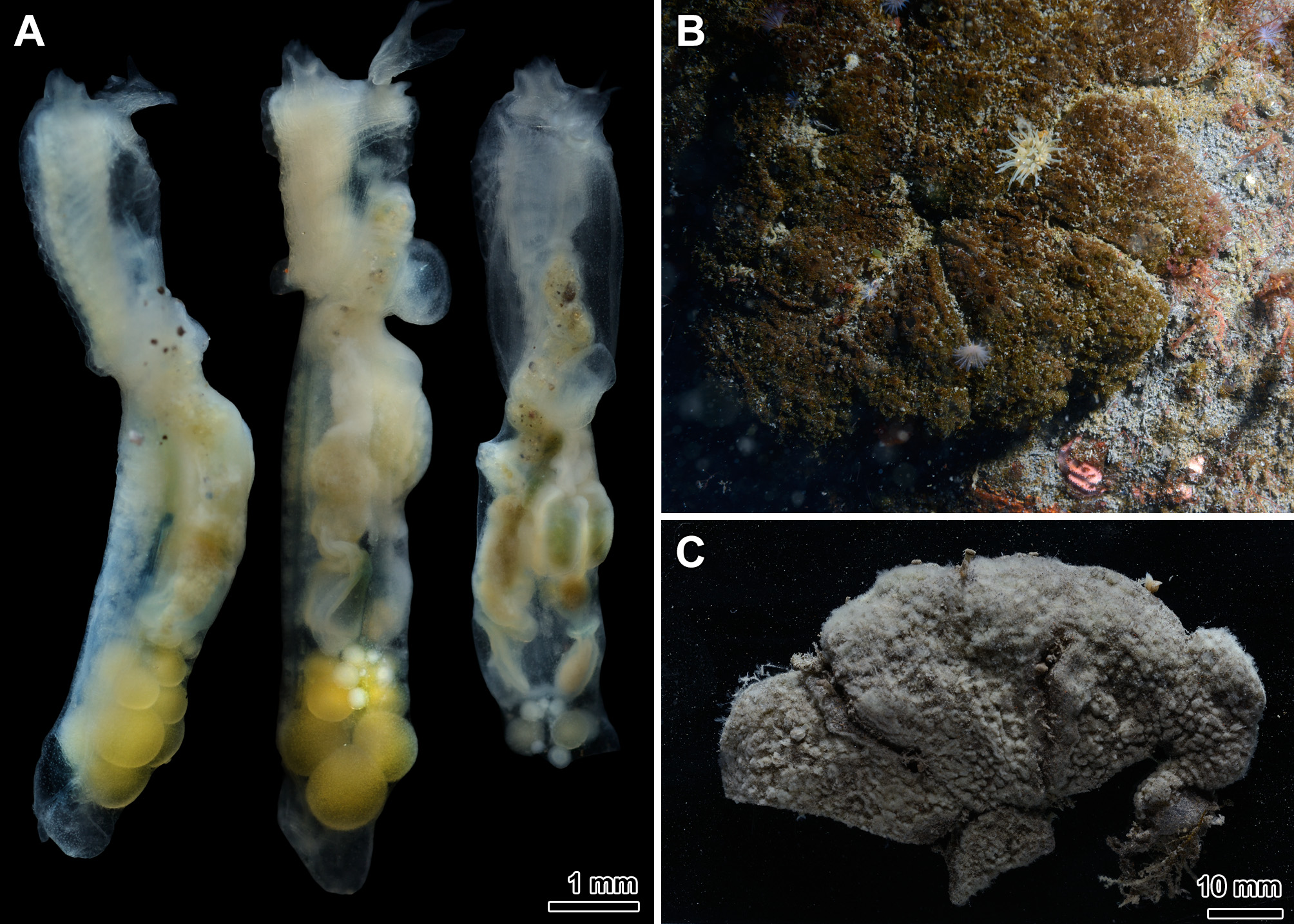
Description. The colony is a flat sandy mass, 8 cm in greatest diameter and about 1 cm thick, attached to a stone by a whole lower surface. The surface and the inner layers of the test contain large amount of sand making the colony extremely cryptic despite its large size. The upper surface is flat, the common cloacal openings are numerous but hard to see and the systems of zooids cannot be recognized even on the underwater photographs of live colonies. The zooids, about 8 mm in somewhat contracted state, stand within the colony vertically and parallel to each other. Longitudinal thoracic muscles are thin, about 12 in number, expand to abdomen and postabdomen as two ventral bands of crowded muscles, which are not strong. Discernible transverse muscles present on the anterior (upper) end of the thorax. The branchial siphon is short, and although it has usual 6 lobes, the lobes are not well defined and often irregular. The atrial languet issued from the upper rim of the small atrial opening. The atrial languet may be wide with three long lobes, or narrow and simple (in zooids from the same colony). The branchial sac has 13 rows of about 20 stigmata on each side. The abdomen is short and straight, the stomach is in its middle part, with five prominent widely separated longitudinal folds. The postabdomen is a direct continuation of the abdomen (no constriction between them) and shorter than the abdomen. It contains a group of large ova and a compact bunch of small testis follicles situated immediately below the pole of the gut loop. The heart is in the end of the postabdomen.
Sanamyan, Karen, Sanamyan, Nadya (2017): Shallow-water Ascidians from Matua Island (central Kuril Islands, NW Pacific). Zootaxa 4232 (3): 301-321, DOI: 10.11646/zootaxa.4232.3.1
Remarks. Most previously recorded specimens of this species had strongly developed epicards extending down from the bottom of the branchial sac along the ventral side of zooid through the whole length of abdomen and postabdomen and usually filled by pink parenchymatous tissue. Redikorzev (1927) misinterpreted them with the heard and created a new genus Macrenteron for this species. Sanamyan (1998) recognized that the heart in this species is in the end of postabdomen, as in all related species of Polyclinidae, but thought the genus may be separated from Aplidium by unusually well developed epicardium. The present colony contains well developed zooids in which epicardium is not filled by parenchyma and is not conspicuous. The zooids certainly are of Aplidium type and the genus Macrenteron is synonymized with Aplidium here. The name Aplidium ritteri is, however, preoccupied by Aplidium ritteri (Sluiter, 1895), so a new replacement name Aplidium macrenteron nom. nov. is proposed here for this species.
Sanamyan, Karen, Sanamyan, Nadya (2017): Shallow-water Ascidians from Matua Island (central Kuril Islands, NW Pacific). Zootaxa 4232 (3): 301-321, DOI: 10.11646/zootaxa.4232.3.1
Material examined. Matua Island, Point Kluv, 16 m, 24.08.2016, one colony (# 162).
Sanamyan, Karen, Sanamyan, Nadya (2017): Shallow-water Ascidians from Matua Island (central Kuril Islands, NW Pacific). Zootaxa 4232 (3): 301-321, DOI: 10.11646/zootaxa.4232.3.1
Export occurrence data
Darwin Core Archive (ZIP)
CLASSIFICATION
Taxonomic Classification Tree

NOMENCLATURE
Synonyms(1)
IMAGES