
AnimaliaNot EvaluatedacceptedspeciesAccepted
Aplidium eborinum
Sanamyan & Sanamyan, 2011
GBIF:127696485
0year
ABOUT
Descriptions(3)
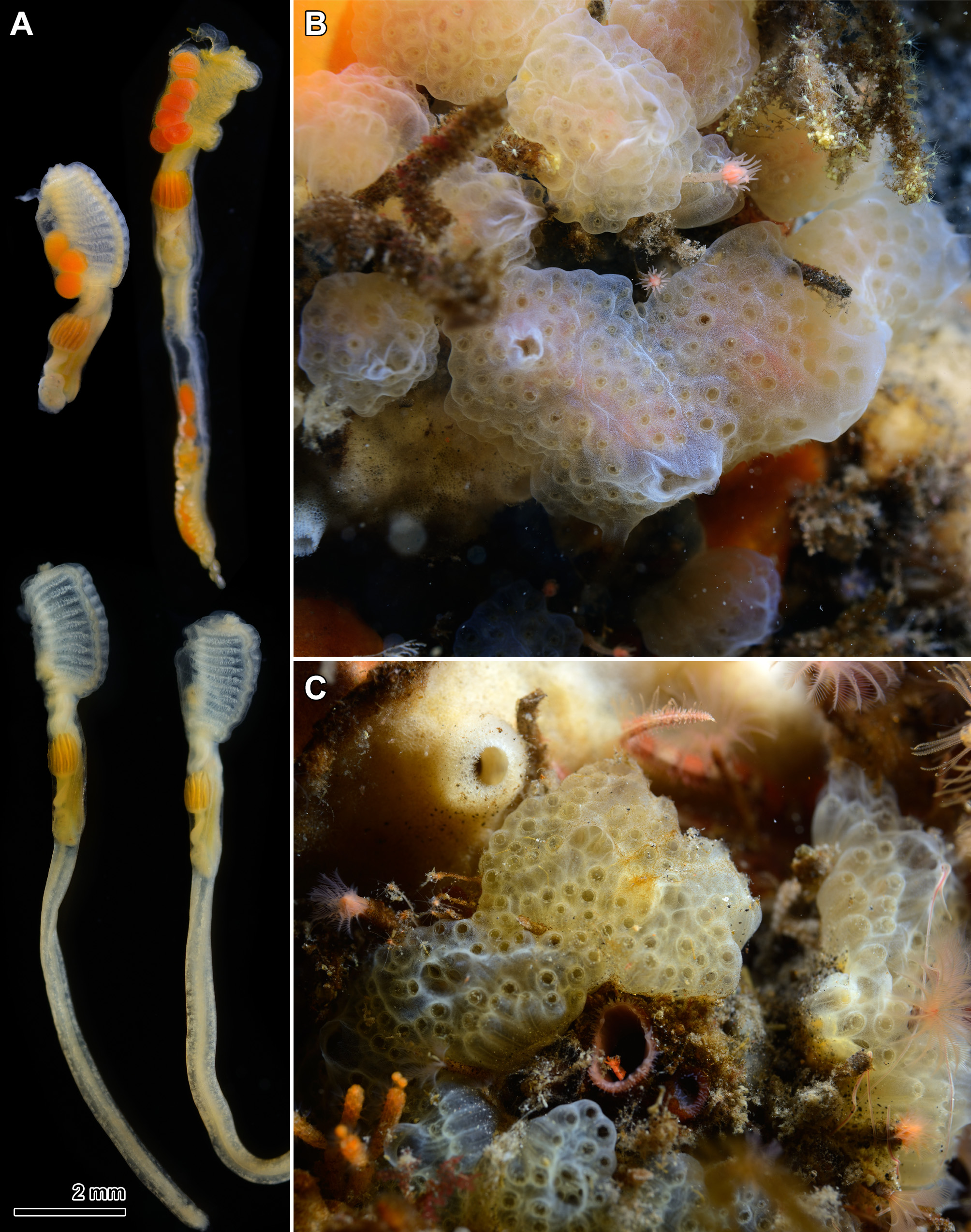
Description. The specimens form irregular small colonies composed of several separated of fused lobes (Figure 10 B). In live the colonies are colourless, whitish, the superficial layer of the test contains crowded white pigment granules which make the colony opaque. Inner layers of the test are transparent and soft. Large common cloacal openings are on the top of low elevations on the upper surface of colony. Zooids are probably arranged in rows along the cloacal canals converging to common cloacal opening, but this is not quite clear on existing photographs of live colonies. The zooids are up to 11 mm long with the thorax and abdomen attaining up to 5 mm in better expanded zooids. The branchial siphon is short, six lobed. The atrial languet is simple and short, issued from the upper rim of the atrial opening, which is very small in contracted zooids. The branchial sac has 12 rows of stigmata with 18 or 19 stigmata per row counted in the middle part of the branchial sac (on each side). The stomach is barrel shaped, with 12 – 14 regular and prominent longitudinal folds. Some zooids have incubated eggs in the atrial cavity, but no developed larvae were found.
Sanamyan, Karen, Sanamyan, Nadya (2017): Shallow-water Ascidians from Matua Island (central Kuril Islands, NW Pacific). Zootaxa 4232 (3): 301-321, DOI: 10.11646/zootaxa.4232.3.1
Remarks. The species was known previously only from Kamchatka waters. The colonies from Matua Island are smaller than the colonies from Kamchatka and have less evident systems: in the specimens from Kamchatka the zooids are arranged into distinct double rows along the cloacal canals which are clearly visible in live colonies (see Sanamyan & Sanamyan, 2011, Figure 5). Also, the type specimens from Kamchatka have a bit larger branchial sac (14 rows of stigmata) and slightly more numerous stomach folds (13 – 15). All these differences are considered here as connected with the smaller size of colonies from Matua Island, however, the identification remains not very reliable and should be confirmed on a material containing larvae.
Sanamyan, Karen, Sanamyan, Nadya (2017): Shallow-water Ascidians from Matua Island (central Kuril Islands, NW Pacific). Zootaxa 4232 (3): 301-321, DOI: 10.11646/zootaxa.4232.3.1
Material examined. Matua Island, Point Kluv, 15 m, 25.08.2016, two colonies and fragments (# 156, 157).
Sanamyan, Karen, Sanamyan, Nadya (2017): Shallow-water Ascidians from Matua Island (central Kuril Islands, NW Pacific). Zootaxa 4232 (3): 301-321, DOI: 10.11646/zootaxa.4232.3.1
Export occurrence data
Darwin Core Archive (ZIP)
CLASSIFICATION
Taxonomic Classification Tree

IMAGES