
AnimaliaNot EvaluatedacceptedspeciesAccepted
Aplidiopsis pannosum
(Ritter, 1899) Ritter, 1899
GBIF:127696487
0year
0
Synonyms
ABOUT
Descriptions(3)
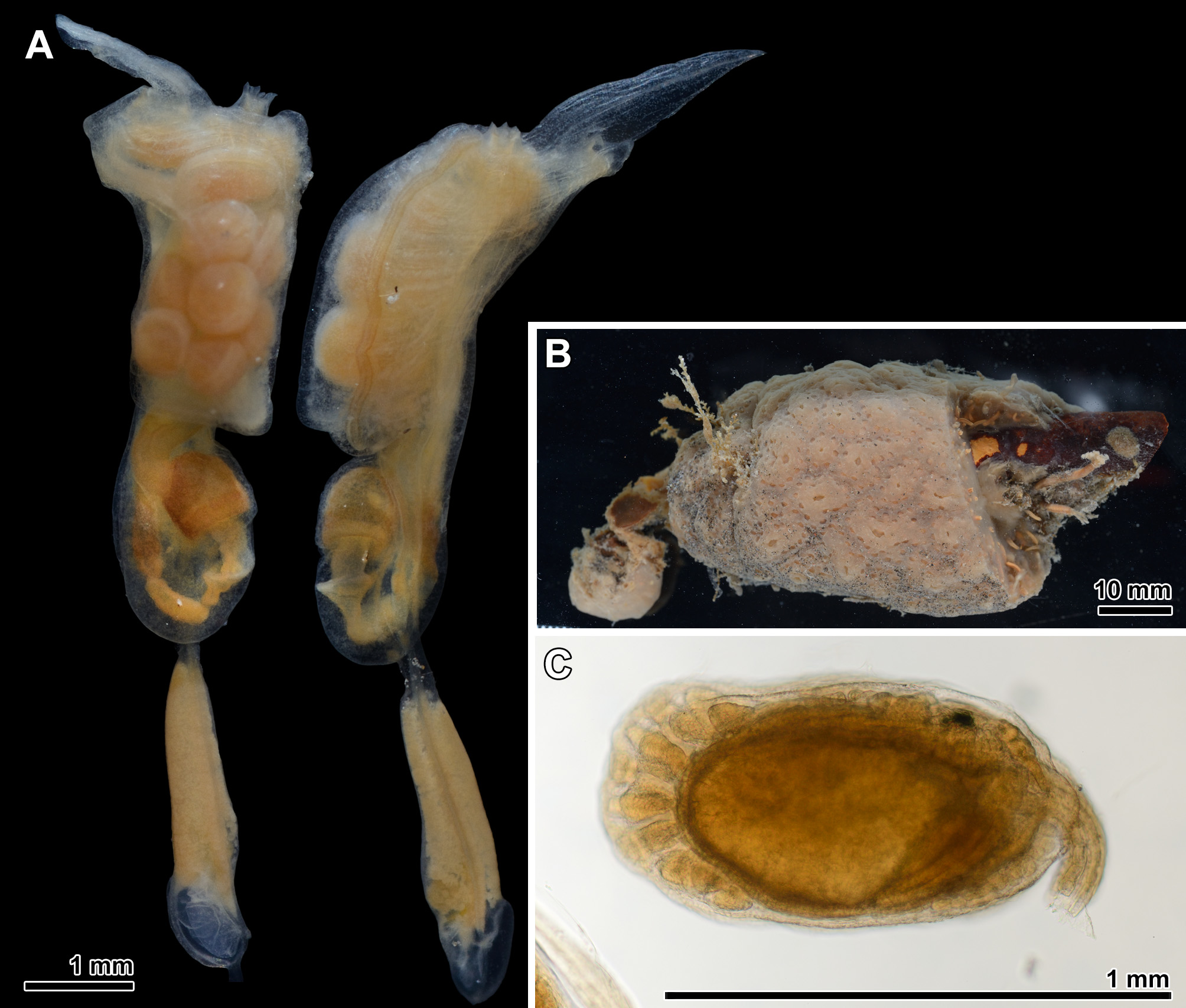
Description. The colonies are thick potato-like dirty brown irregular masses, often embracing stems of algae (e. g. Agarum) (Figure 9 B). The surface sometimes has sparse sand grains but in general is more or less clear. The test is tough, firm, cartilaginous, opaque, the zooids are not visible from the exterior. The zooids are arranged into circular systems. They are about 8 mm long in somewhat contracted condition. The branchial siphon is short and has six pointed lobes. The atrial lip is long and wide, always simple. The thoracic muscles, about eight or ten in number, are fine, weak, and probably not expand to the abdomen, there is no discernible ventral band of muscles in abdomen, which occurs in some other species of this and related genera. The branchial sac has 16 rows of stigmata with about 15 stigmata in each row on each side. The stigmata are short, small, or even oval, especially closer to the endostyle on both sides of the branchial sac. The abdomen is shorter than the thorax, the shape of the gut loop is characteristic for the genus with the oesophagus bent ventrally at the right angle to enter the smooth-walled asymmetric stomach. The post-stomach differentiation of the intestine is pronounced and well defined (Figure 9 A). The postabdomen is attached to the left side of the abdomen by a narrow neck and filled by parenchymatous tissue in the zooids examined. Numerous larvae are incubated in the atrial cavity. The trunk is about 0.9 mm long. Three adhesive organs alternate with four median ampullae. Large lateral ampullae are in two rows anteriorly (one row on each side). Two groups of vesicles, dorsal and postero-ventral, are on each side of the larval trunk. This feature is rather characteristic for the genus.
Sanamyan, Karen, Sanamyan, Nadya (2017): Shallow-water Ascidians from Matua Island (central Kuril Islands, NW Pacific). Zootaxa 4232 (3): 301-321, DOI: 10.11646/zootaxa.4232.3.1
Remarks. The species is common in NW Pacific. Although many colonies were studied previously, the material is insufficient to decide if all of them are conspecific: the variations of the shapes of colony and the number of rows of stigmata seems to be a little too big for a single species (see Sanamyan, 1998). Shallow-water potato-like dirty yellowish brown or grey colonies, we had chance to document underwater during several recent years at Kamchatka (Sanamyan & Sanamyan, 2010), appear to be certainly conspecific with the material from Matua Island described here. On the other hand, a single available photo of this species from Commander Islands shows vivid bright red colony (see Sanamyan & Sanamyan, 2015).
Sanamyan, Karen, Sanamyan, Nadya (2017): Shallow-water Ascidians from Matua Island (central Kuril Islands, NW Pacific). Zootaxa 4232 (3): 301-321, DOI: 10.11646/zootaxa.4232.3.1
Material examined. Matua Island, Point Kluv, 16 m, 24.08.2016, one colony, collector E. Drashev (# 150); 16 m, 23.08.2016, two colonies (# 159, 161).
Sanamyan, Karen, Sanamyan, Nadya (2017): Shallow-water Ascidians from Matua Island (central Kuril Islands, NW Pacific). Zootaxa 4232 (3): 301-321, DOI: 10.11646/zootaxa.4232.3.1
Export occurrence data
Darwin Core Archive (ZIP)
CLASSIFICATION
Taxonomic Classification Tree

NOMENCLATURE
Synonyms(2)
IMAGES