
AnimaliaNot EvaluatedacceptedspeciesAccepted
Placentela crystallina
Redikorzev, 1913
GBIF:127696489
0year
ABOUT
Descriptions(3)
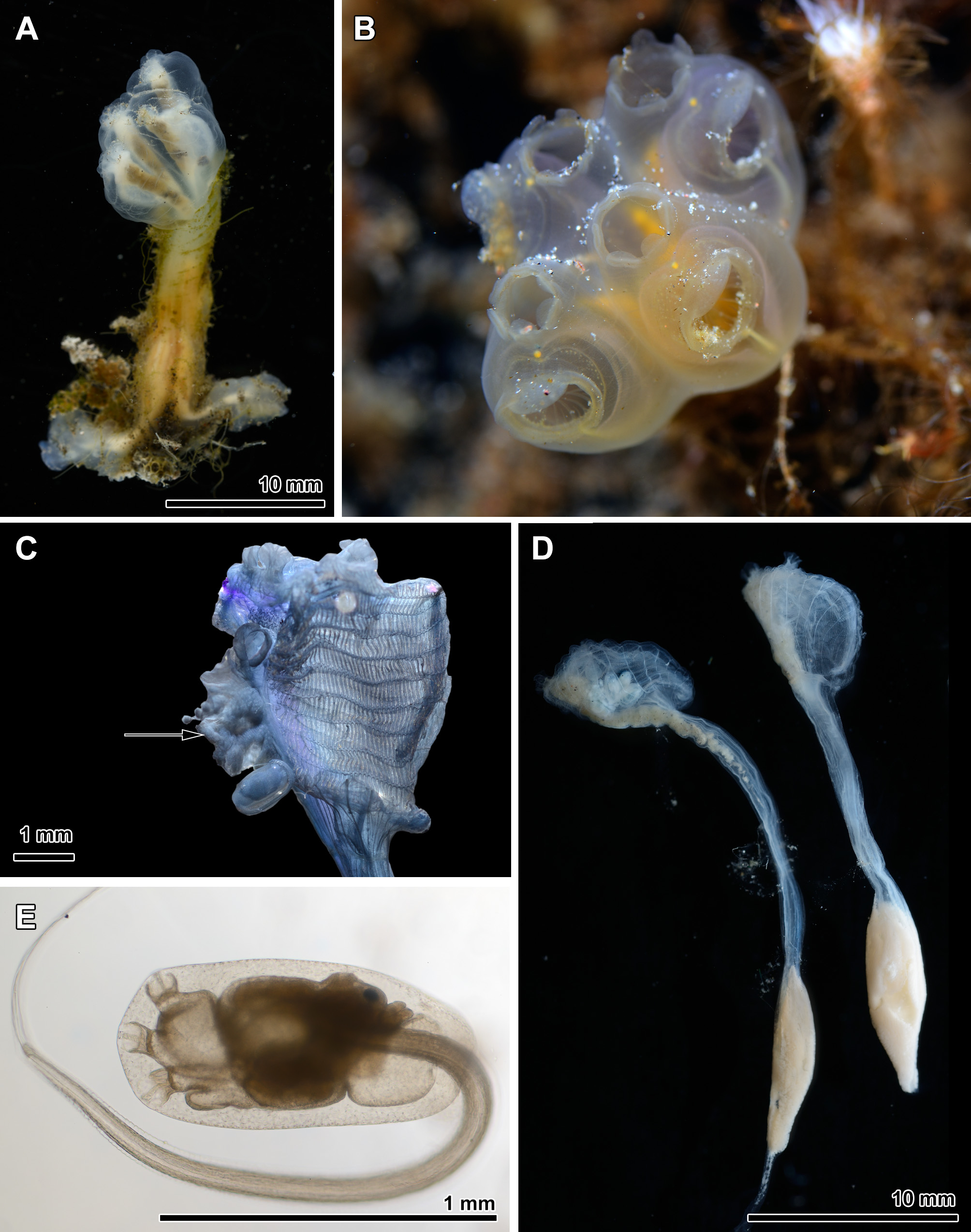
Description. All colonies are small, the largest is 3 cm long, and all are represented by a single head on rather high peduncle and contain from two to five zooids only. The most conspicuous part of colony is a transparent head containing thoraces of the zooids. In the head the zooids are oriented in such a way, that their branchial openings open on the sides of the head and the atrial openings open independently from each other closer to the top of the head (Figure 8 B). The atrial openings have six equal prominent round lobes, the branchial openings also have six lobes, but the dorsal lobe is larger than other, which are low. The zooids are large and characteristic for this species. They have wide, but relatively short branchial sac with 10 rows of stigmata and about 40 stigmata per row on each side. The abdomen is very long, the stomach is in its posterior end which is filled by parenchymatous tissue. The postabdomen and gonads not present in the material examined, however several zooids contained larvae attached to a placental membrane in the right side of the thorax (Figure 8 C, D). The fully developed larva has a trunk 1.1 mm long. It has thee adhesive organs arranged in a vertical row and has no vesicles or ampullae (Figure 8 E).
Sanamyan, Karen, Sanamyan, Nadya (2017): Shallow-water Ascidians from Matua Island (central Kuril Islands, NW Pacific). Zootaxa 4232 (3): 301-321, DOI: 10.11646/zootaxa.4232.3.1
Remarks. In the Sea of Okhotsk and in Kamchatka waters this species may form large, 20 cm and more, heavily branching, tree-like colonies, but all specimens recorded in Matua Island are very small, although some contain fully developed larvae. The genus Homoedistoma Redikorzev, 1927 is a synonym, its type species, H. michaelseni Redikorzev, 1927 is conspecific with Placentela crystallina (see Sanamyan, 1993, type revision).
Sanamyan, Karen, Sanamyan, Nadya (2017): Shallow-water Ascidians from Matua Island (central Kuril Islands, NW Pacific). Zootaxa 4232 (3): 301-321, DOI: 10.11646/zootaxa.4232.3.1
Material examined. Matua Island, Point Kluv, 16 – 17 m, collected at 25 – 28.08.2016, three colonies (# 153, 160, 169).
Sanamyan, Karen, Sanamyan, Nadya (2017): Shallow-water Ascidians from Matua Island (central Kuril Islands, NW Pacific). Zootaxa 4232 (3): 301-321, DOI: 10.11646/zootaxa.4232.3.1
Export occurrence data
Darwin Core Archive (ZIP)
CLASSIFICATION
Taxonomic Classification Tree

IMAGES