
AnimaliaNot EvaluatedacceptedspeciesAccepted
Vertagopus ceratus

Vertagopus ceratus

GBIF:127711384

ABOUT

Descriptions(5)

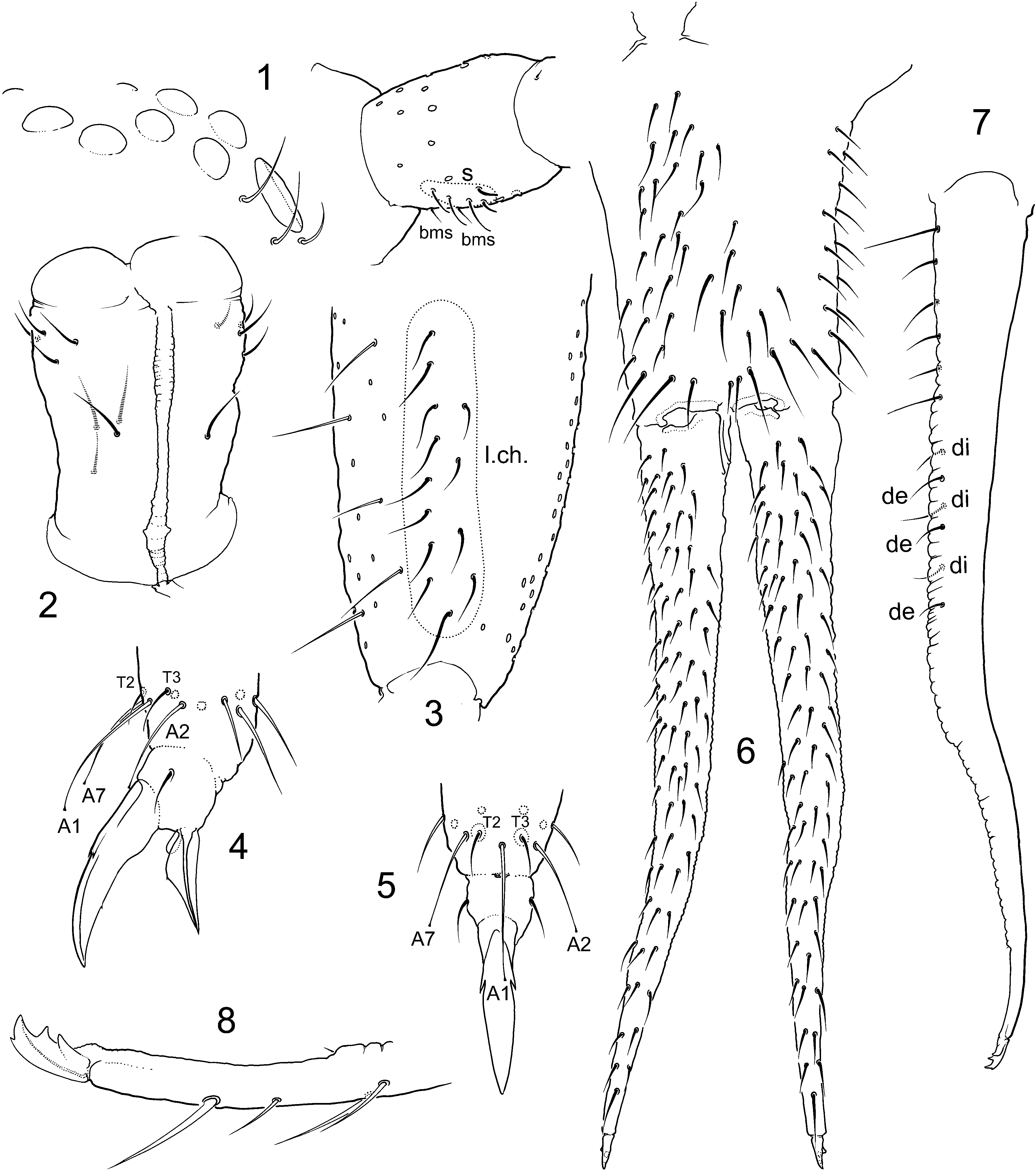
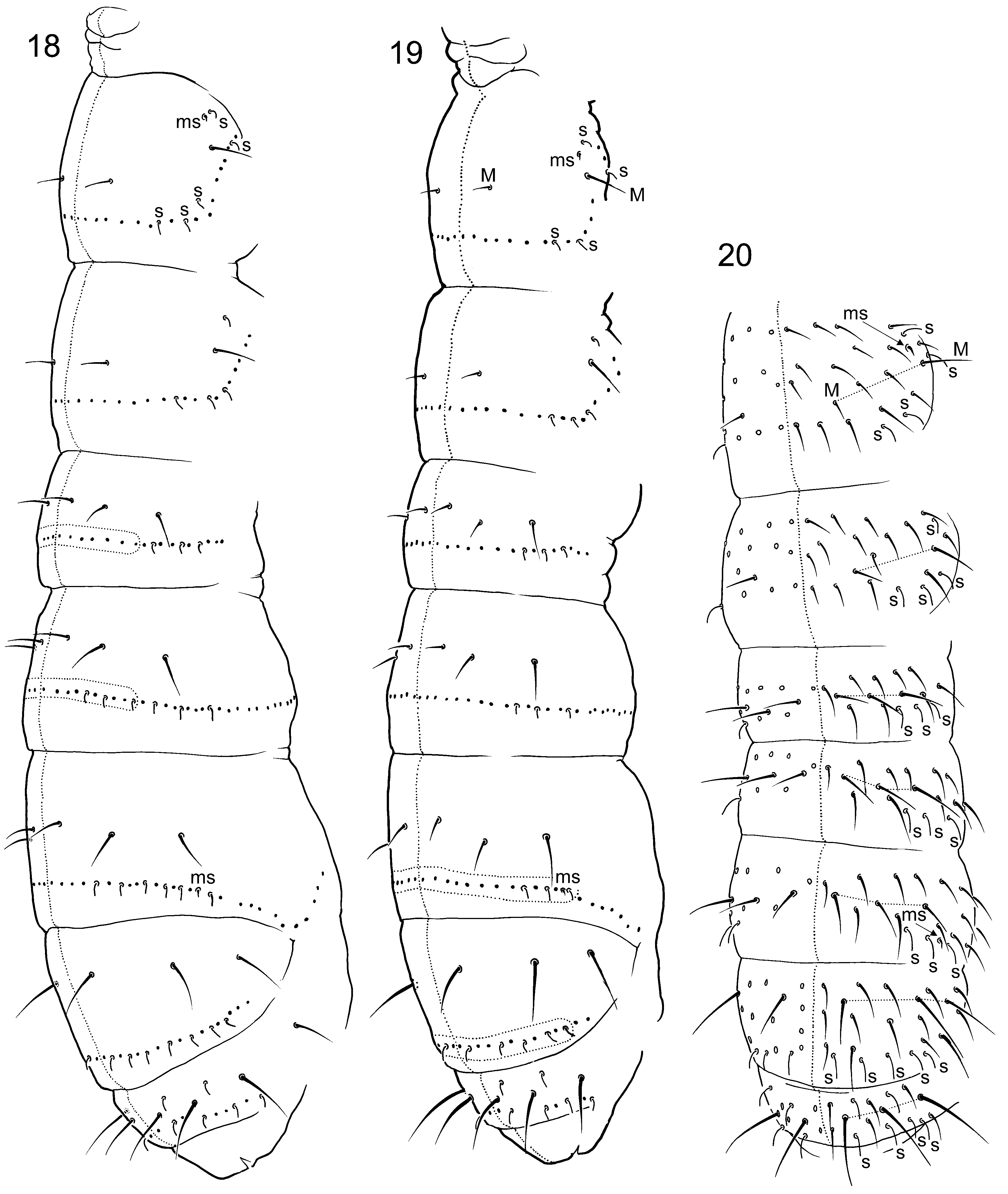
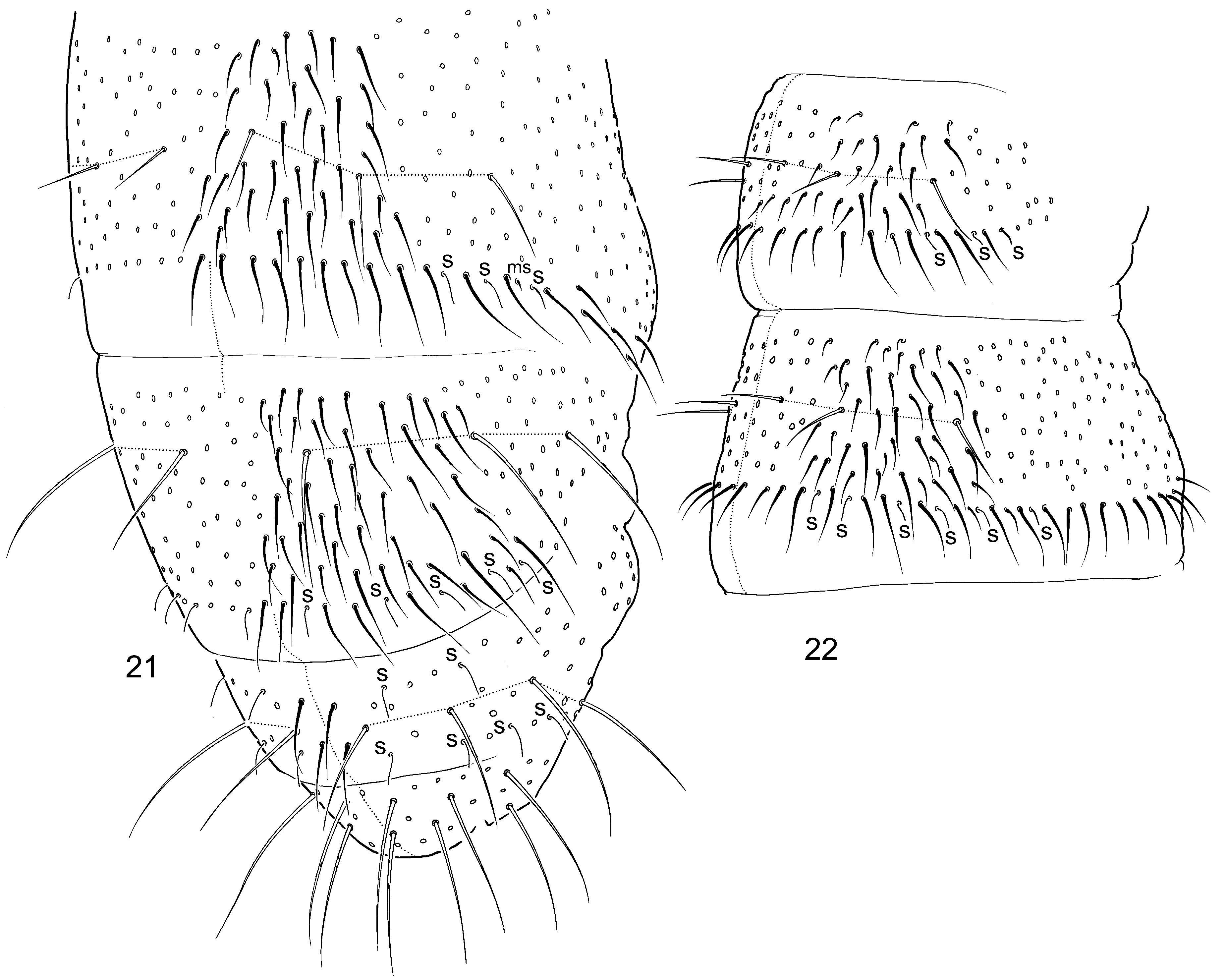
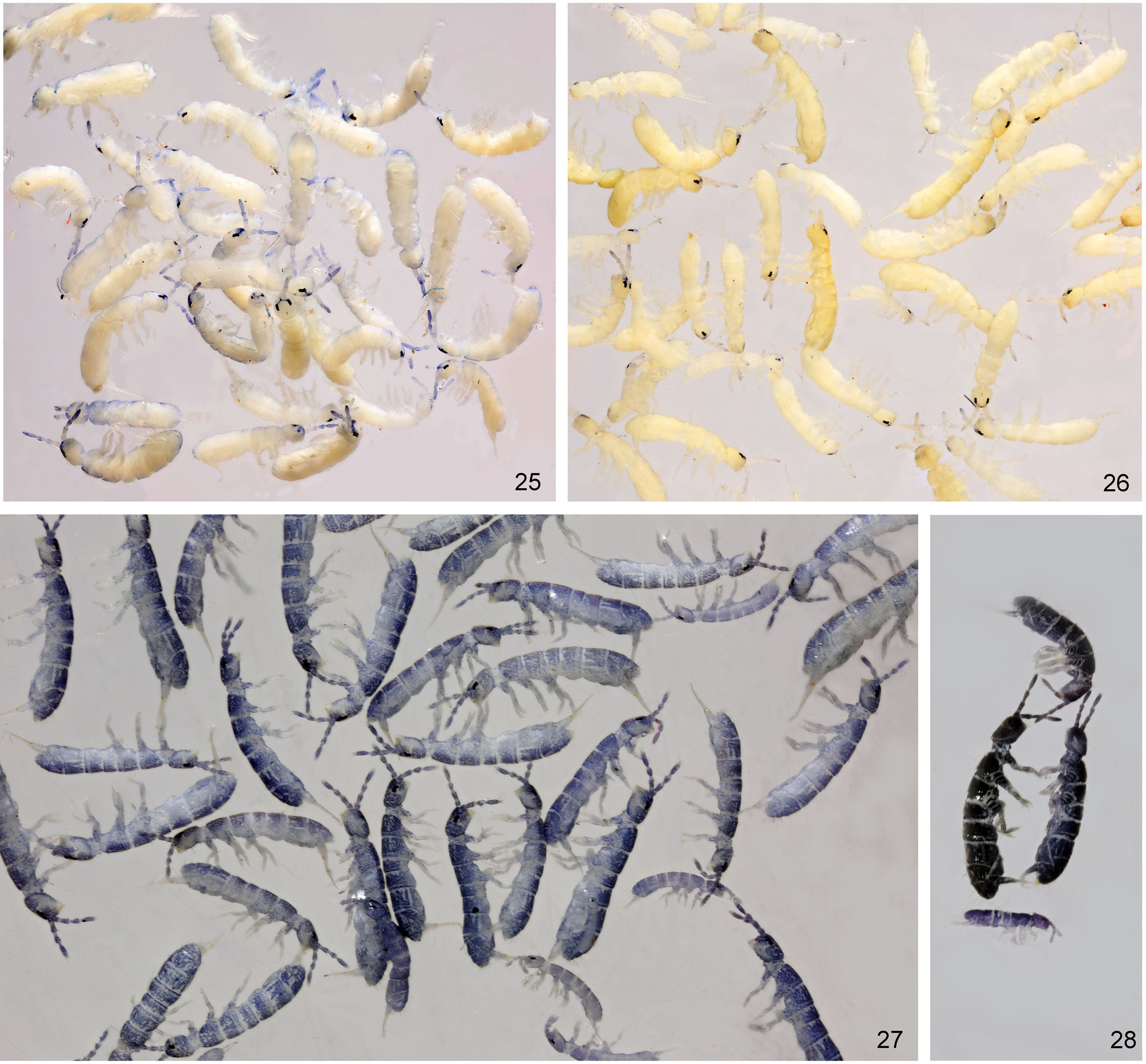
Description. 8 + 8 ommatidia of which G and H much smaller and hardly visible (Fig. 1). PAO elliptical, about twice as long as nearest ommatidium (1.9 – 2.5). Maxillary outer lobe with 4 sublobal hairs and bifurcate palp. Labrum with 4 prelabral chaetae and about 6 – 7 on front, labral edge with four sharp ridges. Labial palp with all usual papillae and complete set (16) of guards (e 7 present), 4 proximal, 4 basomedian and 5 basolateral chaetae. Ventral side of head with 4 – 6 + 4 – 6 postlabial chaetae. Maxillary head with unmodified lamellae. Ant. I with 2 ventral microsens at base and 5 – 7 ventral sens of which 2 – 4 short in distal row (Fig. 1). Ant. II with about ten sens. Ant. IV with bifurcate subapical pin-chaeta and big globular organite. Body with differentiated smooth macrochaetae. Macrochaetae on Abd. V about as long as this segment length (0.9 – 1.1). Number of macrosens in full grown specimens as 4 – 5,4 – 5 / 4 (3 – 5), 6 (5 – 7), 6 (5 – 7), 7 (6 – 8), 6 (Figs 18, 22). Th. II – III with 2 – 3 accp and 2 al. On all segments accp in p - row, sometimes one or two moved forward. On Abd. V six sens arranged as two in anterior position and four in p - row. Microsens 1,0 / 0,0,1 in number, on Abd. III ms associated with p - row. Th. III without ventral chaetae, Abd. II without ventromedial group of chaetae. Legs with claws of normal shape, with lateral teeth and minute inner tooth. Empodium with indistinct corner inner tooth. Tibiotarsi with 11 chaetae in distal whorl, all T - chaetae present (Figs 4, 5). 2,3,3 clavate tenent hairs of medium size, about as long as inner edge of claw (0.8 – 1.0). Retinaculum with 4 + 4 teeth and 5 – 7 chaetae. Chaetotaxy of ventral tube (Fig. 2) invariably with 4 + 4 laterodistal, 1 + 1 anterior and 3 posterior chaetae (2 in distal transversal row and one at base). Furca rather long, 1.2 – 1.4 times longer than length of antennae. Manubrium densely covered by chaetae, with more than 40 on anterior side (Fig. 6). With " double " row of chaetae on lateral sides (l. ch. in Fig. 3). Manubrial thickening simple. Dens gradually narrowed towards apex, crenulated (Fig. 7), with 10 – 12 chaetae on posterior side (4 – 6 basal and 3 + 3 di-de). Anterior side of dens with more than 70 chaetae. Mucro with four teeth as common for the genus, " apical " tooth small (Fig. 8). Ratio dens: manubrium as 1.8 – 2.1. Body size 1.1 – 1.3 mm. Pale, often totally yellowish-white (Figs 26), with dark pigment on ommatidia, at antennal bases and front of head; distal half of antennae darker. Darker specimens with weak diffuse bluish pigmentation, more concentrating on mid-dorsal area and at posterior borders of tergites (Figs 25). Feet pale.
Potapov, Mikhail, Gulgenova, Ayuna, Babykina, Marina (2016): Isotomidae (Collembola) of Buryat Republic. III. The genera Vertagopus and Agrenia, with a note on ' Claw index'. Zootaxa 4088 (1): 112-128, DOI: 10.11646/zootaxa.4088.1.5
Discussion. This species is readily defined due to pale coloration, long furca, the presence of chaetae on anterior side of ventral tube, and unusual sensillar chaetotaxy. Sharp apical folds on the labrum and the presence of e - 7 in labial palp are also uncommon for the genus. Presence of anterior chaetae on the ventral tube are shared with the corticolous V. arboreus (Europe), which differs by dark pigmentation and less abundant sensillar chaetotaxy. The new species shares the presence of e - 7 in labial palp and long furca with V. helveticus Haybach and V. alpinus Haybach (both from high mountains of Austria). In contrast with V. ceratus sp. nov., these two European forms have no anterior chaetae on ventral tube, show more common sensillar chaetotaxy and are intensively pigmented. The new species does not belong to either ' westerlundi ' or ' arboreus ' groups since it has more s-chaetae on abdominal segments. Considerable difference in the number of sens on Abd. I (4) and Abd. II and III (6 on each) is notable. Pale coloration is known also in ' pallidus ' form of V. arc t i cu s Martynova (transholarctic species distributed in more northern areas), which differs from V. ceratus sp. nov. in many significant characters, such as ventral chaetotaxy of thorax, number of chaetae on dens and s - chaetae on body.
Potapov, Mikhail, Gulgenova, Ayuna, Babykina, Marina (2016): Isotomidae (Collembola) of Buryat Republic. III. The genera Vertagopus and Agrenia, with a note on ' Claw index'. Zootaxa 4088 (1): 112-128, DOI: 10.11646/zootaxa.4088.1.5
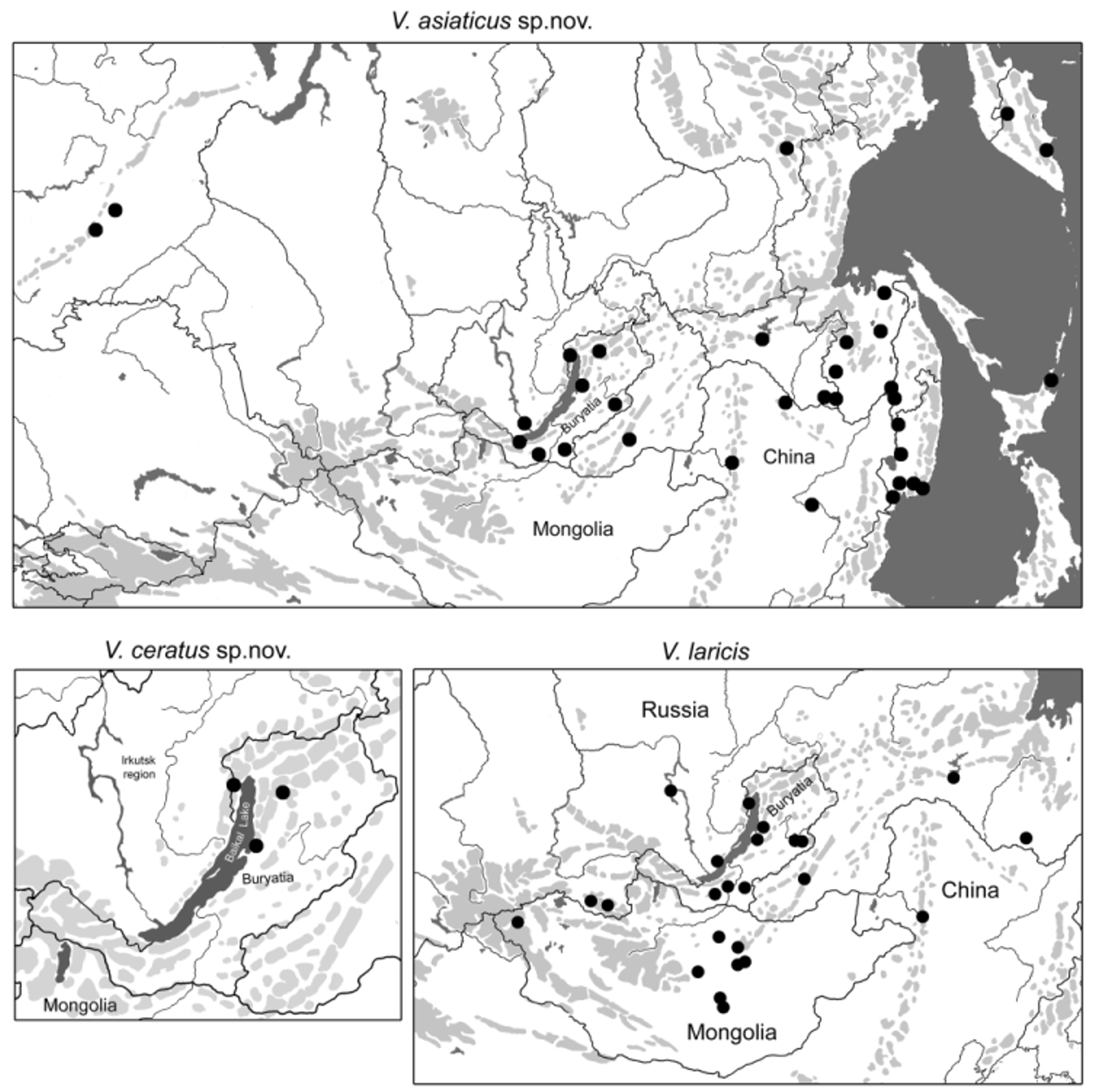
Distribution and ecology. V. ce r a t u s sp. nov. is a local species (Fig. 29). It inhabits lichen tundra in the alpine belt of northern areas of Buryatia (Balan-Tamur Range, Barguzinsky Range, Baikal'sky Range).
Potapov, Mikhail, Gulgenova, Ayuna, Babykina, Marina (2016): Isotomidae (Collembola) of Buryat Republic. III. The genera Vertagopus and Agrenia, with a note on ' Claw index'. Zootaxa 4088 (1): 112-128, DOI: 10.11646/zootaxa.4088.1.5
Etymology. The name reflects the ceral coloration of the type population of the new species.
Potapov, Mikhail, Gulgenova, Ayuna, Babykina, Marina (2016): Isotomidae (Collembola) of Buryat Republic. III. The genera Vertagopus and Agrenia, with a note on ' Claw index'. Zootaxa 4088 (1): 112-128, DOI: 10.11646/zootaxa.4088.1.5
Type material. Holotype, Russia (East Siberia): N Buryat Republic, Dzergynsky Nature Reserve, upper flow of Barguzin River, Balan-Tamur Range, ca. 1800 m alt., 55.36698 ° N, 111.55280 ° E, moss-lichen tundra, 09. ix. 2012, coll. A. Gulgenova and M. Potapov (MSPU). Twenty paratypes, 10 specimens on slides and 10 specimens in alcohol, ibidem (MSPU and BSU). Other material. Russia (East Siberia): N Buryat Republic, Dzergynsky Nature Reserve, upper flow of Barguzin River, Balan-Tamur Range, ca. 1800 m alt., 55.36698 ° N, 111.55280 ° E, mossy sites, litter under Pinus pumila, dry stony slope with lichens and Empetrum, 09. ix. 2012, coll. A. G. and M. P.; NW Buryat Republic, northern shore of Baikal Lake, peak nearby Goudjekit, subalpine belt with Pinus pumila, ca. 1600 m. alt., thick lichen spots, 15. viii. 2013, coll. A. G. and M. P.; NW Buryat Republic, Barguzinsky Range, ca. 10 km W Barguzin, upper flow of Bol'shoi Chevyrkuy Stream, alpine belt, ca. 1970 m. alt., cold mosses in shadow between rocks, 19. viii. 2008, coll. A. G. and M. P.
Potapov, Mikhail, Gulgenova, Ayuna, Babykina, Marina (2016): Isotomidae (Collembola) of Buryat Republic. III. The genera Vertagopus and Agrenia, with a note on ' Claw index'. Zootaxa 4088 (1): 112-128, DOI: 10.11646/zootaxa.4088.1.5

Export occurrence data

Darwin Core Archive (ZIP)

CLASSIFICATION

Taxonomic Classification Tree

MULTIMEDIA

Media Files(5)

FIGURE 29. Records of of three species of Vertagopus occurring in Buryat Republic. For V. l ar i c i s the papers of Martynova (1975), Dunger (1982), Stebaeva & Sedelnikova (1999), Stebaeva et al. (2001), and Gulgenova (2012) were also used.
Imageimage/png© Potapov, Mikhail;Gulgenova, Ayuna;Babykina, MarinaPotapov, Mikhail;Gulgenova, Ayuna;Babykina, Marina

FIGURES 1 – 8. Vertagopus ceratus sp. nov.: 1, anterior part of head; 2, ventral tube, front view; 3, manubrium, lateral view; 4 – 5, distal part of tibiotarsus 3 (4) and 2 (5); 6, furca, anterior view; 7, dens, lateral view; 8, distal part of furca. di, de — dorsointernal and dorso-external chaetae, l. ch. — lateral chaetae of manubrium.
Imageimage/png© Potapov, Mikhail;Gulgenova, Ayuna;Babykina, MarinaPotapov, Mikhail;Gulgenova, Ayuna;Babykina, Marina

FIGURES 18 – 20. Chaetotaxy: 18 – 19, sensillar chaetotaxy of adult stage of V. ceratus sp. nov. (18) and V. asiaticus sp. nov. (19); 20, 1 - st instar of V. asiaticus sp. nov.
Imageimage/png© Potapov, Mikhail;Gulgenova, Ayuna;Babykina, MarinaPotapov, Mikhail;Gulgenova, Ayuna;Babykina, Marina

FIGURES 21 – 22. Chaetotaxy: 21, Abd. III – VI in V. asiaticus sp. nov.; 22, Abd. I – II in V. ceratus sp. nov.
Imageimage/png© Potapov, Mikhail;Gulgenova, Ayuna;Babykina, MarinaPotapov, Mikhail;Gulgenova, Ayuna;Babykina, Marina

FIGURES 25 – 28. Coloration of Buryatian species of Vertagopus: 25 – 26, V. ceratus sp. nov., populations from Barguzin Range (25) and Balan-Tamur Range (26); 27, V. asiaticus sp. nov.; 28, V. laricis.

Imageimage/png© Potapov, Mikhail;Gulgenova, Ayuna;Babykina, MarinaPotapov, Mikhail;Gulgenova, Ayuna;Babykina, Marina

IMAGES

Gallery(5)

See Gallery

Occurrences with images

Source Information

Isotomidae (Collembola) of Buryat Republic. III. The genera Vertagopus and Agrenia, with a note on ' Claw index'

checklist

This dataset contains the digitized treatments in Plazi based on the original journal article Potapov, Mikhail, Gulgenova, Ayuna, Babykina, Marina (2016): Isotomidae (Collembola) of Buryat Republic. III. The genera Vertagopus and Agrenia, with a note on ' Claw index'. Zootaxa 4088 (1): 112-128, DOI: 10.11646/zootaxa.4088.1.5

Abstract

Two genera are revised based on material from Buryatia (Russia, East Siberia). Vertagopus ceratus sp. nov. and V. asiaticus sp. nov. are described of which the former species is strictly alpine and is defined by pale colouration, the presence of chaetae on the anterior side of the ventral tube, and abundant sensillar chaetotaxy. V. asiaticus sp. nov. is widely distributed in Asia and is unusual due to only 9 chaetae in apical whorl on tibiotarsi. A key to species of Vertagopus Börner, recorded in the republic is given, and notes on morphology, distribution, and ecology are provided. In the genus Agrenia Börner, a form similar with A. bidenticulata was recorded in mountainous areas. Buryatian populations considerably differ from the diagnosis of the typical arctic A.bidenticulata (Tullberg) by a much longer claw. A conception of A. bidenticulata sensu lato complex is temporarily proposed basing on available materials from Palearctic, including High Arctic, sub-Arctic and South Siberian mountains. The complex consists of several local forms which are different in Claw index and associated Tibiotarsus/Claw ratio, while the dependence of the two indexes on the latitude is shown.

Key words: distribution area of species, Baikal, Buryatia, new species, springtails

Potapov M, Gulgenova A, Babykina M, Agosti D (2016). Isotomidae (Collembola) of Buryat Republic. III. The genera Vertagopus and Agrenia, with a note on ' Claw index'. Plazi.org taxonomic treatments database. Checklist dataset https://doi.org/10.11646/zootaxa.4088.1.5 accessed via GBIF.org on 2026-06-18.

CC0Published 12/31/2016View dataset
GBIF Usage Key
127711384
Dataset Key
5e75397d-e57b-4f20-b80e-cbd257b04235
Origin
source
Backbone Key
9304789
Taxon ID
256B931EFFC6FFA8FF3A4B13FB2DFBE9.taxon
Last Crawled
6/11/2026
Last Interpreted
6/11/2026