
AnimaliaNot EvaluatedacceptedspeciesAccepted
Lepidonotopodium okinawae
GBIF:127719442
ABOUT
Descriptions(5)
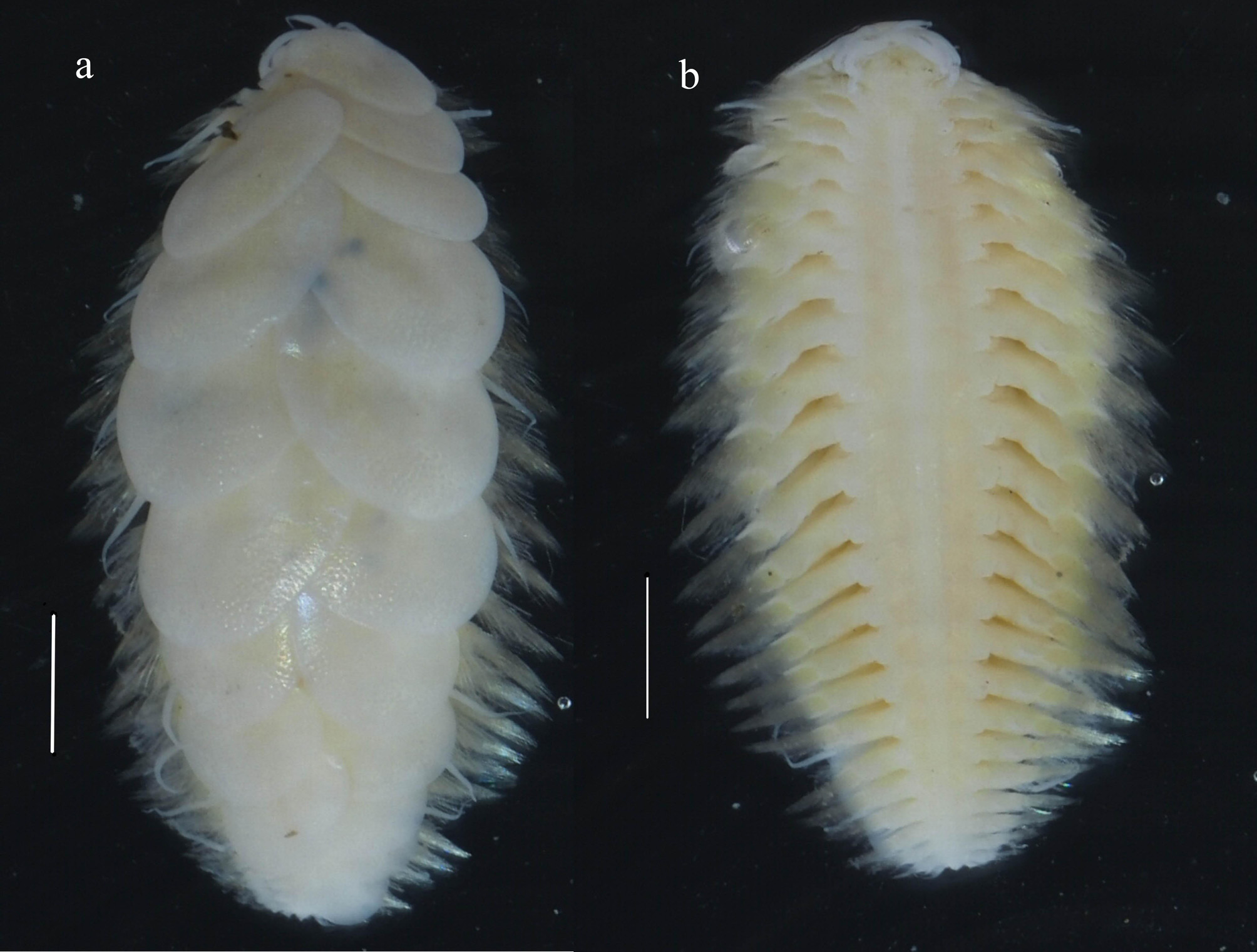
Description. Holotype: length 14 mm, width 7 mm, including chaetae. Colour blood red, jaws orange-yellow. Body short, spindle-shaped, slightly tapered anteriorly and posteriorly, flattened ventrally and strongly arched dorsally with 24 segments. Distinct segmental or nephridial papillae absent (Fig. 4 a, b). With 11 pairs of elytra, attached on segments 2, 4, 5, 7, 9, 11, 13, 15, 17, 19 and 21. Elytra opaque, oval to subreniform (Fig. 5 c, d), imbricate, covering the dorsum. Numerous scattered foveolae are located near the posterior and lateral borders of the elytra (Fig. 5 d; Fig. 6 a). There is one globular micropapilla in every foveola (Fig. 6 b). Non-elytra-bearing segments with dorsal cirri, long enough to reach the tips of neurochaetae. The dorsal tubercles on the elytrophorous segments are large and inflated. No elongate ventral papilla. Pygidium with one pair of anal cirri. The prostomium is bilobed, the anterior lobes subtriangular, each with a small frontal filament; lateral antennae are absent (Fig. 5 a, b). The median antenna is inserted in the anterior notch, having a short cylindrical ceratophore and a relatively long subulate style. The palps are subulate, smooth, with filamentous tips, more than two times the length of the prostomium. Eyes absent. The first or tentacular segment is not visible dorsally. The tentaculophores of the tentacular segment are lateral to the prostomium and lack chaetae. The styles of the dorsal tentacular cirri and the ventral ones are smooth and tapered. The mouth is enclosed in upper, lateral and posterior lips between segments 1 and 2. Pharynx with 7 pairs of unequal pear-shaped papillae, the two median papillae largest, gradually decreasing in size to the lateral. The two pairs of dorsal and ventral hooked jaws are serrated, with numerous teeth. Parapodia biramous, from segment 2 to 25, with a shorter notopodia located on the anterodorsal sides of the longer neuropodia (Fig. 5 e). The notopodium is subconical, with acicular lobe (Fig. 5 f), enclosed by a flaring bract. The neuropodium is deeply cleft on the upper and lower parts. The notochaetae are numerous, acicular, forming thick radiating bundles, protrude from the epidermis. They are stouter than neurochaetae, with blunt, straight, serrated tips (Fig. 5 e; Fig. 6 c). The neurochaetae are numerous, forming fan-shaped bundles, with one row of spines and curved tips (Fig. 6 d). Variation. Length of paratypes 8 – 9 mm, width including chaetae 4 – 5 mm, with 23 – 24 segments. The smallest paratype has 23 segments and other paratypes have 24 segments. All paratypes have no everted pharynx and elongate ventral papilla.
Sui, Jixing, Li, Xinzheng (2017): A new species and new record of deep-sea scale-worms (Polynoidae: Polychaeta) from the Okinawa Trough and the South China Sea. Zootaxa 4238 (4): 562-570, DOI: 10.11646/zootaxa.4238.4.4
Remarks. The new species resembles Lepidonotopodium williamsae Pettibone, 1984 in having very similar elytrae, foveolae and micropapillae, while Lepidonotopodium williamsae differs in numbers of segments and in having ventral elongate papillae on the neuropodia. The new species is a small (not more than 15 mm) species of Lepidonotopodium, as are most other species in the genus (L. atalantae Desbruyères & Hourdez, 2000, L. minutum Pettibone, 1989, L. jouinae Desbruyères & Hourdez, 2000 and L. riftense Pettibone, 1984). The new species resembles L. minutum Pettibone, 1989 in having no elongate ventral papilla but differs in having more segments. In L. atalantae Desbruyères & Hourdez, 2000, L. jouinae Desbruyères & Hourdez, 2000 and L. riftense Pettibone, 1984, the surface of the elytra are different from the new species. A key to all Lepidonotopodium species is provided.
Sui, Jixing, Li, Xinzheng (2017): A new species and new record of deep-sea scale-worms (Polynoidae: Polychaeta) from the Okinawa Trough and the South China Sea. Zootaxa 4238 (4): 562-570, DOI: 10.11646/zootaxa.4238.4.4
Distribution. The Okinawa Trough.
Sui, Jixing, Li, Xinzheng (2017): A new species and new record of deep-sea scale-worms (Polynoidae: Polychaeta) from the Okinawa Trough and the South China Sea. Zootaxa 4238 (4): 562-570, DOI: 10.11646/zootaxa.4238.4.4
Etymology. The species name is derived from the type locality, the Okinawa Trough.
Sui, Jixing, Li, Xinzheng (2017): A new species and new record of deep-sea scale-worms (Polynoidae: Polychaeta) from the Okinawa Trough and the South China Sea. Zootaxa 4238 (4): 562-570, DOI: 10.11646/zootaxa.4238.4.4
Material examined. Holotype. Hydrothermal vent, Okinawa Trough, MBM 304566, 27 ° 33.06928 ’ N, 126 ° 58.13082 ’ E, 1361 m, coll. Faxian ROV of R / V Kexue, 20 Mar. 2014. Paratypes. 5 specimens. MBM 304567, same location as holotype.
Sui, Jixing, Li, Xinzheng (2017): A new species and new record of deep-sea scale-worms (Polynoidae: Polychaeta) from the Okinawa Trough and the South China Sea. Zootaxa 4238 (4): 562-570, DOI: 10.11646/zootaxa.4238.4.4
Export occurrence data
Darwin Core Archive (ZIP)
CLASSIFICATION
Taxonomic Classification Tree

MULTIMEDIA
Media Files(3)
FIGURE 4. Lepidonotopodium okinawae sp. nov. a. Dorsal view. b. Same, ventral view. Scale bars = 3 mm.
Imageimage/png© Sui, Jixing;Li, XinzhengSui, Jixing;Li, Xinzheng
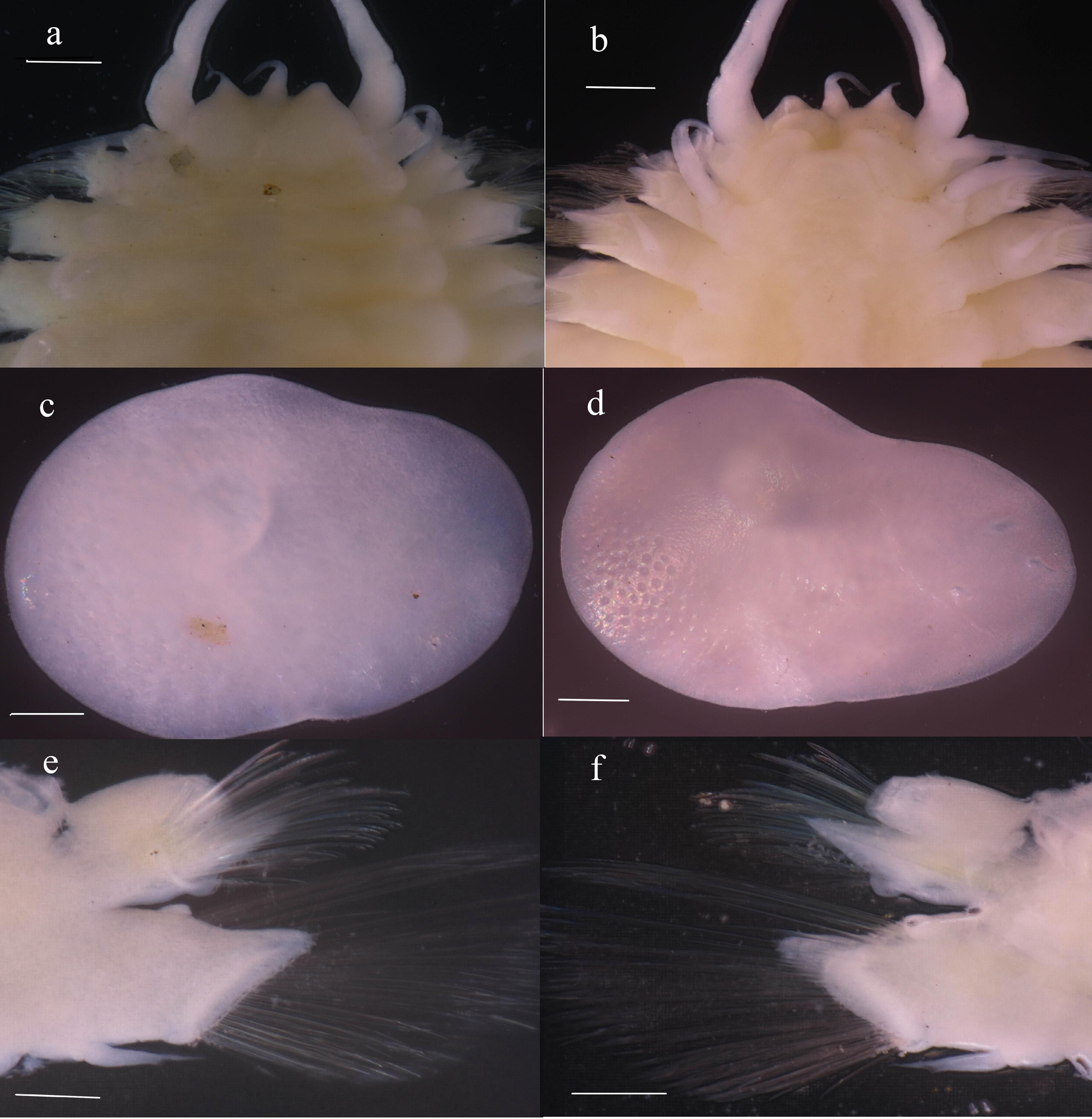
FIGURE 5. Lepidonotopodium okinawae sp. nov. a. Anterior end, dorsal view; b. Same, ventral view; c. Second elytra; d. Sixth elytra; e. Anterior view of parapodium (segment 8); f. Posterior view of parapodium (segment 8). Scale bars: a, b = 1 mm; c = 200 µm; d = 300 µm; e, f = 150 µm.
Imageimage/png© Sui, Jixing;Li, XinzhengSui, Jixing;Li, Xinzheng

FIGURE 6. Lepidonotopodium okinawae sp. nov. a. View of the elytral surface showing numerousfoveolae; b. Micropapilla in the foveola. c. Notochaetae (segment 8); d. Neurochaetae (segment 8). Scale bars: a = 150 µm; b = 15 µm; c = 25 µm; d = 50 µm.
Imageimage/png© Sui, Jixing;Li, XinzhengSui, Jixing;Li, Xinzheng
IMAGES