
AnimaliaNot EvaluatedacceptedspeciesAccepted
Alopoglossus angulatus
(Linnaeus, 1758) Linnaeus, 1758
GBIF:130810528
0year
ABOUT
Descriptions(2)
Pertinent taxonomic references. Linnaeus (1758), Cope (1876), Boulenger (1885), Ruthven (1924), Amaral (1937), Brongersma (1946 a), Ruibal (1952), Cunha (1961), Hoogmoed (1973), Ávila-Pires (1995), Pellegrino et al. (2001), Castoe et al. (2004), K ӧhler et al. (2012), Lobos (2013), Torres-Carvajal & Lobos (2014), Goicoechea et al. (2016). Taxonomic remarks. Despite some recent studies (e. g., Ávila-Pires 1995; Köhler et al. 2012; Lobos 2013; Torres-Carvajal & Lobos 2014), an understanding of the taxonomy of Alopoglossus angulatus needs further resolution. Analysis of 334 specimens of Alopoglossus angulatus by MAR-J revealed a complex of at least seven cryptic species. Lobos (2013), in his comprehensive study of the Alopoglossus species from Ecuador, identified 17 genetic candidate species for that country. Alopoglossus angulatus was presented by the author as a complex of five divergent evolutionary lineages. Torres-Carvajal & Lobos (2014) analyzed the phylogenetic relationships among species of Alopoglossus, and based on two samples of A. angulatus the authors recovered the existence of two different lineages in Ecuador. Currently, taxonomy of Alopoglossus angulatus is under study and the new species are being described by MAR-J.
Ribeiro-Júnior, Marco A., Amaral, Silvana (2017): Catalogue of distribution of lizards (Reptilia: Squamata) from the Brazilian Amazonia. IV. Alopoglossidae, Gymnophthalmidae. Zootaxa 4269 (2): 151-196, DOI: 10.11646/zootaxa.4269.2.1
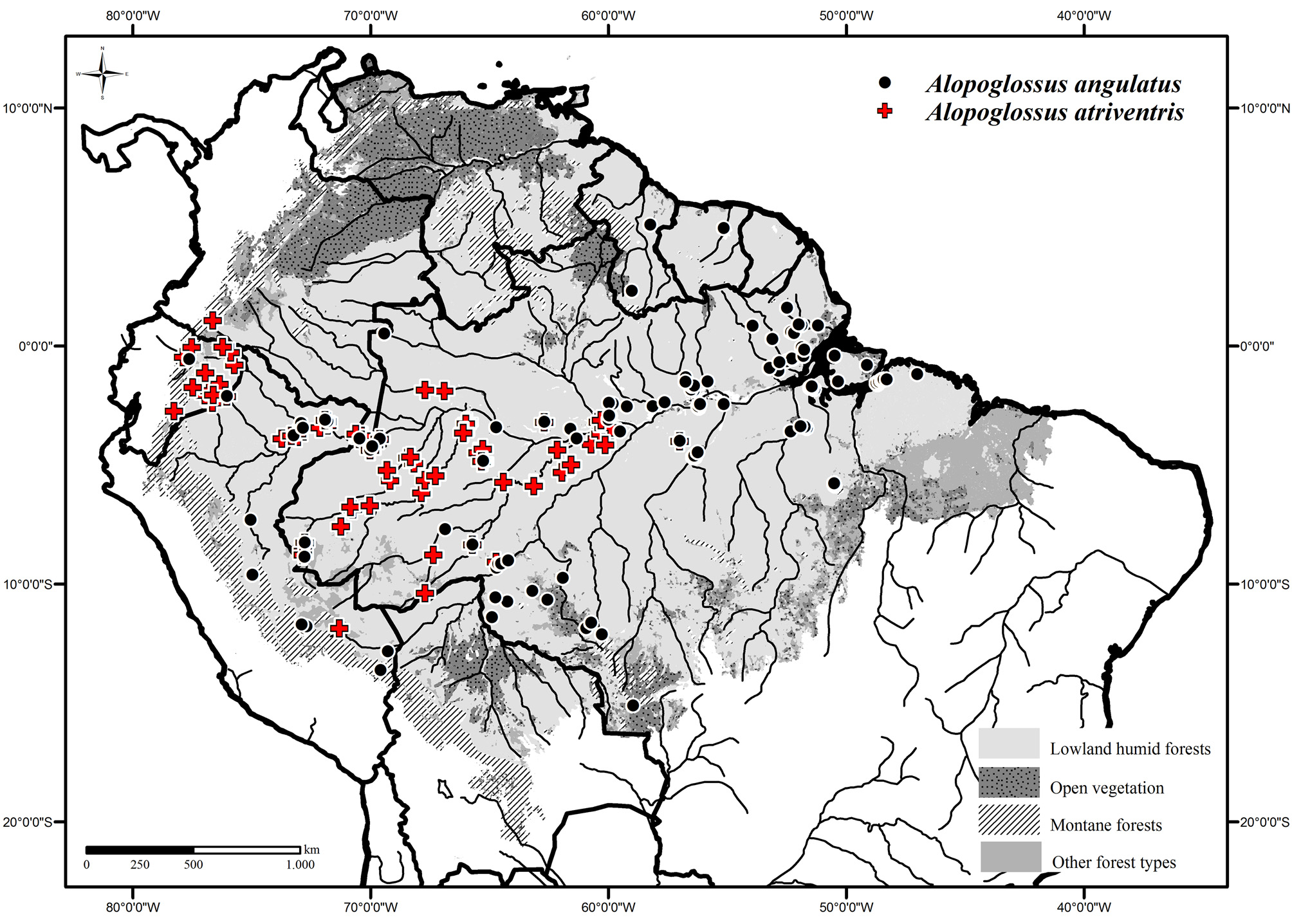
Distribution and habitat. Alopoglossus angulatus is endemic to, and widespread in, Amazonia, occurring in Brazil, Suriname, Guyana, Colombia, Ecuador, and Peru (Fig. 1). Hoogmoed (1973) also reported it from French Guiana, and Langstroth (2005) from Bolivia. In Brazil, it is known from the states of Amapá, Pará, Amazonas, Acre, Rondônia, and Mato Grosso. Alopoglossus angulatus is terrestrial and diurnal, inhabits primary terra firme and flooded (varzea) forest, as well as disturbed forest (Martins 1991 b; Ribeiro-Júnior et al. 2008; Vitt et al. 2008; Pantoja & Fraga 2012), where it is mainly found in shaded spots among leaf litter near water, and occasionally on open ground or in water (Martins 1991 b; Vitt et al. 2007, 2008). MAR-J collected two individuals on logs floating in the water (Afuá, Rio Preto, northwestern Marajó Island, Brazil) and one in an Eucalyptus plantation (Almeirim, northern state of Pará, Brazil).
Ribeiro-Júnior, Marco A., Amaral, Silvana (2017): Catalogue of distribution of lizards (Reptilia: Squamata) from the Brazilian Amazonia. IV. Alopoglossidae, Gymnophthalmidae. Zootaxa 4269 (2): 151-196, DOI: 10.11646/zootaxa.4269.2.1
Export occurrence data
Darwin Core Archive (ZIP)
CLASSIFICATION
Taxonomic Classification Tree

IMAGES