AnimaliaNot EvaluatedacceptedspeciesAccepted
Calyptotheca alexandriensis

Calyptotheca alexandriensis

Abdelsalam, Taylor & Dorgham, 2017

GBIF:131878179

0year

ABOUT

Descriptions(5)

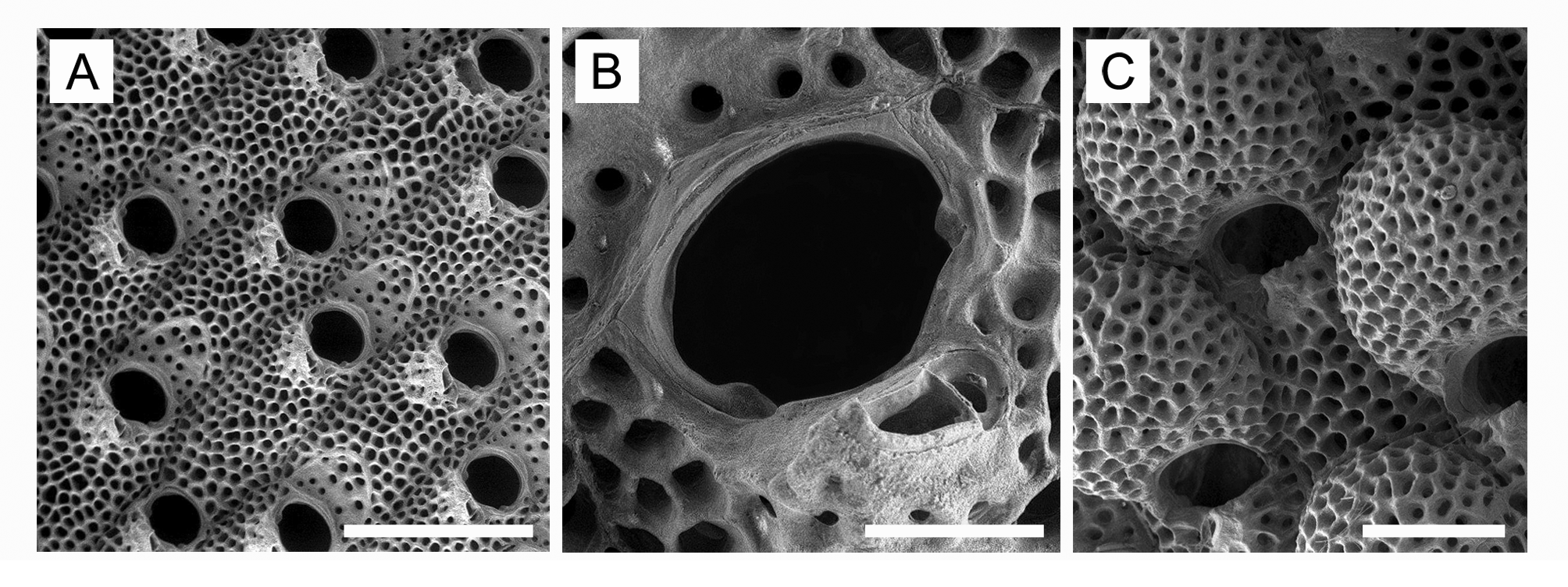
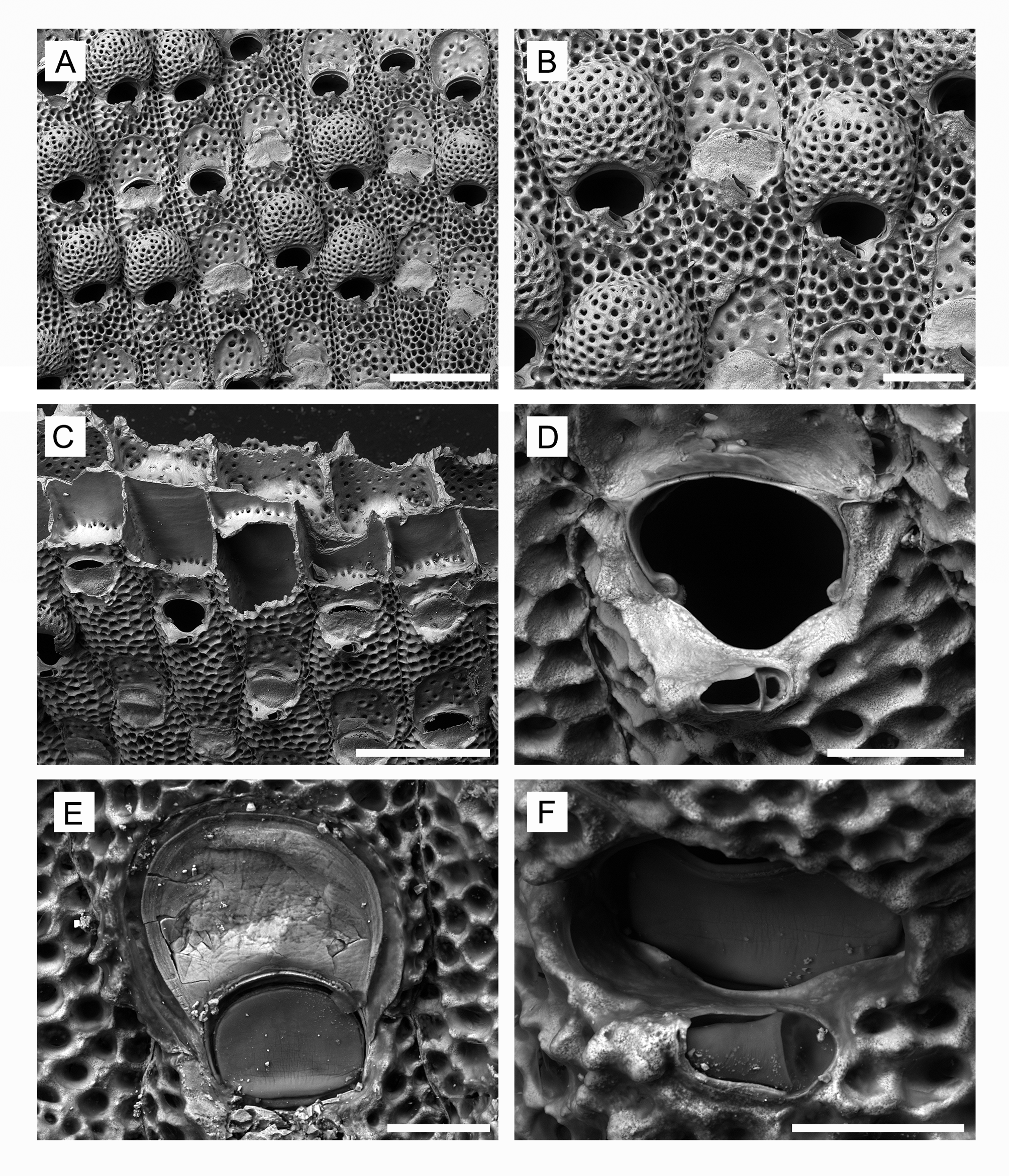
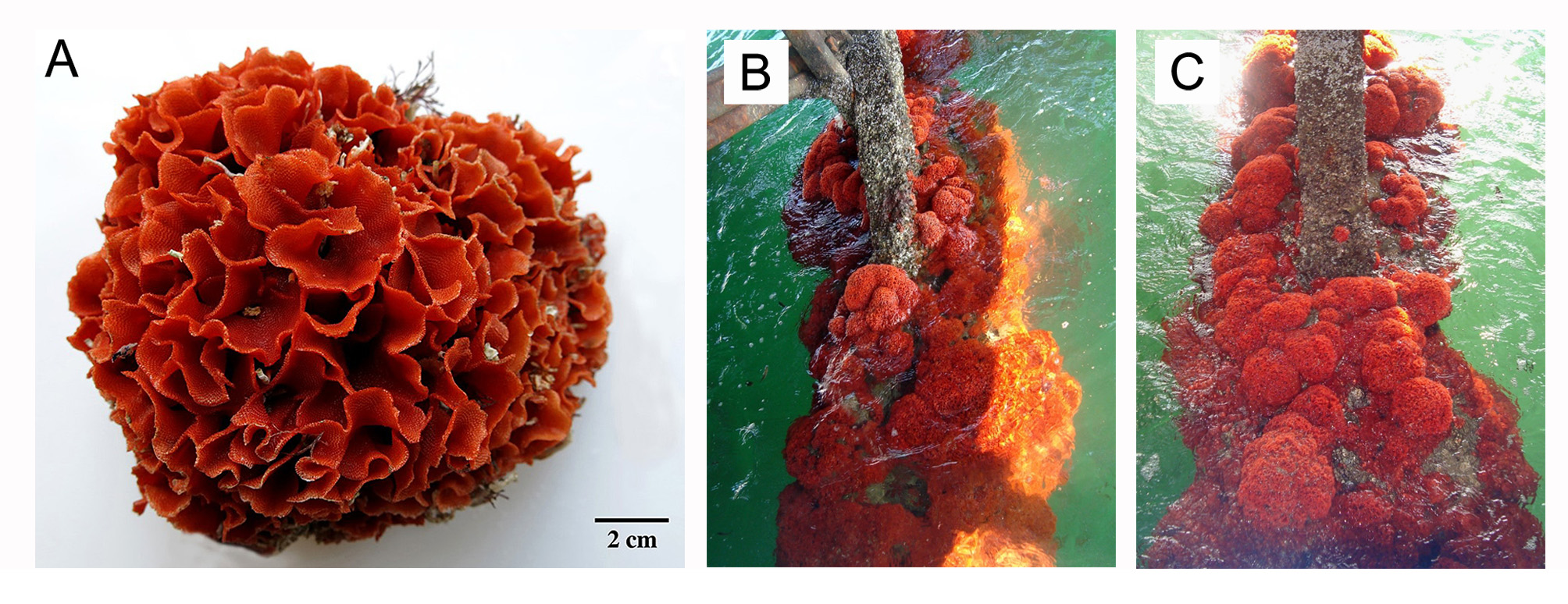
Description. Colony erect, foliaceous, comprising an open honeycomb of anastomosing bifoliate fronds forming a spheroidal mass (Fig. 2 A). Intracolonial overgrowths occasionally developed. Uniporous septulae present in lateral and transverse vertical walls, situated close to the basal wall (Fig. 4 C). Colour vivid deep orange to red when alive (Fig. 2 A – C), fading to pale brown in spirit or dry. Ancestrula and early astogeny unknown. Autozooids subrectangular, about 1.75 x longer than wide (Figs 3 A, 4 A). Frontal shield moderately convex, densely pseudoporous, pseudopores subcircular, about 10 – 35 µm in diameter, decreasing in size from the centre to the edge of the frontal shield, sunken, calcification around the pseudopores in the form of a polygonal network with low pustules often present at the corners; marginal areolar pores not clearly distinct from pseudopores; zooidal boundaries well defined, marked by thin but well-defined salient walls. Primary orifice broader than long (Figs 3 B, 4 D), inclined to face distofrontally, with a broad, U-shaped sinus divided from the semielliptical poster by a pair of rounded, non-serrated condyles. Closure plates cover some orifices, imperforate and with an irregularly granular surface (Fig. 4 B). Ovicells present in a high proportion of zooids (Figs 3 C, 4 A, B), hyperstomial, bulbous, wider than long, ectooecium uncalcified, endooecial calcification resembling frontal shield but with smaller, more closely spaced pseudopores; floor of incompletely developed ovicells with a scattering of 10 – 20 irregularly arranged pores of variable size (Figs 3 A, 4 A, B). Ovicellate zooids without apparent orificial dimorphism. Avicularia suboral (Figs 3 B, 4 D, F), present in the majority of, possibly all, zooids, oriented predominantly laterally but slightly distally, all avicularia on the same side of a frond apparently oriented in the same direction, either facing left or right; plane of avicularium inclined at a steep angle to the frontal surface of the colony; small in size, about 0.08 – 0.09 mm long; opesia semicircular; pivotal bar complete, more or less straight, longer than opesia; rostrum arch-shaped, with a hook-like distal end. Vicarious avicularia not observed. Measurements. See Table 1.
Abdelsalam, Khaled M., Taylor, Paul D., Dorgham, Mohamed M. (2017): A new species of Calyptotheca (Bryozoa: Cheilostomata) from Alexandria, Egypt, southeastern Mediterranean. Zootaxa 4276 (4): 582-590, DOI: 10.11646/zootaxa.4276.4.9

Remarks. The shape of the primary orifice, with a broad sinus and condyles, evenly pseudoporous frontal shield, presence of adventitious avicularia and ovicell morphology permit this bryozoan to be assigned to Calyptotheca. As noted above, Calyptotheca is a speciose genus (Bock et al. 2017). There is considerable variability in the shape, disposition and orientation of the adventitious avicularia. Cumming & Tilbrook (2014) identified a subgroup of species having suboral avicularia, like that seen in the new species from Egypt. However, in most of these species the avicularium is oriented parallel to the length of the autozooid, whereas in C. alexandriensis n. sp. it is oriented transversely. Only two species of Calyptotheca have been recorded previously from the Mediterranean Sea according to a recent review of bryozoans from the Mediterranean Sea (Rosso & Di Martino 2016). Hayward (1974) originally described Calyptotheca rugosa from Chios in Greece. This species is encrusting, unlike C. alexandriensis n. sp., and also differs from C. alexandriensis n. sp. in having rare, rounded suboral avicularia and partially immersed ovicells. A second species of Calyptotheca, found in the Strait of Gibraltar as well as the Atlantic (Azores), was described as Calyptotheca obscura (Osburn, 1952) by Harmelin et al. (1989). This species has transversely oriented adventitious avicularia of similar morphology to those of C. alexandriensis n. sp. but, unlike C. alexandriensis n. sp., the avicularia are positioned around the edges of the autozooids rather than suborally. The colour of C. obscura is dark red whereas that of C. alexandriensis n. sp. is very dark orange, and C. obscura has encrusting colonies and denticulate condyles contrasting with the erect colonies and smooth condyles of C. alexandriensis n. sp. Dumont (1981) recorded five species of Calyptotheca from the Red Sea: Calyptotheca acutirostris (Canu & Bassler, 1929), Calyptotheca heteroavicularia Dumont, 1981, Calyptotheca nigra Dumont, 1981, Calyptotheca sudanensis Dumont, 1981, and Calyptotheca wasinensis (Waters, 1909). All of the species from the Red Sea have encrusting colonies in contrast to the erect colonies of C. alexandriensis n. sp.. Adventitious avicularia in C. acutirostris are located proximolaterally of the orifice and directed distally, those of C. heteroavicularia are suboral and directed proximally, C. nigra lacks adventitious avicularia, and in C. wasinensis the adventitious avicularia are scattered around the edges of the autozooids. Only those of C. sudanensis are suboral and directed laterally, as in C. alexandriensis n. sp., but this reef-associate has small, brown- or green-coloured colonies quite unlike the large deep orange colonies of C. alexandriensis n. sp.. A website devoted to the bryozoans of the Northern Bay of Safaga in the Red Sea contains SEM images of six species of Calyptotheca: C. wasiensis, C. nigra, C. sudanensis, C. cf. wasiensis, Calyptotheca sp. 1, and Calyptotheca sp. 2 (Ostrovsky et al., accessed 20 March 2017). Images of the four specimens identified as C. sudanensis show the closest resemblance to C. alexandriensis n. sp., particularly with respect to the transverse suboral avicularium, although this appears to be smaller and restricted to one side of the sinus in the Safaga material. In addition, the floor of the ovicells appears to lack the large pores seen in C. alexandriensis n. sp. The lack of descriptive text means that colony-form and colour cannot be compared between the material from Safaga and Alexandria. In possessing a transversely oriented suboral avicularium, C. alexandriensis n. sp. resembles the species Calyptotheca subimmersa (MacGillivray, 1879) from Australia. However, the avicularium of C. subimmersa is smaller than that of C. alexandriensis n. sp., rounded rather than arch-shaped, and opens in the plane of the frontal surface of the zooid instead of being steeply inclined.
Abdelsalam, Khaled M., Taylor, Paul D., Dorgham, Mohamed M. (2017): A new species of Calyptotheca (Bryozoa: Cheilostomata) from Alexandria, Egypt, southeastern Mediterranean. Zootaxa 4276 (4): 582-590, DOI: 10.11646/zootaxa.4276.4.9
Distribution. Eastern Harbour, Alexandria, Egypt.
Abdelsalam, Khaled M., Taylor, Paul D., Dorgham, Mohamed M. (2017): A new species of Calyptotheca (Bryozoa: Cheilostomata) from Alexandria, Egypt, southeastern Mediterranean. Zootaxa 4276 (4): 582-590, DOI: 10.11646/zootaxa.4276.4.9
Etymology. Named for Alexandria, the type locality.
Abdelsalam, Khaled M., Taylor, Paul D., Dorgham, Mohamed M. (2017): A new species of Calyptotheca (Bryozoa: Cheilostomata) from Alexandria, Egypt, southeastern Mediterranean. Zootaxa 4276 (4): 582-590, DOI: 10.11646/zootaxa.4276.4.9
Material examined. Holotype: TBAB BR- 2015 - 2 - 10 (Fig. 3), Mediterranean, Alexandria, Eastern Harbour, 0 – 1 metre depth on metallic marina supports, collected by Mohamed M. Dorgham and Khaled M. Abdelsalam, December 2015. Paratypes: TBAB BR- 2016 - 2 - 11 (Fig. 2 A), NHMUK 2016.12. 22.1 (Fig. 4), details as for holotype.
Abdelsalam, Khaled M., Taylor, Paul D., Dorgham, Mohamed M. (2017): A new species of Calyptotheca (Bryozoa: Cheilostomata) from Alexandria, Egypt, southeastern Mediterranean. Zootaxa 4276 (4): 582-590, DOI: 10.11646/zootaxa.4276.4.9

Export occurrence data

Darwin Core Archive (ZIP)

CLASSIFICATION

Taxonomic Classification Tree

MULTIMEDIA

Media Files(3)

FIGURE 2. Calyptotheca alexandriensis n. sp. A, fresh specimen showing the foliaceous colony-form and deep orange colour; paratype, TBAB BR- 2016 - 2 - 11. B, C, luxuriant growth of colonies on pilings in the Eastern Harbour, Alexandria.

Imageimage/png© Abdelsalam, Khaled M.;Taylor, Paul D.;Dorgham, Mohamed M.Abdelsalam, Khaled M.;Taylor, Paul D.;Dorgham, Mohamed M.

FIGURE 3. Calyptotheca alexandriensis n. sp., scanning electron micrographs of the holotype, TBAB BR- 2015 - 2 - 10. A, group of zooids with locations of undeveloped ovicells marked by areas of fewer pseudopores on the frontal shields of the distal zooids. B, primary orifice and suboral avicularium. C, ovicells. Scale bars: A = 500 µm; B = 100 µm; C = 200 µm.

Imageimage/png© Abdelsalam, Khaled M.;Taylor, Paul D.;Dorgham, Mohamed M.Abdelsalam, Khaled M.;Taylor, Paul D.;Dorgham, Mohamed M.

FIGURE 4. Calyptotheca alexandriensis n. sp., scanning electron micrographs of the paratype, NHMUK 2016.12.22.1; A – D are of a bleached fragment, E and F of an unbleached fragment. A, group of zooids, some with complete ovicells, others with undeveloped ovicells, and some with orifices covered by closure plates. B, zooid with an undeveloped ovicell and a closure plate between two zooids with complete ovicells. C, oblique view of growing edge showing septulae in transverse vertical walls. D, primary orifice, condyles and suboral avicularium in a zooid viewed obliquely. E, zooid with in-situ operculum and a partly formed ovicell showing the floor of the entooecium. F, oblique view to show the in-situ mandible of a suboral avicularium. Scale bars: A, C = 500 µm; B = 200 µm; D – F = 100 µm.

Imageimage/png© Abdelsalam, Khaled M.;Taylor, Paul D.;Dorgham, Mohamed M.Abdelsalam, Khaled M.;Taylor, Paul D.;Dorgham, Mohamed M.

IMAGES

Gallery(3)

See Gallery

Occurrences with images

Source Information

A new species of Calyptotheca (Bryozoa: Cheilostomata) from Alexandria, Egypt, southeastern Mediterranean

checklist

This dataset contains the digitized treatments in Plazi based on the original journal article Abdelsalam, Khaled M., Taylor, Paul D., Dorgham, Mohamed M. (2017): A new species of Calyptotheca (Bryozoa: Cheilostomata) from Alexandria, Egypt, southeastern Mediterranean. Zootaxa 4276 (4): 582-590, DOI: 10.11646/zootaxa.4276.4.9

Abstract

Beginning in December 2015, an unknown bryozoan with large, deep-orange colonies began to appear in the Eastern Harbour of Alexandria, Egypt. Here we identify the species as belonging to the predominantly Indo-Pacific cheilostome genus Calyptotheca Harmer, 1957 and describe it as a new species, Calyptotheca alexandriensis n. sp. The new species exhibits intensive growth sporadically on different hard substrata, including rocks, submerged concrete walls, ropes, ships’ hulls, and metal pipes supporting marina piers. It is restricted to the Eastern Harbour, particularly in shallow parts, with the densest aggregations on the metal pier supports. The source of this bryozoan is enigmatic but most likely involved introduction by shipping.

Key words: non-indigenous species, fouling, new species, Lanceoporidae

Abdelsalam K M, Taylor P D, Dorgham M M, plazi (2017). A new species of Calyptotheca (Bryozoa: Cheilostomata) from Alexandria, Egypt, southeastern Mediterranean. Plazi.org taxonomic treatments database. Checklist dataset https://doi.org/10.11646/zootaxa.4276.4.9 accessed via GBIF.org on 2026-06-19.

CC0Published 12/31/2017View dataset
GBIF Usage Key
131878179
Dataset Key
0081d7e4-e694-400c-8683-132166e3e038
Origin
source
Backbone Key
9281072
Taxon ID
03E89C04A020000542F2D2CEE5393A39.taxon
Last Crawled
6/11/2026
Last Interpreted
6/11/2026