AnimaliaNot EvaluatedacceptedspeciesAccepted
Victorgorgia josephinae

Victorgorgia josephinae

Lopez Gonzalez & Briand, 2002

GBIF:132631034

0year

ABOUT

Descriptions(4)

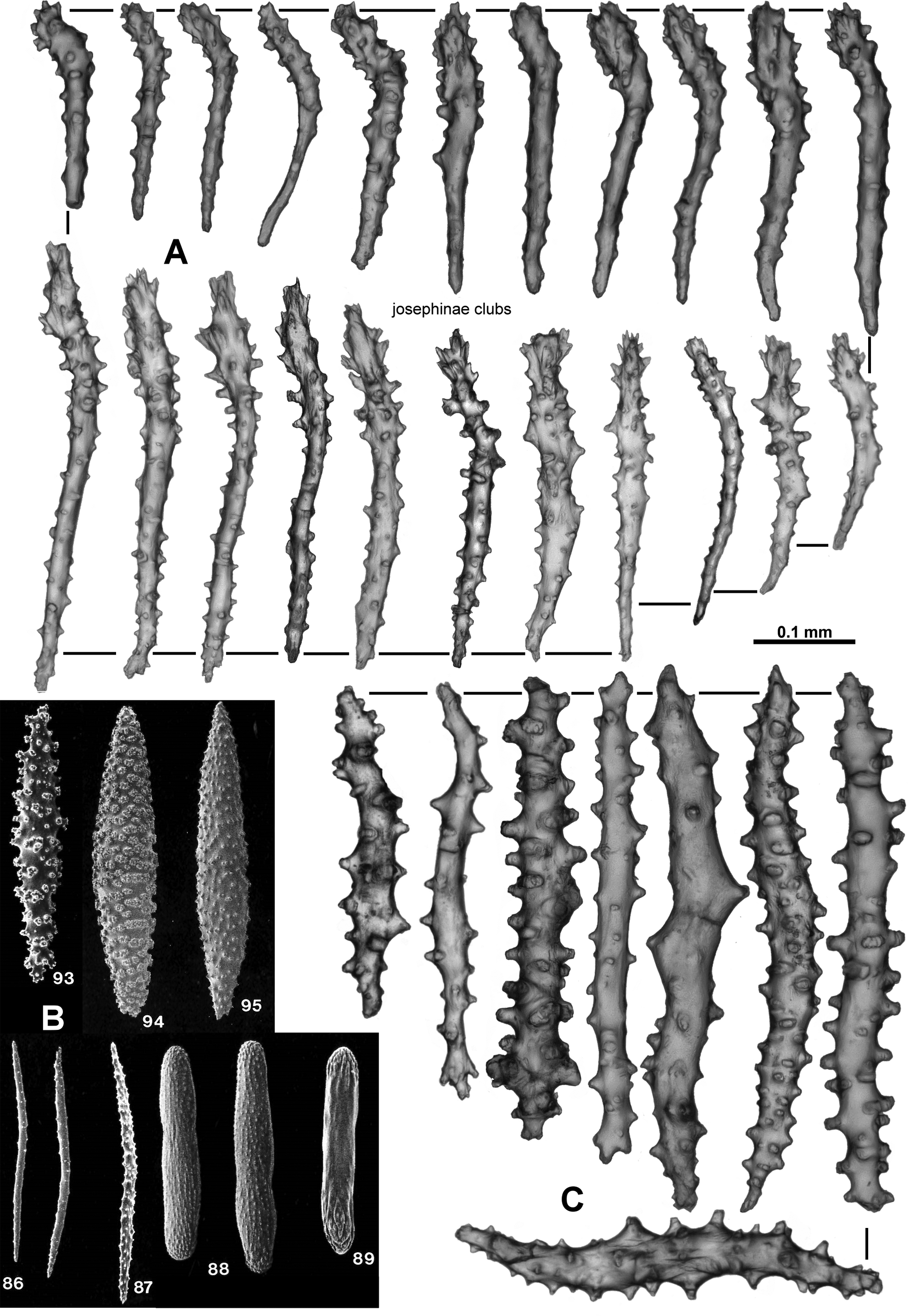
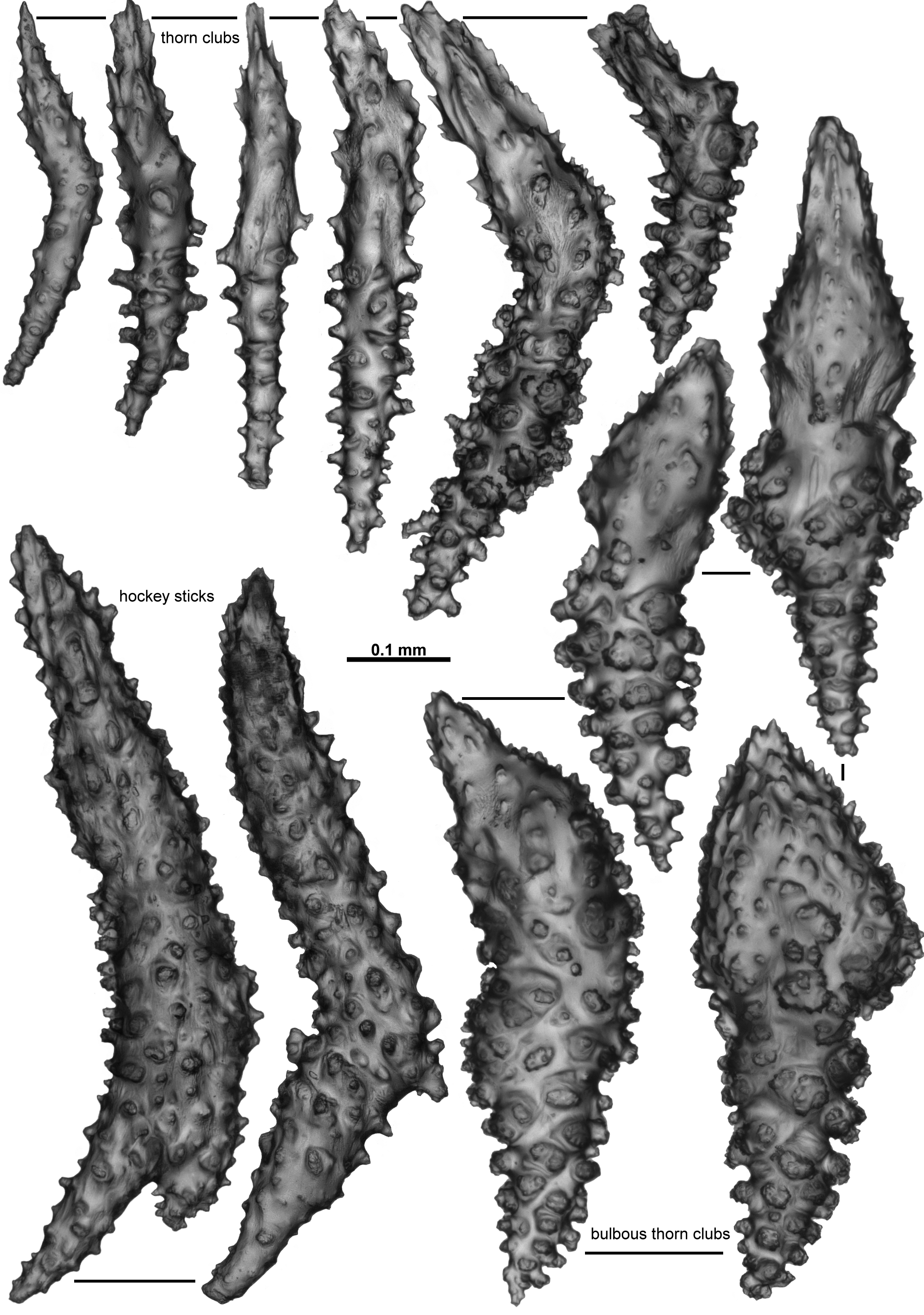
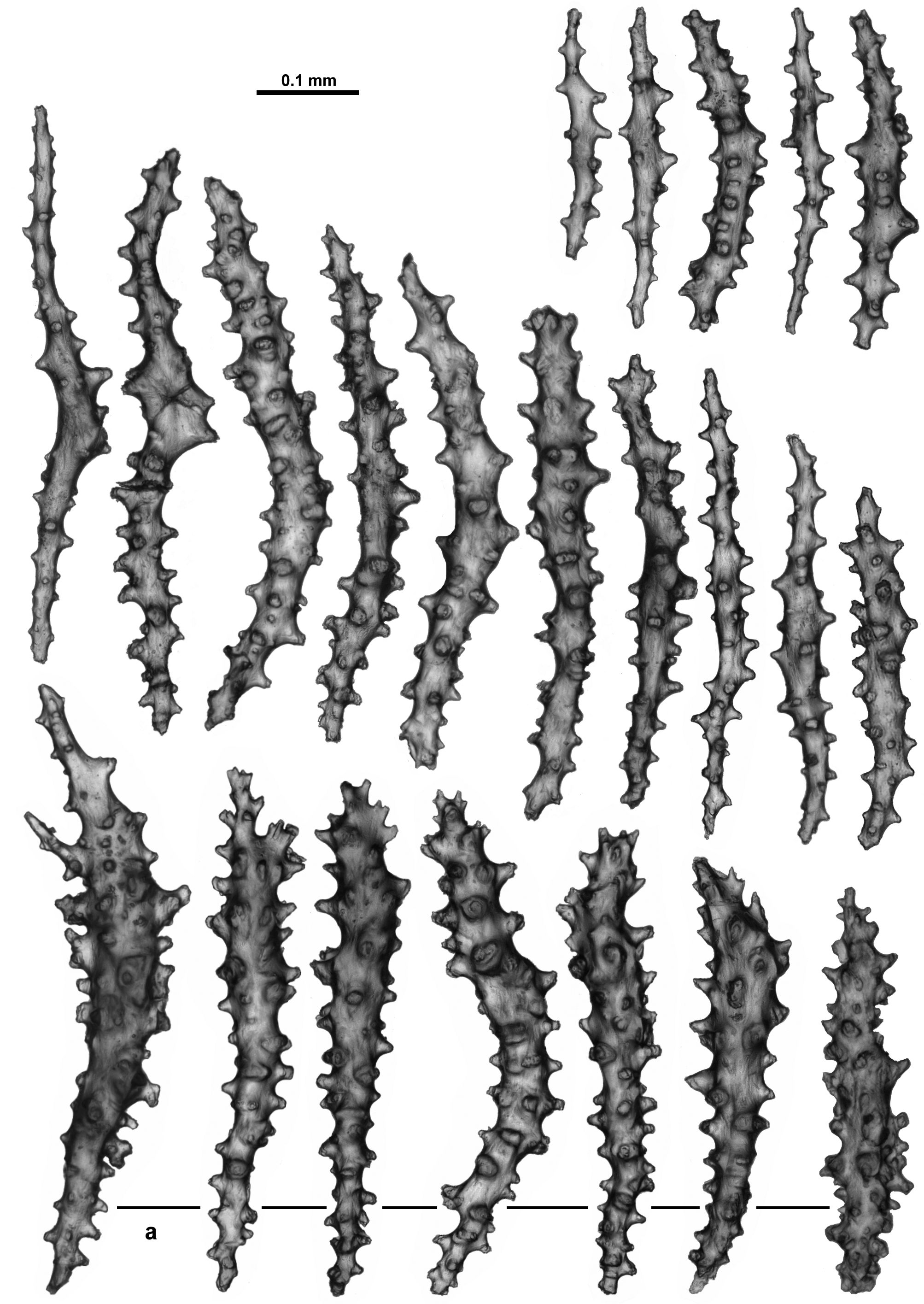
Description: The holotype is in good condition and the characteristics of the colony, calyces, polyps and sclerites are as described by Lόpez-González & Briand. The sclerites from the tentacle rachis are almost exclusively josephinae clubs (Fig. 98 A). They are arranged with the clubbed tip distad and projecting out from the tentacle, as pictured in Fig. 2 D – F of Lόpez-González & Briand’s description. The pinnules are crowded with longitudinally positioned, straight, narrow, sparsely tuberculate sticks and spindles and clubs along with smaller josephinae clubs that are less-developed than those in the tentacle rachis (Fig. 98 B). According to Lόpez-González & Briand, the sclerites from the tentacles range from 0.19 – 0.48 mm long which generally concurs with measurements taken here (0.16 – 0.43 mm long). The authors did not distinguish between sclerites from the tentacle rachis and those from the pinnules. All other sclerites in the holotype are well-represented in the figures of Lόpez-González & Briand’s description excepting those from the calyx. The latter do not significantly differ from those found in the points and collaret and in the cortex (Lόpez-González & Briand (2002) Figs. 6 A; 5 B respectively), consisting of straight, tuberculate sticks and spindles without clavate or modified tips (Fig. 99). The size range is 0.35 – 0.57 mm long.
Moore, Kirrily M., Alderslade, Philip, Miller, Karen J. (2017): A taxonomic revision of Anthothela (Octocorallia: Scleraxonia: Anthothelidae) and related genera, with the addition of new taxa, using morphological and molecular data. Zootaxa 4304 (1): 1-212, DOI: 10.11646/zootaxa.4304.1.1
Ƒictorgorgia josephinae Lόpez-González & Briand, 2002: 97 – 105, Figs. 1 – 6.
Moore, Kirrily M., Alderslade, Philip, Miller, Karen J. (2017): A taxonomic revision of Anthothela (Octocorallia: Scleraxonia: Anthothelidae) and related genera, with the addition of new taxa, using morphological and molecular data. Zootaxa 4304 (1): 1-212, DOI: 10.11646/zootaxa.4304.1.1
Remarks: The description and figures in the original form a functional portrayal of Victorgorgia josephinae and do not need significant revision. However, a more extensive figure of pinnule and tentacle sclerites from the holotype is necessary to assist in the delineation of V. josephinae from the newly added species. The so called “ hockey-stick ” sclerites in the tentacles (Fig. 6 B of Lόpez-González & Briand and Fig. 98 A here) are common in the genus and an important part of the delimiting features of this species. However, these sclerites do not match those pictured as “ hockeystick spindles ” in Bayer et al. (1983) so herein they have been named josephinae clubs. Other species in this genus are distinguished from V. josephinae mainly by sclerite differences. The three species transferred to Victorgorgia have only fragmented holotypes, thus a direct comparison of colony form is not possible. V. alba n. comb. (= A. nuttingi) and V. macrocalyx n. comb. have squat rods on the tentacle rachis and very few josephinae clubs, while V. argentea n. comb. has large, straight, dense clubs in the top of the points and along the tentacle rachis. Of the other species added to the genus herein, V. eminens n. sp. is magenta to deep purple (while V. josephinae is cream with purple polyps) and has simple, tuberculate sticks and spindles on the tentacle rachis mixed with only a few josephinae clubs, and V. nyahae n. sp. has highly modified, robust and thorny josephinae clubs and spiky thorn clubs in the pinnules, tentacle rachis and in the calyx.
Moore, Kirrily M., Alderslade, Philip, Miller, Karen J. (2017): A taxonomic revision of Anthothela (Octocorallia: Scleraxonia: Anthothelidae) and related genera, with the addition of new taxa, using morphological and molecular data. Zootaxa 4304 (1): 1-212, DOI: 10.11646/zootaxa.4304.1.1
Material examined. Holotype: MNHN OCT. 2008 - 0004, Josephine Bank, SW of Portugal, Victor cruise, PL 28 / 0 5, 37.8 ° N, 14.017 ° W, depth 1500 m, 14 th August 1998.
Moore, Kirrily M., Alderslade, Philip, Miller, Karen J. (2017): A taxonomic revision of Anthothela (Octocorallia: Scleraxonia: Anthothelidae) and related genera, with the addition of new taxa, using morphological and molecular data. Zootaxa 4304 (1): 1-212, DOI: 10.11646/zootaxa.4304.1.1

Export occurrence data

Darwin Core Archive (ZIP)

CLASSIFICATION

Taxonomic Classification Tree

MULTIMEDIA

Media Files(8)

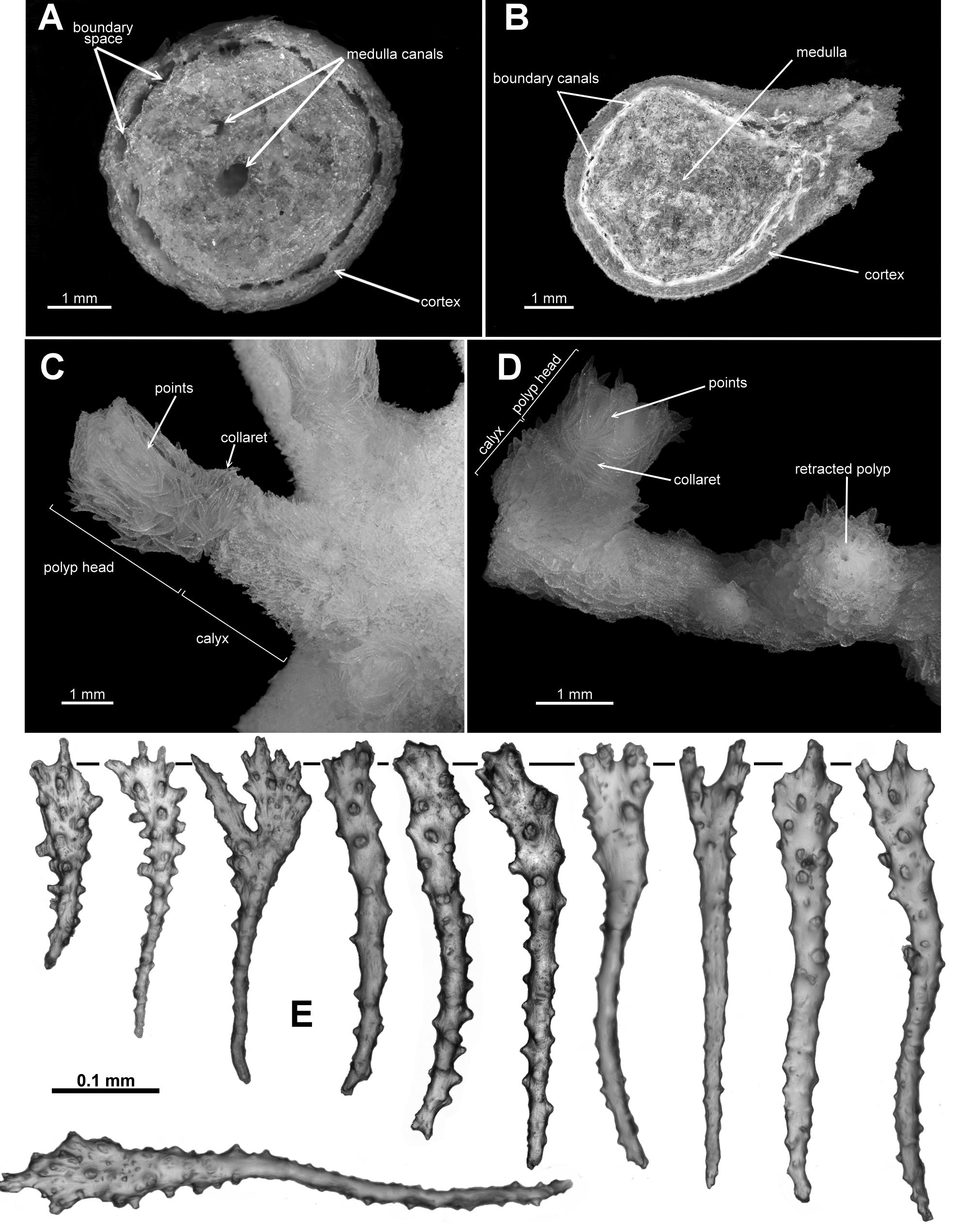
FIGURE 1. A. Cross-section of the holotype of Ƒictorgorgia eminens n. sp. showing extensive boundary canals which frequently anastomose and distinct central canals in the medulla; B. Cross-section of the holotype of Anthothela grandiflora showing boundary canals, adjacent but separate, and a medulla lacking any obvious central canals; C. Extended polyp of the holotype of A. aldersladei n. sp. showing polyp, calyx, points and collaret; D. Partly extended polyp of A. quattriniae n. sp. showing polyp head, calyx, points and collaret and, on right, a fully retracted polyp; E. Spatulate clubs found in Anthothela.

Imageimage/png© Moore, Kirrily M.;Alderslade, Philip;Miller, Karen J.Moore, Kirrily M.;Alderslade, Philip;Miller, Karen J.

FIGURE 2. A. Josephinae clubs found in the pinnules and tentacle rachis of Ƒictorgorgia and Lateothela n. gen.; B. Spindles (93 – 95), needles (86 – 87) and bars (88 – 89) from Bayer et al. 1983, Plate 16; C. Sticks.

Imageimage/png© Moore, Kirrily M.;Alderslade, Philip;Miller, Karen J.Moore, Kirrily M.;Alderslade, Philip;Miller, Karen J.

FIGURE 3. Sclerite forms found in the points, calyx and cortex of Anthothela and Ƒictorgorgia species.

Imageimage/png© Moore, Kirrily M.;Alderslade, Philip;Miller, Karen J.Moore, Kirrily M.;Alderslade, Philip;Miller, Karen J.

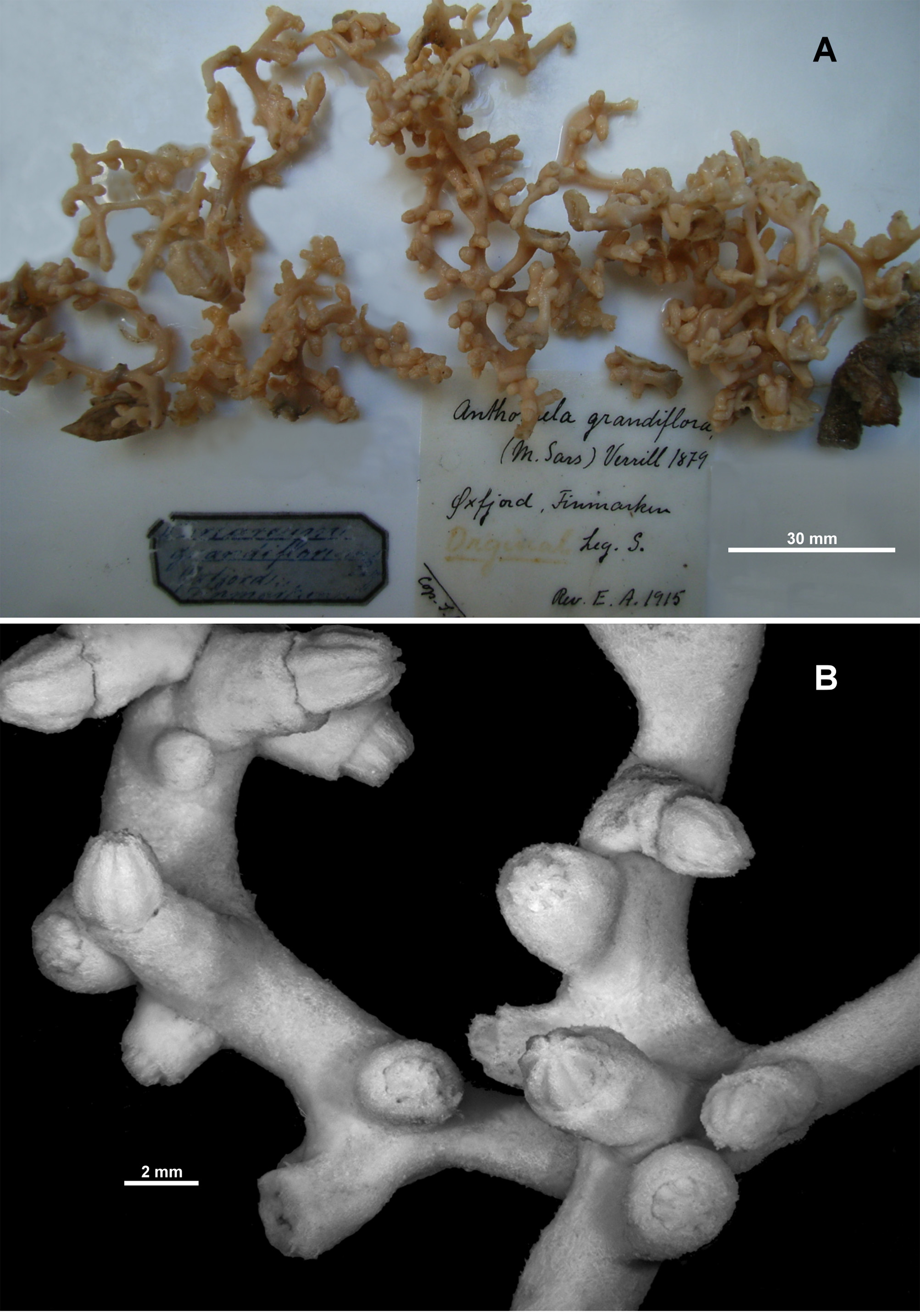
FIGURE 4. Anthothela grandiflora (Sars, 1856), holotype: A. Holotype fragments; B. Polyps and branches.

Imageimage/png© Moore, Kirrily M.;Alderslade, Philip;Miller, Karen J.Moore, Kirrily M.;Alderslade, Philip;Miller, Karen J.

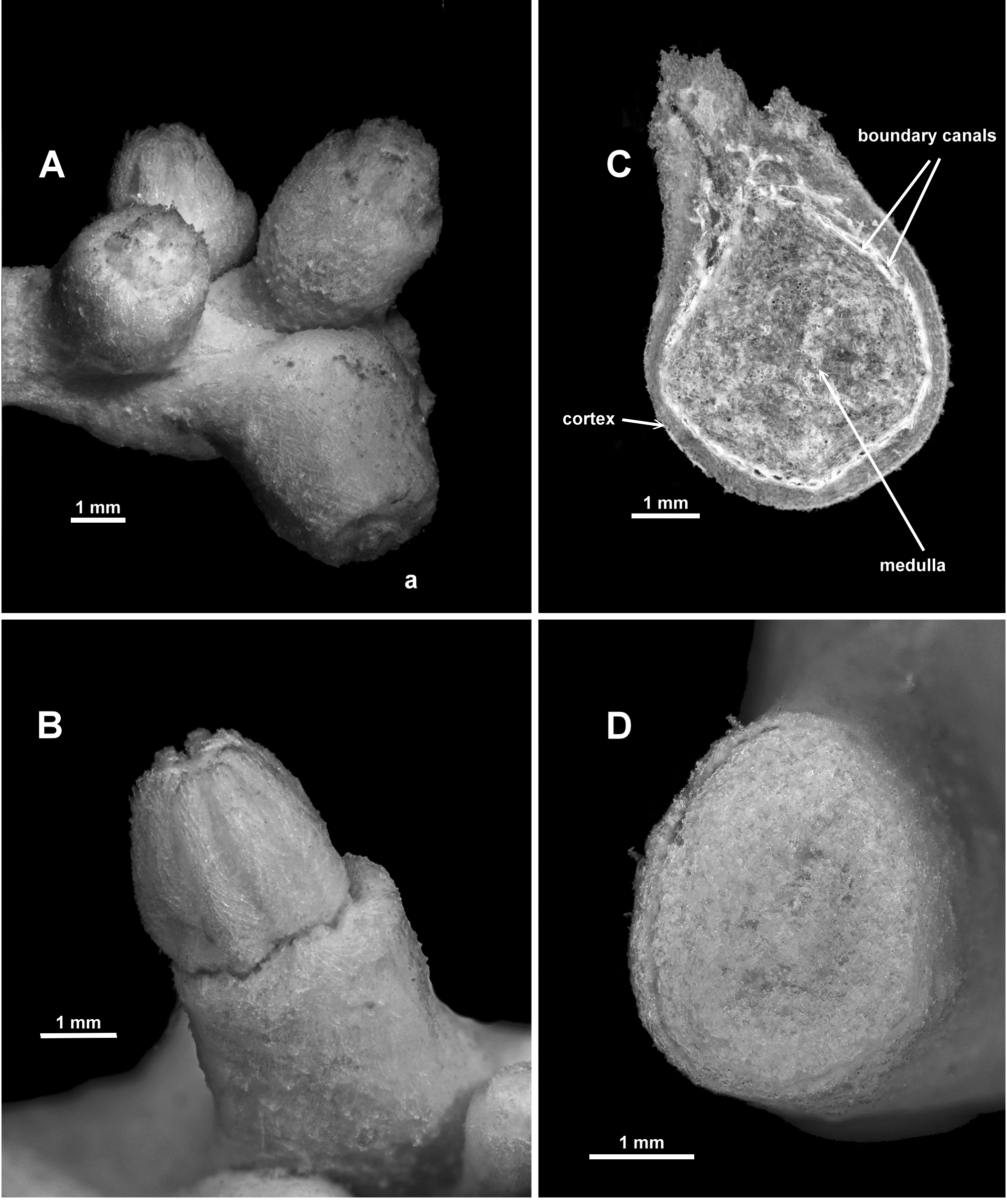
FIGURE 5. Anthothela grandiflora (Sars, 1856), holotype: A. Terminal polyp bunch (a. fully retracted polyp); B. Partly retracted polyp; C. Cross-section of decalcified medulla; D. Cross-section of medulla.

Imageimage/png© Moore, Kirrily M.;Alderslade, Philip;Miller, Karen J.Moore, Kirrily M.;Alderslade, Philip;Miller, Karen J.

FIGURE 6. Anthothela grandiflora (Sars, 1856), holotype, sclerites: Point and collaret (a. sclerites with slightly more developed tips).

Imageimage/png© Moore, Kirrily M.;Alderslade, Philip;Miller, Karen J.Moore, Kirrily M.;Alderslade, Philip;Miller, Karen J.

IMAGES

Gallery(8)

See Gallery

Occurrences with images

Source Information

A taxonomic revision of Anthothela (Octocorallia: Scleraxonia: Anthothelidae) and related genera, with the addition of new taxa, using morphological and molecular data

checklist

This dataset contains the digitized treatments in Plazi based on the original journal article Moore, Kirrily M., Alderslade, Philip, Miller, Karen J. (2017): A taxonomic revision of Anthothela (Octocorallia: Scleraxonia: Anthothelidae) and related genera, with the addition of new taxa, using morphological and molecular data. Zootaxa 4304 (1): 1-212, DOI: 10.11646/zootaxa.4304.1.1

Abstract

A complete taxonomic revision of the genus Anthothela (Anthothelidae) and closely related taxa is presented herein, based on original type material of nominal species and additional specimens from multiple deep-water surveys. A multi-disciplinary approach was used, combining morphological characteristics such as colonial branching patterns, polyp structure, and sclerite form and arrangement, together with phylogenetic reconstructions using two mitochondrial gene regions (mt- MutS and igr1– cox1). The genus Anthothela, with seven nominal species globally, is here divided into four genera, two of which are new. Three of the original species of Anthothela are validated (A. grandiflora Sars, 1856, A. pacifica Kükenthal, 1913 and A. tropicalis Bayer, 1961), Spongioderma (?) vickersi Benham, 1928 is reassigned to Anthothela and two new species, A. aldersladei and A. quattriniae, are described. Anthothela argentea Studer, 1894, A. macrocalyx (Nutting, 1911) and A. nuttingi Bayer, 1956 are reassigned to Victorgorgia López-González & Briand, 2002 and two new species of this genus, V. eminens and V. nyahae are described. A new family, Victorgorgiidae is described for Victorgorgia due to clear morphological and genetic differences from Anthothela, the type genus of Anthothelidae. A new genus, Williamsium (Anthothelidae), is described for A. parviflora Thomson, 1916 which is restricted to South African waters. A number of North Atlantic Ocean specimens that have traditionally been mistaken for Anthothela grandiflora were found to be synonymous with Alcyonium grandiflorum (Tixier-Durivault & d'Hondt, 1974) and a second new genus, Lateothela (Anthothelidae), is erected for these specimens based on morphological and molecular evidence that Alcyonium grandiflorum was incorrectly placed in the genus Alcyonium Linnaeus. There is good congruence between morphological characteristics and molecular data at a generic level but at a species level, the degree of congruence was inconclusive as morphological and genetic variation is very low. Anthothela and Lateothela n. gen. are found to be closely related to some nominal Alcyonium species, and the family Anthothelidae and subfamily Anthothelinae are shown to be paraphyletic. These are the first records of Anthothela and Victorgorgia from Australian waters.

Key words: Cnidaria, Southern Ocean, deep-sea, octocoral, soft coral, gorgonian, Alcyonacea

Moore K M, Alderslade P, Miller K J, plazi (2017). A taxonomic revision of Anthothela (Octocorallia: Scleraxonia: Anthothelidae) and related genera, with the addition of new taxa, using morphological and molecular data. Plazi.org taxonomic treatments database. Checklist dataset https://doi.org/10.11646/zootaxa.4304.1.1 accessed via GBIF.org on 2026-06-16.

CC0Published 12/31/2017View dataset
GBIF Usage Key
132631034
Dataset Key
3b9bd2c4-7dee-46a3-a36d-80077b88a78b
Origin
source
Backbone Key
2262183
Taxon ID
039B87ED3EC0FF32FF4BE7D9794FDF4F.taxon
Last Crawled
6/11/2026
Last Interpreted
6/11/2026