AnimaliaNot EvaluatedacceptedspeciesAccepted
Exechonella brasiliensis

Exechonella brasiliensis

GBIF:132632417

ABOUT

Descriptions(4)

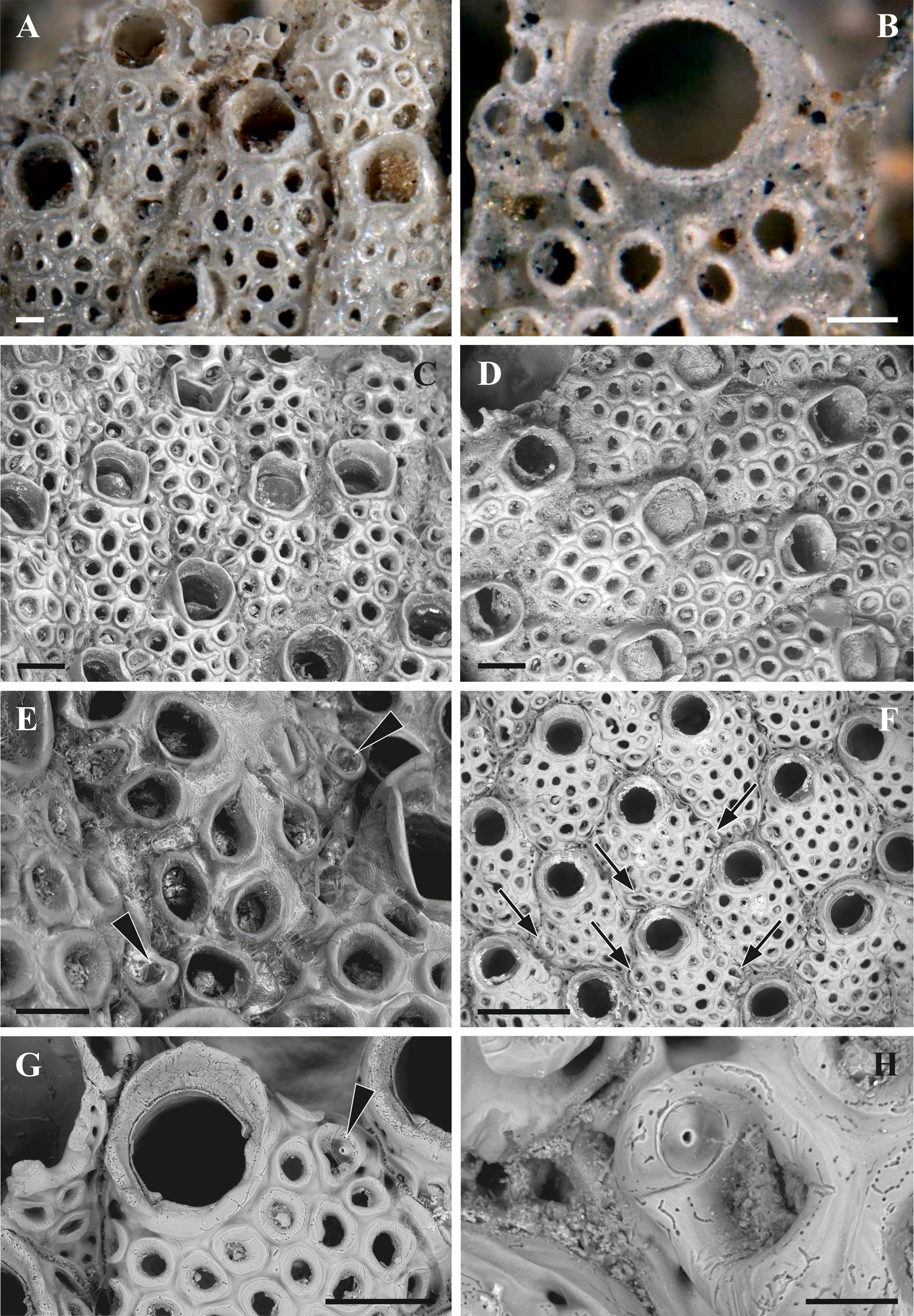
Description. Colonies encrusting, unilaminar, multiserial. Zooids pentagonal, hexagonal or oval, some with a narrow gymnocystal rim, separated by a narrow groove. Primary orifice pear-shaped or subcircular, longer than wide, poster (one-third) narrower and more angular than the anter (two-thirds) of a more rounded outline; anter wall underlain by an inner lamina the ends of which proximally form well-defined, usually ‘ boot’ - shaped (triangular) condyles with pointed or rounded tip, extending slightly beyond the edge of the step-like curved area below. Operculum light brown in dry non-cleaned material. A low, smooth, collar-like peristome, most prominent laterally, sometimes slightly flared, oval or with parallel lateral sides; peristome edge even or sometimes waved, its proximal edge low and flat or, incidentally, with low, central, blunt projection. Frontal shield convex, smooth, evenly covered with 12 – 33 round or oval, sometimes angular, well-separated foramina with very large lumen, each with a relatively narrow raised rim of smooth or wrinkled gymnocyst. Foraminal rims widen during ontogeny, but fusions between them are rare. Incidentally, a short spike is formed on the gymnocystal rim in some foramina. Rims of lateral foramina often fused with the marginal gymnocystal rim thus making the zooidal outline zigzaglike. Marginal pores are small, and often overshadowed by the wide rims of neighbouring frontal foramina. One or two lateral avicularia seen in many zooids, situated on the outer edge (often raised, reminiscent an ear) of lateralmost foramina; these foramina are comparable in size with the other foramina. Each avicularium is represented by a shallow depression with a central nipple-like elevation (thin-walled conical or cylindrical) with a central pore, pointing frontally or tilted. In non-cleaned specimens the nipple is covered with a thin cuticular mandible, oval in shape, frequently shrinking in dried material. Vertical zooidal walls wide, represented by multiporous mural septula with one row of communication pores. Kenozooids and ancestrula are unknown.
Cáceres-Chamizo, Julia P., Sanner, Joann, Tilbrook, Kevin J., Ostrovsky, Andrew N. (2017): Revision of the Recent species of Exechonella Canu & Bassler in Duvergier, 1924 and Actisecos Canu & Bassler, 1927 (Bryozoa, Cheilostomata): systematics, biogeography and evolutionary trends in skeletal morphology. Zootaxa 4305 (1): 1-79, DOI: 10.11646/zootaxa.4305.1.1
Remarks. Exechonella brasiliensis is characterized by its low, smooth, collar-like peristome and frontal shield evenly covered with very large, round or oval, well-separated foramina. Originally described from the Atlantic coast of Brazil, Exechonella brasiliensis has since been mentioned from the Indian Ocean, Indonesia, Komodo Island (Winston & Heimberg 1986; Winston 1986), the Pacific Ocean, Vanuatu Archipelago (Tilbrook et al. 2001) and Atlantic Ocean, Brazil, Bay of Bahia (Almeida et al. 2015). While we consider the specimen from Vanuatu to be E. similis n. sp. (see below), specimens from Komodo and Bay of Bahia should be checked to establish the species identity. Bay of Bahia, Atlantic Ocean m ± sd r n AzL 874 ± 123.5 654 – 1121 28 AzW 607.6 ± 98.2 467 – 836 29 OrL 217 ± 28.3 154 – 275 31 OrW 210 ± 25 185 – 266 32 FoN 19 ± 4.7 12 – 33 32 FoD 108 ± 13.6 85 – 138.5 51 OD 63 ± 10.9 34.6 – 88.5 145 Comparison of published illustrations and recently collected material from Lizard Island (described below as E. similis n. sp.) with the material of Canu and Bassler (USNM) revealed several differences between specimens from different localities: (1) the primary orifice in E. brasiliensis is almost as long as wide, whilst on average it is wider than long in the specimens from Komodo, Vanuatu and Lizard Island; (2) while the poster is angular and narrower than the anter in most zooids of E. brasiliensis, it has the same width with a rounded outline in colonies from Komodo and Pacific; (3) the condyles are less prominent in the Indo – Pacific specimens; (4) in some zooids of E. brasiliensis the proximal border of the peristome bears a small blunt projection, but it is far more common and more prominent in the Indo – Pacific material; (5) whilst the range in foramina number is similar between the localities (12 – 33 in Brazil, 14 – 19 in Komodo, 16 – 23 in Vanuatu and 21 – 36 in Lizard Island), the average diameter of the lumen differs — almost 2.4 times larger in the holotype than in the specimen from Komodo (63 µm vs 26 µm), 1.6 times that of the specimen from Vanuatu (63 µm vs 39 µm) and 1.7 times of the specimens from Lizard Island; (5) the foramina with avicularia are normally larger than those without them in the Indo – Pacific material, and they are easily distinguished, but they are of a similar size in E. brasiliensis; (6) in E. brasiliensis the kenozooids are not seen in the frontal view, whereas they are easily recognizable in the specimens from the Indo – Pacific; (7) finally, the marginal pores are obvious in the Indo – Pacific species, but in the Brazilian material they are frequently hidden by the rims of the nearest frontal foramina. These rims also often fused with the marginal gymnocystal rim of the zooid giving it the zigzag-like outline.
Cáceres-Chamizo, Julia P., Sanner, Joann, Tilbrook, Kevin J., Ostrovsky, Andrew N. (2017): Revision of the Recent species of Exechonella Canu & Bassler in Duvergier, 1924 and Actisecos Canu & Bassler, 1927 (Bryozoa, Cheilostomata): systematics, biogeography and evolutionary trends in skeletal morphology. Zootaxa 4305 (1): 1-79, DOI: 10.11646/zootaxa.4305.1.1
Distribution. Exechonella brasiliensis was originally described from the Bay of Bahia, Brazil, south-west Atlantic Ocean. It has not been found in the Brazilian waters since its original description (Dr L. Vieira, pers. comm. 2016).
Cáceres-Chamizo, Julia P., Sanner, Joann, Tilbrook, Kevin J., Ostrovsky, Andrew N. (2017): Revision of the Recent species of Exechonella Canu & Bassler in Duvergier, 1924 and Actisecos Canu & Bassler, 1927 (Bryozoa, Cheilostomata): systematics, biogeography and evolutionary trends in skeletal morphology. Zootaxa 4305 (1): 1-79, DOI: 10.11646/zootaxa.4305.1.1
Material examined. Holotype: USNM 8547, encrusting on rock. Atlantic Ocean, Brazil, Bay of Bahia, Norseman St. 320, 1876, coll. by Rathbun. Other material examined: USNM 8580, encrusting on rock. Atlantic Ocean, Brazil, Bay of Bahia, Norseman St. 343, Plataforma, 1876, coll. by Rathbun; USNM 8581, encrusting on rock. Atlantic Ocean, Brazil, Bay of Bahia, Periperi, Norseman St. 335, 1876, coll. by Rathbun; USMN 8582. Atlantic Ocean, Brazil, Bay of Bahia, Norseman St. 326, 1876, coll. by Rathbun.
Cáceres-Chamizo, Julia P., Sanner, Joann, Tilbrook, Kevin J., Ostrovsky, Andrew N. (2017): Revision of the Recent species of Exechonella Canu & Bassler in Duvergier, 1924 and Actisecos Canu & Bassler, 1927 (Bryozoa, Cheilostomata): systematics, biogeography and evolutionary trends in skeletal morphology. Zootaxa 4305 (1): 1-79, DOI: 10.11646/zootaxa.4305.1.1

Export occurrence data

Darwin Core Archive (ZIP)

CLASSIFICATION

Taxonomic Classification Tree

MULTIMEDIA

Media Files(1)

FIGURE 15. Exechonella brasiliensis Canu & Bassler, 1928. Atlantic Ocean, Brazil (A ‒ E: holotype USNM 8547; F ‒ H: USMN 8582). A, C, D, general view of holotype from above. B, close-up of autozooid, showing shape of primary orifice; E, close-up of frontal shields with two foramina bearing avicularia (arrowheads). F, view of central part of colony from above (some lateralmost foramina with avicularia shown by arrows). G, close-up of autozooid showing shape of primary orifice and lateralmost foramina with avicularium (arrowhead). H, close-up of lateralmost foramina with avicularium. Scale bars: A, B, E = 100 µm; C, D, G = 200 µm; F = 500 µm; H = 50 µm.

Imageimage/png© Cáceres-Chamizo, Julia P.;Sanner, Joann;Tilbrook, Kevin J.;Ostrovsky, Andrew N.Cáceres-Chamizo, Julia P.;Sanner, Joann;Tilbrook, Kevin J.;Ostrovsky, Andrew N.

IMAGES

Gallery(1)

See Gallery

Occurrences with images

Source Information

Revision of the Recent species of Exechonella Canu & Bassler in Duvergier, 1924 and Actisecos Canu & Bassler, 1927 (Bryozoa, Cheilostomata): systematics, biogeography and evolutionary trends in skeletal morphology

checklist

This dataset contains the digitized treatments in Plazi based on the original journal article Cáceres-Chamizo, Julia P., Sanner, Joann, Tilbrook, Kevin J., Ostrovsky, Andrew N. (2017): Revision of the Recent species of Exechonella Canu & Bassler in Duvergier, 1924 and Actisecos Canu & Bassler, 1927 (Bryozoa, Cheilostomata): systematics, biogeography and evolutionary trends in skeletal morphology. Zootaxa 4305 (1): 1-79, DOI: 10.11646/zootaxa.4305.1.1

Abstract

The present study describes species of Exechonella and Actisecos discovered through the examination of recent collections from the Red Sea, coast of Oman and Maldive Islands (Indian Ocean) and the Lizard Island, Australia (Great Barrier Reef, Coral Sea) in comparison with historical collections. Eight species of Exechonella are redescribed: E. grandis (type species), E. ampullacea, E. antillea, E. brasiliensis, E. erinacea, E. pumicosa, E. spinosa and E. verrucosa. Eighteen new species of Exechonella are also described: E. azeezi n. sp., E. catalinae n. sp., E. californiensis n. sp., E. claereboudti n. sp., E. elegantissima n. sp., E. floridiana n. sp., E. harmelini n. sp., E. kleemanni n. sp., E. maldiviensis n. sp. E. nikitai n. sp., E. panamensis n. sp., E. reniporosa n. sp., E. rimopora n. sp., E. safagaensis n. sp., E. similis n. sp., E. variperforata n. sp. E. vavrai n. sp. and E. vieirai n. sp. The species studied were grouped in five species complexes. Additionally, two species from the genus Actisecos — A. regulari s and A. discoidea were redescribed. The current revision highlights a number of important taxonomical, biogeographical and morphological questions that are of the general biological interest. Among thеm is a polyphyletic nature of Cheilostomata possessing umbonuloid frontal shield.

Key words: bryozoans, Exechonellidae, Actisecidae, new species, systematics, biogeography, evolution

Cáceres-Chamizo J P, Sanner J, Tilbrook K J, Ostrovsky A N, plazi (2017). Revision of the Recent species of Exechonella Canu & Bassler in Duvergier, 1924 and Actisecos Canu & Bassler, 1927 (Bryozoa, Cheilostomata): systematics, biogeography and evolutionary trends in skeletal morphology. Plazi.org taxonomic treatments database. Checklist dataset https://doi.org/10.11646/zootaxa.4305.1.1 accessed via GBIF.org on 2026-06-18.

CC0Published 12/31/2017View dataset
GBIF Usage Key
132632417
Dataset Key
24ae3650-4b27-4fcb-9f51-1787fd8aa2a4
Origin
source
Backbone Key
1005435
Taxon ID
CF0AB852FFDBE90FFF03FD0F9467E231.taxon
Last Crawled
6/11/2026
Last Interpreted
6/11/2026
