
AnimaliaNot EvaluatedacceptedspeciesAccepted
Megalothorax nigropunctatus

Megalothorax nigropunctatus

Schneider & D'Haese, 2013

GBIF:132786154

0year

ABOUT

Descriptions(2)

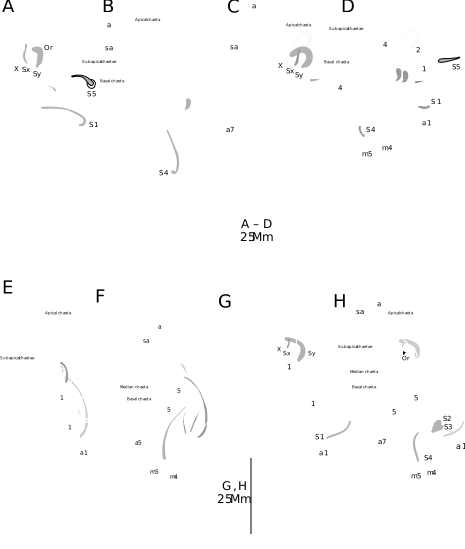
Description. Addendum to Schneider & D’Haese (2013). Adult. Total length of antenna ~ 100 µm; max width (Ant. III) ~ 22.5 µm; ratio width: length = 0.225; ratio length of Ant. I: Ant. II: Ant. III: Ant. IV ~ 0.36: 0.53: 1: 1. Correction from Schneider & D’Haese (2013): with six ordinary chaetae on Ant. IV (Fig. 14 A, B). Testis as in Fig. 20 A. Juvenile. The difference of chaetae between juvenile and adult chaetotaxy is similar to what have been described for M. minimus with one exception: the chaetae β 3 are specific to the adult of M. minimus and appear during the post-embryonic development. The supplementary chaetae on M. nigropunctatus in regard to M. minimus (on fields of labium and Abd. IV sternum) are present in the juvenile. Size. Length from labrum to anus: ~ 300 µm. Pigmentation. White (in ethanol). Body shape and segmentation. Orthognathous. Ratio height: length of head ~ 0.75. Total length of antenna ~ 50 µm; max width (Ant. III) ~ 8 µm; ratio width: length ~ 0.16; ratio length of Ant. I: Ant. II: Ant. III: Ant. IV ~ 0.4: 0.6: 1: 0.88. On each leg, length of coxa> tibiotarsus ~ femur ~ trochanter. Length of manubrium: dp: dd: mucro ~ 0.81: 0.68: 1: 1. Granulation. Secondary granulation present. Dorsal protuberance T present at the posterior extremity of the dorso-median line (Fig. 20 B). Integumentary channels. Not precisely observed, present dorsally on head, and ventrally on Th. II – Th. III but apparently less developed than in the adult (Fig. 20 B). Chaetae. The chaetotaxic pattern and morphology are very similar to the adult though the absence of some specific chaetae and wrc (Fig. 20 B). Wax secretory rods and sensory fields. With 6 + 6 sensory fields like the adult. Smaller inner chaeta of sf 5 absent (the bigger present), inner chaetotaxy of the other sensory fields as in the adult (Fig. 20 B). Labium, maxilla outer lobe, oral fold, labrum. All chaetae observed on the adult present. Head chaetotaxy. Postero-dorsal area with 9 + 9 chaetae (the 2 + 2 most anterior chaetae missing); anterodorsal area with nine pairs of chaetae and two unpaired chaetae (2 + 2 chaetae missing in regard to adult near the dorsal edge of sf 1, a 0 present); antero-lateral areas with 1 + 1 chaetae (L; Figs 3 D, 20 B). Ventral area with 3 + 3 post-labial mesochaetae (Fig. 4 D). Antenna chaetotaxy. Ant. I with a chaeta, Ant II with four chaetae, Ant III with 10 ordinary chaetae, two long S-chaetae and two short, swollen S-chaetae (S 1 – S 4, Ant. III sensory organ) and a long S-chaeta S (one missing in regard to adult; Figs 6, 20 C). Ant. IV with six ordinary chaetae as the adult; seven S-chaetae including five thin and long (S, three missing in regard to adult), a short and thin (Sx) and a long and thick (Sy); two apical and sub-apical sensory rods (a, sa) and a short organite Or (Fig. 20 C, 6). Th. II – Abd. V terga chaetotaxy. A total of 26 + 26 ordinary chaetae (15 + 15 missing in regard to adult), τchaetae not observed but probably present, 3 + 3 s-chaetae (s 1, s 2, s 3), 4 + 4 sensory fields and 5 + 5 wrc (3 + 3 missing in regard to adult; Fig. 20 B). Dorso-lateral area of Th. II with 5 + 5 chaetae (a 3, p 2, p 3 missing in regard to adult). Precoxal areas of Th. II with 1 + 1 s-chaetae (s 1) and 2 + 2 chaetae (a 7, a 8 missing in regard to adult; Fig. 20 B). Dorso-lateral area of Th. III – anterior abdomen with 7 + 7 chaetae (a 5, p 2, p 3, p 4, α 1, α 2, β 1, β 2 missing in regard to adult) and 3 + 3 wrc (wrc 2, wrc 7 missing in regard to adult; Fig. 20 B). Precoxal areas of Th. III with 2 + 2 chaetae (a 8 missing in regard to adult) and 1 + 1 wrc (wrc 5 missing; Fig. 20 B). Posterior area of the abdomen (until Abd. V included) with 10 + 10 chaetae (η 2 missing in regard to adult), 1 + 1 wrc and 1 + 1 s-chaetae (s 2; Fig. 20 B). s 1 short, tubular with rounded apex, s 2 and s 3 spherical (Fig. 20 B). Legs chaetotaxy. With two chaetae on trochanter I (one missing in regard to adult), no chaeta on coxa II and III (one missing on each in regard to adult) and seven chaetae on femur III (one missing in regard to adult; Figs 21 A – C, Tables 9, 10, 11). Claws morphology. Similar to the adult (Fig. 21 A – C). Abd. VI. Tergum anterior row with 2 + 2 chaetae and an unpaired chaeta, posterior row with 2 + 2 chaetae, anal valve with one chaeta, as the adult (Fig. 20 B). Sternum with 5 + 5 chaetae including one on each anal valve. Abd. IV sternum. With 3 + 3 chaetae and 2 + 2 neosminthuroid chaetae (as the adult). Abdominal appendages. As the adult: manubrium with 2 + 2 posterior chaetae; dens proximal part with a posterior chaeta, distal part with a posterior chaeta, four posterior spines and three anterior spines; tenaculum with 4 + 4 apical teeth, ventral tube with 2 + 2 apical mesochaetae.
Schneider, Clément (2017): Morphological review of the order Neelipleona (Collembola) through the redescription of the type species of Acanthoneelidus, Neelides and Neelus. Zootaxa 4308 (1): 1-94, DOI: 10.11646/zootaxa.4308.1.1
Material examined. Holotype. ♂ on slide (MNHN-EA 040153), Chile, Puerto Montt, Parque Nacional Alerce Andino, 41 ° 34 ' 58 " S 72 ° 34 ' 1 " W, 25. xi. 2011, captured with aspirator under the bark of a dead tree, C. Schneider leg., [MNHNCH]. Paratypes. 10 ♀, 5 ♂ on slides (MNHN-EA 040154 – 161) same data as the holotype, [MNHNCH]; 12 ♀, 4 ♂ and 4 juveniles on slides (MNHN-EA 040162 – 169), same data as the holotype, [MNHN]; 8 spm on mount for SEM (MNHN-EA 041007), same data as the holotype, [MNHN].
Schneider, Clément (2017): Morphological review of the order Neelipleona (Collembola) through the redescription of the type species of Acanthoneelidus, Neelides and Neelus. Zootaxa 4308 (1): 1-94, DOI: 10.11646/zootaxa.4308.1.1

Export occurrence data

Darwin Core Archive (ZIP)

CLASSIFICATION

Taxonomic Classification Tree

MULTIMEDIA

Media Files(5)

FIGURE 3. Diagram of the dorsal chaetotaxy of the head. (A) Neelides folsomi; (B) Acanthoneelidus pratensis; (C) Neelus murinus; (D) Megalothorax nigropunctatus; (E) Megalothorax perspicillum; (F) Megalothorax granulosus, integumentary channels not represented. In gray, chaetae absent in juvenile.

Imageimage/png© Schneider, ClémentSchneider, Clément

FIGURE 4. Diagram of the ventral chaetotaxy of the head. (A) Neelides folsomi; (B) Acanthoneelidus pratensis; (C) Neelus murinus; (D) Megalothorax nigropunctatus; (E) Megalothorax minimus; (F) Megalothorax granulosus.
Imageimage/png© Schneider, ClémentSchneider, Clément

FIGURE 14. Antenna, genus Megalothorax. M. granulosus (A) posterior side, (B) anterior side modified after Schneider & D'Haese (2013), (C) ventral side, (D), dorsal side; M. massoudi after Deharveng 1978, (E) posterior side, (F) anterior side; M. minimus (G) posterior side, (H) anterior side.

Imageimage/png© Schneider, ClémentSchneider, Clément

FIGURE 20. Megalothorax nigropunctatus. Male, (A) testis; juvenile (B) chaetotaxy of the body, dorsal side; (C) chaetotaxy of the antenna.

Imageimage/png© Schneider, ClémentSchneider, Clément

FIGURE 21. Megalothorax nigropunctatus, juvenile. Chaetotaxy of the legs (A) leg I anterior side; (B) leg II posterior side; (C) leg III posterior side.

Imageimage/png© Schneider, ClémentSchneider, Clément

IMAGES

Gallery(5)

See Gallery

Occurrences with images

Source Information

Morphological review of the order Neelipleona (Collembola) through the redescription of the type species of Acanthoneelidus, Neelides and Neelus

checklist

This dataset contains the digitized treatments in Plazi based on the original journal article Schneider, Clément (2017): Morphological review of the order Neelipleona (Collembola) through the redescription of the type species of Acanthoneelidus, Neelides and Neelus. Zootaxa 4308 (1): 1-94, DOI: 10.11646/zootaxa.4308.1.1

Abstract

This work proposes a comprehensive review of the morphological features of the Neelipleona, with focus on chaetotaxy. The major contributions to the knowledge of Neelipleona are discussed and new data are presented, acquired from the redescription of Neelides folsomi, Acanthoneelidus pratensis and Neelus murinus. New elements of description are given for Neelus fimbriatus, Megalothorax granulosus, Megalothorax minimus, Megalothorax nigropunctatus, Megalothorax svalbardensis. Juvenile morphology is also taken in consideration with the description of the early instar of Neelides folsomi, Neelus murinus, Megalothorax minimus and Megalothorax nigropunctatus. A nomenclatural framework is proposed to illustrate the descriptions and the hypotheses of homology debated in the paper. Comparative tables are provided to summarize the morphological variations observed in the order. An identification key to the genera is also provided. A set of intriguing and unique characteristics of the Neelipleona were discovered or enlighten such as labral morphology, vibrating antennae in the genus Neelus, special chaetae associated to the secretion of wax rods and pattern of special τchaetae.

Key words: Neelides folsomi, Acanthoneelidus pratensis, Neelus murinus, Neelus fimbriatu s, Megalothorax minimus, Megalothorax nigropunctatus, Neelidae, morphology, chaetotaxy, identification key

Schneider C, plazi (2017). Morphological review of the order Neelipleona (Collembola) through the redescription of the type species of Acanthoneelidus, Neelides and Neelus. Plazi.org taxonomic treatments database. Checklist dataset https://doi.org/10.11646/zootaxa.4308.1.1 accessed via GBIF.org on 2026-06-15.

CC0Published 12/31/2017View dataset
GBIF Usage Key
132786154
Dataset Key
01ef7a56-a2ba-4493-9182-a0ca2f9a32d2
Origin
source
Backbone Key
9250727
Taxon ID
03A8760E7B1D4F7872BBFF45D07172E4.taxon
Last Crawled
6/11/2026
Last Interpreted
6/11/2026