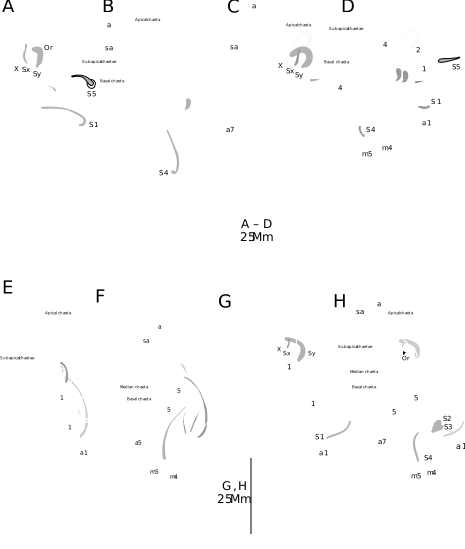
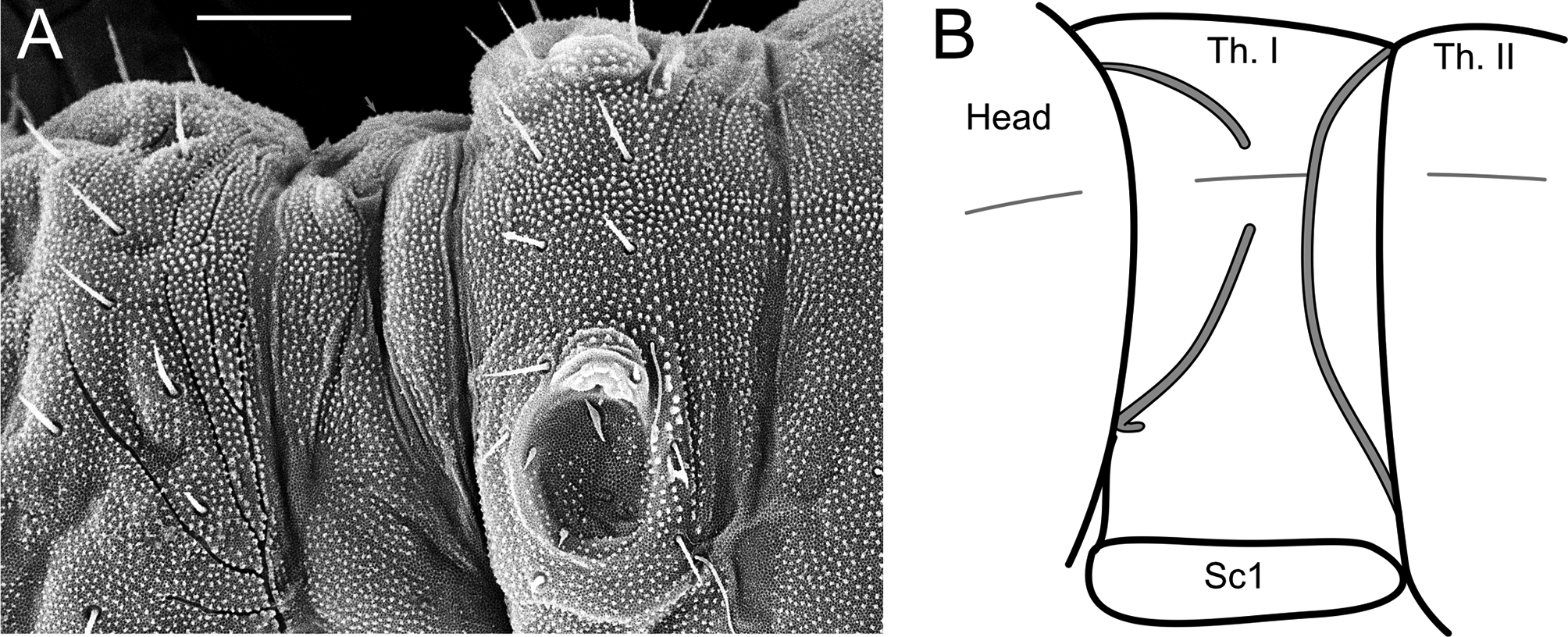
Description. Addendum to Schneider & D’Haese (2013). Adult. Th. I in one part, with neck vestigial. Th. I with (i) a posterior transversal fold reaching laterally the limit of Th. I – Th. II; (ii) an anterior pair of oblique folds that is the posterior limit of the vestigial neck (Fig. 16 A, B). Total length of antenna ~ 78.4 µm; max width (Ant. III) ~ 18.7 µm; ratio width: length ~ 0.24; ratio length of Ant. I: Ant. II: Ant. III: Ant. IV ~ 0.22: 0.36: 0.6: 1. Correction from Schneider & D’Haese (2013): only seven ordinary chaetae on Ant. IV (Fig. 14 G, H); a simple channel present on Th. II – Th. III sterna, not reaching the terga. Juvenile. Size. Length from labrum to anus ~ 225 µm. Body shape and segmentation. Orthognathous. Ratio height: length of head ~ 0.80. Total length of antenna ~ 50 µm; max width (Ant. III) ~ 17 µm; ratio width: length ~ 0.34; ratio length of Ant. I: Ant. II: Ant. III: Ant. IV ~ 0.25: 0.35: 0.75: 1. On each leg, length of coxa> tibiotarsus ~ femur ~ trochanter. Length of manubrium: dp: dd: mucro ~ 0.81: 0.73: 0.86: 1. Pigmentation. White (in ethanol). Granulation. Secondary granulation present. Dorsal protuberance T present at the posterior extremity of the dorso-median line (Fig. 17 C). Integumentary channels. Not precisely observed, present dorsally on head but apparently less developed than adult, and present ventrally on Th. II – Th. III as the adult. Chaetae. The chaetotaxic pattern and morphology are very similar to the adult though the absence of some specific chaetae and wrc (Figs 8 A, 17 A, C). Wax secretory rods and sensory fields. With 6 + 6 sensory fields as the adult (Figs 8 A, 17 C). Smaller inner chaeta of sf 5 absent (the bigger present), inner chaetotaxy of the other sensory fields as the adult (Figs 8 A, 17 C). Labium, maxilla outer lobe, oral fold, labrum. All chaetae observed on the adult present. Head chaetotaxy. Postero-dorsal area with 9 + 9 chaetae (the 2 + 2 most anterior chaetae missing in regard to adult); antero-dorsal area with 9 + 9 chaetae and two unpaired chaetae (2 + 2 chaetae missing near the dorsal edge of sf 1, a 0 present), antero-lateral areas with 1 + 1 chaetae (L; Fig. 17 A). Ventral area with 3 + 3 post-labial chaetae (Fig. 4 E). Antenna chaetotaxy. Ant. I with one chaeta, Ant II with four chaetae, Ant III with nine ordinary chaetae, two long S-chaetae (S 1, S 4) and two short, swollen S-chaetae (S 2, S 3), as in the adult (Figs 6, 17 B). Ant. IV with seven ordinary chaetae as in the adult; eight S-chaetae including six thin and long (S, four missing in regard to adult), a short and thin (Sx) and a long and thick (Sy); two apical and sub-apical sensory rods (a, sa) and a short organite Or (Figs 6, 17 B). Th. II – Abd. V terga chaetotaxy. Th. II – Abd. V terga with a total of 26 + 26 ordinary chaetae (16 + 16 missing in regard to adult), τ-chaetae not observed but maybe present, 2 + 2 s-chaetae (s 1, s 2), 4 + 4 sensory fields and 5 + 5 wrc (3 + 3 missing in regard to adult; Figs 8 A, 17 C). Dorso-lateral areas of Th. II with 5 + 5 chaetae (a 3, p 2, p 3 missing in regard to adult; Figs 8 A, 17 C). Precoxal areas of Th. II with 1 + 1 s-chaetae (s 1) and 2 + 2 chaetae (a 7, a 8 missing in regard to adult; Figs 8 A, 17 C). Dorso-lateral area of Th. III – anterior abdomen with 7 + 7 chaetae (a 5, p 2, 3, 4, α 1, 2, β 1, 2, 3 missing in regard to adult) and 3 + 3 wrc (wrc 2, wrc 7 missing in regard to adult; Figs 8 A, 17 C). Precoxal areas of Th. III with 2 + 2 chaetae (a 8 missing) and 1 + 1 wrc (wrc 5 missing; Figs 8 A, 17 C). Posterior area of the abdomen (until Abd. V included) with 10 + 10 chaetae (η 2 missing in regard to adult), 1 + 1 wrc and 1 + 1 s-chaetae (s 2; Figs 8 A, 17 C). s 1 curved, tubular with rounded apex, s 2 spherical. Legs chaetotaxy. With two chaetae on trochanter I (one missing in regard to adult), no chaeta on coxa II and III (one missing on each in regard to adult) and seven chaetae on femur III (one missing in regard to adult; Figs 18 A – C, Tables 9, 10, 11). Claws morphology. Similar to the adult (Fig. 18 A – C). Abd. VI. Tergum anterior row with 2 + 2 chaetae and an unpaired chaeta, posterior row with 2 + 2 chaetae, anal valve with a chaeta, as the adult (Figs 8 A, 17 C). Sternum with 6 + 6 chaetae including one on each anal valve. Abd. IV sternum. With 2 + 2 chaetae and 2 + 2 neosminthuroid chaetae (as the adult). Abdominal appendages. Similar to the adult: manubrium with 2 + 2 posterior chaetae; dens proximal part with a posterior chaeta, distal part with a posterior chaeta, four posterior spines and three anterior spines; tenaculum with 3 + 3 apical teeth, ventral tube with 2 + 2 apical chaetae. B C
Schneider, Clément (2017): Morphological review of the order Neelipleona (Collembola) through the redescription of the type species of Acanthoneelidus, Neelides and Neelus. Zootaxa 4308 (1): 1-94, DOI: 10.11646/zootaxa.4308.1.1