
AnimaliaNot EvaluatedacceptedspeciesAccepted
Novocrania altivertex
(Zezina, 1990)
GBIF:135435376
0year
ABOUT
Descriptions(4)
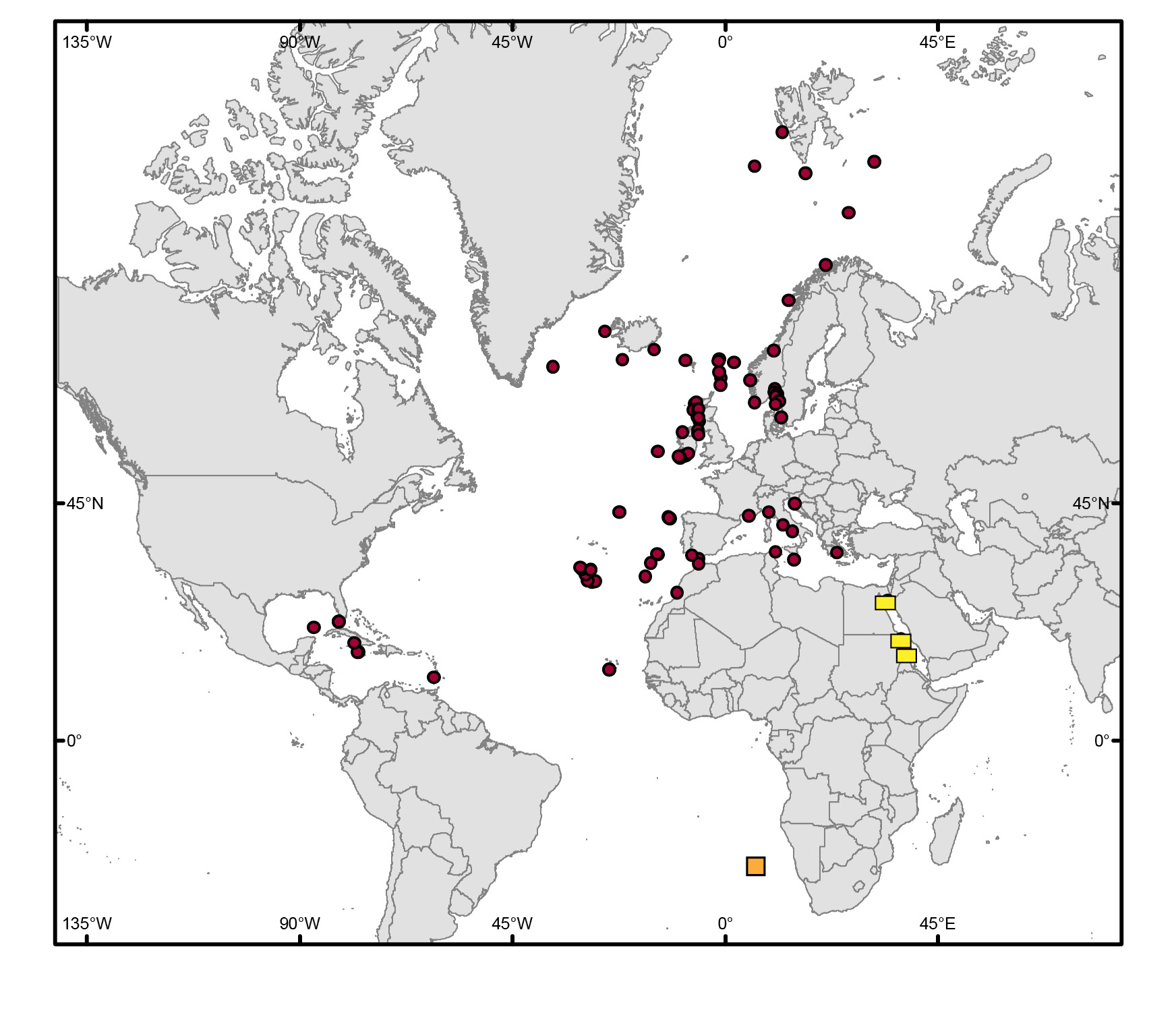
1990: Neocrania altivertex Zezina, Akad. Nauk SSSR, Okean. Instit., p. 128, fig. 1. 2001: Novocrania altivertex (Zezina), Lee & Brunton, Bull. Nat. Hist. Mus. (Geol.), 57 (1), p. 5. Synonymy. Zezina (1990) listed two Novocrania species collected from the Walfish Ridge in the South Atlantic (off Namibia, Fig. 1), including a new species N. altivertex based on one adult specimen and three juveniles. No images were published but two simple line drawings of the dorsal valve holotype were included, a lateral view of the valve exterior and the muscle scars on the interior.
Jeffrey H Robinson (2017): A review of all Recent species in the genus Novocrania (Craniata, Brachiopoda). Zootaxa 4329 (6): 501-559, DOI: 10.11646/zootaxa.4329.6.1
Description (translated from Russian, Zezina 1990, p. 128 – 129). “ Dorsal valve is shaped like a tall, sharp, peaked cap, the posterior edge is straight, almost along the entire width of the valve. Its width is greater the length. The height of the valve is about half the width. The peak is one sixth of the shell length from the posterior. The posterior slope of the valve is flattened and forms distinct edges with the rest of the valve. The surface of the shell is uneven, wrinkled / ribbed, without any radial structure or spines characteristic of other types of Neocrania. The periostracum is brown. On the inner surface of the dorsal valve there is a clearly distinguishable depression under the apex, and also raised above the surface the muscle scars of the anterior adductor [slow muscles], the posterior adductors, the oblique internal muscles and the [anterior aductor quick] muscles. The attachments of the [small anterior muscles] are halfway between the peak and shell anterior, leave no noticable imprints. The length of the type specimen is 6.2 mm, the width is 8.2 and the height is 4 mm. ” “ In the same sample there were three juvenile specimens which comprise a series in growth stages. They are all characterized by a brown periostracum, they have a straight posterior edge and a tall peak no more than 1 fifth of the shell length from the posterior edge. Another two specimens of Crania from this sample have a white flattened shell with the peak positioned more centrally at a distance 1 third of the length of the shell from the back edge. These specimens are of the species N. pourtalesi (Dall, 1871). ” “ The muscle scars on the dorsal valve type specimen of N. altivertex are distinctly raised on the dorsal surface of the holotype. On the underside of the holotype is preserved a fragment of a thick and strongly calcified lower valve. The edges of the dorsal valve are slightly thickened. However, these traits are most likely age related rather than taxonomic. In the juvenile paratypes the ventral valve is a thin film, in the dorsal valves very weak impressions of muscle attachments. ”
Jeffrey H Robinson (2017): A review of all Recent species in the genus Novocrania (Craniata, Brachiopoda). Zootaxa 4329 (6): 501-559, DOI: 10.11646/zootaxa.4329.6.1
Remarks. I have observed similar dorsal valves, tall with a distinct peak, in populations of N. huttoni and N. lecointei (Fig. 10 I – J). Lee & Brunton (1986, fig. 34) figured a peaked dorsal valve of N. anomala. It is part of morphological variation within at least three species and is not, on its own, grounds for the introduction of a new species. In the type specimen part of the ventral valve remains attached to the dorsal valve, being “ thick and strongly calcified ”, therefore this specimen is unlikely to be N. lecointei or N. huttoni which have organic ventral valves. The dorsal valve muscle scars are “ distinctly raised ”. This suggests N. turbinata but could apply to N. anomala, not enough information is given to rule out either species. Zezina suggested that N. pourtalesii was also present at Walfish Ridge, this study has placed that species into synonymy under N. anomala. It is probable that the Walfish Ridge material includes one or both of N. anomala and N. turbinata, both are found at the Cape Verde Islands off Central Africa. The species N. altivertex is retained until the material can be examined.
Jeffrey H Robinson (2017): A review of all Recent species in the genus Novocrania (Craniata, Brachiopoda). Zootaxa 4329 (6): 501-559, DOI: 10.11646/zootaxa.4329.6.1
Type material and locality. The type specimens are held in the P. P. Shirshov Institute of Oceanology, Russian Acadamy of Sciences (XI- 52 - 10). Zezina (1990) gave the type locality only as Station 4916, off the Valdivia Seamount, Walfish Ridge, South Atlantic. The Valdivia Seamount is at 26.25 ° S, 6.41 ° E. I was not able to examine the specimens or images of them. The text of Zezina (1990) is in Russian so the Description and some further paragraphs from the original paper are reproduced here in English.
Jeffrey H Robinson (2017): A review of all Recent species in the genus Novocrania (Craniata, Brachiopoda). Zootaxa 4329 (6): 501-559, DOI: 10.11646/zootaxa.4329.6.1
Export occurrence data
Darwin Core Archive (ZIP)
CLASSIFICATION
Taxonomic Classification Tree

IMAGES