
AnimaliaNot EvaluatedacceptedspeciesAccepted
Dicranocentrus cuprum

Dicranocentrus cuprum

GBIF:137307189

ABOUT

Descriptions(4)

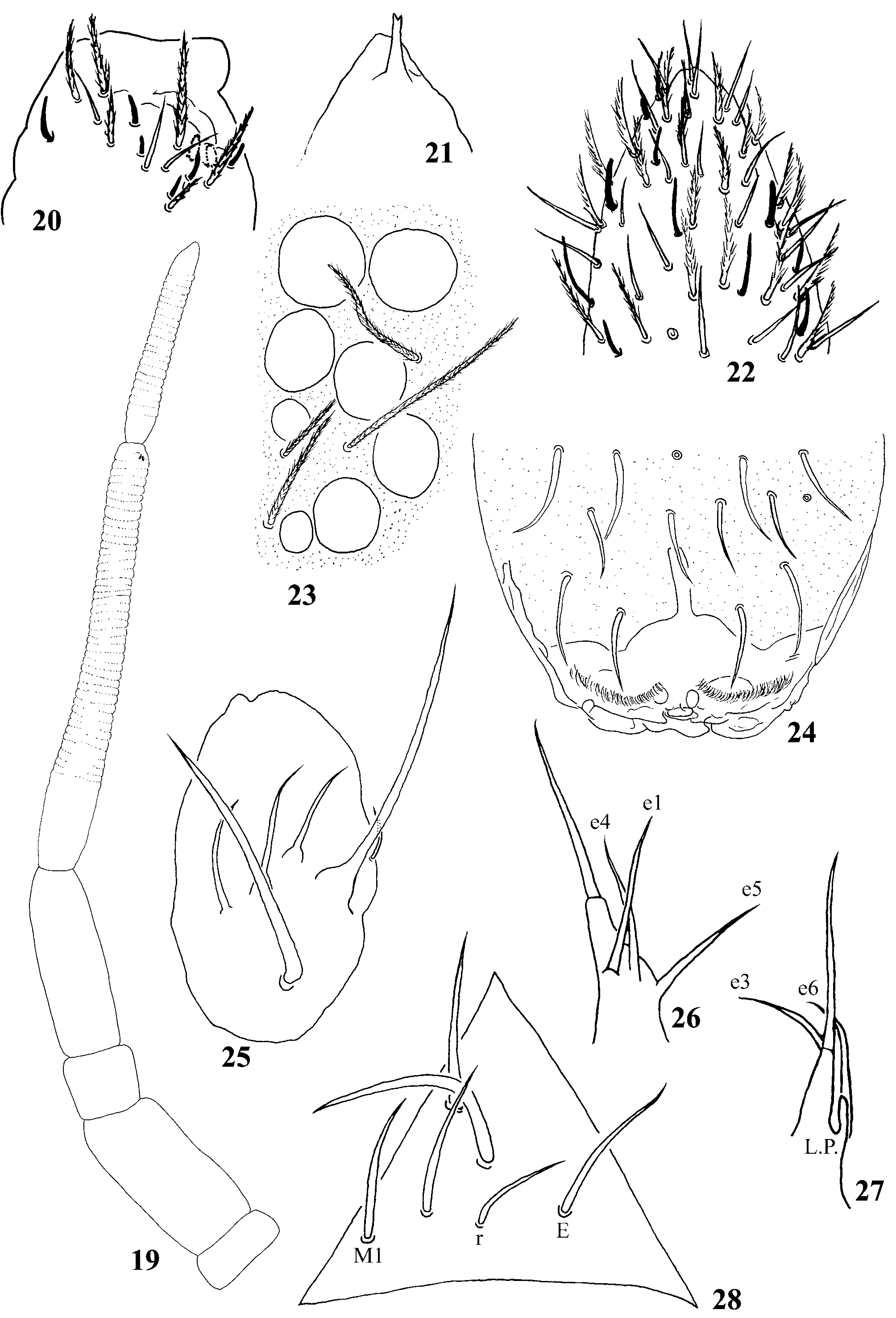
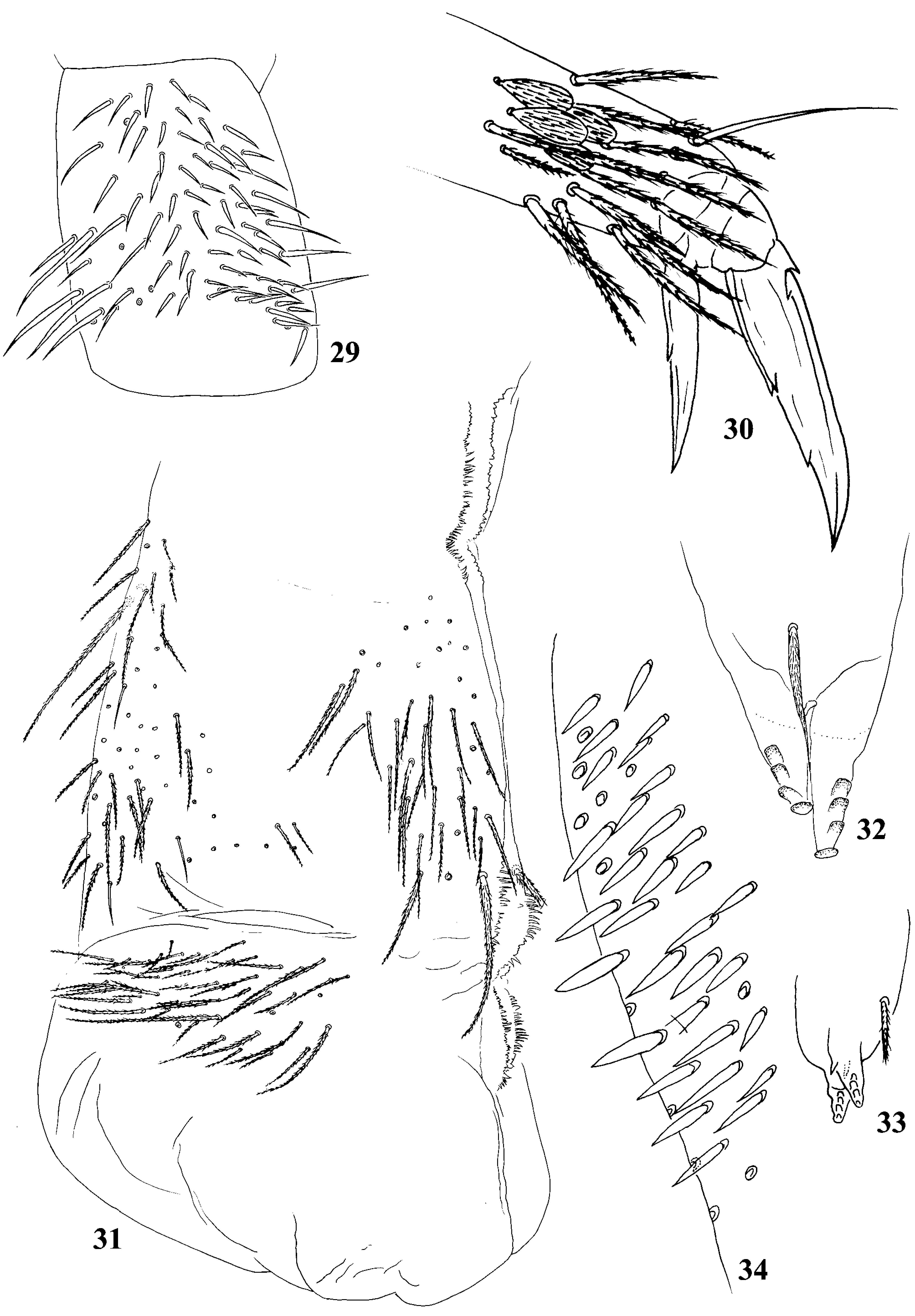
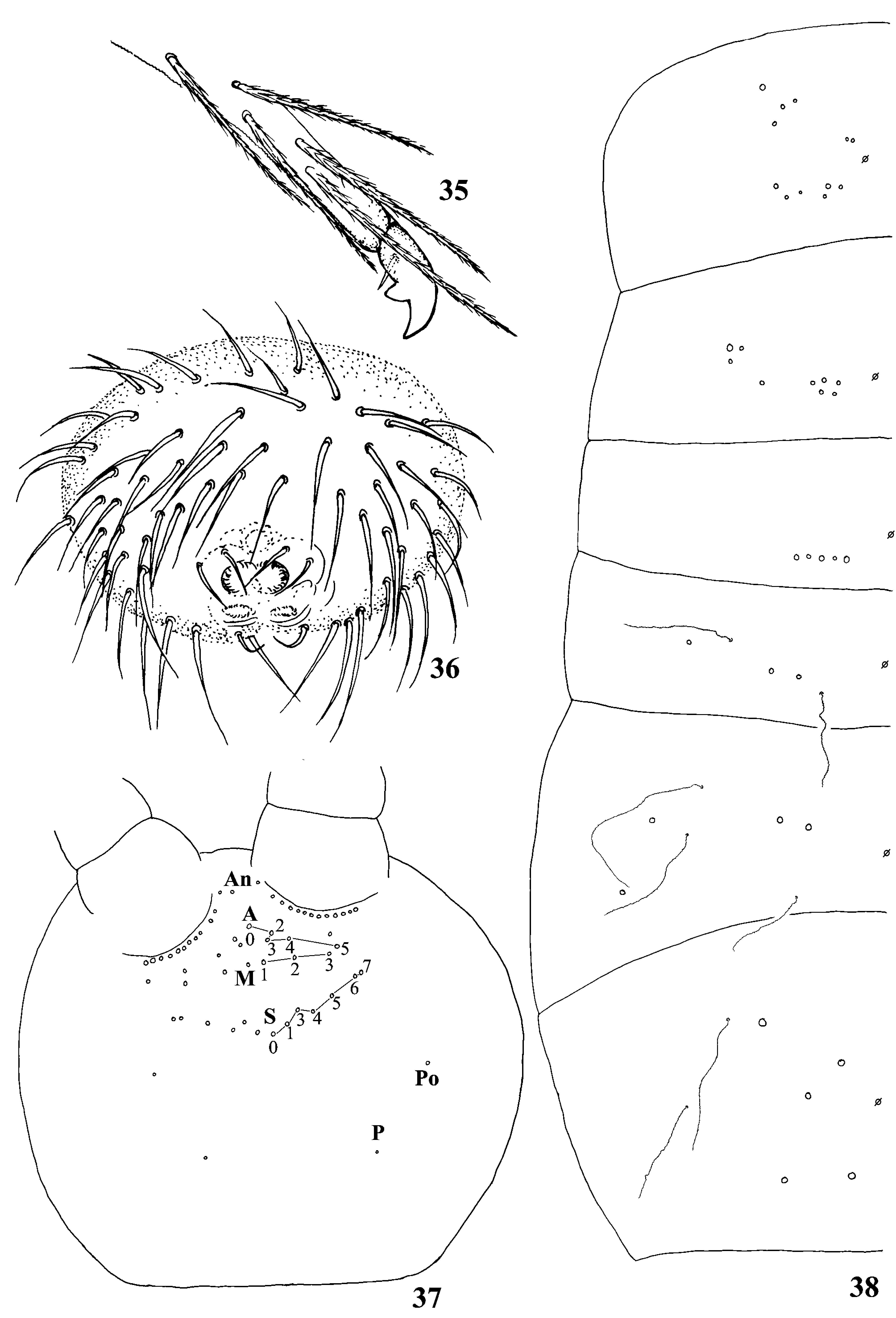
Description. Body length: 3.0 mm to 3.5 mm. Habitus robust, general color pattern coppery on head, body and dark bluish pigment on distal region of antennal segments (Fig. 18). Head. Antennae long, approximately twice to three times the length of cephalic diagonal. Ratio of antennal segments I: II: III: IV: V: VI = 1.0: 3.3: 1.3: 4.0: 9.7: 4.5 (Fig. 19). Ant. I – IV with ciliated microchatae interspersed with smooth chateae and small scales. Ant. V with sensory organ located distally on dorsolateral region, composed of two robust sensilla covered by a tegument fold and protected laterally by guard sensilla and ciliated chaetae (Fig. 20). Ant. VI with one subapical pin seta ventrally and apical bulb absent (Figs 21 and 22). Ant. V and VI annulated, with ciliated microchatae interspersed with smooth chateae arranged in rings on finely granulated tegument and without scales. Eyes 8 + 8 in strongly pigmented eyepatch, G and H eyes smaller than others (Fig. 23). Pre-labral chaetae simple; labral chaetotaxy 4 / 5,5,4, all chaetae smooth; labral papilla of type II (Fig. 24). Maxillary palp simple with basal chaeta subequal to apical chaeta, and four sublobal hairs (Fig. 25). Outer labial papilla with a small lateral process reaching one-third of papilla E; presence of five guard chaetae (e 1, e 3, e 4, e 5 and e 6) (Figs 26 and 27). Labial triangle with chaeta M 1 smooth, chaeta r smooth and smaller than chaeta E (Fig. 28). Appendages. Legs covered by numerous ciliated chaetae and small scales. Trochanteral organ consisting of approximately 70 small spines; few scales present (Fig. 29). Tibiotarsi covered with numerous ciliated chaetae and small scales; about 20 spiny ciliated chaetae on inner and outer margin; smooth chaetae also present. Unguis long and robust with a pair of basal teeth and one unpaired teeth on inner margin, two lateral teeth and one dorsal tooth; unguiculi lanceolate with a median outer tooth; tibiotarsal tenent hair acuminate (Fig. 30). Ventral tube covered with numerous small scales, 20 + 20 ciliated mesochaetae and 2 + 2 macrochaetae anteriorly; ciliated chaetae of various sizes interspersed with scales posteriorly; approximately 40 smooth and ciliated mesochaetae, 1 + 1 macrochaeta laterally (Fig. 31). Tenaculum well developed with 4 + 4 teeth, 1 + 1 spine on each ramus and one ciliated macrochaeta in basomedian region (Figs 32 and 33). Dens long, crenulate, with approximately 50 spines only in the inner basal area (Fig. 34); distal part of dens smooth and measuring about three times the mucro’s length. Mucro small with two teeth and one basal spine (Fig. 35). Genital plate of male with about 70 smooth and subequal chaetae, arranged in four to five concentric rows and six small eugenital chaetae (Fig. 36). Macrochaetotaxy. Head with 14 + 14 chaetae on antennal group (An); anterior group with 4 + 4 chaetae (A 2, A 3, A 4 and A 5) and unpaired chaeta A 0; median-ocellar line with 3 + 3 chaetae (M 1, M 2 and M 3); sutural group with 6 + 6 chaetae (S 1, S 3, S 4, S 5, S 6 and S 7) and unpaired chaeta S 0; post sutural chaeta (Ps) absent; post ocellar chaeta (Po) present; posterior group (P) with 1 + 1 chaeta (Fig. 37). Th. II with 2 + 2 inner Mc., 4 + 4 outer chaetae in median region and 6 + 6 posterior Mc.; Th. III with 9 + 9 Mc.; Abd. I with 5 + 5 Mc.; Abd. II with 2 + 2 inner and 1 + 1 outer Mc.; Abd. III with 2 + 2 inner and 2 + 2 outer Mc.; Abd. IV with 5 + 5 inner Mc. (Fig. 38).
Xisto, Thiago, Mendonça, Maria Cleide De (2016): Two new species of Dicranocentrus Schött, 1893 (Collembola: Entomobryidae) from Serra do Gandarela, Minas Gerais State, Brazil. Zootaxa 4079 (2): 217-228, DOI: 10.11646/zootaxa.4079.2.4
Discussion. The species Dicranocentrus cuprum sp. nov. jointly with the neotropical species D. platensis (Izarra, 1972) (described from Argentina) and D. heloisae Arlé & Mendonça, 1982 (described from Brazil) can be included into the gracilis - group sensu Mari Mutt, 1979 due to the absence of chaeta A 1, S 2, Ps and up to 6 + 6 chaetae P dorsally on head. The new specie is more similar to D. platensis by sharing the presence of pin setae, G and H eyes reduced, labral papilla of type II according the classification preconized by Mari Mutt (1981), tenent hair acuminate, absence of spines on outer basal region of dens and macroquetotaxy of Th. and Abd. However, Dicranocentrus cuprum sp. nov. shows maxillary palp with basal chaeta subequal to apical chaeta, labial triangle with M 1 and r chaetae smooth, unguis with a pair of basal teeth, tenaculum with 1 + 1 spine and one ciliated Mc., about 50 spines on inner basal region of dens and 1 + 1 chaetae P dorsally on head. D. platensis, on the other side, differs from the new species by maxillary palp with basal chaeta longer than apical chaeta, labial triangle with M 1 and r chaetae ciliated, unguis with a pair of median teeth, tenaculum without chaetae, about 60 spines on inner basal region of dens and 3 + 3 chaetae P dorsally on head (Izarra 1972; Mari Mutt 1981).
Xisto, Thiago, Mendonça, Maria Cleide De (2016): Two new species of Dicranocentrus Schött, 1893 (Collembola: Entomobryidae) from Serra do Gandarela, Minas Gerais State, Brazil. Zootaxa 4079 (2): 217-228, DOI: 10.11646/zootaxa.4079.2.4
Etymology. The name cuprum, from Latin, means copper and refers to the copperish coloration exhibited by the new species.
Xisto, Thiago, Mendonça, Maria Cleide De (2016): Two new species of Dicranocentrus Schött, 1893 (Collembola: Entomobryidae) from Serra do Gandarela, Minas Gerais State, Brazil. Zootaxa 4079 (2): 217-228, DOI: 10.11646/zootaxa.4079.2.4
Type locality. “ Parque Nacional da Serra do Gandarela ”, Caeté municipality, Minas Gerais State, Rain forest litter, lat / long coordinates 20 ° 1 ' 49.91 " S; 43 ° 40 ' 43.83 " W, about 1500 meters a. s. l. Type material. Holotype: male, 2270 b CM / MNRJ, 29 – 02 / XII / 2011, Abrantes, E. A. & Silveira, T. C. leg. Paratypes: slide 2104 CM / MNRJ, 09 / VII / 2011, Abrantes, E. A. & Silveira, T. C. leg.; slides 2116 a CM / MNRJ and 2116 b CM / MNRJ, 09 / VII / 2011, Abrantes, E. A. & Silveira, T. C. leg.; slides 2117 a CM / MNRJ and 2117 b CM / MNRJ, 09 / VII / 2011, Abrantes, E. A. & Silveira, T. C. leg.; slides 2266 a CM / MNRJ and 2266 b CM / MNRJ, 29 – 02 / XII / 2011, Abrantes, E. A. & Silveira, T. C. leg.; slide 2267 CM / MNRJ, 29 – 02 / XII / 2011, Abrantes, E. A. & Silveira, T. C. leg.; slide 2269 CM / MNRJ, 29 – 02 / XII / 2011, Abrantes, E. A. & Silveira, T. C. leg.; slides 2270 a CM / MNRJ and 2270 c CM / MNRJ, 29 – 02 / XII / 2011, Abrantes, E. A. & Silveira, T. C. leg.; slide 2281 CM / MNRJ, 29 – 02 / XII / 2011, Abrantes, E. A. & Silveira, T. C. leg.; slide 2285 CM / MNRJ, 29 – 02 / XII / 2011, Abrantes, E. A. & Silveira, T. C. leg.; slide 2286 CM / MNRJ, 29 – 02 / XII / 2011, Abrantes, E. A. & Silveira, T. C. leg.; slide 2290 a CM / MNRJ and 2290 b CM / MNRJ, 29 – 02 / XII / 2011, Abrantes, E. A. & Silveira, T. C. leg.; slide 2291 CM / MNRJ, 29 – 02 / XII / 2011, Abrantes, E. A. & Silveira, T. C. leg.; slide 2292 CM / MNRJ, 29 – 02 / XII / 2011, Abrantes, E. A. & Silveira, T. C. leg.
Xisto, Thiago, Mendonça, Maria Cleide De (2016): Two new species of Dicranocentrus Schött, 1893 (Collembola: Entomobryidae) from Serra do Gandarela, Minas Gerais State, Brazil. Zootaxa 4079 (2): 217-228, DOI: 10.11646/zootaxa.4079.2.4

Export occurrence data

Darwin Core Archive (ZIP)

CLASSIFICATION

Taxonomic Classification Tree

MULTIMEDIA

Media Files(3)

FIGURES 19 – 28. Dicranocentrus cuprum sp. nov.: 19, antenna—chaetae omitted; 20, sensory organ on Ant. V; 21, ventral view of Ant. VI apex – chaetae omitted; 22, dorsal view of Ant. VI apex; 23, eyepatch; 24, labrum; 25, maxillary palp and sublobal plate; 26, outer labial papilla with ventral guard chaetae; 27, outer labial papilla with dorsal guard chaetae (L. P. — lateral process); 28, labial triangle.
Imageimage/png© Xisto, Thiago;Mendonça, Maria Cleide DeXisto, Thiago;Mendonça, Maria Cleide De

FIGURES 29 – 34. Dicranocentrus cuprum sp. nov.: 29, trochanteral organ; 30, distal part of metathoracic tibiotarsus and foot complex with acuminate tenent hair; 31, lateral view of ventral tube; 32, tenaculum; 33, lateral view of tenaculum with spine on rami; 34, spines on basal region of dens.
Imageimage/png© Xisto, Thiago;Mendonça, Maria Cleide DeXisto, Thiago;Mendonça, Maria Cleide De

FIGURES 35 – 38. Dicranocentrus cuprum sp. nov.: 35, distal region of dens and mucro; 36, male genital plate; 37, dorsal cephalic macrochaetotaxy—eyepatch omitted (An—antennal group, A—anterior group, M—median-ocellar line, S—sutural group, Po—post ocellar chaeta, P—posterior group); 38, half dorsal macrochaetotaxy, bothriotricha and pseudopores of Th. II to Abd. IV.

Imageimage/png© Xisto, Thiago;Mendonça, Maria Cleide DeXisto, Thiago;Mendonça, Maria Cleide De

IMAGES

Gallery(3)

See Gallery

Occurrences with images

Source Information

Two new species of Dicranocentrus Schött, 1893 (Collembola: Entomobryidae) from Serra do Gandarela, Minas Gerais State, Brazil

checklist

This dataset contains the digitized treatments in Plazi based on the original journal article Xisto, Thiago, Mendonça, Maria Cleide De (2016): Two new species of Dicranocentrus Schött, 1893 (Collembola: Entomobryidae) from Serra do Gandarela, Minas Gerais State, Brazil. Zootaxa 4079 (2): 217-228, DOI: 10.11646/zootaxa.4079.2.4

Abstract

Two new species of Dicranocentrus from Southeastern Brazil are described: D. melinus sp. nov. and D. cuprum sp. nov., both from “Parque Nacional da Serra do Gandarela” (Minas Gerais State), Brazil. These species can be included to gracilis -group due to the absence of chaeta A1, S2, Ps and up to 6+6 chaetae P on dorsal head. A male genital plate is for the first time illustrated for the genus.

Key words: Chaetotaxy, Iron ore soil, Orchesellinae, Southeastern Brazil, Taxonomy

Xisto T, Mendonça M C D, plazi (2016). Two new species of Dicranocentrus Schött, 1893 (Collembola: Entomobryidae) from Serra do Gandarela, Minas Gerais State, Brazil. Plazi.org taxonomic treatments database. Checklist dataset https://doi.org/10.11646/zootaxa.4079.2.4 accessed via GBIF.org on 2026-06-15.

CC0Published 12/31/2016View dataset
GBIF Usage Key
137307189
Dataset Key
0830133d-f3e8-4182-94a6-684bda876090
Origin
source
Backbone Key
9590358
Taxon ID
03F5532ABF423748598FFF6AFEAAF93E.taxon
Last Crawled
6/11/2026
Last Interpreted
6/11/2026