
AnimaliaNot EvaluatedacceptedspeciesAccepted
Allobates bacurau

Allobates bacurau

Simões, 2016

GBIF:137453467

0year

ABOUT

Descriptions(5)

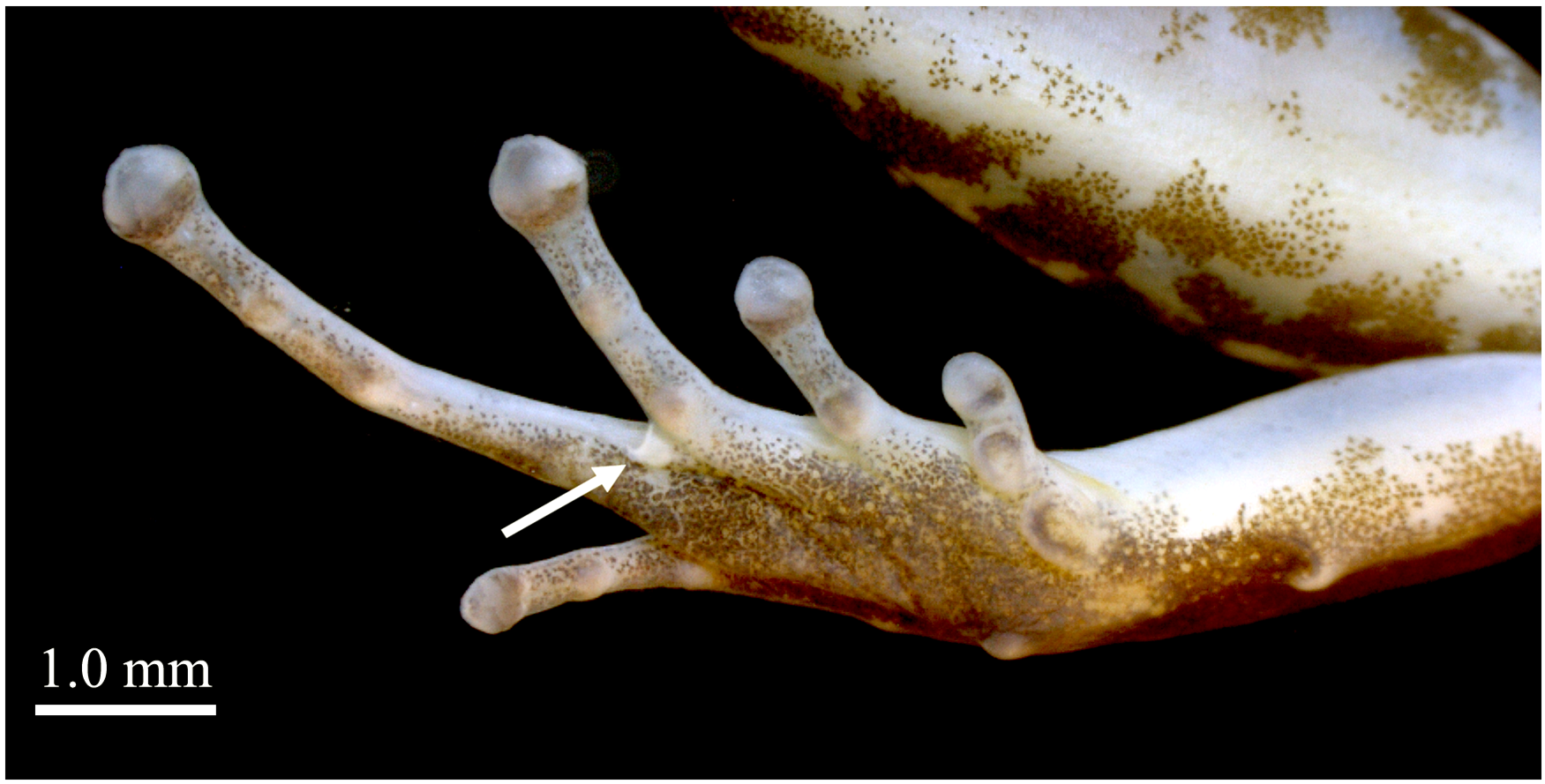
Allobates bacurau is distinguished from A. marchesianus (Melin 1941) by lacking basal webbing between Toes II and III and by the absence of strong sexual dimorphism in color of ventral surfaces of preserved and live specimens (basal webbing present between Toes II and III in A. marchesianus; throat and chest of males strongly pigmented, appearing dark gray; ventral surfaces of preserved females uniformly cream, bright yellow in life).
Simões, Pedro Ivo (2016): A new species of nurse-frog (Aromobatidae, Allobates) from the Madeira River basin with a small geographic range. Zootaxa 4083 (4): 501-525, DOI: 10.11646/zootaxa.4083.4.3
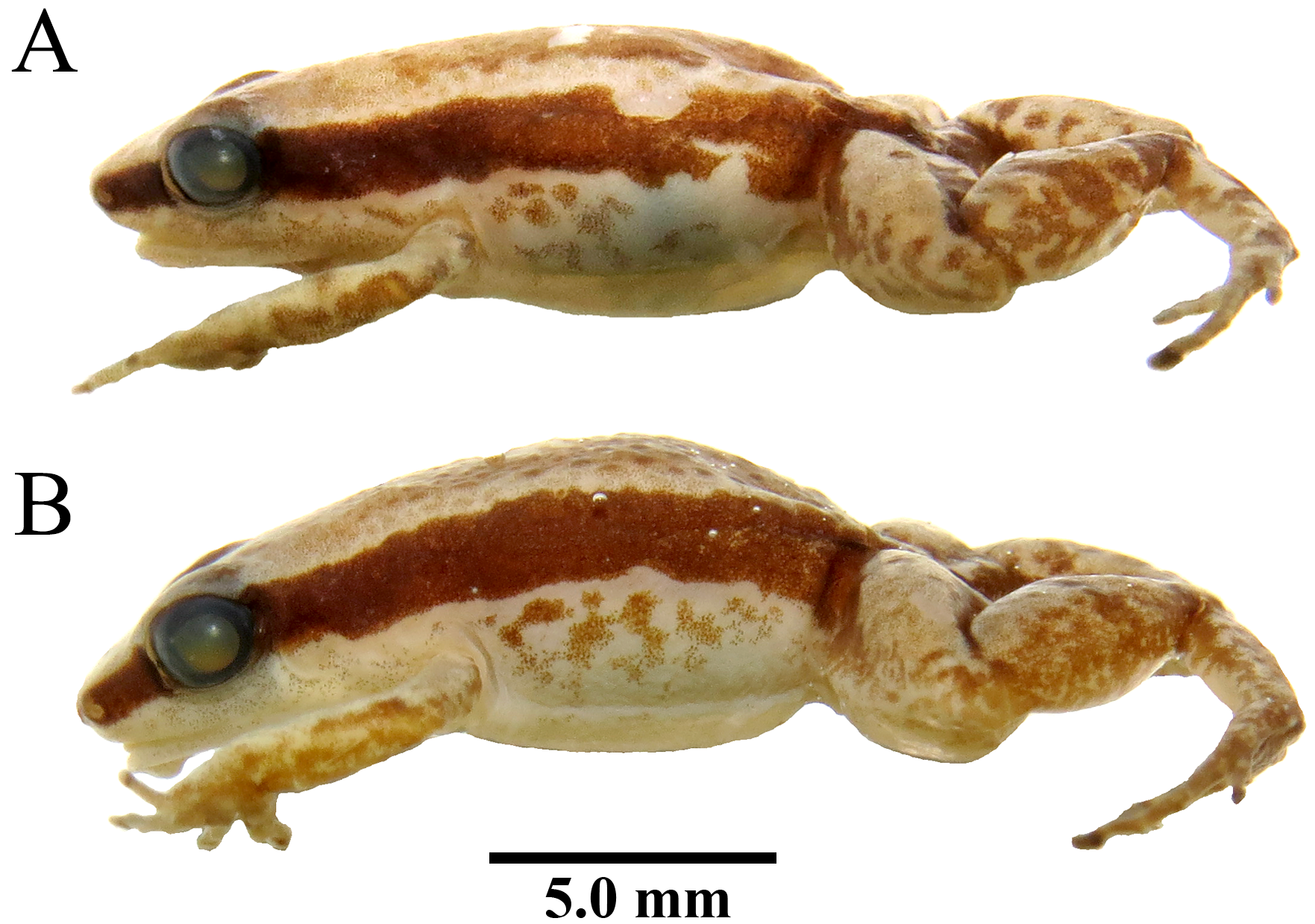
Description of holotype. Measurements of the holotype are presented in Table 1. Body is robust, head wider than long (HL / HW = 0.84), head length 0.29 times the SVL (Fig 1 A, B; Fig. 2 A). Eye diameter larger than distance from anterior corner of the eye to nostril (EN / EL = 0.63). Nares located posterolaterally to tip of snout, directed laterally, visible in dorsal, ventral, lateral, and anterior views. Distance between nostrils 0.82 times that of HW. Canthus rostralis slightly convex from tip of snout to nostril, straight from nostril to anterior corner of the eye. Loreal region vertical. Tympanum round, 0.37 times the maximum diameter of the eye. Margins of tympanum indistinct to the naked eye, visible under a dissecting microscope, more conspicuous anteroventrally. Maxillary teeth absent, not visually detectable under 40 X magnification or when a wire probe is moved along the maxillary surface. Tongue conspicuously longer than wide, with anterior tip attached to the mouth floor. Median lingual process absent. Choanae round, positioned anterodorsally to eye bulge. Vocal sac single, corresponding to most of the area of the medial and posterior subgular region. Lateral vocal slits conspicuous. Palmar tubercle elliptical, with the longer width aligned towards the base of Finger II. Thenar tubercle conspicuous, oval, evident in ventral view and in hand profile. Maximum diameter of thenar tubercle 68 % of maximum diameter of palmar tubercle (Fig. 3 A). Subarticular tubercles of Fingers II, III and IV round, small, never exceeding the width of phalanges. Subarticular tubercle on Finger I elliptical, protuberant, 1.2 times larger than thenar tubercle in maximum diameter. Distal subarticular tubercle absent on Finger IV. Supernumerary tubercles absent. Carpal and metacarpal ridges absent. Fringes or webbings absent on fingers. Length of Finger II equivalent to approximately 85 % of Finger I´s length. Tip of Finger IV does not reach distal subarticular tubercle of Finger III when fingers are juxtaposed. Relative lengths of fingers: IV = II
Simões, Pedro Ivo (2016): A new species of nurse-frog (Aromobatidae, Allobates) from the Madeira River basin with a small geographic range. Zootaxa 4083 (4): 501-525, DOI: 10.11646/zootaxa.4083.4.3
Diagnosis. Allobates bacurau is characterized by: (1) skin texture of dorsum granular, flat granules scattered from the level of tympanum to the urostyle region, more evident from mid to posterior dorsum; (2) paired dorsal digital scutes present; (3) distal tubercle absent on Finger IV; (4) discs on fingers II and III unexpanded, discs of fingers I and IV weakly expanded; (5) dermal lateral fringes and basal webbing absent on fingers; (6) metacarpal ridge absent; (7) Finger III swollen in male specimens, width of swelling variable among males; Finger III not swollen in females; (8) carpal pad absent; (9) male excrescences absent on thumbs; (10) thenar tubercle conspicuous; (11) black gland absent on arm; (12) tarsal keel present, tubercle-like, strongly curved; (13) disc of Toe I weakly expanded; discs of toes II, III and IV moderately expanded; (14) basal webbing present between toes III and IV; (15) metartarsal fold absent; (16) cryptic external coloration; background color of dorsum tan brown, with darker brown spots scattered from the level of tympanum to posterior dorsum; large diamond, “ X ” or hourglass-shaped marks absent on dorsum; dorsal surface of thigh grayish brown in life, light brown in preserved specimens, with no transverse bars; dorsal surface of arm yellow to dark copper in life, cream in specimens preserved for at least five years; pale dorsolateral stripe present, well defined, variable in width among specimens; a dark brown lateral stripe surrounds the whole body, reaching leg-body insertion; pale oblique lateral stripe absent; pale ventrolateral stripe present, partially diffuse, extending from behind the eyes to groin, cream in preserved specimens, iridescent white in live individuals; small, brown irregular blotches or marbling present ventrolaterally from snout to groin; pale paracloacal mark present; (17) dark throat-collar absent; (18) color of throat generally cream in preserved specimens, appearing light brown in specimens with higher concentration of melanophores on throat skin; density of melanophores on throat variable among specimens; throat light to dark gray in life; (19) central abdominal region immaculate, white to translucent in live male and female specimens; throat region with a variable number of melanophores in both sexes; chest and posterior third of throat light to dark gray in live males, white to translucent in live females, with parietal peritoneum projecting anteriorly from the level of chest and visible through skin; (20) iris metallic gold with tiny black flecks and a light gold pupil ring; (21) large intestine unpigmented; (22) testis unpigmented; (23) mature oocytes pigmented, pigments dark brown; (24) median lingual process absent; (25) tympanum inconspicuous; (26) vocal sac single; (27) maxillary teeth absent or inconspicuous; (27) habit is diurnal, males calling during daytime; (28) advertisement calls characterized by distinctively long trills (7 – 11 s) formed by approximately 60 – 80 short notes, emitted at an average rate of seven notes per second; (29) very small snout-to-vent length (SVL), adult males 14.4 mm on average (range 14.0 – 14.7 mm), adult females 14.8 mm on average (range 14.7 – 14.9 mm). The new species is assigned to genus Allobates by the combination of characters 14, 17, 22, 24, 27 and 29. Species comparisons. The new species has a small geographic distribution in central Brazilian Amazonia (see Geographic distribution section below), located at least 600 km from the nearest country border. Thus, we restrict comparisons to Allobates species occurring in Brazil and to three additional species distributed outside the country, but which closely resemble the new species in external morphology.
Simões, Pedro Ivo (2016): A new species of nurse-frog (Aromobatidae, Allobates) from the Madeira River basin with a small geographic range. Zootaxa 4083 (4): 501-525, DOI: 10.11646/zootaxa.4083.4.3
Etymology. The specific epithet is in reference to the Portuguese word “ bacurau ” (modified from the original native Tupi word “ wakura’wa ”), which designates several species of nighthawks (Family Caprimulgidade). Inhabitants of Manicoré have historically entitled themselves “ Povo Bacurau ” (“ The Nighthawk People ”). The origin of this habit is disputed, but it possibly relates to the nickname of a notable citizen, Mr. Francisco A. Vieira Nunes (1939 – 1997), a writer and politician who gained prestige as a social worker and activist for Hansen’s disease awareness. The epithet is applied as a noun in apposition.
Simões, Pedro Ivo (2016): A new species of nurse-frog (Aromobatidae, Allobates) from the Madeira River basin with a small geographic range. Zootaxa 4083 (4): 501-525, DOI: 10.11646/zootaxa.4083.4.3
Holotype. INPA-H 35398 (original field number APL 12647). An adult male collected by P. I. Simões on 4 th of December 2007, at Estrada do Miriti, in the outskirts of the city of Manicoré, on the right bank of the Madeira River, State of Amazonas, Brazil (05 ° 52 ' 05 " S, 61 ° 17 ' 13 " W). Advertisement calls of holotype recorded at 11: 30 h and 25.2 ° C. Paratypes. INPA-H 35397, 35399 – 35409 (original field numbers APL 12644 – 12646, 12648 – 12656), ten males, two females. Collected by P. I. Simões on 4 th – 5 th of December 2007, proceeding from the same locality.
Simões, Pedro Ivo (2016): A new species of nurse-frog (Aromobatidae, Allobates) from the Madeira River basin with a small geographic range. Zootaxa 4083 (4): 501-525, DOI: 10.11646/zootaxa.4083.4.3

Export occurrence data

Darwin Core Archive (ZIP)

CLASSIFICATION

Taxonomic Classification Tree

MULTIMEDIA

Media Files(11)

FIGURE 2. (A) Lateral view of Allobates bacurau holotype (INPA-H 35398). (B) Lateral view of a female paratype (INPA-H 35397).

Imageimage/png© Simões, Pedro IvoSimões, Pedro Ivo

FIGURE 3. (A) Hand of Allobates bacurau holotype (INPA-H 35398). (B) Hand of a female paratype (INPA-H 35397). Edges of some tubercles have been digitally highlighted for improved clarity. Variation in swelling of Finger III is not exclusively sexually dimorphic. Some male specimens have Finger III more similar to (B).
Imageimage/png© Simões, Pedro IvoSimões, Pedro Ivo

FIGURE 4. Foot of Allobates bacurau holotype (INPA-H 35398). White arrow indicates basal webbing between Toes III and IV.

Imageimage/png© Simões, Pedro IvoSimões, Pedro Ivo

FIGURE 5. Variation in dorsal color pattern among six male paratypes of Allobates bacurau. Clockwise from upper left: INPA-H 35405, 35403, 35406, 35409, 35401 and 35407. Note presence of a pale dorsolateral stripe and the absence of dark transverse bars on thighs of all specimens. Scratches on skin occurred post-preservation.
Imageimage/png© Simões, Pedro IvoSimões, Pedro Ivo

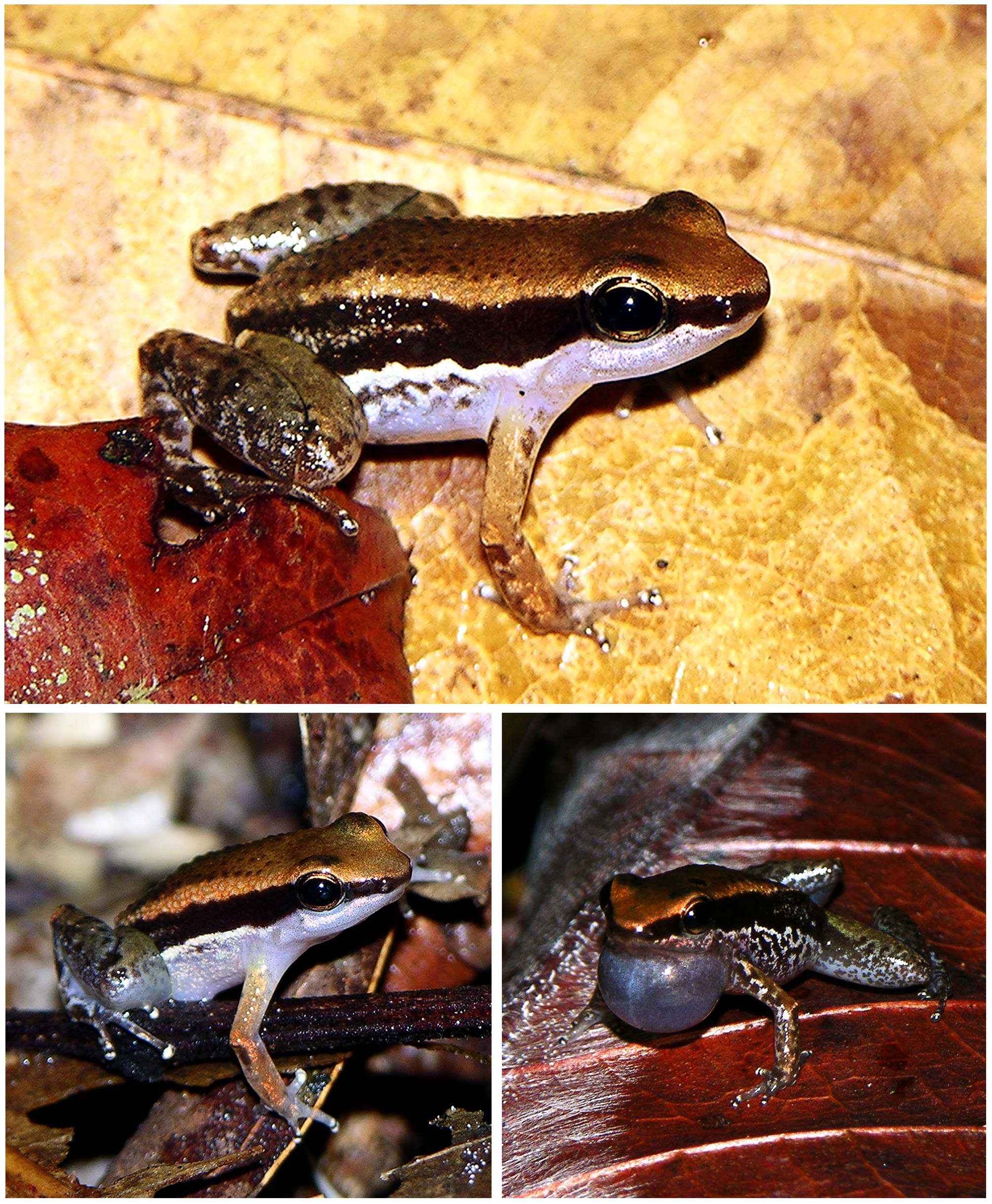
FIGURE 6. Color in life of Allobates bacurau photographed at the species type locality in Manicoré, on the eastern bank of the Madeira River, in Amazonas State, Brazil. (A) Dorsolateral view of a male specimen. (B) Lateral view of a second male specimen. (C) Calling male. Note gray-colored vocal-sac. Also note variation in coverage of iridescent-white reticulation on the ventrolateral region among the three specimens.

Imageimage/png© Simões, Pedro IvoSimões, Pedro Ivo

FIGURE 7. (A) Dorsal and ventral views of a live female paratype of Allobates bacurau (INPA-H 35408). Note that throat is pigmented anteriorly and white posteriorly. (B) Dorsolateral view of a second live female paratype (INPA-H 35397). (C) Variation in throat pigmentation density among live male paratypes of A. bacurau (from left to right: INPA-H 35398, 35402, 35401).

Imageimage/png© Simões, Pedro IvoSimões, Pedro Ivo

IMAGES

Gallery(11)

See Gallery

Occurrences with images

Source Information

A new species of nurse-frog (Aromobatidae, Allobates) from the Madeira River basin with a small geographic range

checklist

This dataset contains the digitized treatments in Plazi based on the original journal article Simões, Pedro Ivo (2016): A new species of nurse-frog (Aromobatidae, Allobates) from the Madeira River basin with a small geographic range. Zootaxa 4083 (4): 501-525, DOI: 10.11646/zootaxa.4083.4.3

Abstract

I describe the seventh species of nurse-frog (Allobates) from the Madeira River basin in Brazilian Amazonia. The new species is distinguished from similar congeneric species by its small body size (snout-to-vent length ranging between 14.0– 14.7 mm in adult males and between 14.7–14.9 mm in adult females), by the absence of dark brown regular shapes (e.g. hourglass, “X” or polygon-like marks) on the dorsum, by the absence of transverse dark bars on the dorsal surface of the thigh, and by the light gray to white ventral surfaces, light to dark gray only on throat in live male and female specimens. Males have a distinctive advertisement call characterized by the emission of long (7–11 s) trills of short notes (0.04 s in average) with dominant frequency at 5.9–6.3 kHz and emission rate ranging between 6.7–8.7 notes/s. DNA barcode analyses based on a fragment of the 16S rDNA mitochondrial gene provides additional support to the recognition of the new taxon, which is probably distributed on the east riverbank of the Madeira River, in the interfluve between the Aripuanã and Ji-Paraná rivers.

Key words: Advertisement calls, Amazonia, Dendrobatoidea, endemism, mtDNA

Simões P I, plazi (2016). A new species of nurse-frog (Aromobatidae, Allobates) from the Madeira River basin with a small geographic range. Plazi.org taxonomic treatments database. Checklist dataset https://doi.org/10.11646/zootaxa.4083.4.3 accessed via GBIF.org on 2026-06-14.

CC0Published 2/23/2016View dataset
GBIF Usage Key
137453467
Dataset Key
c04698fa-bd1c-4a8a-a388-cf2800b9fa0d
Origin
source
Backbone Key
8781153
Taxon ID
E118DE161870B016FFFFFF63FEAA6C18.taxon
Last Crawled
6/11/2026
Last Interpreted
6/11/2026