
AnimaliaacceptedgenusAccepted
Leptophyton
Ofwegen & Schleyer, 1997
GBIF:137679931
0year
ABOUT
Descriptions(3)
Emended diagnosis. Soft corals with lobate growth form, with lobes arising from common base or stalk and often giving rise to multiple secondary lobes. Polyps retractile. Sclerites are rods, radiates and club-like forms. Polyps lack collaret and points, but may have small rods or spindles in the tentacles. Colony interior with few or no sclerites. Colonies flabby with easily torn surface layer. Sclerites colorless.
Mcfadden, Catherine S., Van Ofwegen, Leen P. (2017): Revisionary systematics of the endemic soft coral fauna (Octocorallia: Alcyonacea: Alcyoniina) of the Agulhas Bioregion, South Africa. Zootaxa 4363 (4): 451-488, DOI: 10.11646/zootaxa.4363.4.1
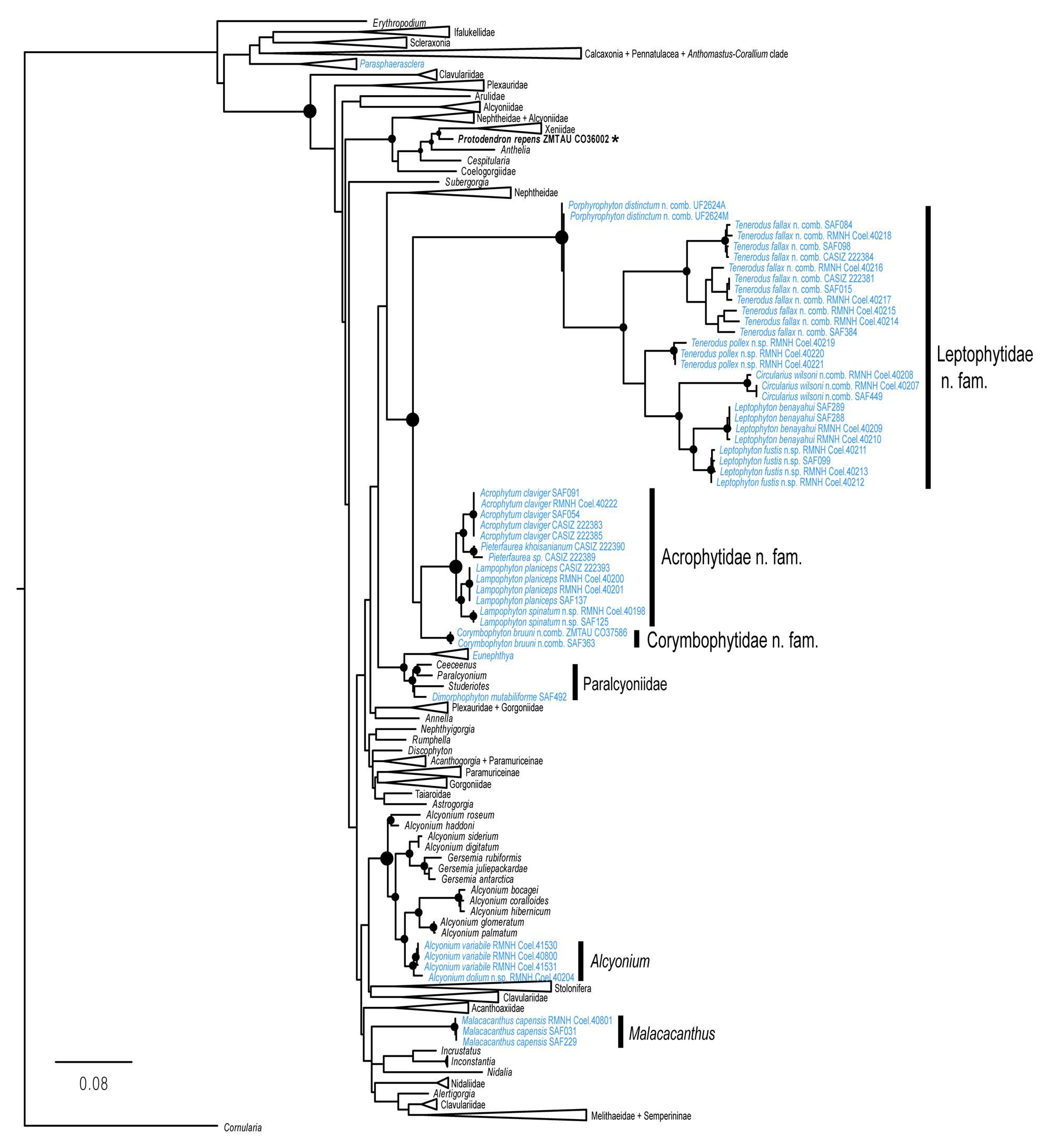
Remarks. Ofwegen & Schleyer (1997) assigned Leptophyton to Nephtheidae based on the colony growth form, which is dendritic with polyps arranged most densely on the distal regions of the branched lobes. In general, however, Nephtheidae have non-retractile polyps, while L. benayahui has retractile polyps. The only other genus of nephtheids in which species have retractile polyps is Gersemia, a genus that appears from molecular phylogenetic analyses to be closely related to Alcyonium (Alcyoniidae) and not to other Nephtheidae (McFadden et al. 2006; McFadden & Ofwegen 2013). Despite the phylogenetic distance separating them (Fig. 1), Leptophyton and Gersemia share a number of features, including having small spindles and radiates in the colony surface, and few or no sclerites in the interior. They can be distinguished, however, by the arrangement of sclerites in the polyps, which in Gersemia form distinct points and a typically weak collaret (Utinomi 1961). In Leptophyton the sclerites may be arranged in eight longitudinal tracts in the proximal region of the polyp, but the distal region lacks points or a collaret and has only sparse rods or spindles in the tentacles. Gersemia liltvedi (Verseveldt & Williams), a South African species originally assigned to the nephtheid genus Litophyton, has a branched growth form similar to the two species of Leptophyton. Like Leptophyton, it also has polyp sclerites that are spindles and rods arranged en chevron but not forming a typical collaret and points; spindles (some club-like) and radiates in the surface of the polyparium; and radiates in the surface of the stalk (Verseveldt & Williams 1988). Interior sclerites are scarce or absent, and the colony is described as weak and flabby. G. liltvedi differs significantly from Leptophyton, however, in having non-retractile polyps that are arranged on terminal catkins rather than distributed over the entire surface of the lobes. A sequence of 28 S rDNA obtained for a specimen of G. liltvedi (UF 2623) places this species in an unresolved phylogenetic position distant from both Leptophytidae and Gersemia, perhaps close to Eunephthya (Verrill) (data not shown).
Mcfadden, Catherine S., Van Ofwegen, Leen P. (2017): Revisionary systematics of the endemic soft coral fauna (Octocorallia: Alcyonacea: Alcyoniina) of the Agulhas Bioregion, South Africa. Zootaxa 4363 (4): 451-488, DOI: 10.11646/zootaxa.4363.4.1
Type species. L. benayahui Ofwegen & Schleyer, 1997
Mcfadden, Catherine S., Van Ofwegen, Leen P. (2017): Revisionary systematics of the endemic soft coral fauna (Octocorallia: Alcyonacea: Alcyoniina) of the Agulhas Bioregion, South Africa. Zootaxa 4363 (4): 451-488, DOI: 10.11646/zootaxa.4363.4.1
Export occurrence data
Darwin Core Archive (ZIP)
CLASSIFICATION
Taxonomic Classification Tree

MULTIMEDIA
Media Files(1)
FIGURE 1. Maximum likelihood phylogeny of Octocorallia based on combined, partitioned analysis of 28S rDNA, COI and 16S mtDNA.South African species and clades are identified in blue. Filled circles indicate nodes with>70% bootstrap support and Bayesian posterior probabilities>0.95 (shown for South African clades only). Strongly supported clades (bootstrap 70%) with no South African members have been collapsed to facilitate readability. Phylogenetic position of Protodendron repens indicated with *.
Imageimage/png© Mcfadden, Catherine S.;Van Ofwegen, Leen P.Mcfadden, Catherine S.;Van Ofwegen, Leen P.
IMAGES