
AnimaliaNot EvaluatedacceptedspeciesAccepted
Leptophyton benayahui

Leptophyton benayahui

Ofwegen & Schleyer, 1997

GBIF:137679932

0year

ABOUT

Descriptions(1)

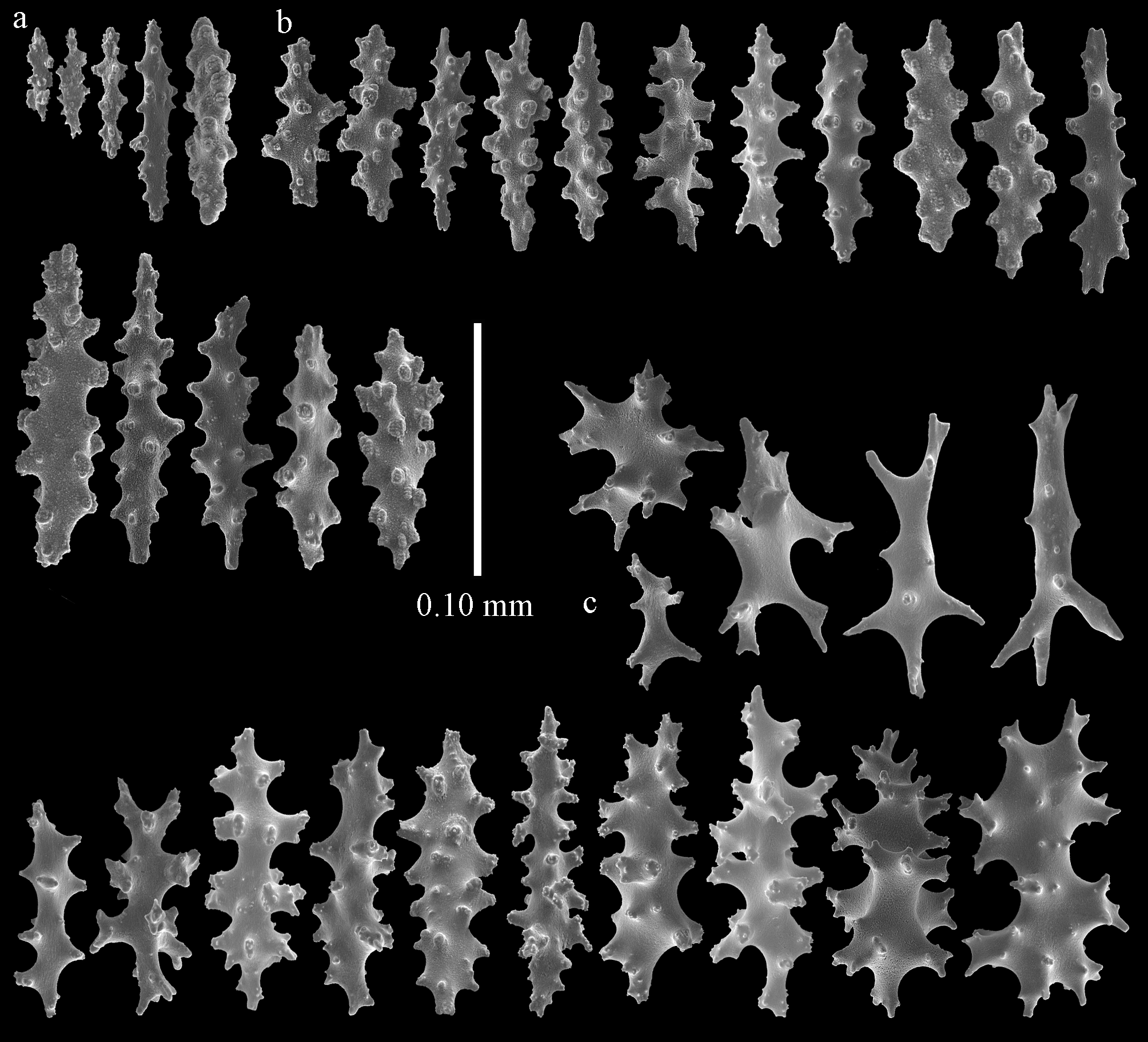
Material examined. RMNH Coel. 40209 (SAF 333), South Africa, Kwazulu-Natal, Aliwal Shoal, NE Pinnacles. 30 º 15.599 ' S, 30 º 49.724 ' E, depth 12 – 16 m, coll. C. S. McFadden, 19 March 2008. RMNH Coel. 40210 (SAF 290), SAF 288, SAF 289, South Africa, Kwazulu-Natal, Park Rynie, Lander's Reef, 30 º 19.973 ' S, 30 º 47.523 ' E, depth 22 – 28 m, coll. C. S. McFadden, 18 March 2008. In their original description of L. benayahui, Ofwegen & Schleyer (1997) state that the sclerites of the holotype have an eroded appearance, as though the specimen had been stored in formalin. In the newly collected material we have examined this is not the case, and additional details of the distribution and ornamentation of the sclerites can be discerned. Consequently, we update and revise the description of the sclerites of this species. The description of the holotype states that the polyps lack sclerites, but in the material examined here we find small rods, 0.04 – 0.08 mm long, at the bases of the tentacles (Fig. 12 a). The proximal region of the polyps and the colony surface have spindles, 0.08 – 0.13 mm long, with fairly sparse, high, simple tubercles (Fig. 12 b). In the proximal region of the polyp these are arranged in eight longitudinal tracts, but do not form a collaret or points. The surface of the colony base has similar spindles, 0.08 – 0.13 mm long, with longer, simple tubercles and spinose projections (Fig. 12 c). The general shapes and sizes of these sclerites are similar to those depicted for the holotype (Ofwegen and Schleyer 1997: Figs. 3, 4), but the details of the tubercular and spinose ornamentation can be seen more clearly in our material. The interior of the colony lacks sclerites. Spherical gametes, 0.35 – 0.6 mm in diameter, can be seen within the stalk of RMNH Coel. 40210.
Mcfadden, Catherine S., Van Ofwegen, Leen P. (2017): Revisionary systematics of the endemic soft coral fauna (Octocorallia: Alcyonacea: Alcyoniina) of the Agulhas Bioregion, South Africa. Zootaxa 4363 (4): 451-488, DOI: 10.11646/zootaxa.4363.4.1

Export occurrence data

Darwin Core Archive (ZIP)

CLASSIFICATION

Taxonomic Classification Tree

MULTIMEDIA

Media Files(4)

FIGURE 3. a, b: Lampophyton spinatum n. sp., holotype, RMNH Coel. 40198 (SAF164); b, close-up of polyparium surface and margin of stalk; c-e: Lampophyton spinatum n. sp., SAF125; d, lateral view of polyparium surface; e, top view of polyparium;f, g:Lampophyton planiceps RMNH Coel.40200 (SAF237),lateral view of polyparium and margin of stalk; g,top view of partially retracted polyparium.s = sclerites protruding through colony surface.
Imageimage/png© Mcfadden, Catherine S.;Van Ofwegen, Leen P.Mcfadden, Catherine S.;Van Ofwegen, Leen P.

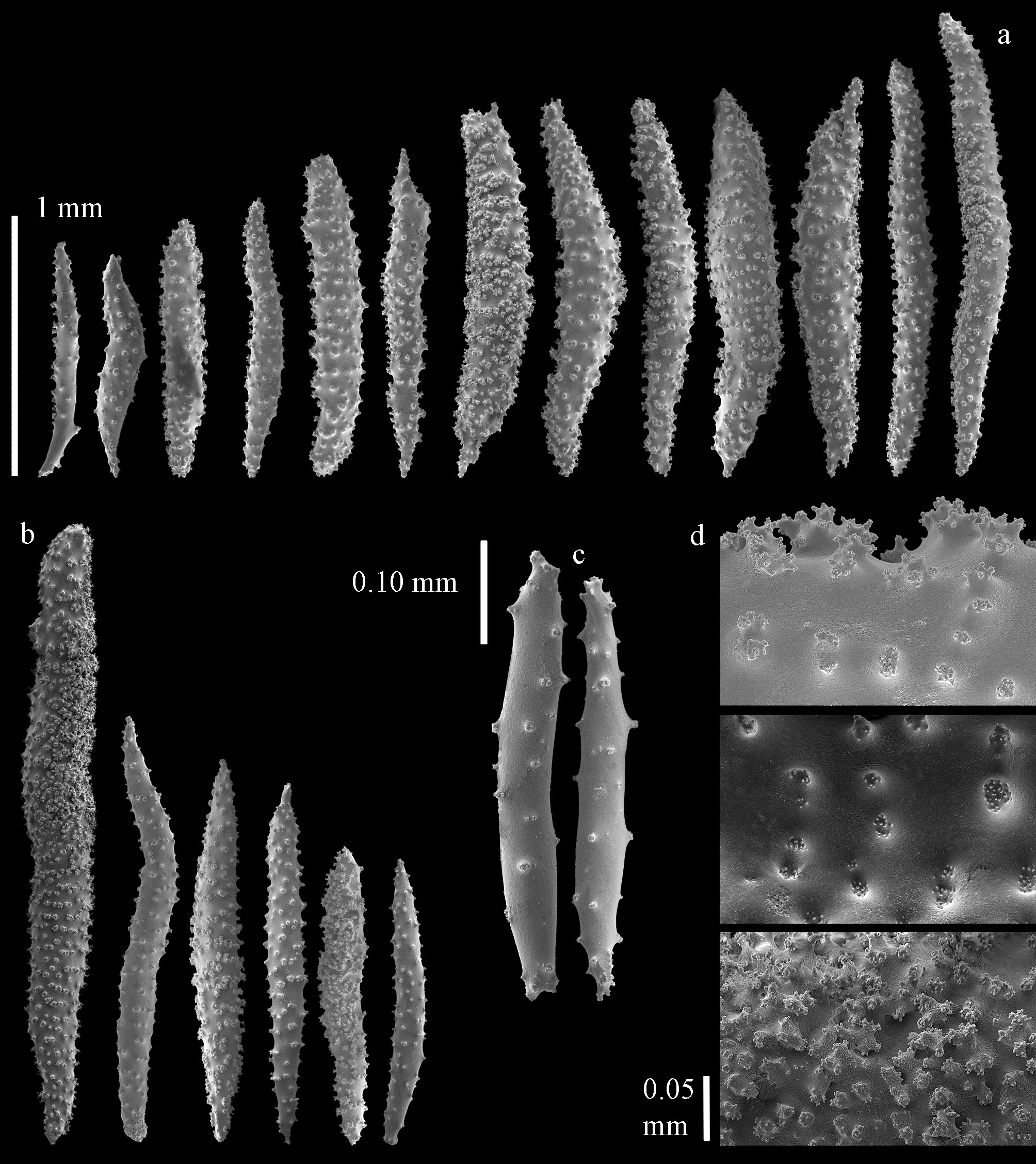
FIGURE4. Lampophyton spinatum n. sp., holotype,RMNH Coel.40198 (SAF164).a, scleritesfrom upperregion ofstalk and polyparium; b, tuberculate spindles and needles from base of stalk; c, smooth spindles from base of stalk; d, details of tubercular ornamentation:top and middle, spindles of upper surface of stalk; bottom, spindles of base of stalk.
Imageimage/png© Mcfadden, Catherine S.;Van Ofwegen, Leen P.Mcfadden, Catherine S.;Van Ofwegen, Leen P.

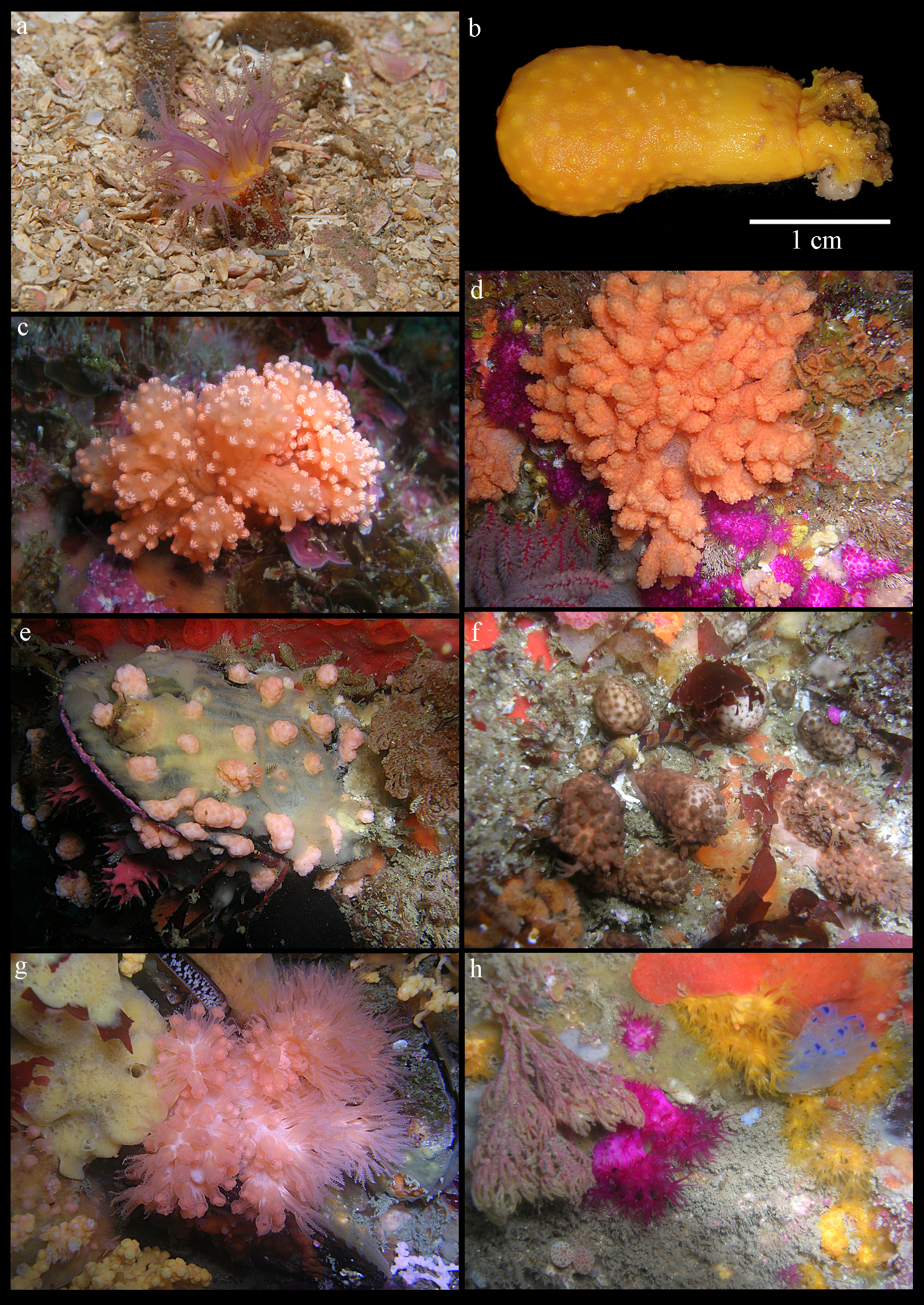
FIGURE 5. a, Lampophyton spinatum n. sp. paratype, RMNH Coel. 40199 (SAF195), colony photographed in situ; b, Alcyonium dolium n. sp. holotype, RMNH Coel.40204 (SAF292); c, Leptophyton benayahui SAF289 photographed in situ; d, Leptophyton fustis n. sp., holotype, RMNH Coel. 40211 (SAF087), colony photographed in situ (T. fallax n. comb. purple morph visible in lower right corner); e, Circularius wilsoni n. comb. RMNH Coel. 40207 (SAF448), colonies growing on mussel shell photographed in situ; f, Tenerodus pollex n. gen., n. sp. holotype, RMNH Coel. 40219 (SAF420), colonies photographed in situ; g, Tenerodus fallax, n. comb. RMNH Coel. 40217 (SAF383), pink color morph; h, Tenerodus fallax, n. comb. SAF015, purple and yellow color morphs.
Imageimage/png© Mcfadden, Catherine S.;Van Ofwegen, Leen P.Mcfadden, Catherine S.;Van Ofwegen, Leen P.

FIGURE 12. Leptophyton benayahui, RMNH Coel.40209 (SAF333). a, tentaclesclerites; b, sclerites from proximal region of polyps and colony surface; c, sclerites from base of colony.

Imageimage/png© Mcfadden, Catherine S.;Van Ofwegen, Leen P.Mcfadden, Catherine S.;Van Ofwegen, Leen P.

IMAGES

Gallery(4)

See Gallery

Occurrences with images

Source Information

Revisionary systematics of the endemic soft coral fauna (Octocorallia: Alcyonacea: Alcyoniina) of the Agulhas Bioregion, South Africa

checklist

This dataset contains the digitized treatments in Plazi based on the original journal article Mcfadden, Catherine S., Van Ofwegen, Leen P. (2017): Revisionary systematics of the endemic soft coral fauna (Octocorallia: Alcyonacea: Alcyoniina) of the Agulhas Bioregion, South Africa. Zootaxa 4363 (4): 451-488, DOI: 10.11646/zootaxa.4363.4.1

Abstract

The Agulhas Bioregion of southern South Africa supports a unique octocoral fauna that is entirely endemic to the region. Recent molecular phylogenetic studies indicate that this endemism extends to deeper taxonomic levels than had previously been recognized, and that most of these endemic species belong to genera and families that are also endemic to South Africa. Here we revise the taxonomy of soft corals (subordinal group Alcyoniina) that were previously assigned to the cosmopolitan families Alcyoniidae, Nephtheidae and Nidaliidae, describing three new families endemic to South Africa, along with four new genera and four new species. We reassign the endemic genera Acrophytum, Pieterfaurea and Lampophyton to Acrophytidae n. fam, and describe a new species of Lampophyton, L. spinatum n. sp. The endemic species Protodendron bruuni is reassigned to a new, monotypic genus, Corymbophyton bruuni n. comb., and family, Corymbophytidae n. fam. The endemic genus Leptophyton is placed in a third new family, Leptophytidae n. fam., along with three new genera that are established for species previously assigned to Alcyonium: Circularius wilsoni n. comb., Porphyrophyton distinctum n. comb., and Tenerodus fallax n. comb. In addition, we describe new species of Leptophyton, L. fustis n. sp.; Tenerodus, T. pollex n. gen. n. sp.; and Alcyonium, A. dolium n. sp.; reassign Protodendron verseveldti to Tenerodus verseveldti n. comb.; and reassign the endemic genus Dimorphophyton to family Paralcyoniidae. Although molecular phylogenetic analyses unite Acrophytidae, Corymbophytidae and Leptophytidae within a well-supported monophyletic group, both morphological and molecular distinctions support maintaining them as three separate families. These revisions increase the number of endemic species of shallow-water soft corals known from the Agulhas Bioregion to 40, and the number of endemic genera to 13.

Key words: molecular phylogenetics, Acrophytum, Alcyonium, Dimorphophyton, Lampophyton, Leptophyton, Pieterfaurea, Protodendron

Mcfadden C S, Van Ofwegen L P, plazi (2017). Revisionary systematics of the endemic soft coral fauna (Octocorallia: Alcyonacea: Alcyoniina) of the Agulhas Bioregion, South Africa. Plazi.org taxonomic treatments database. Checklist dataset https://doi.org/10.11646/zootaxa.4363.4.1 accessed via GBIF.org on 2026-06-19.

CC0Published 12/13/2017View dataset
GBIF Usage Key
137679932
Dataset Key
a141fa76-cc88-4901-944a-306171e41413
Origin
source
Backbone Key
2263175
Taxon ID
038A07766C1F286CFF245CEEFA994F32.taxon
Last Crawled
6/10/2026
Last Interpreted
6/10/2026