
AnimaliaNot EvaluatedacceptedspeciesAccepted
Leptophyton fustis

Leptophyton fustis

Mcfadden & Van Ofwegen, 2017

GBIF:137679934

0year

ABOUT

Descriptions(4)

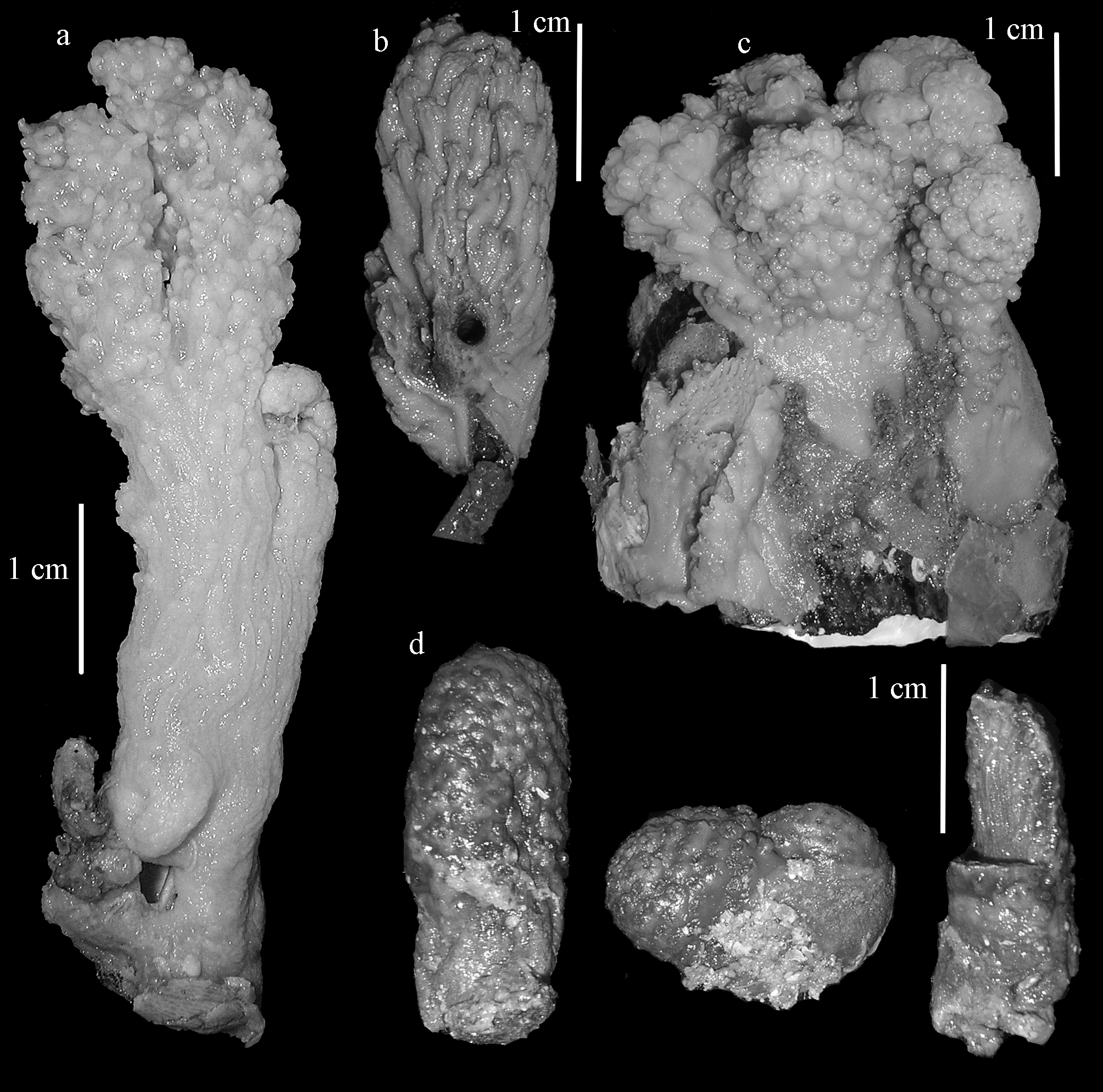
Description. The holotype is an erect lobate colony 5.7 cm in height, with a poorly demarcated stalk approximately 2.5 cm long and 1.0 cm in diameter (Fig. 13 a). It is a fragment of a larger colony (Fig. 5 d). The surface of the stalk is slightly rough, with numerous longitudinal creases and bumps formed by denser aggregations of sclerites. Four elongate, primary lobes, 0.5 – 2.7 cm in length and 0.5 – 1.0 cm in diameter, arise from the stalk; the larger lobes branch to give rise to a few smaller lobes. The polyps are distributed uniformly over the surfaces of the lobes. Polyps are retractile, although in the holotype a majority were preserved with the tentacles extended or in various stages of incomplete retraction. The colony has a flabby consistency, and the surface tissue is thin and easily torn. The polyps have small spindles and rods, 0.07 – 0.16 mm long, in the tentacles (Fig. 14 a). Around the bases of the polyps and in the surface of the polyparium and stalk are radiates, 0.08 – 0.15 mm long (Fig. 14 b), and stout club-like sclerites, 0.11 – 0.18 mm long (Fig. 14 c). The surface of the stalk base has predominantly small radiates, 0.05 – 0.09 mm long (Fig. 14 d). The interior of the colony lacks sclerites. All three paratypes are smaller colonies or portions of colonies, 2.5 cm tall with the stalk constituting about half of the total height. They have from 1 – 3 primary lobes, each subdivided into a few secondary lobes. In all other respects they resemble the holotype. Spherical gametes, 0.25 – 0.55 mm in diameter, can be seen within the stalk of RMNH Coel. 40212 and SAF 099. Color. In life, pale orange to salmon-pink (Fig. 5 d). White or cream in alcohol. Sclerites colorless.
Mcfadden, Catherine S., Van Ofwegen, Leen P. (2017): Revisionary systematics of the endemic soft coral fauna (Octocorallia: Alcyonacea: Alcyoniina) of the Agulhas Bioregion, South Africa. Zootaxa 4363 (4): 451-488, DOI: 10.11646/zootaxa.4363.4.1
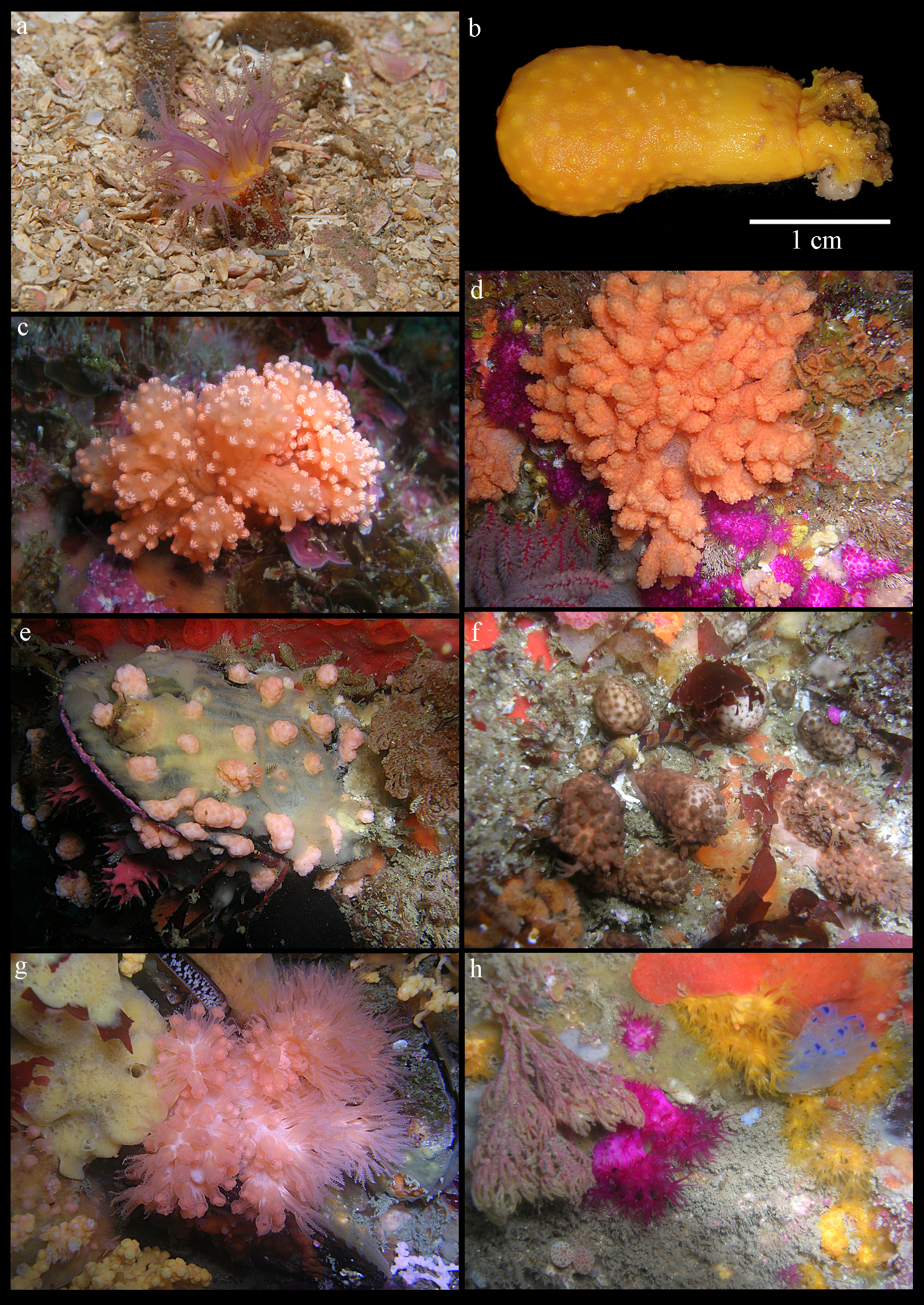
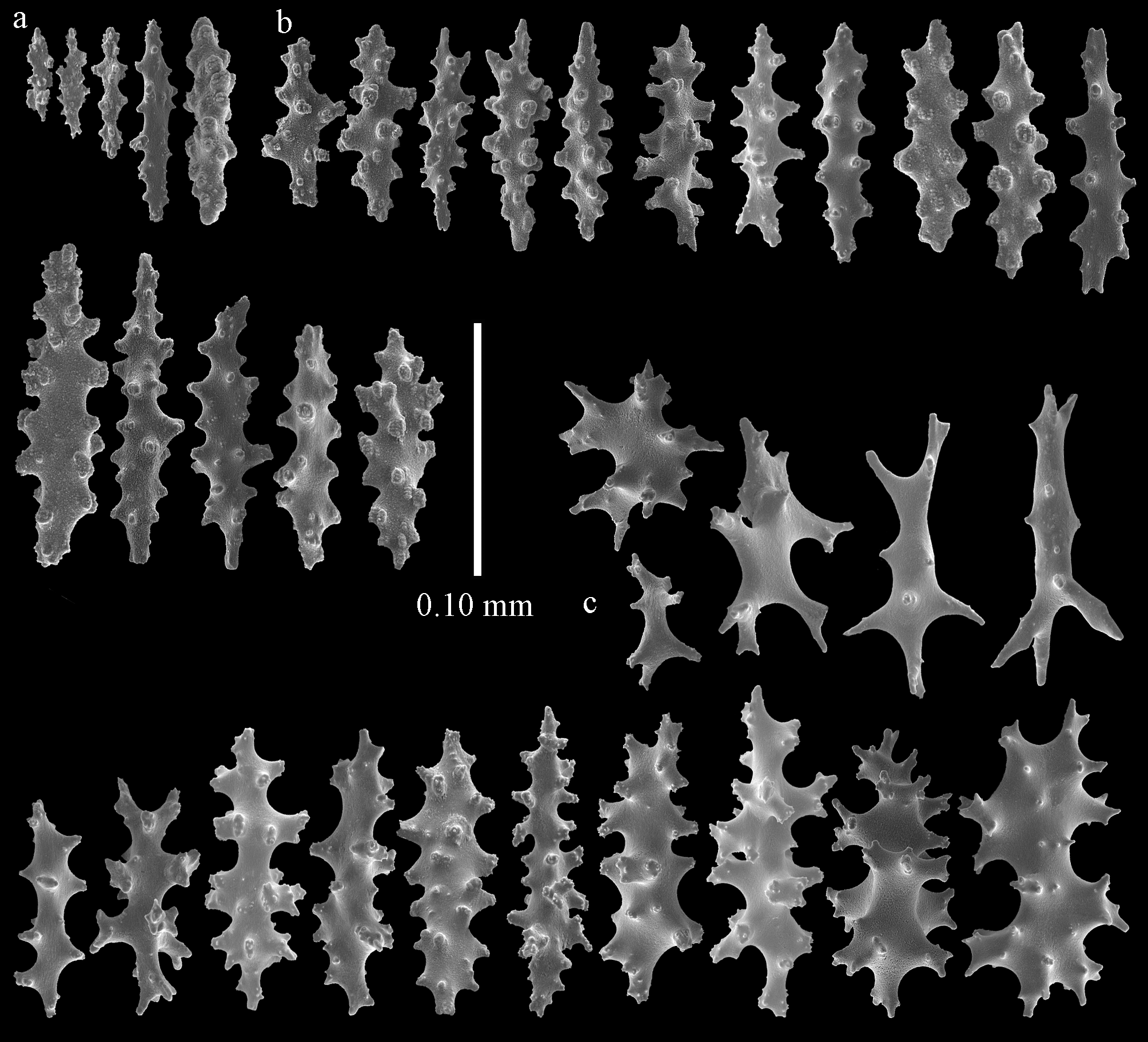
Remarks. Although L. fustis n. sp. and L. benayahui share a similar colony growth form, weakly armored polyps, and both lack sclerites in the colony interior, the form of the sclerites differs greatly between the two congeners (Figs. 12, 14). At present, their geographic ranges are not known to overlap, with L. benayahui found in the subtropical regions of KwaZulu-Natal and L. fustis n. sp. in the cold waters of the Eastern Cape (Algoa and Plettenberg Bays). Superficially, expanded colonies of L. fustis n. sp. resemble the pink color morph of Tenerodus fallax n. comb. (compare Figs. 5 d and 5 g) with which it may co-occur. The form and arrangement of sclerites in the two species differ greatly, however. The heavily armored polyps and surface of T. fallax give the contracted or preserved colony a firm consistency. In contrast, L. fustis n. sp. lacks sclerites in the colony interior and has smaller, more sparsely arranged sclerites in the colony surface, giving the colonies a weak, flabby consistency. L. fustis can be distinguished from Gersemia liltvedi by its fully retractile polyps that are distributed over the entire surface of the branched lobes rather than being restricted to terminal catkins. L. benayahui and L. fustis n. sp. differed at all of the loci we sequenced, with pairwise genetic distances of 2.6 % at 28 S rDNA, 5.4 – 6.0 % at COI and 2.1 – 2.5 % at 16 S rDNA.
Mcfadden, Catherine S., Van Ofwegen, Leen P. (2017): Revisionary systematics of the endemic soft coral fauna (Octocorallia: Alcyonacea: Alcyoniina) of the Agulhas Bioregion, South Africa. Zootaxa 4363 (4): 451-488, DOI: 10.11646/zootaxa.4363.4.1
Etymology. From the Latin fustis, a club or cudgel, in reference to the stout, club-shaped sclerites that surround the base of the polyp.
Mcfadden, Catherine S., Van Ofwegen, Leen P. (2017): Revisionary systematics of the endemic soft coral fauna (Octocorallia: Alcyonacea: Alcyoniina) of the Agulhas Bioregion, South Africa. Zootaxa 4363 (4): 451-488, DOI: 10.11646/zootaxa.4363.4.1
Material examined. Holotype. RMNH Coel. 40211 (SAF 087), South Africa, Eastern Cape, Algoa Bay, Riy Banks, 33 º 59.097 ’ S, 25 º 51.774 ’ E, depth 15 – 20 m, coll. C. S. McFadden, 11 March 2008. Paratypes. RMNH Coel. 40213 (SAF 086), RMNH Coel. 40212 (SAF 088), same data as holotype. Other material. SAF 099, same data as holotype except 33 º 59.069 ’ S, 25 º 51.841 E. UF 2435, South Africa, Plettenberg Bay, Grootbank, depth 9 m, coll. J. Starmer, 22 March 2000.
Mcfadden, Catherine S., Van Ofwegen, Leen P. (2017): Revisionary systematics of the endemic soft coral fauna (Octocorallia: Alcyonacea: Alcyoniina) of the Agulhas Bioregion, South Africa. Zootaxa 4363 (4): 451-488, DOI: 10.11646/zootaxa.4363.4.1

Export occurrence data

Darwin Core Archive (ZIP)

CLASSIFICATION

Taxonomic Classification Tree

MULTIMEDIA

Media Files(4)

FIGURE 5. a, Lampophyton spinatum n. sp. paratype, RMNH Coel. 40199 (SAF195), colony photographed in situ; b, Alcyonium dolium n. sp. holotype, RMNH Coel.40204 (SAF292); c, Leptophyton benayahui SAF289 photographed in situ; d, Leptophyton fustis n. sp., holotype, RMNH Coel. 40211 (SAF087), colony photographed in situ (T. fallax n. comb. purple morph visible in lower right corner); e, Circularius wilsoni n. comb. RMNH Coel. 40207 (SAF448), colonies growing on mussel shell photographed in situ; f, Tenerodus pollex n. gen., n. sp. holotype, RMNH Coel. 40219 (SAF420), colonies photographed in situ; g, Tenerodus fallax, n. comb. RMNH Coel. 40217 (SAF383), pink color morph; h, Tenerodus fallax, n. comb. SAF015, purple and yellow color morphs.
Imageimage/png© Mcfadden, Catherine S.;Van Ofwegen, Leen P.Mcfadden, Catherine S.;Van Ofwegen, Leen P.

FIGURE 12. Leptophyton benayahui, RMNH Coel.40209 (SAF333). a, tentaclesclerites; b, sclerites from proximal region of polyps and colony surface; c, sclerites from base of colony.
Imageimage/png© Mcfadden, Catherine S.;Van Ofwegen, Leen P.Mcfadden, Catherine S.;Van Ofwegen, Leen P.

FIGURE 13. a, Leptophyton fustis n. sp. holotype, RMNH Coel. 40211 (SAF087); b, Tenerodus fallax RMNH Coel. 40215 (SAF067), attached to a polychaete tube; c, Tenerodus fallax RMNH Coel. 40217 (SAF383), growing on a mussel shell; d, Tenerodus pollex n. sp. holotype, RMNH Coel.40219 (SAF420).

Imageimage/png© Mcfadden, Catherine S.;Van Ofwegen, Leen P.Mcfadden, Catherine S.;Van Ofwegen, Leen P.

FIGURE 14. Leptophyton fustis n. sp. holotype, RMNH Coel. 40211 (SAF087). a, tentacle sclerites; b, radiates from colony surface; c, club-like forms from colony surface; d, sclerites from base of stalk.

Imageimage/png© Mcfadden, Catherine S.;Van Ofwegen, Leen P.Mcfadden, Catherine S.;Van Ofwegen, Leen P.

IMAGES

Gallery(4)

See Gallery

Occurrences with images

Source Information

Revisionary systematics of the endemic soft coral fauna (Octocorallia: Alcyonacea: Alcyoniina) of the Agulhas Bioregion, South Africa

checklist

This dataset contains the digitized treatments in Plazi based on the original journal article Mcfadden, Catherine S., Van Ofwegen, Leen P. (2017): Revisionary systematics of the endemic soft coral fauna (Octocorallia: Alcyonacea: Alcyoniina) of the Agulhas Bioregion, South Africa. Zootaxa 4363 (4): 451-488, DOI: 10.11646/zootaxa.4363.4.1

Abstract

The Agulhas Bioregion of southern South Africa supports a unique octocoral fauna that is entirely endemic to the region. Recent molecular phylogenetic studies indicate that this endemism extends to deeper taxonomic levels than had previously been recognized, and that most of these endemic species belong to genera and families that are also endemic to South Africa. Here we revise the taxonomy of soft corals (subordinal group Alcyoniina) that were previously assigned to the cosmopolitan families Alcyoniidae, Nephtheidae and Nidaliidae, describing three new families endemic to South Africa, along with four new genera and four new species. We reassign the endemic genera Acrophytum, Pieterfaurea and Lampophyton to Acrophytidae n. fam, and describe a new species of Lampophyton, L. spinatum n. sp. The endemic species Protodendron bruuni is reassigned to a new, monotypic genus, Corymbophyton bruuni n. comb., and family, Corymbophytidae n. fam. The endemic genus Leptophyton is placed in a third new family, Leptophytidae n. fam., along with three new genera that are established for species previously assigned to Alcyonium: Circularius wilsoni n. comb., Porphyrophyton distinctum n. comb., and Tenerodus fallax n. comb. In addition, we describe new species of Leptophyton, L. fustis n. sp.; Tenerodus, T. pollex n. gen. n. sp.; and Alcyonium, A. dolium n. sp.; reassign Protodendron verseveldti to Tenerodus verseveldti n. comb.; and reassign the endemic genus Dimorphophyton to family Paralcyoniidae. Although molecular phylogenetic analyses unite Acrophytidae, Corymbophytidae and Leptophytidae within a well-supported monophyletic group, both morphological and molecular distinctions support maintaining them as three separate families. These revisions increase the number of endemic species of shallow-water soft corals known from the Agulhas Bioregion to 40, and the number of endemic genera to 13.

Key words: molecular phylogenetics, Acrophytum, Alcyonium, Dimorphophyton, Lampophyton, Leptophyton, Pieterfaurea, Protodendron

Mcfadden C S, Van Ofwegen L P, plazi (2017). Revisionary systematics of the endemic soft coral fauna (Octocorallia: Alcyonacea: Alcyoniina) of the Agulhas Bioregion, South Africa. Plazi.org taxonomic treatments database. Checklist dataset https://doi.org/10.11646/zootaxa.4363.4.1 accessed via GBIF.org on 2026-06-17.

CC0Published 12/13/2017View dataset
GBIF Usage Key
137679934
Dataset Key
a141fa76-cc88-4901-944a-306171e41413
Origin
source
Backbone Key
9538813
Taxon ID
038A07766C1C2862FF245D06FE334B22.taxon
Last Crawled
6/10/2026
Last Interpreted
6/10/2026