
AnimaliaNot EvaluatedacceptedspeciesAccepted
Tenerodus pollex

Tenerodus pollex

Mcfadden & Van Ofwegen, 2017

GBIF:137679938

0year

ABOUT

Descriptions(5)

? Alcyonium fauri (non Thomson, 1910) Broch, 1939: 11 (part); Williams 1992 a: fig. 13 C, 14 C.
Mcfadden, Catherine S., Van Ofwegen, Leen P. (2017): Revisionary systematics of the endemic soft coral fauna (Octocorallia: Alcyonacea: Alcyoniina) of the Agulhas Bioregion, South Africa. Zootaxa 4363 (4): 451-488, DOI: 10.11646/zootaxa.4363.4.1
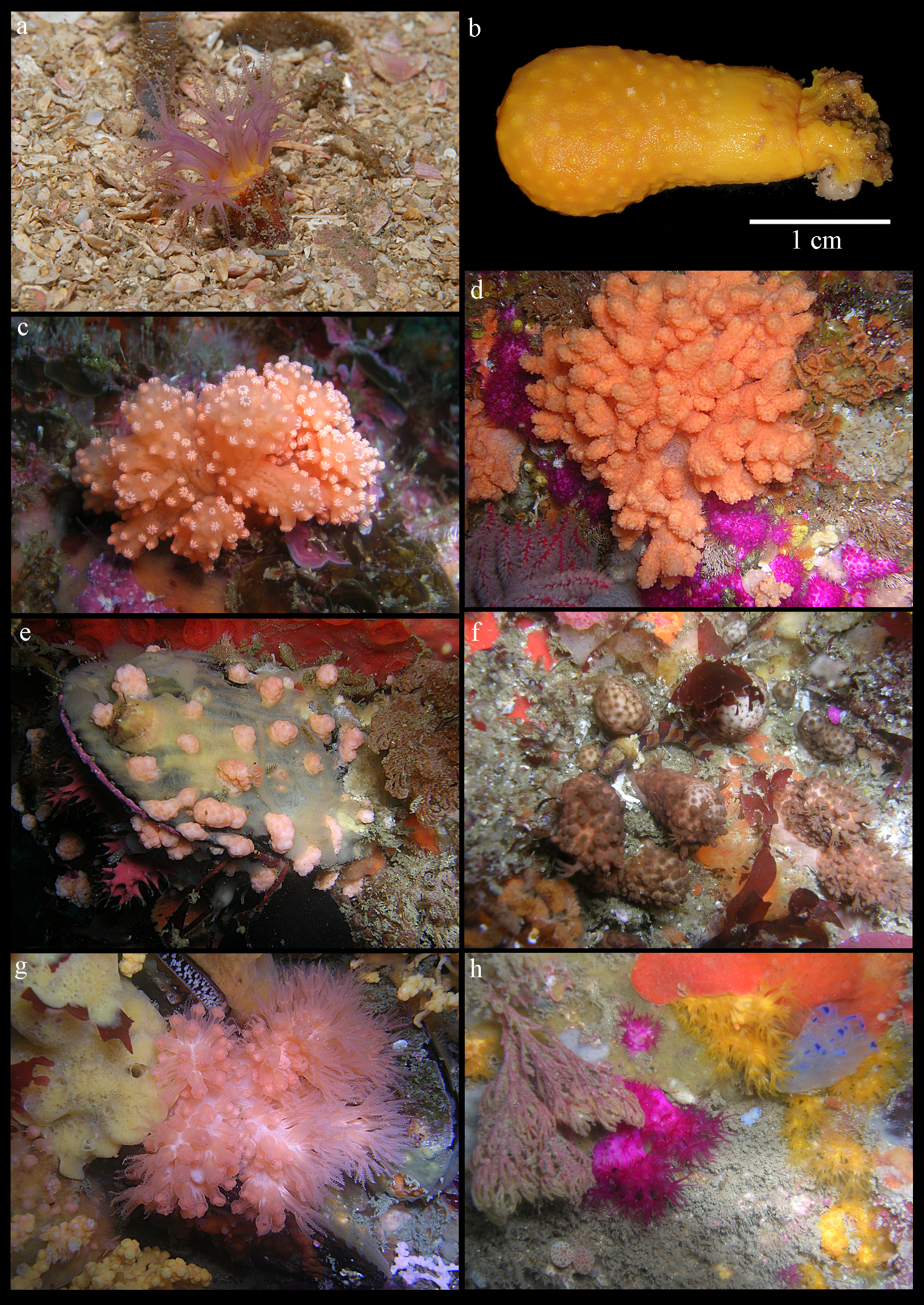
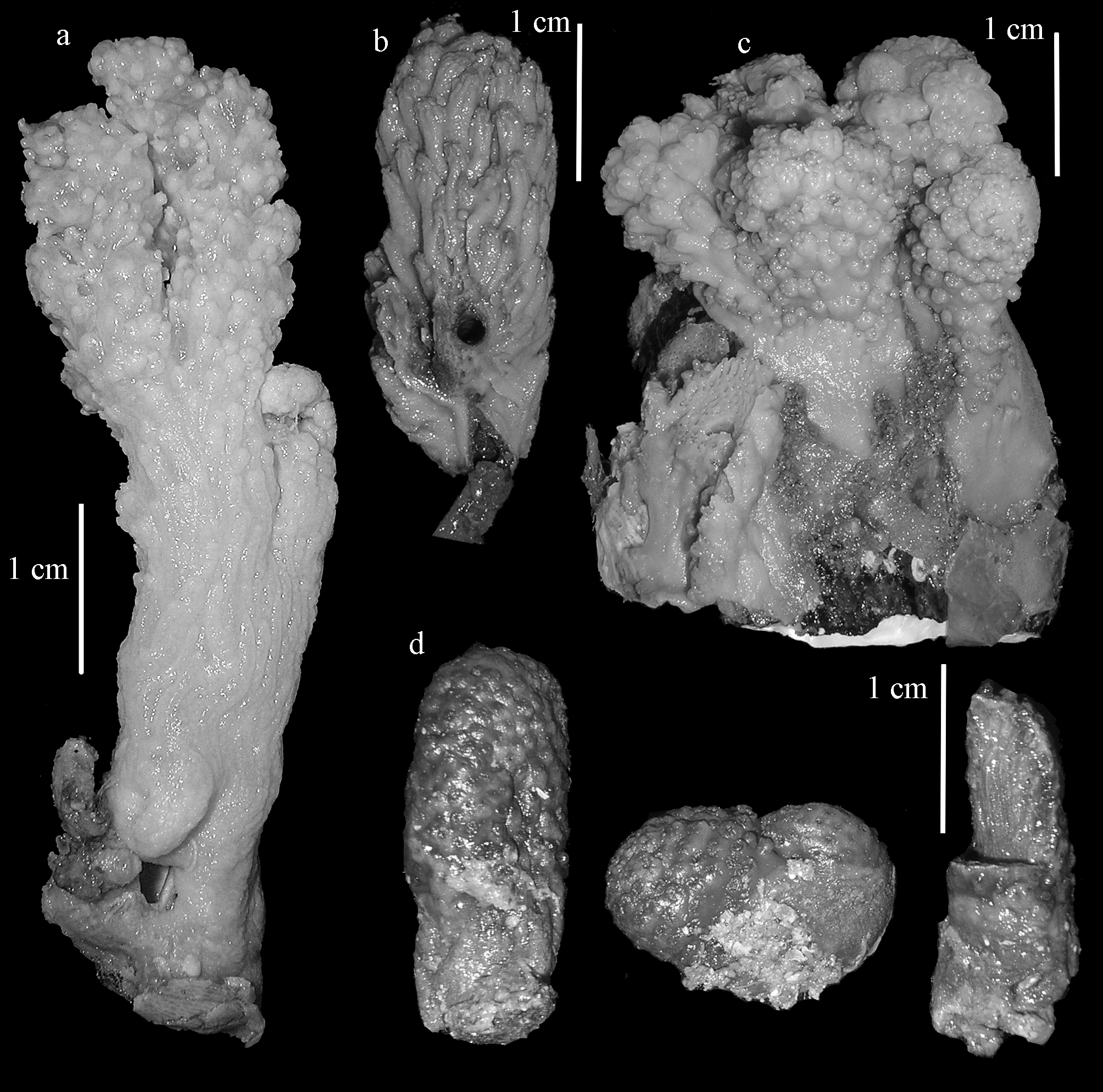
Description. The holotype consists of three small, digitate lobes that may originally have been attached at the base but are now separated (Fig. 13 d). The largest of the three is 2.4 cm tall and 1.0 cm in diameter, with a stalk of 1.0 cm. The smallest lobe is 2.1 cm tall and 0.8 cm in diameter, and has had approximately half the polyparium removed for DNA analysis. The stalk and polyparium are demarcated only by the presence of polyps in the latter, and by a slight difference in color, with the polyparium darker than the stalk. The stalk is somewhat rough in appearance and has a number of longitudinal and transverse wrinkles. When fully retracted the polyps are visible as small mounds on the colony surface. The polyps are devoid of sclerites except for a few small rods, 0.10 – 0.13 mm long, found in the tentacles (Fig. 17 a). The sclerites of the surface of the polyparium and stalk are club-like forms, irregular ovals and radiates, 0.13 – 0.20 mm long and up to 0.10 mm wide, all densely ornamented with complex tubercles (Fig. 17 b, c). At the base of the stalk the same sclerite forms are present only slightly smaller, 0.09 – 0.17 mm long (Fig. 18). The interior of the colony has the same sclerite forms as the surface. The two paratypes and SAF 419 are similar, small digitate colonies to 2.5 cm tall. Both paratypes consist of a single small lobe and two lobes that may have been separated from a common base. In SAF 419 three lobes remain attached via a common stalk. In all other respects the paratypes and SAF 419 resemble the holotype. Color. In life orange-brown (Fig. 5 f). In alcohol, brown with darker brown polyps. Sclerites colorless or white.
Mcfadden, Catherine S., Van Ofwegen, Leen P. (2017): Revisionary systematics of the endemic soft coral fauna (Octocorallia: Alcyonacea: Alcyoniina) of the Agulhas Bioregion, South Africa. Zootaxa 4363 (4): 451-488, DOI: 10.11646/zootaxa.4363.4.1
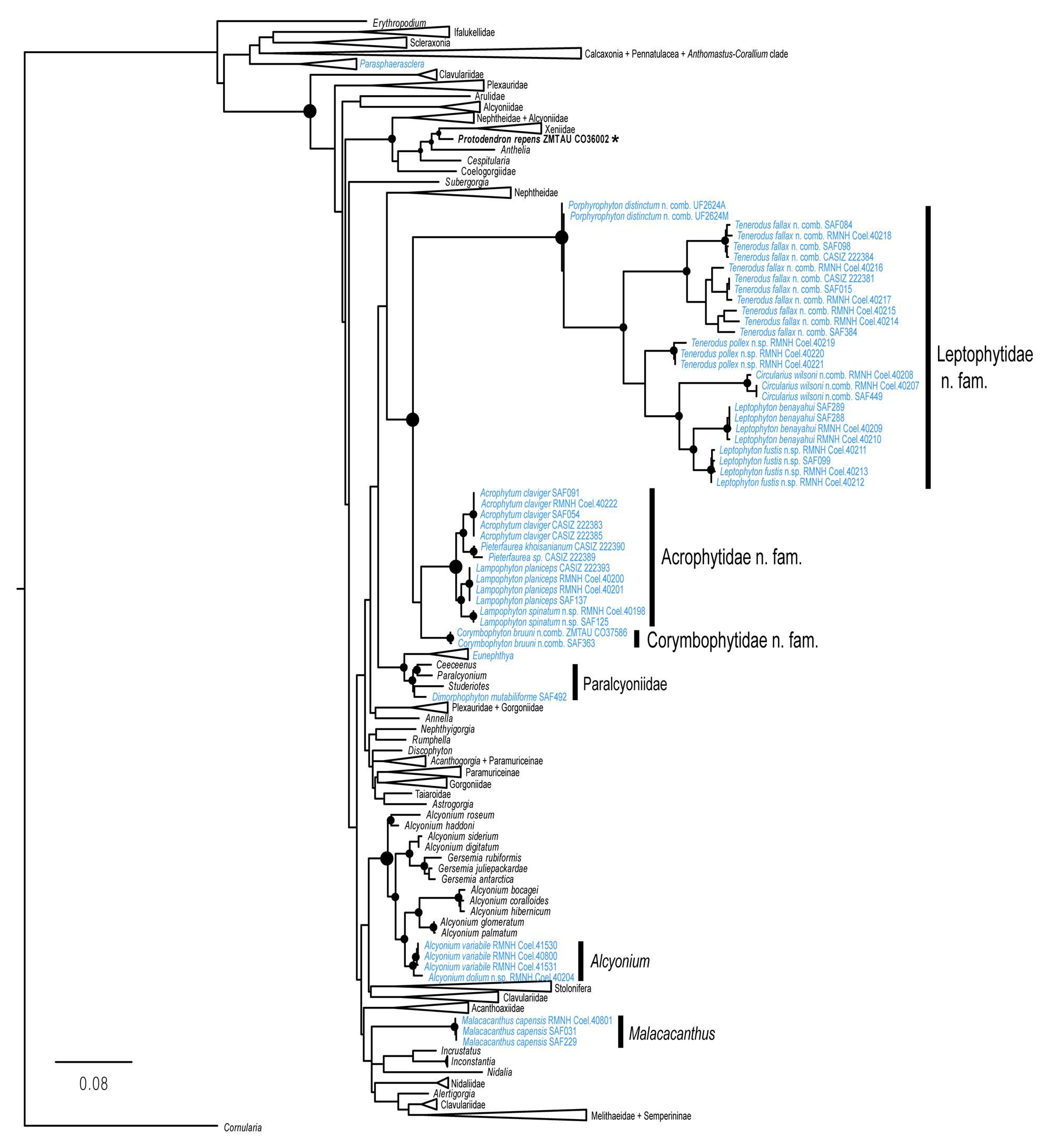
Remarks. Broch (1939) discussed a specimen from Table Bay, Cape Peninsula that he considered to be a close match to Thomson’s (1910) description of Alcyonium fauri. He described it as brown in color with darker brown polyps and white sclerites that in places gave the colony surface “ a chalky appearance, ” an effect we also see in the holotype of T. pollex n. sp. Broch’s specimen lacked sclerites in the polyps, and in addition to the “ double-wheels ” depicted by Thomson (1910) it also had club-like sclerites in the upper part of the colony; Broch’s sketch of this sclerite type quite closely resembles the broad, triangular club-like forms we see in T. pollex n. sp. Williams (1992 a) included a brown color morph within A. fauri sensu lato, and several of his illustrations of variants of that species (e. g., Figs. 13 C, 14 C) closely resemble T. pollex n. sp. In addition, some of the very irregular sclerite forms depicted in his Fig. 14 D more closely resemble those found in T. pollex n. sp. than the spheroids and radiates typical of T. fallax n. comb. T. fallax n. comb. and T. pollex n. sp. differ from one another by pairwise genetic distances of 1.7 – 1.8 % at 28 S rDNA, 13.4 – 16.0 % at COI, and 8.6 – 10.4 % at 16 S. Although the phylogenetic analysis suggests that T. pollex n. sp. is sister to [Circularius n. gen. + Leptophyton] (Fig. 1), support for that relationship is relatively weak, and we consider its morphological similarity to T. fallax n. comb. sufficient to place them in the same genus.
Mcfadden, Catherine S., Van Ofwegen, Leen P. (2017): Revisionary systematics of the endemic soft coral fauna (Octocorallia: Alcyonacea: Alcyoniina) of the Agulhas Bioregion, South Africa. Zootaxa 4363 (4): 451-488, DOI: 10.11646/zootaxa.4363.4.1
Etymology. From the Latin pollex, thumb or big toe, in reference to the shapes of the contracted lobes.
Mcfadden, Catherine S., Van Ofwegen, Leen P. (2017): Revisionary systematics of the endemic soft coral fauna (Octocorallia: Alcyonacea: Alcyoniina) of the Agulhas Bioregion, South Africa. Zootaxa 4363 (4): 451-488, DOI: 10.11646/zootaxa.4363.4.1
Material examined. Holotype. RMNH Coel. 40219 (SAF 420), South Africa, Western Cape, Cape Peninsula, Oudekraal, Justin’s Caves, 33 º 58.899 ' S, 18 º 21.590 ' E, depth 7 – 11 m, coll. C. S. McFadden, 24 March 2008. Paratypes. RMNH Coel. 40221 (SAF 417), RMNH Coel. 40220 (SAF 418), same data as holotype. Other material. SAF 419, same data as holotype.
Mcfadden, Catherine S., Van Ofwegen, Leen P. (2017): Revisionary systematics of the endemic soft coral fauna (Octocorallia: Alcyonacea: Alcyoniina) of the Agulhas Bioregion, South Africa. Zootaxa 4363 (4): 451-488, DOI: 10.11646/zootaxa.4363.4.1

Export occurrence data

Darwin Core Archive (ZIP)

CLASSIFICATION

Taxonomic Classification Tree

MULTIMEDIA

Media Files(6)

FIGURE 1. Maximum likelihood phylogeny of Octocorallia based on combined, partitioned analysis of 28S rDNA, COI and 16S mtDNA.South African species and clades are identified in blue. Filled circles indicate nodes with>70% bootstrap support and Bayesian posterior probabilities>0.95 (shown for South African clades only). Strongly supported clades (bootstrap 70%) with no South African members have been collapsed to facilitate readability. Phylogenetic position of Protodendron repens indicated with *.
Imageimage/png© Mcfadden, Catherine S.;Van Ofwegen, Leen P.Mcfadden, Catherine S.;Van Ofwegen, Leen P.

FIGURE 5. a, Lampophyton spinatum n. sp. paratype, RMNH Coel. 40199 (SAF195), colony photographed in situ; b, Alcyonium dolium n. sp. holotype, RMNH Coel.40204 (SAF292); c, Leptophyton benayahui SAF289 photographed in situ; d, Leptophyton fustis n. sp., holotype, RMNH Coel. 40211 (SAF087), colony photographed in situ (T. fallax n. comb. purple morph visible in lower right corner); e, Circularius wilsoni n. comb. RMNH Coel. 40207 (SAF448), colonies growing on mussel shell photographed in situ; f, Tenerodus pollex n. gen., n. sp. holotype, RMNH Coel. 40219 (SAF420), colonies photographed in situ; g, Tenerodus fallax, n. comb. RMNH Coel. 40217 (SAF383), pink color morph; h, Tenerodus fallax, n. comb. SAF015, purple and yellow color morphs.
Imageimage/png© Mcfadden, Catherine S.;Van Ofwegen, Leen P.Mcfadden, Catherine S.;Van Ofwegen, Leen P.

FIGURE 13. a, Leptophyton fustis n. sp. holotype, RMNH Coel. 40211 (SAF087); b, Tenerodus fallax RMNH Coel. 40215 (SAF067), attached to a polychaete tube; c, Tenerodus fallax RMNH Coel. 40217 (SAF383), growing on a mussel shell; d, Tenerodus pollex n. sp. holotype, RMNH Coel.40219 (SAF420).

Imageimage/png© Mcfadden, Catherine S.;Van Ofwegen, Leen P.Mcfadden, Catherine S.;Van Ofwegen, Leen P.

FIGURE 14. Leptophyton fustis n. sp. holotype, RMNH Coel. 40211 (SAF087). a, tentacle sclerites; b, radiates from colony surface; c, club-like forms from colony surface; d, sclerites from base of stalk.

Imageimage/png© Mcfadden, Catherine S.;Van Ofwegen, Leen P.Mcfadden, Catherine S.;Van Ofwegen, Leen P.

FIGURE 17. Tenerodus pollex n. sp. holotype, RMNH Coel. 40219 (SAF420). a, tentacle sclerites; b, club-like sclerites from surface of polypariumand stalk; c,irregular ovals from surface of polyparium and stalk.

Imageimage/png© Mcfadden, Catherine S.;Van Ofwegen, Leen P.Mcfadden, Catherine S.;Van Ofwegen, Leen P.

FIGURE 18. Tenerodus pollex n. sp. holotype, RMNH Coel. 40219 (SAF420).Sclerites from base of colony.

Imageimage/png© Mcfadden, Catherine S.;Van Ofwegen, Leen P.Mcfadden, Catherine S.;Van Ofwegen, Leen P.

IMAGES

Gallery(6)

See Gallery

Occurrences with images

Source Information

Revisionary systematics of the endemic soft coral fauna (Octocorallia: Alcyonacea: Alcyoniina) of the Agulhas Bioregion, South Africa

checklist

This dataset contains the digitized treatments in Plazi based on the original journal article Mcfadden, Catherine S., Van Ofwegen, Leen P. (2017): Revisionary systematics of the endemic soft coral fauna (Octocorallia: Alcyonacea: Alcyoniina) of the Agulhas Bioregion, South Africa. Zootaxa 4363 (4): 451-488, DOI: 10.11646/zootaxa.4363.4.1

Abstract

The Agulhas Bioregion of southern South Africa supports a unique octocoral fauna that is entirely endemic to the region. Recent molecular phylogenetic studies indicate that this endemism extends to deeper taxonomic levels than had previously been recognized, and that most of these endemic species belong to genera and families that are also endemic to South Africa. Here we revise the taxonomy of soft corals (subordinal group Alcyoniina) that were previously assigned to the cosmopolitan families Alcyoniidae, Nephtheidae and Nidaliidae, describing three new families endemic to South Africa, along with four new genera and four new species. We reassign the endemic genera Acrophytum, Pieterfaurea and Lampophyton to Acrophytidae n. fam, and describe a new species of Lampophyton, L. spinatum n. sp. The endemic species Protodendron bruuni is reassigned to a new, monotypic genus, Corymbophyton bruuni n. comb., and family, Corymbophytidae n. fam. The endemic genus Leptophyton is placed in a third new family, Leptophytidae n. fam., along with three new genera that are established for species previously assigned to Alcyonium: Circularius wilsoni n. comb., Porphyrophyton distinctum n. comb., and Tenerodus fallax n. comb. In addition, we describe new species of Leptophyton, L. fustis n. sp.; Tenerodus, T. pollex n. gen. n. sp.; and Alcyonium, A. dolium n. sp.; reassign Protodendron verseveldti to Tenerodus verseveldti n. comb.; and reassign the endemic genus Dimorphophyton to family Paralcyoniidae. Although molecular phylogenetic analyses unite Acrophytidae, Corymbophytidae and Leptophytidae within a well-supported monophyletic group, both morphological and molecular distinctions support maintaining them as three separate families. These revisions increase the number of endemic species of shallow-water soft corals known from the Agulhas Bioregion to 40, and the number of endemic genera to 13.

Key words: molecular phylogenetics, Acrophytum, Alcyonium, Dimorphophyton, Lampophyton, Leptophyton, Pieterfaurea, Protodendron

Mcfadden C S, Van Ofwegen L P, plazi (2017). Revisionary systematics of the endemic soft coral fauna (Octocorallia: Alcyonacea: Alcyoniina) of the Agulhas Bioregion, South Africa. Plazi.org taxonomic treatments database. Checklist dataset https://doi.org/10.11646/zootaxa.4363.4.1 accessed via GBIF.org on 2026-06-16.

CC0Published 12/13/2017View dataset
GBIF Usage Key
137679938
Dataset Key
a141fa76-cc88-4901-944a-306171e41413
Origin
source
Backbone Key
9464500
Taxon ID
038A07766C162865FF245B2EFE334DAE.taxon
Last Crawled
6/10/2026
Last Interpreted
6/10/2026