
AnimaliaNot EvaluatedacceptedspeciesAccepted
Tenerodus fallax

Tenerodus fallax

(Luttschwager, 1922) Mcfadden & Van Ofwegen, 2017

GBIF:137679939

0year

0

Synonyms

ABOUT

Descriptions(4)

Alcyonium fallax Lüttschwager, 1922 (nom. nov.): 520, 534; Lüttschwager, 1926: 288. Alcyonium fauri (non Thomson, 1910) Broch, 1939: 8 – 11; Williams, 1992 a (part): 277 – 282, fig. 1 B; 1992 b: 381 – 385, 396, fig. 20 G; Branch et al. 2010: 38, fig. 12.8.
Mcfadden, Catherine S., Van Ofwegen, Leen P. (2017): Revisionary systematics of the endemic soft coral fauna (Octocorallia: Alcyonacea: Alcyoniina) of the Agulhas Bioregion, South Africa. Zootaxa 4363 (4): 451-488, DOI: 10.11646/zootaxa.4363.4.1
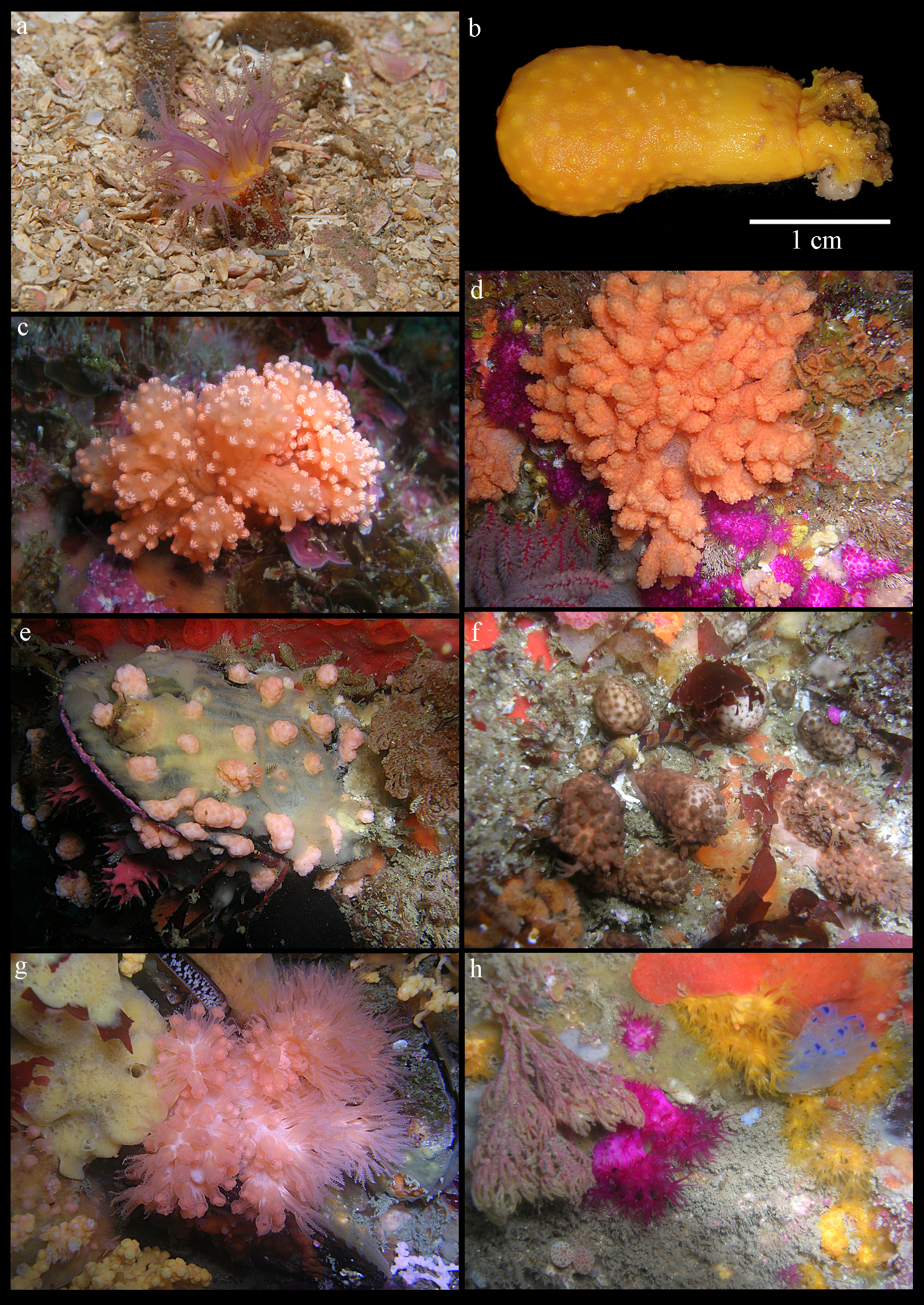
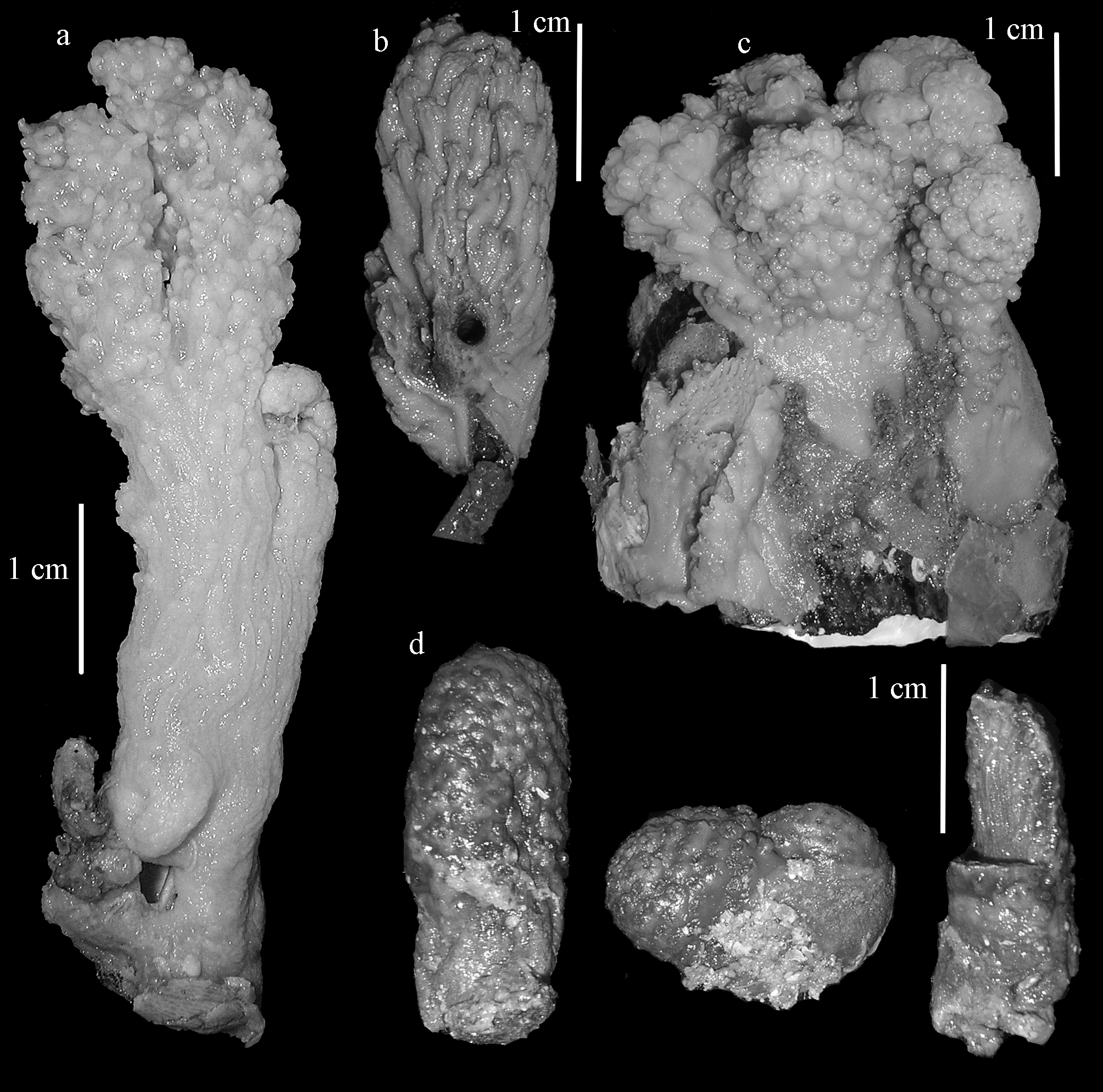
Description. As re-described by Williams (1992 a), Alcyonium fauri Thomson sensu lato encompasses material with a wide range of colony growth forms (“ membranous, globular to capitate, or lobate ”), colors (“ purple, pink, white, golden yellow, orange, or dark smoke-grey to dark brown ”), and polyp armature (polyp sclerites ranging from dense to very sparse or absent). We consider it likely that multiple species have been lumped within this broad definition of this taxon. Here we re-describe newly collected material that matches the original description of Alcyonium purpureum Hickson (= Alcyonium fallax Lüttschwager) and Thomson’s (1910) later more detailed description of that species. Some of our material was collected from a site very close to the type locality in Mossel Bay. T. fallax n. comb. forms encrusting to lobate colonies in which the polyps arise from a membranous base and are fused together along their lengths to form a more-or-less homogeneous mass (Fig. 13 b, c). The polyps are prominent, and remain oriented vertically with their oral surfaces facing upwards, even when retracted. There is little colony coenenchyme between neighboring polyps, with the result that in those polyps that are located on the periphery of the colony the entire length of the polyp body remains visible and distinguishable from its neighbors. When fully retracted the polyps remain visible as coenenchymal mounds. Colonies range from encrusting, a few mm thick, to erect forms> 3 cm tall with multiple lobes. They often grow attached to other organisms such as worm tubes or bivalve shells. The polyp sclerites are robust spindles and slightly clubbed forms, 0.16 – 0.25 mm long, with complex tubercles (Fig. 15 a), and torch-like clubs, 0.13 – 0.22 mm long, with asymmetrical heads of smooth, spinose processes (Fig. 15 b). They are arranged in eight longitudinal tracts in the base of the polyp and extend distally to form points at the bases of the tentacles. A collaret of transverse sclerites is lacking. The tentacles have smooth, flat, antler-like rods, 0.12 – 0.18 mm long (Fig. 15 c). In the surface of the polyparium and base of the colony there are radiates, 0.06 – 0.11 mm long, and tuberculate spheroids, 0.08 – 0.13 mm long (Fig. 15 d), in addition to the same types of spindles and clubs found in the polyps. As one moves from the base of a polyp to the base of the colony the proportion of sclerite types shifts gradually from predominantly spindles and clubs to predominantly radiates and spheroids, but there is no sharp demarcation in sclerite form between different anatomical regions. The colony interior contains mostly spheres and radiates of the same sizes and shapes as those found in the surface of the base (Fig. 16). Color. In life, vivid purple, yellow, pink, or white with purple or yellow highlights (Fig. 5 g, h). All colors turn brown to cream in EtOH. Sclerites colorless.
Mcfadden, Catherine S., Van Ofwegen, Leen P. (2017): Revisionary systematics of the endemic soft coral fauna (Octocorallia: Alcyonacea: Alcyoniina) of the Agulhas Bioregion, South Africa. Zootaxa 4363 (4): 451-488, DOI: 10.11646/zootaxa.4363.4.1
Remarks. Hickson (1904) first described Alcyonium purpureum non Lamarck, a bright purple colony collected from the jetty at Mossel Bay. Thomson (1910) subsequently identified this same species in his material. Thomson’s description and illustration of A. purpureum Hickson best matches the specimens described here: colonies consisting of a number of lobes arising from an encrusting membrane; sclerite forms are mostly clubs, spindles, tuberculate spheres and " double spheres ", similar in all parts of the colony; spindles arranged in eight parallel bands and irregularly en chevron in the polyps; some radiates (“ double clubs ”) in the colony base; color in life due to a soluble purple pigment. From this description we conclude that our material corresponds to Thomson’s A. purpureum Hickson. Lüttschwager (1922) recognized that the name A. purpureum used by Hickson was preoccupied by a species from Australia (A. purpureum Linnaeus), and re-named the South African species Alcyonium fallax nom. nov. In the same paper in which he identified purple, lobate colonies as A. purpureum Hickson, Thomson (1910) described Alcyonium fauri, a brown, encrusting colony that lacks sclerites in the polyps and colony interior, and has only “ double wheels ” in the colony surface. From his illustrations these sclerites appear to be compact radiates or spheroids with sparse ornamentation and a median waist. Based on examination of material collected by Carlgren (and apparently not the material of Thomson), Broch (1939) concluded that there was wide variation in the degree of polyp armature and presence of interior sclerites among specimens, and consequently synonymized A. fauri with A. fallax, the former name taking precedence. Williams (1992 a) accepted Broch’s conclusion that A. fauri and A. purpureum Hickson (= A. fallax Lüttschwager) are synonyms, but he also does not appear to have examined the material of Thomson. Thomson's original material was also unavailable to us for examination, but based on his illustrations and detailed descriptions, we disagree that these two forms are synonymous, and retain the species name fallax for material that fits the description given above. Thomson’s (1910) description of A. fauri does not closely match any species recorded subsequently from South Africa with the possible exception of Porphyrophyton distinctum n. comb. (see remarks above for that species). Although Williams (1992 a) illustrated the range of variation in polyp armature and sclerite form he observed among three colonies he examined, he did not indicate which specimens were illustrated or which sclerite variants came from which colony. The absence of such information makes it impossible to determine if any of the specimens he included within A. fauri sensu lato match those we recognize here as different species. The colony forms he illustrates in Figs. 1 B, 13 B, and 13 E, and the polyp armature depicted in Fig. 14 A most closely match T. fallax n. comb.
Mcfadden, Catherine S., Van Ofwegen, Leen P. (2017): Revisionary systematics of the endemic soft coral fauna (Octocorallia: Alcyonacea: Alcyoniina) of the Agulhas Bioregion, South Africa. Zootaxa 4363 (4): 451-488, DOI: 10.11646/zootaxa.4363.4.1
Material examined. RMNH Coel. 40218 (SAF 013), CASIZ 222381 (SAF 014), SAF 015, South Africa, Western Cape, Mossel Bay, Phluffy Reef, 34 º 10.988 ' S, 22 º 09.745 ' E, depth 12 – 15 m, coll. C. S. McFadden, 0 8 March 2008. RMNH Coel. 40216 (SAF 059), RMNH Coel. 40215 (SAF 067), South Africa, Eastern Cape, Port Elizabeth, Algoa Bay, Bell Buoy 1, 33 º 58.927 ’ S, 25 º 41.473 ’ E, depth 20 m, coll. C. S. McFadden, 10 March 2008. RMNH Coel. 40214 (SAF 072), CASIZ 222384 (SAF 073), SAF 084, South Africa, Eastern Cape, Port Elizabeth, Algoa Bay, Philips Reef, 33 º 15.933 ' S, 25 º 41.768 ' E, depth 10 – 12 m, coll. C. S. McFadden, 10 March 2008. SAF 098, South Africa, Eastern Cape, Port Elizabeth, Algoa Bay, Riy Banks, 33 º 59.069 ' S, 25 º 51.841 ' E, depth 14 – 17 m, coll. C. S. McFadden, 11 March 2008. RMNH Coel. 40217 (SAF 383), SAF 384, CASIZ 222395 (SAF 386), South Africa, Western Cape, Cape Peninsula, Vulcan Rock, 34 º 03.970 ' S, 18 º 18.627 ' E, depth 15 – 27 m, coll. C. S. McFadden, 23 March 2008.
Mcfadden, Catherine S., Van Ofwegen, Leen P. (2017): Revisionary systematics of the endemic soft coral fauna (Octocorallia: Alcyonacea: Alcyoniina) of the Agulhas Bioregion, South Africa. Zootaxa 4363 (4): 451-488, DOI: 10.11646/zootaxa.4363.4.1

Export occurrence data

Darwin Core Archive (ZIP)

CLASSIFICATION

Taxonomic Classification Tree

MULTIMEDIA

Media Files(6)

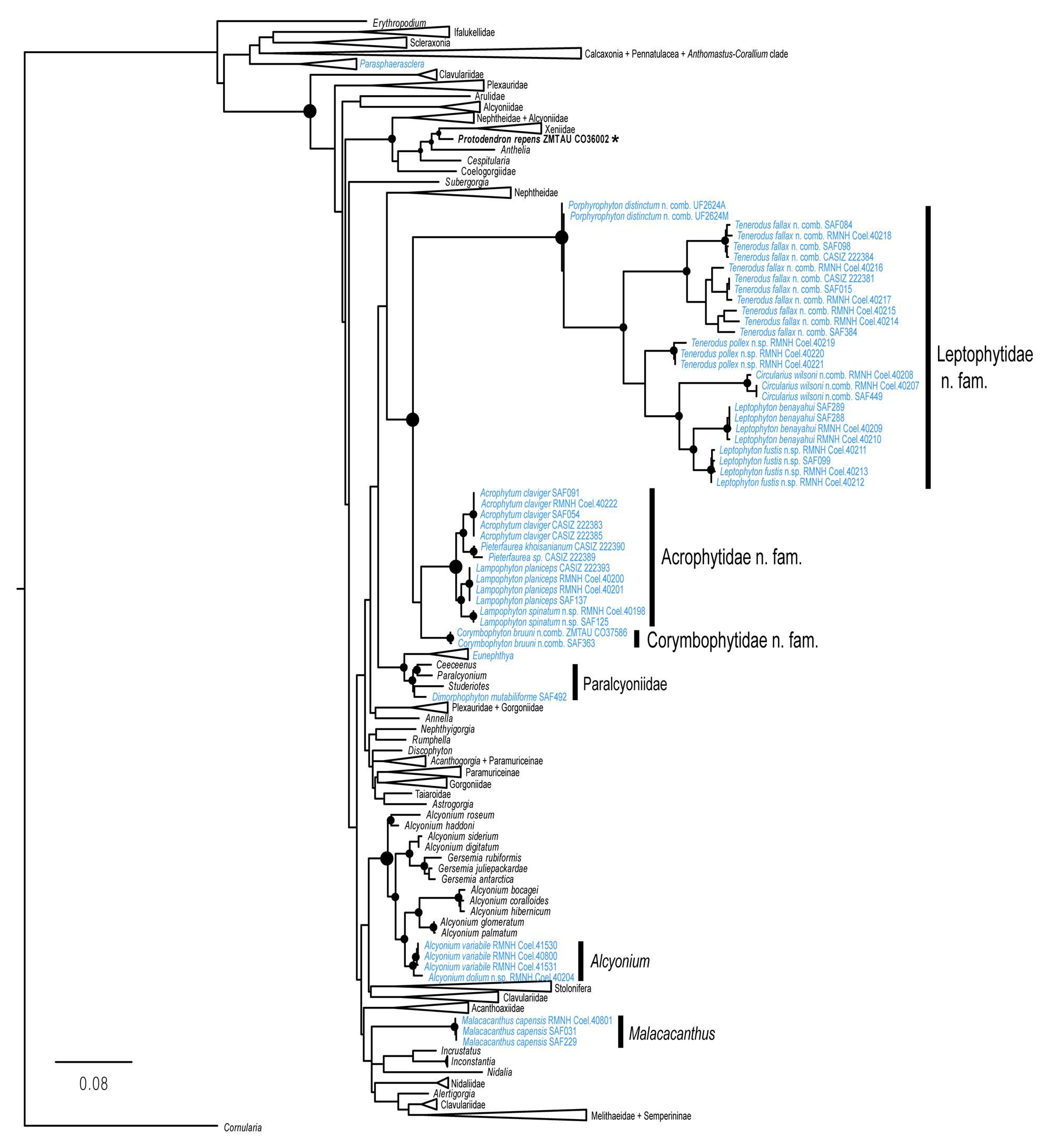
FIGURE 1. Maximum likelihood phylogeny of Octocorallia based on combined, partitioned analysis of 28S rDNA, COI and 16S mtDNA.South African species and clades are identified in blue. Filled circles indicate nodes with>70% bootstrap support and Bayesian posterior probabilities>0.95 (shown for South African clades only). Strongly supported clades (bootstrap 70%) with no South African members have been collapsed to facilitate readability. Phylogenetic position of Protodendron repens indicated with *.
Imageimage/png© Mcfadden, Catherine S.;Van Ofwegen, Leen P.Mcfadden, Catherine S.;Van Ofwegen, Leen P.

FIGURE 5. a, Lampophyton spinatum n. sp. paratype, RMNH Coel. 40199 (SAF195), colony photographed in situ; b, Alcyonium dolium n. sp. holotype, RMNH Coel.40204 (SAF292); c, Leptophyton benayahui SAF289 photographed in situ; d, Leptophyton fustis n. sp., holotype, RMNH Coel. 40211 (SAF087), colony photographed in situ (T. fallax n. comb. purple morph visible in lower right corner); e, Circularius wilsoni n. comb. RMNH Coel. 40207 (SAF448), colonies growing on mussel shell photographed in situ; f, Tenerodus pollex n. gen., n. sp. holotype, RMNH Coel. 40219 (SAF420), colonies photographed in situ; g, Tenerodus fallax, n. comb. RMNH Coel. 40217 (SAF383), pink color morph; h, Tenerodus fallax, n. comb. SAF015, purple and yellow color morphs.
Imageimage/png© Mcfadden, Catherine S.;Van Ofwegen, Leen P.Mcfadden, Catherine S.;Van Ofwegen, Leen P.

FIGURE 13. a, Leptophyton fustis n. sp. holotype, RMNH Coel. 40211 (SAF087); b, Tenerodus fallax RMNH Coel. 40215 (SAF067), attached to a polychaete tube; c, Tenerodus fallax RMNH Coel. 40217 (SAF383), growing on a mussel shell; d, Tenerodus pollex n. sp. holotype, RMNH Coel.40219 (SAF420).

Imageimage/png© Mcfadden, Catherine S.;Van Ofwegen, Leen P.Mcfadden, Catherine S.;Van Ofwegen, Leen P.

FIGURE 14. Leptophyton fustis n. sp. holotype, RMNH Coel. 40211 (SAF087). a, tentacle sclerites; b, radiates from colony surface; c, club-like forms from colony surface; d, sclerites from base of stalk.

Imageimage/png© Mcfadden, Catherine S.;Van Ofwegen, Leen P.Mcfadden, Catherine S.;Van Ofwegen, Leen P.

FIGURE 15. Tenerodus fallax n. comb. RMNH Coel. 40214 (SAF072). a, club-like sclerites from polyps and colony surface; b, asymmetrical spinose clubs from polyps and colony surface; c, tentacle sclerites; d, radiates and tuberculate spheroids from colony surface.

Imageimage/png© Mcfadden, Catherine S.;Van Ofwegen, Leen P.Mcfadden, Catherine S.;Van Ofwegen, Leen P.

FIGURE 16. Tenerodus fallax n. comb. RMNH Coel. 40214 (SAF072). Radiates and tuberculate spheroids from interior of colony.

Imageimage/png© Mcfadden, Catherine S.;Van Ofwegen, Leen P.Mcfadden, Catherine S.;Van Ofwegen, Leen P.

IMAGES

Gallery(6)

See Gallery

Occurrences with images

Source Information

Revisionary systematics of the endemic soft coral fauna (Octocorallia: Alcyonacea: Alcyoniina) of the Agulhas Bioregion, South Africa

checklist

This dataset contains the digitized treatments in Plazi based on the original journal article Mcfadden, Catherine S., Van Ofwegen, Leen P. (2017): Revisionary systematics of the endemic soft coral fauna (Octocorallia: Alcyonacea: Alcyoniina) of the Agulhas Bioregion, South Africa. Zootaxa 4363 (4): 451-488, DOI: 10.11646/zootaxa.4363.4.1

Abstract

The Agulhas Bioregion of southern South Africa supports a unique octocoral fauna that is entirely endemic to the region. Recent molecular phylogenetic studies indicate that this endemism extends to deeper taxonomic levels than had previously been recognized, and that most of these endemic species belong to genera and families that are also endemic to South Africa. Here we revise the taxonomy of soft corals (subordinal group Alcyoniina) that were previously assigned to the cosmopolitan families Alcyoniidae, Nephtheidae and Nidaliidae, describing three new families endemic to South Africa, along with four new genera and four new species. We reassign the endemic genera Acrophytum, Pieterfaurea and Lampophyton to Acrophytidae n. fam, and describe a new species of Lampophyton, L. spinatum n. sp. The endemic species Protodendron bruuni is reassigned to a new, monotypic genus, Corymbophyton bruuni n. comb., and family, Corymbophytidae n. fam. The endemic genus Leptophyton is placed in a third new family, Leptophytidae n. fam., along with three new genera that are established for species previously assigned to Alcyonium: Circularius wilsoni n. comb., Porphyrophyton distinctum n. comb., and Tenerodus fallax n. comb. In addition, we describe new species of Leptophyton, L. fustis n. sp.; Tenerodus, T. pollex n. gen. n. sp.; and Alcyonium, A. dolium n. sp.; reassign Protodendron verseveldti to Tenerodus verseveldti n. comb.; and reassign the endemic genus Dimorphophyton to family Paralcyoniidae. Although molecular phylogenetic analyses unite Acrophytidae, Corymbophytidae and Leptophytidae within a well-supported monophyletic group, both morphological and molecular distinctions support maintaining them as three separate families. These revisions increase the number of endemic species of shallow-water soft corals known from the Agulhas Bioregion to 40, and the number of endemic genera to 13.

Key words: molecular phylogenetics, Acrophytum, Alcyonium, Dimorphophyton, Lampophyton, Leptophyton, Pieterfaurea, Protodendron

Mcfadden C S, Van Ofwegen L P, plazi (2017). Revisionary systematics of the endemic soft coral fauna (Octocorallia: Alcyonacea: Alcyoniina) of the Agulhas Bioregion, South Africa. Plazi.org taxonomic treatments database. Checklist dataset https://doi.org/10.11646/zootaxa.4363.4.1 accessed via GBIF.org on 2026-06-16.

CC0Published 12/13/2017View dataset
GBIF Usage Key
137679939
Dataset Key
a141fa76-cc88-4901-944a-306171e41413
Origin
source
Backbone Key
9494161
Taxon ID
038A07766C132866FF245A22FEA9492B.taxon
Last Crawled
6/10/2026
Last Interpreted
6/10/2026