
AnimaliaNot EvaluatedacceptedspeciesAccepted
Corymbophyton bruuni

Corymbophyton bruuni

(Bayer, 1995) Mcfadden & Van Ofwegen, 2017

GBIF:137679946

0year

0

Synonyms

ABOUT

Descriptions(2)

Remarks. The material we collected in shallow water off Park Rynie, Natal and sequenced here corresponds morphologically to the syntypes, which were collected nearby in deeper waters, and are described and illustrated well by Bayer (1995). We include SEMs of the sclerites of the shallow-water material for comparison (Fig. 9).
Mcfadden, Catherine S., Van Ofwegen, Leen P. (2017): Revisionary systematics of the endemic soft coral fauna (Octocorallia: Alcyonacea: Alcyoniina) of the Agulhas Bioregion, South Africa. Zootaxa 4363 (4): 451-488, DOI: 10.11646/zootaxa.4363.4.1
Material examined. Syntype. USNM 93241, South Africa, Natal, off Durban, 29 º 26 ' S, 31 º 46 ' E, depth 77 m, IIOE, R / V Anton Bruun sta. 391 F, 9 September 1964. Other material: USNM 93239, South Africa, Natal, off Durban, 29 º 21 ' S, 31 º 35 ' E, depth 57 m, IIOE, R / V Anton Bruun sta. 391 J, 9 September 1964. ZMTAU CO 37586 (SAF 361), SAF 363, South Africa, Kwazulu-Natal, Park Rynie, Howard's Castle, 30 º 16.862 ' S, 30 º 48.555 ' E, depth 16 – 21 m, coll. C. S. McFadden, 19 March 2008.
Mcfadden, Catherine S., Van Ofwegen, Leen P. (2017): Revisionary systematics of the endemic soft coral fauna (Octocorallia: Alcyonacea: Alcyoniina) of the Agulhas Bioregion, South Africa. Zootaxa 4363 (4): 451-488, DOI: 10.11646/zootaxa.4363.4.1

Export occurrence data

Darwin Core Archive (ZIP)

CLASSIFICATION

Taxonomic Classification Tree

MULTIMEDIA

Media Files(5)

FIGURE 2. Maximum likelihood trees of Octocorallia based on analyses of single genes. a: 28S rDNA; b. COI, codonpartitioned model; c. 16S mtDNA; d. mtMutS, L: Leptophyton benayahui, C: Circularius wilsoni. Blue: Leptophytidae; red: Acrophytidae; green:Corymbophytidae.Filled circles indicate nodes with>70% bootstrap support. All other clades for which bootstrap support was>50% have been collapsedto facilitate readability. All gene trees are rooted to Cornularia.

Imageimage/png© Mcfadden, Catherine S.;Van Ofwegen, Leen P.Mcfadden, Catherine S.;Van Ofwegen, Leen P.

FIGURE 3. a, b: Lampophyton spinatum n. sp., holotype, RMNH Coel. 40198 (SAF164); b, close-up of polyparium surface and margin of stalk; c-e: Lampophyton spinatum n. sp., SAF125; d, lateral view of polyparium surface; e, top view of polyparium;f, g:Lampophyton planiceps RMNH Coel.40200 (SAF237),lateral view of polyparium and margin of stalk; g,top view of partially retracted polyparium.s = sclerites protruding through colony surface.
Imageimage/png© Mcfadden, Catherine S.;Van Ofwegen, Leen P.Mcfadden, Catherine S.;Van Ofwegen, Leen P.

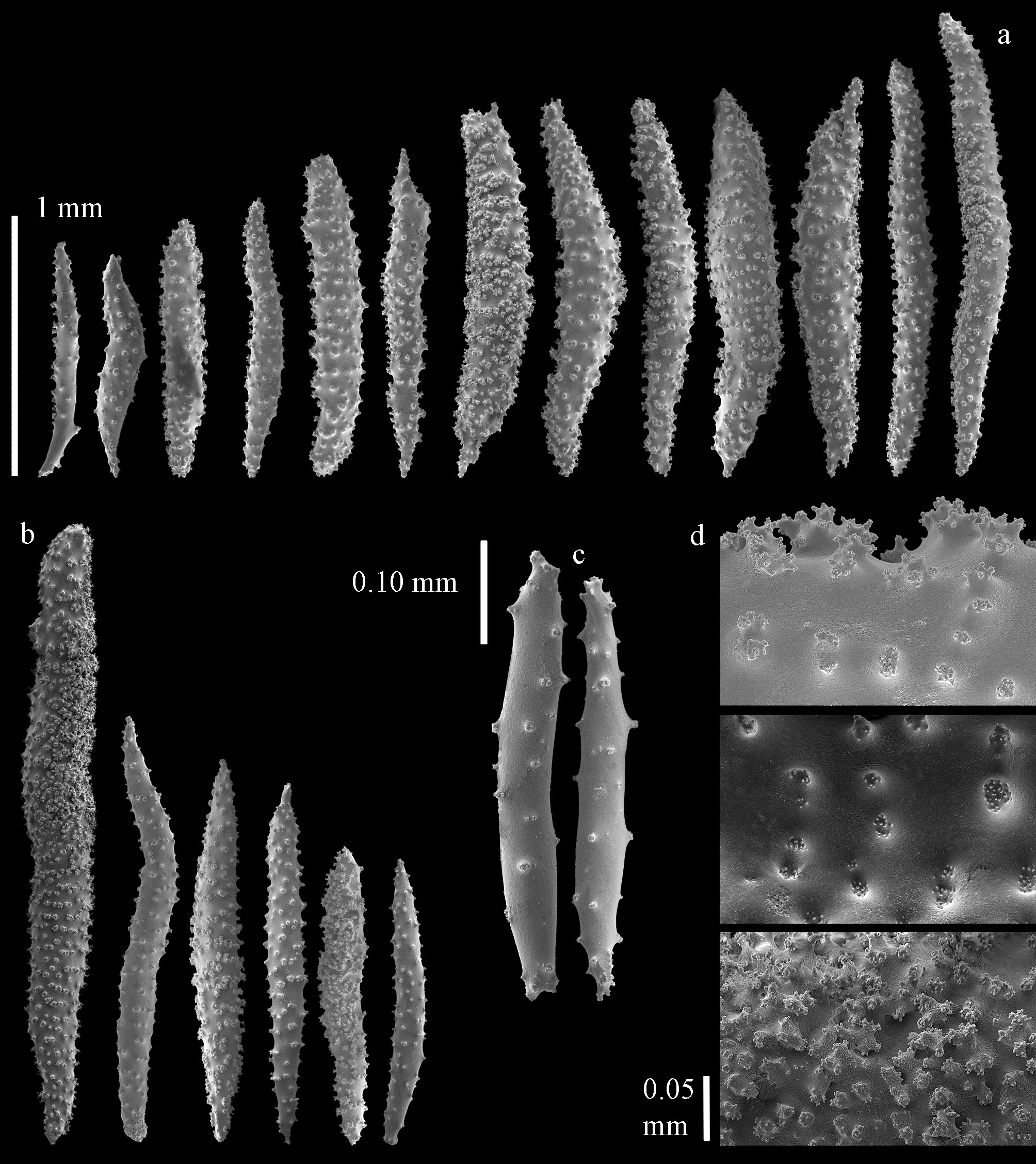
FIGURE4. Lampophyton spinatum n. sp., holotype,RMNH Coel.40198 (SAF164).a, scleritesfrom upperregion ofstalk and polyparium; b, tuberculate spindles and needles from base of stalk; c, smooth spindles from base of stalk; d, details of tubercular ornamentation:top and middle, spindles of upper surface of stalk; bottom, spindles of base of stalk.
Imageimage/png© Mcfadden, Catherine S.;Van Ofwegen, Leen P.Mcfadden, Catherine S.;Van Ofwegen, Leen P.

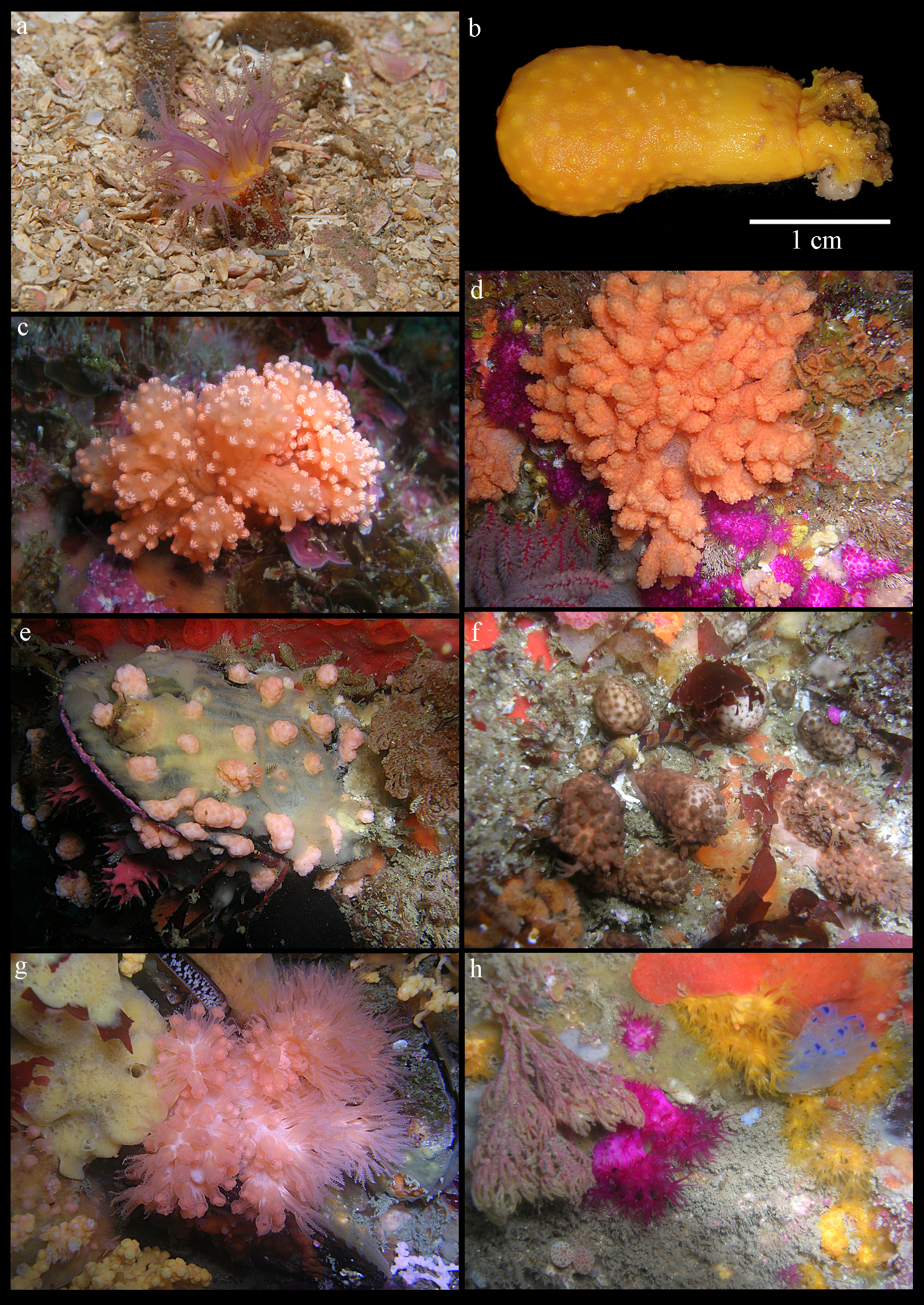
FIGURE 5. a, Lampophyton spinatum n. sp. paratype, RMNH Coel. 40199 (SAF195), colony photographed in situ; b, Alcyonium dolium n. sp. holotype, RMNH Coel.40204 (SAF292); c, Leptophyton benayahui SAF289 photographed in situ; d, Leptophyton fustis n. sp., holotype, RMNH Coel. 40211 (SAF087), colony photographed in situ (T. fallax n. comb. purple morph visible in lower right corner); e, Circularius wilsoni n. comb. RMNH Coel. 40207 (SAF448), colonies growing on mussel shell photographed in situ; f, Tenerodus pollex n. gen., n. sp. holotype, RMNH Coel. 40219 (SAF420), colonies photographed in situ; g, Tenerodus fallax, n. comb. RMNH Coel. 40217 (SAF383), pink color morph; h, Tenerodus fallax, n. comb. SAF015, purple and yellow color morphs.

Imageimage/png© Mcfadden, Catherine S.;Van Ofwegen, Leen P.Mcfadden, Catherine S.;Van Ofwegen, Leen P.

FIGURE9. Corymbophyton bruuni n. comb., ZMTAU CO37586 (SAF361). a, tentacle sclerites; b, calycular clubs; c, spindles from fused part of polyps and coenenchymal membrane.

Imageimage/png© Mcfadden, Catherine S.;Van Ofwegen, Leen P.Mcfadden, Catherine S.;Van Ofwegen, Leen P.

IMAGES

Gallery(5)

See Gallery

Occurrences with images

Source Information

Revisionary systematics of the endemic soft coral fauna (Octocorallia: Alcyonacea: Alcyoniina) of the Agulhas Bioregion, South Africa

checklist

This dataset contains the digitized treatments in Plazi based on the original journal article Mcfadden, Catherine S., Van Ofwegen, Leen P. (2017): Revisionary systematics of the endemic soft coral fauna (Octocorallia: Alcyonacea: Alcyoniina) of the Agulhas Bioregion, South Africa. Zootaxa 4363 (4): 451-488, DOI: 10.11646/zootaxa.4363.4.1

Abstract

The Agulhas Bioregion of southern South Africa supports a unique octocoral fauna that is entirely endemic to the region. Recent molecular phylogenetic studies indicate that this endemism extends to deeper taxonomic levels than had previously been recognized, and that most of these endemic species belong to genera and families that are also endemic to South Africa. Here we revise the taxonomy of soft corals (subordinal group Alcyoniina) that were previously assigned to the cosmopolitan families Alcyoniidae, Nephtheidae and Nidaliidae, describing three new families endemic to South Africa, along with four new genera and four new species. We reassign the endemic genera Acrophytum, Pieterfaurea and Lampophyton to Acrophytidae n. fam, and describe a new species of Lampophyton, L. spinatum n. sp. The endemic species Protodendron bruuni is reassigned to a new, monotypic genus, Corymbophyton bruuni n. comb., and family, Corymbophytidae n. fam. The endemic genus Leptophyton is placed in a third new family, Leptophytidae n. fam., along with three new genera that are established for species previously assigned to Alcyonium: Circularius wilsoni n. comb., Porphyrophyton distinctum n. comb., and Tenerodus fallax n. comb. In addition, we describe new species of Leptophyton, L. fustis n. sp.; Tenerodus, T. pollex n. gen. n. sp.; and Alcyonium, A. dolium n. sp.; reassign Protodendron verseveldti to Tenerodus verseveldti n. comb.; and reassign the endemic genus Dimorphophyton to family Paralcyoniidae. Although molecular phylogenetic analyses unite Acrophytidae, Corymbophytidae and Leptophytidae within a well-supported monophyletic group, both morphological and molecular distinctions support maintaining them as three separate families. These revisions increase the number of endemic species of shallow-water soft corals known from the Agulhas Bioregion to 40, and the number of endemic genera to 13.

Key words: molecular phylogenetics, Acrophytum, Alcyonium, Dimorphophyton, Lampophyton, Leptophyton, Pieterfaurea, Protodendron

Mcfadden C S, Van Ofwegen L P, plazi (2017). Revisionary systematics of the endemic soft coral fauna (Octocorallia: Alcyonacea: Alcyoniina) of the Agulhas Bioregion, South Africa. Plazi.org taxonomic treatments database. Checklist dataset https://doi.org/10.11646/zootaxa.4363.4.1 accessed via GBIF.org on 2026-06-16.

CC0Published 12/13/2017View dataset
GBIF Usage Key
137679946
Dataset Key
a141fa76-cc88-4901-944a-306171e41413
Origin
source
Backbone Key
9260454
Taxon ID
038A07766C052875FF245EF8FAFC4A41.taxon
Last Crawled
6/10/2026
Last Interpreted
6/10/2026