
AnimaliaNot EvaluatedacceptedspeciesAccepted
Alcyonium dolium

Alcyonium dolium

Mcfadden & Van Ofwegen, 2017

GBIF:137679951

0year

ABOUT

Descriptions(5)

? Alcyonium sarcophytoides (non Burchardt, 1903) Thomson 1921: 157 – 158.
Mcfadden, Catherine S., Van Ofwegen, Leen P. (2017): Revisionary systematics of the endemic soft coral fauna (Octocorallia: Alcyonacea: Alcyoniina) of the Agulhas Bioregion, South Africa. Zootaxa 4363 (4): 451-488, DOI: 10.11646/zootaxa.4363.4.1
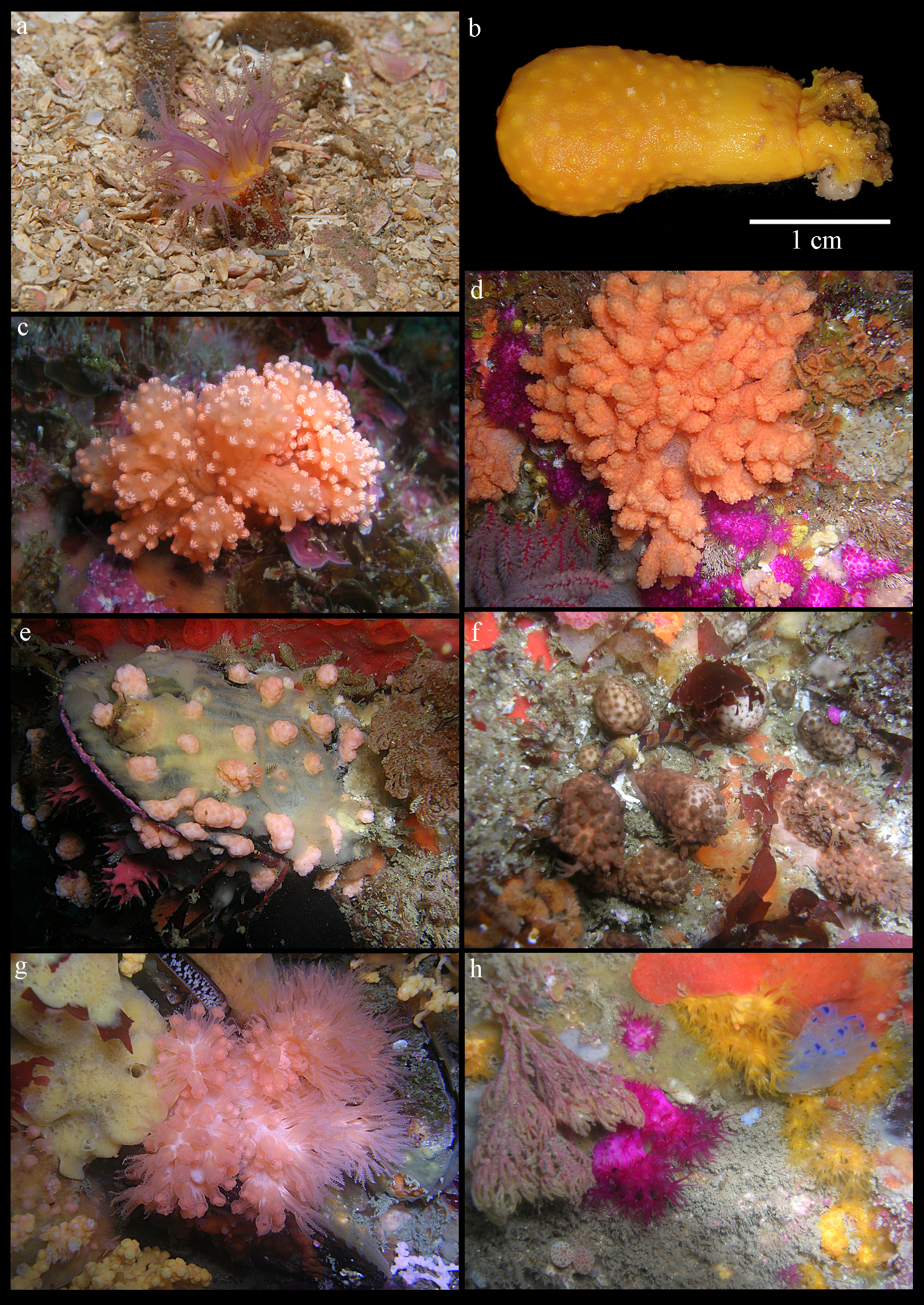
Description. The holotype is a firm, club-shaped colony, 4.0 cm tall (Fig. 5 b). The stalk is 1.5 cm long and 1.2 cm in diameter at its widest point, and is smooth except for a few small bumps and longitudinal wrinkles. The polyparium is smooth and bulbous, 1.8 cm in diameter at its widest point near the distal end. The stalk and polyparium are demarcated only by the presence of polyps in the latter, and by a slight difference in color. Polyps are distributed regularly over the surface of the polyparium, spaced about 1 mm apart. The polyps are retracted flush with the colony surface, but remain visible as small, pale bumps. The sclerites in the polyps are spindles, 0.14 – 0.22 mm long, sparsely tuberculated and often with small terminal spines (Fig. 7 a), arranged in a collaret and points. The tentacles have small, flat rods (Fig. 7 b). The sclerites in the surface of the polyparium are stout spindles, clubs and radiates, 0.06 – 0.14 mm long, with thorny tubercles (Fig. 7 c – e). The interior of the polyparium contains needle-like spindles up to 0.47 mm long (Fig. 7 f – g), very sparsely distributed. The surface and interior of the stalk have tuberculated spheroids with a median waist, 0.09 – 0.11 mm long and up to 0.08 mm wide (Fig. 7 h), barrels, 0.15 mm long by 0.07 mm wide (Fig. 7 i), and a few small radiates, 0.05 – 0.08 mm long (Fig. 7 j), all with thorny tubercles. Color. Golden yellow with a paler yellow stalk and white polyps. The sclerites are colored, mostly yellow with a few red spindles in the colony interior. Azooxanthellate.
Mcfadden, Catherine S., Van Ofwegen, Leen P. (2017): Revisionary systematics of the endemic soft coral fauna (Octocorallia: Alcyonacea: Alcyoniina) of the Agulhas Bioregion, South Africa. Zootaxa 4363 (4): 451-488, DOI: 10.11646/zootaxa.4363.4.1
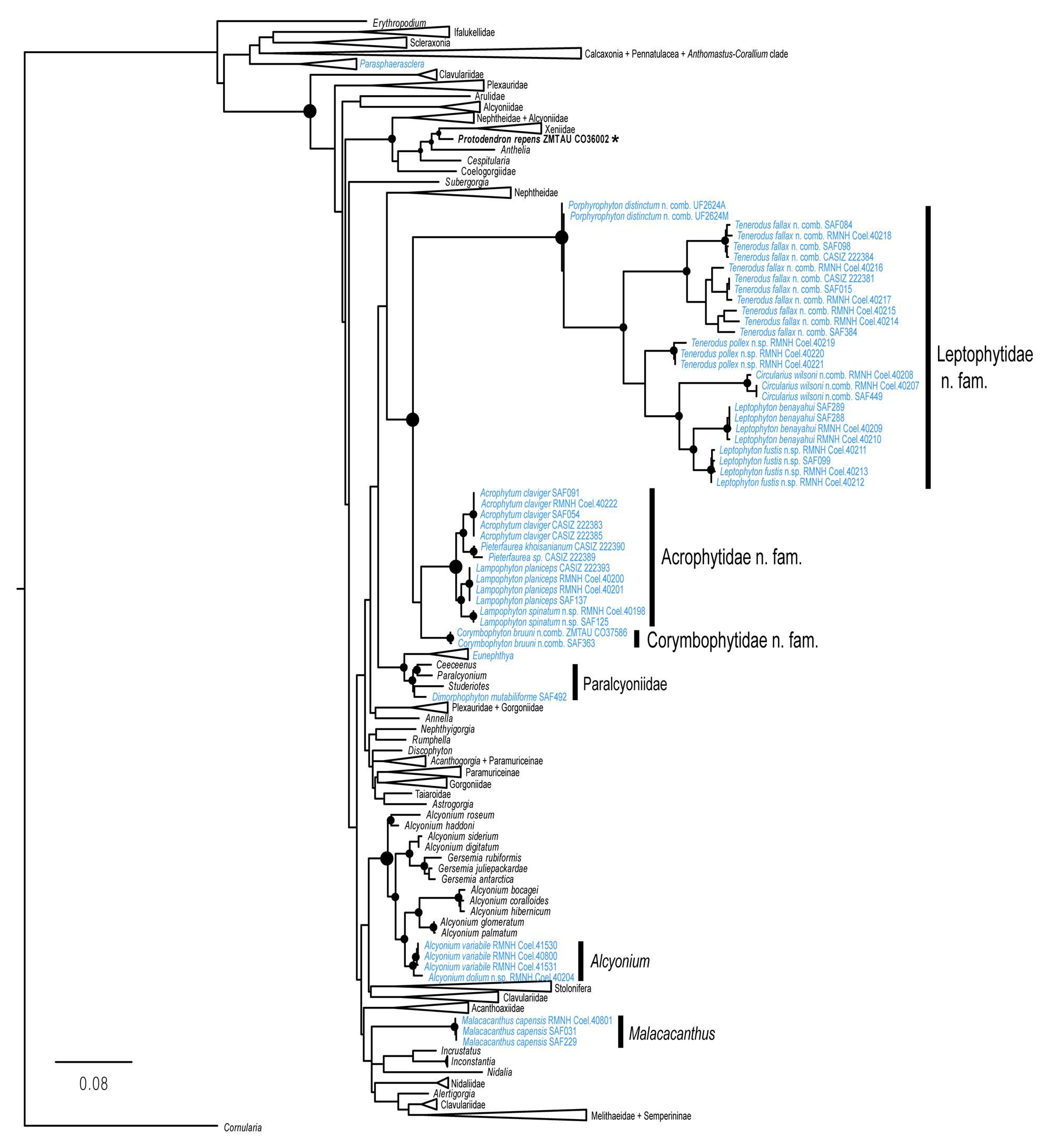
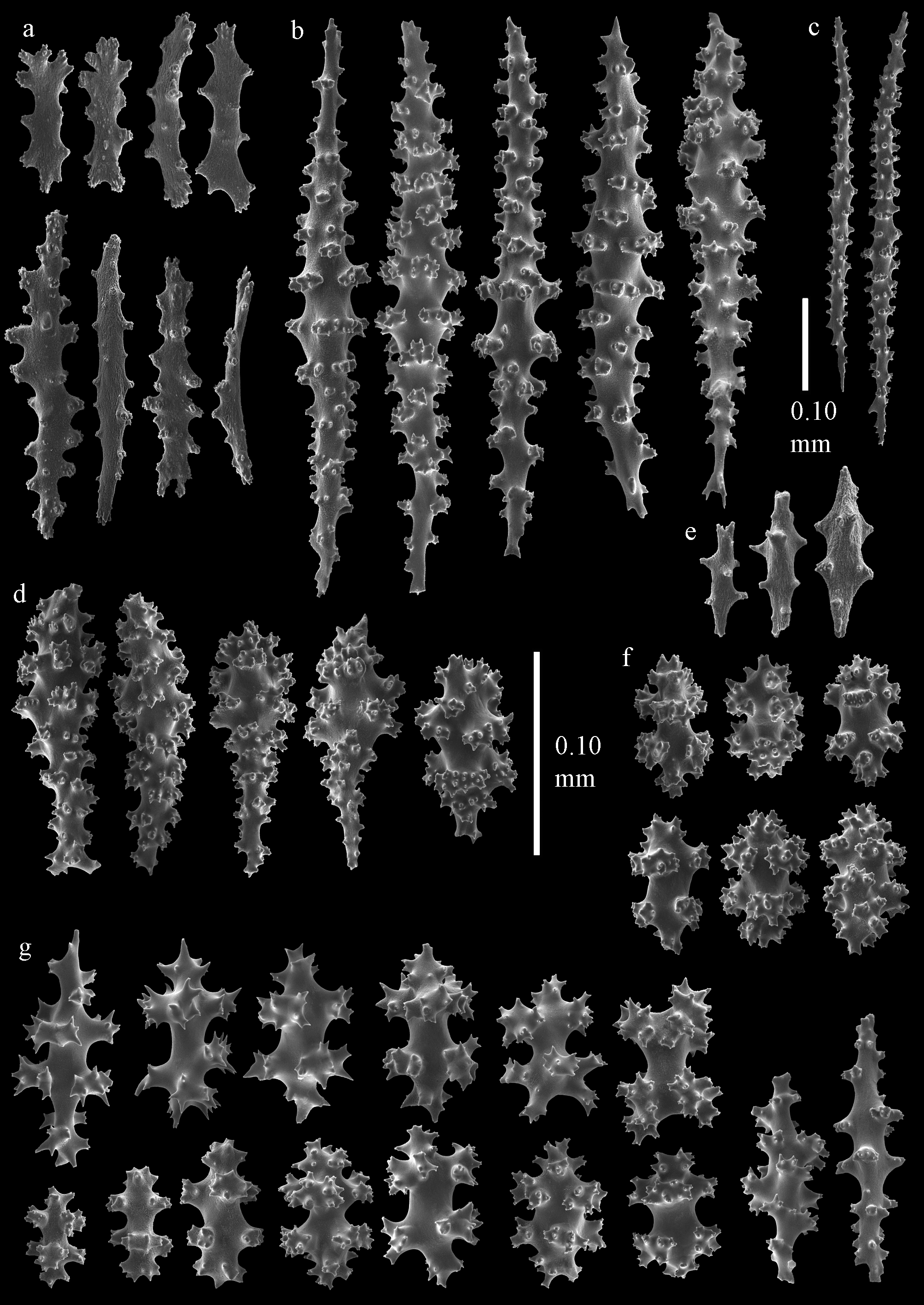
Remarks. A. dolium n. sp. is superficially very similar to the yellow color morph of Alcyonium variabile (Thomson) (Williams 1986 b). It can be distinguished from that species by differences in the colony growth form, which in A. dolium n. sp. is clavate without a strong distinction between stalk and polyparium, while A. variabile is typically capitate, with a strongly demarcated stalk and polyparium. The form of the sclerites in the surface and interior of the stalk differs, with A. variable having radiates while A. dolium n. sp. has barrels and spheroids with a median waist. The clubs in the polyparium surface also differ in shape from those of A. variabile. These distinctions can be seen by comparing Fig. 7 to Fig. 8, which depicts the sclerites typically found in A. variabile. Phylogenetic analyses place A. dolium n. sp. as a very close sister taxon to A. variabile (Fig. 1) but slightly differentiated from it genetically at all of the loci we sequenced. Pairwise genetic distances (K 2 p) between the two species were 0.4 – 0.6 % at mtMutS, 0.1 % at COI, and 1.5 – 1.7 % at 28 S rDNA. A. compactofestucum Verseveldt & Ofwegen differs from both A. dolium n. sp. and A. variabile by the unique shape of the sclerites in the stalk interior, which are spindles with long, oblique spinose processes (Verseveldt & Ofwegen 1992: Fig. 6, r – t) rather than spheroids, barrels or radiates. Likewise, A. studeri (Thomson) can be distinguished from each of these other similar species by the presence of needle-like spindles in the interior of the stalk. Thomson (1921) identified as A. sarcophytoides (non Burchardt) a specimen he described as “ irregularly cylindrical in shape and yellow in color, ” with a distinct stalk and polyparium, and sclerites of a form he termed “ Zwirnrollen ” (spools). Williams (1992 a) reported, however, that this specimen has long, slender spindles in the surface of the polyparium, a character that would distinguish it from A. dolium n. sp. Neither author, however, gives any illustrations of the colony or its sclerites, and we were unable to examine the specimen. A. dolium n. sp. occurs syntopically with Parasphaerasclera aurea (Benayahu & Schleyer), which shares a similar golden-yellow color and unbranched growth form. Colonies of P. aurea are, however, digitiform rather than clavate, and typically have a shorter stalk, the polyps lack sclerites, and the only sclerite forms present in the colony surface and interior are tuberculate spheroids and radiates (McFadden & Ofwegen 2013). In addition to the four very similar species discussed above, the only other South African species that appears to belong to Alcyonium sensu stricto is A. elegans (Kükenthal). A. elegans has an unbranched colony form with polyps restricted to the distal end of a broad and compressed sterile stalk. Like other Alcyonium species (McFadden & Ofwegen 2013) it has spindles arranged to form a collaret and points in the polyp, radiates in the colony surface, both radiates and slender spindles in the interior coenenchyme, and the sclerites are permanently colored (Williams 1992 a). Attempts to obtain DNA sequences from specimen SAM H 3802 were unsuccessful, so at present we cannot confirm this species' status as a member of Alcyonium sensu stricto. Several other South African species that are currently placed in Alcyonium do not, however, share the characters of that genus. We reassign A. fauri Thomson, A. distinctum Williams and A. wilsoni (Thomson) to other genera below. The correct generic placement of A. foliatum Thomson, a membranous species with foliate clubs in the coenenchyme, is not clear at present, but it does not appear to belong to Alcyonium sensu stricto. Attempts to sequence specimen SAM H 3690 failed. Williams (1992 a) discussed six additional species of Alcyonium that have been reported from South African waters, but whose occurrence and identity remain unverified. Other Alcyoniidae. Four additional genera endemic to South Africa are currently assigned to family Alcyoniidae. These include the monotypic Dimorphophyton mutabiliforme Williams, Lanthanocephalus clandestinus Williams & Starmer and Malacacanthus capensis Hickson, and two species of Verseveldtia Williams. Phylogenetic analysis of a 28 S rDNA sequence obtained from an uncatalogued specimen from SAM (SAF 492) suggests that Dimorphophyton belongs not to Alcyoniidae but rather to Paralcyoniidae, where it is a sister taxon to Studeriotes and [Paralcyonium + Ceeceenus] (Fig. 1). Like these other genera, Dimorphophyton has a colony form consisting of a distinct, stout pedicel into which the fleshy polyparium or trunk can be partially or completely retracted. The simple, irregular rod-like sclerites of Dimorphophyton are also similar in form to those found in the polyps and trunk of other paralcyoniid genera (e. g., Ofwegen & Benayahu 2006), but it differs from them in lacking supporting spindles in the pedicel. Based on the molecular phylogenetic result and these morphological similarities, we hereby re-assign Dimorphophyton to Paralcyoniidae. Among the other three endemic genera assigned to Alcyoniidae, molecular data are available only for Malacacanthus capensis. This species occupies a unique phylogenetic position in the Holaxonia-Alcyoniina clade of octocorals, not closely related to any other genus of Alcyoniidae (or any other family) for which sequence data are available (Fig. 1). Better phylogenetic resolution of the basal relationships within the Holaxonia-Alcyoniina clade is needed, however, to determine if Malacacanthus merits assignment to a monotypic family. Although Lanthanocephalus and Verseveldtia are unlike any other members of Alcyoniidae, molecular phylogenetic datanot currently available for either genus — will be necessary to confirm their familial placement. Lanthanocephalus resembles Malacacanthus most closely in colony growth form, but unlike that genus it has sclerites (spindles and radiates) in the colony surface (Williams & Starmer 2000). The sclerites of Verseveldtia are permanently colored spheroids and radiates similar in form to those found in family Parasphaerascleridae, but it differs from Parasphaerasclera in having dimorphic polyps and sclerites in the autozooids (Williams 1990).
Mcfadden, Catherine S., Van Ofwegen, Leen P. (2017): Revisionary systematics of the endemic soft coral fauna (Octocorallia: Alcyonacea: Alcyoniina) of the Agulhas Bioregion, South Africa. Zootaxa 4363 (4): 451-488, DOI: 10.11646/zootaxa.4363.4.1
Etymology. From the Latin dolium, a cask or tun, in reference to the barrel-shaped sclerites in the surface of the stalk.
Mcfadden, Catherine S., Van Ofwegen, Leen P. (2017): Revisionary systematics of the endemic soft coral fauna (Octocorallia: Alcyonacea: Alcyoniina) of the Agulhas Bioregion, South Africa. Zootaxa 4363 (4): 451-488, DOI: 10.11646/zootaxa.4363.4.1
Material examined. Holotype. RMNH Coel. 40204 (SAF 292), South Africa, KwaZulu-Natal, Park Rynie, Lander’s Reef, 30 º 19.973 ' S, 30 º 47.523 ' E, depth 22 – 28 m, coll. C. S. McFadden, 18 March 2008. Other material. Alcyonium variabile: RMNH Coel. 40202, South Africa, Eastern Cape, Algoa Bay, Riy Banks; 33 º 59.097 ' S, 25 º 51.774 ' E, depth 15 – 20 m, coll. C. S. McFadden, 11 March 2008. RMNH Coel. 41530, RMNH Coel. 41531, South Africa, Eastern Cape, Algoa Bay, Evans Peak, 33 º 50.578 ' S, 25 º 48.998 ' E, depth 22 – 28 m, coll. C. S. McFadden, 14 March 2008. RMNH Coel. 40203, South Africa, Western Cape, Cape Peninsula, Vulcan Rock, 34 º 03.970 ' S, 18 º 18.627 ' E, depth 15 – 27 m, coll. C. S. McFadden, 23 March 2008. RMNH Coel. 40800, South Africa, Eastern Cape, Algoa Bay, Riy Banks, depth 18 – 20 m, coll. J. Starmer, 12 October 1998.
Mcfadden, Catherine S., Van Ofwegen, Leen P. (2017): Revisionary systematics of the endemic soft coral fauna (Octocorallia: Alcyonacea: Alcyoniina) of the Agulhas Bioregion, South Africa. Zootaxa 4363 (4): 451-488, DOI: 10.11646/zootaxa.4363.4.1

Export occurrence data

Darwin Core Archive (ZIP)

CLASSIFICATION

Taxonomic Classification Tree

MULTIMEDIA

Media Files(5)

FIGURE 1. Maximum likelihood phylogeny of Octocorallia based on combined, partitioned analysis of 28S rDNA, COI and 16S mtDNA.South African species and clades are identified in blue. Filled circles indicate nodes with>70% bootstrap support and Bayesian posterior probabilities>0.95 (shown for South African clades only). Strongly supported clades (bootstrap 70%) with no South African members have been collapsed to facilitate readability. Phylogenetic position of Protodendron repens indicated with *.
Imageimage/png© Mcfadden, Catherine S.;Van Ofwegen, Leen P.Mcfadden, Catherine S.;Van Ofwegen, Leen P.

FIGURE 5. a, Lampophyton spinatum n. sp. paratype, RMNH Coel. 40199 (SAF195), colony photographed in situ; b, Alcyonium dolium n. sp. holotype, RMNH Coel.40204 (SAF292); c, Leptophyton benayahui SAF289 photographed in situ; d, Leptophyton fustis n. sp., holotype, RMNH Coel. 40211 (SAF087), colony photographed in situ (T. fallax n. comb. purple morph visible in lower right corner); e, Circularius wilsoni n. comb. RMNH Coel. 40207 (SAF448), colonies growing on mussel shell photographed in situ; f, Tenerodus pollex n. gen., n. sp. holotype, RMNH Coel. 40219 (SAF420), colonies photographed in situ; g, Tenerodus fallax, n. comb. RMNH Coel. 40217 (SAF383), pink color morph; h, Tenerodus fallax, n. comb. SAF015, purple and yellow color morphs.
Imageimage/png© Mcfadden, Catherine S.;Van Ofwegen, Leen P.Mcfadden, Catherine S.;Van Ofwegen, Leen P.

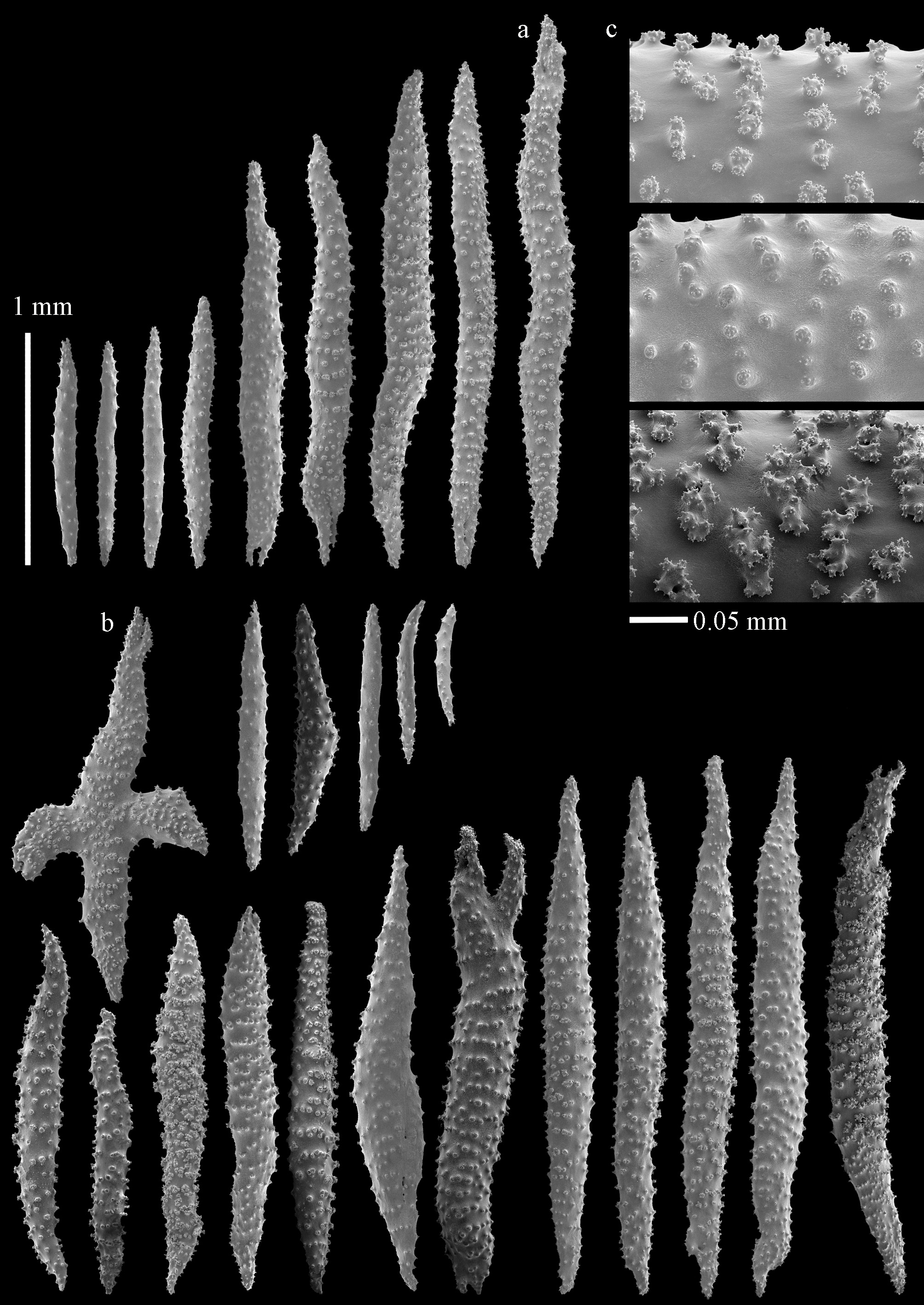
FIGURE 6. Lampophyton planiceps RMNH Coel. 40201 (SAF239). a, sclerites from upper surface of stalk; b, tuberculate spindles and needles from base of stalk; c, details of tubercular ornamentation: top and middle, spindles of upper surface of stalk; bottom, spindles of base of stalk.

Imageimage/png© Mcfadden, Catherine S.;Van Ofwegen, Leen P.Mcfadden, Catherine S.;Van Ofwegen, Leen P.

FIGURE7. Alcyonium dolium n. sp.holotype, RMNH Coel.40204 (SAF292).a, sclerites from collaret and points of polyp; b, tentacle sclerites; c, spindles from polyparium surface; d, clubs from polyparium surface; e, radiates from polyparium surface; f, spindle from polyparium interior; g, needles from polyparium interior, different scale; h, tuberculate spheroids from surface and interior of stalk; i, barrels from surface and interior of stalk; j, radiates from surface and interior of stalk. Scale at g applies only to sclerites at g; scale at b applies to all others.
Imageimage/png© Mcfadden, Catherine S.;Van Ofwegen, Leen P.Mcfadden, Catherine S.;Van Ofwegen, Leen P.

FIGURE 8. Alcyonium variabile RMNH Coel. 40203 (SAF390). a, polyp sclerites; b, spindles from polyparium surface; c, needles from polyparium interior, different scale; d, clubs from surface of polyparium and stalk; e, f, radiates from surface of polyparium and stalk; g, radiates from base of stalk. Scale at c applies only to sclerites at c; scale at d applies to all others.

Imageimage/png© Mcfadden, Catherine S.;Van Ofwegen, Leen P.Mcfadden, Catherine S.;Van Ofwegen, Leen P.

IMAGES

Gallery(5)

See Gallery

Occurrences with images

Source Information

Revisionary systematics of the endemic soft coral fauna (Octocorallia: Alcyonacea: Alcyoniina) of the Agulhas Bioregion, South Africa

checklist

This dataset contains the digitized treatments in Plazi based on the original journal article Mcfadden, Catherine S., Van Ofwegen, Leen P. (2017): Revisionary systematics of the endemic soft coral fauna (Octocorallia: Alcyonacea: Alcyoniina) of the Agulhas Bioregion, South Africa. Zootaxa 4363 (4): 451-488, DOI: 10.11646/zootaxa.4363.4.1

Abstract

The Agulhas Bioregion of southern South Africa supports a unique octocoral fauna that is entirely endemic to the region. Recent molecular phylogenetic studies indicate that this endemism extends to deeper taxonomic levels than had previously been recognized, and that most of these endemic species belong to genera and families that are also endemic to South Africa. Here we revise the taxonomy of soft corals (subordinal group Alcyoniina) that were previously assigned to the cosmopolitan families Alcyoniidae, Nephtheidae and Nidaliidae, describing three new families endemic to South Africa, along with four new genera and four new species. We reassign the endemic genera Acrophytum, Pieterfaurea and Lampophyton to Acrophytidae n. fam, and describe a new species of Lampophyton, L. spinatum n. sp. The endemic species Protodendron bruuni is reassigned to a new, monotypic genus, Corymbophyton bruuni n. comb., and family, Corymbophytidae n. fam. The endemic genus Leptophyton is placed in a third new family, Leptophytidae n. fam., along with three new genera that are established for species previously assigned to Alcyonium: Circularius wilsoni n. comb., Porphyrophyton distinctum n. comb., and Tenerodus fallax n. comb. In addition, we describe new species of Leptophyton, L. fustis n. sp.; Tenerodus, T. pollex n. gen. n. sp.; and Alcyonium, A. dolium n. sp.; reassign Protodendron verseveldti to Tenerodus verseveldti n. comb.; and reassign the endemic genus Dimorphophyton to family Paralcyoniidae. Although molecular phylogenetic analyses unite Acrophytidae, Corymbophytidae and Leptophytidae within a well-supported monophyletic group, both morphological and molecular distinctions support maintaining them as three separate families. These revisions increase the number of endemic species of shallow-water soft corals known from the Agulhas Bioregion to 40, and the number of endemic genera to 13.

Key words: molecular phylogenetics, Acrophytum, Alcyonium, Dimorphophyton, Lampophyton, Leptophyton, Pieterfaurea, Protodendron

Mcfadden C S, Van Ofwegen L P, plazi (2017). Revisionary systematics of the endemic soft coral fauna (Octocorallia: Alcyonacea: Alcyoniina) of the Agulhas Bioregion, South Africa. Plazi.org taxonomic treatments database. Checklist dataset https://doi.org/10.11646/zootaxa.4363.4.1 accessed via GBIF.org on 2026-06-16.

CC0Published 12/13/2017View dataset
GBIF Usage Key
137679951
Dataset Key
a141fa76-cc88-4901-944a-306171e41413
Origin
source
Backbone Key
9386097
Taxon ID
038A07766C062877FF245CEEFB514B56.taxon
Last Crawled
6/10/2026
Last Interpreted
6/10/2026