AnimaliaacceptedgenusAccepted
Amazhomidia

Amazhomidia

Cipola & Bellini, 2016

GBIF:141263923

0year

ABOUT

Descriptions(3)

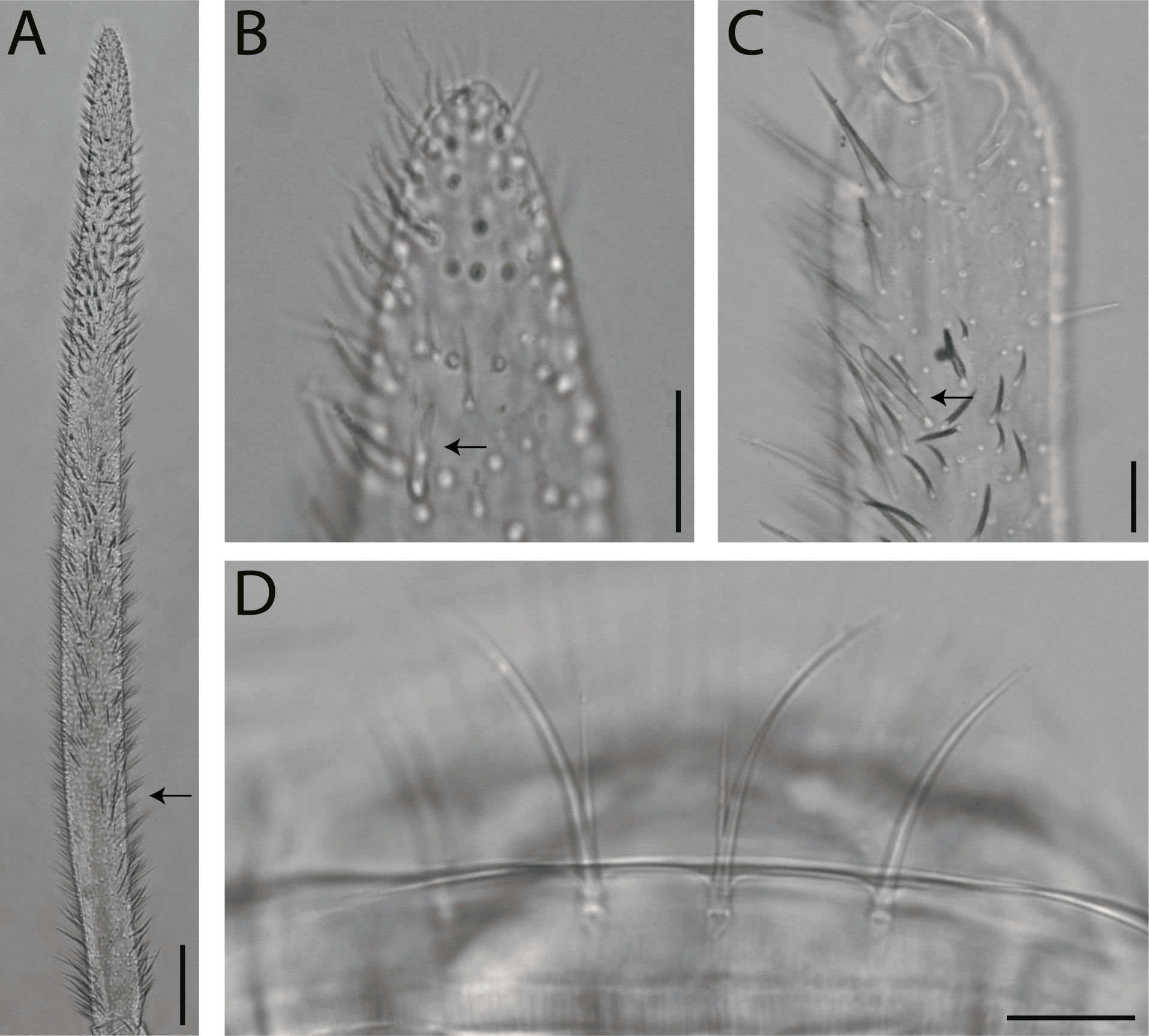
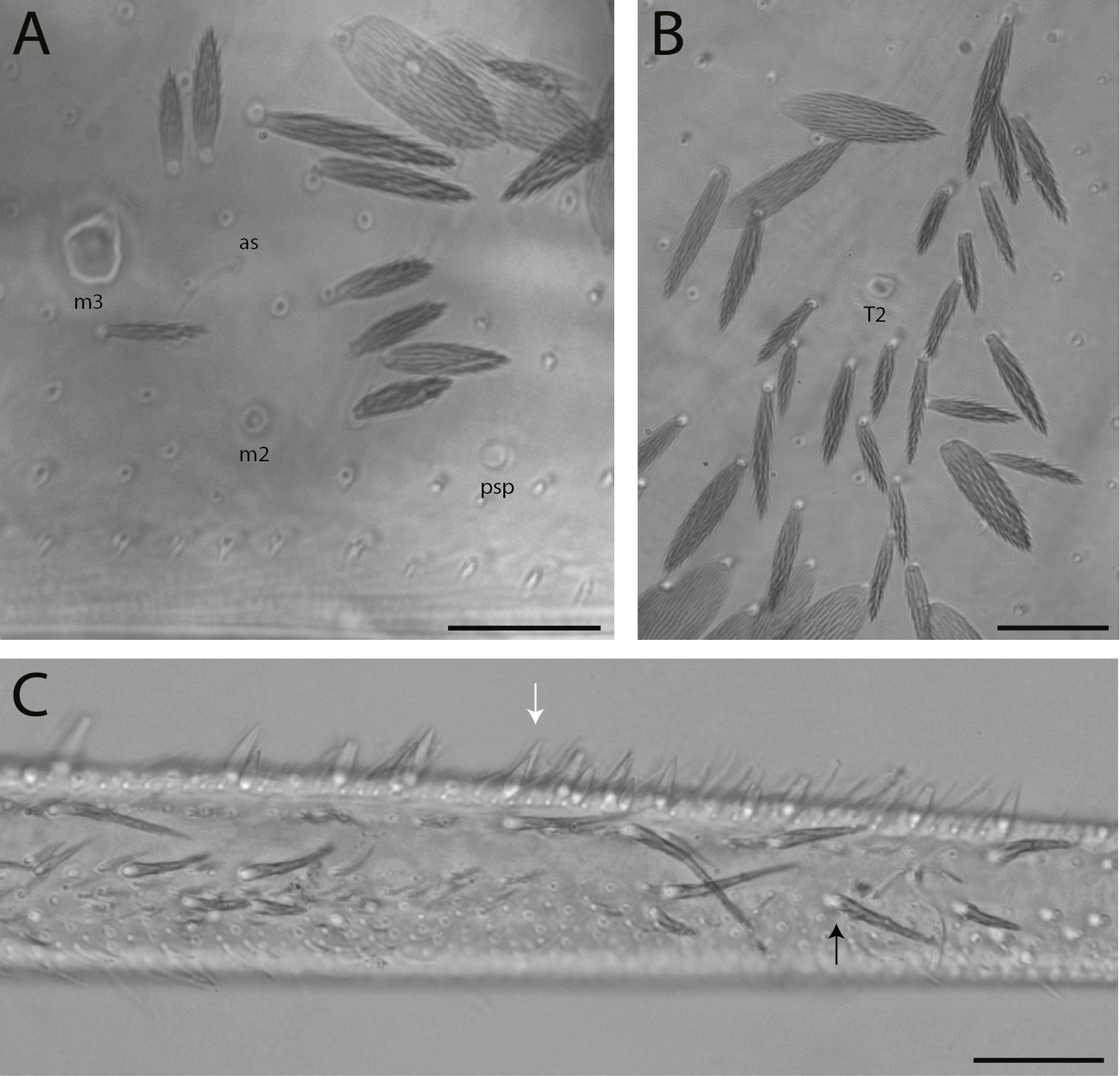
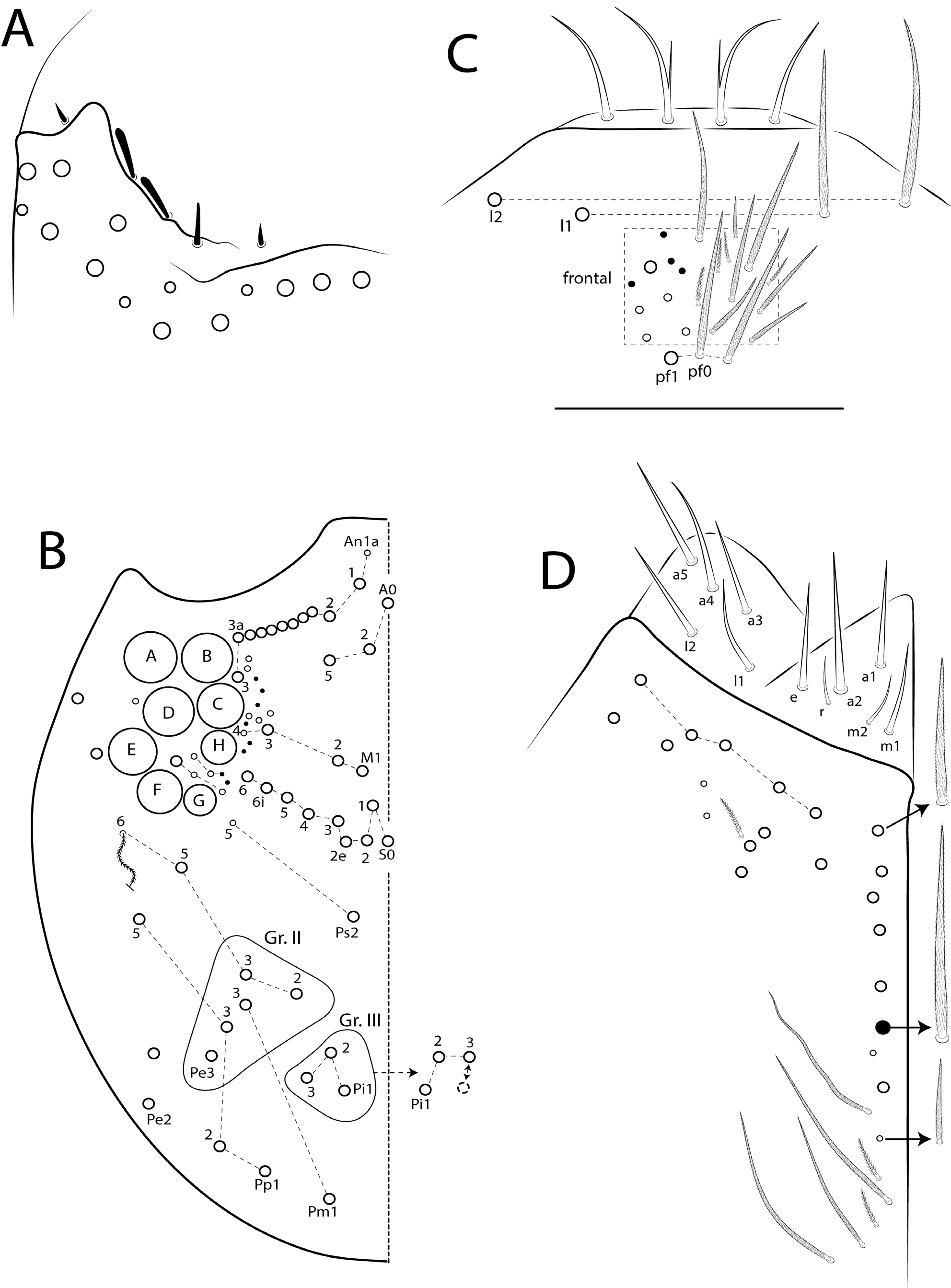
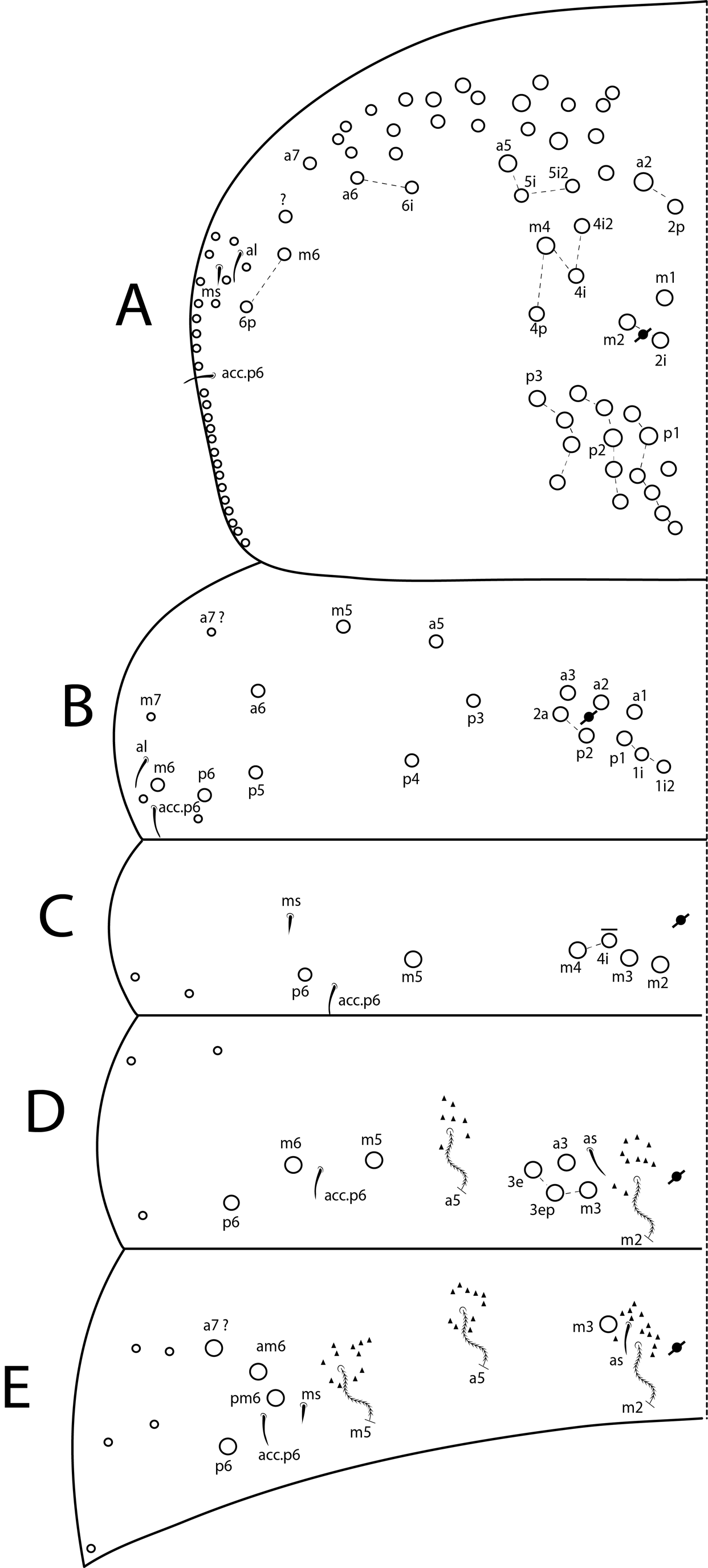
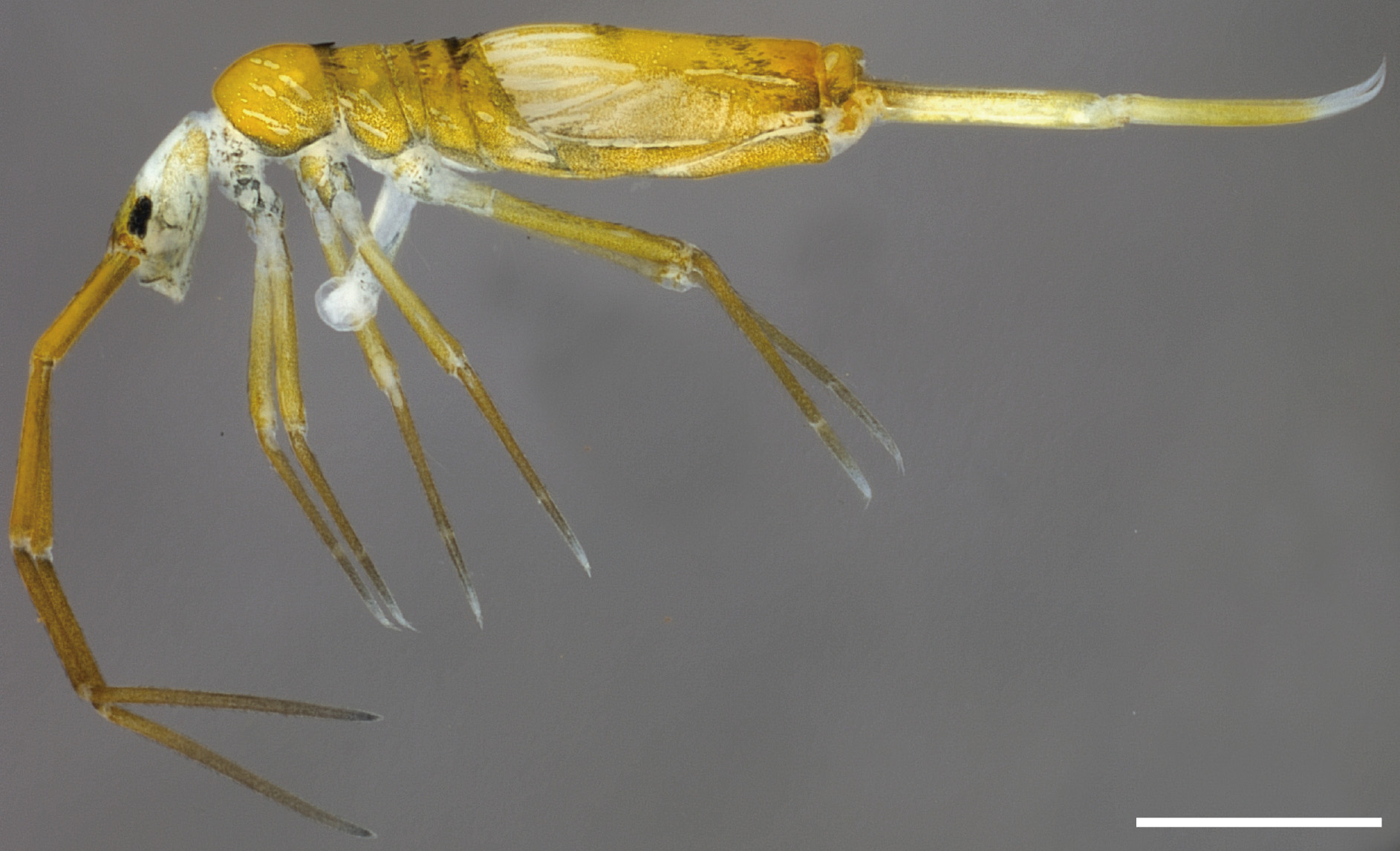
Description. Total length (head + trunk) of specimen 3.60 mm. Body mostly golden yellow except most of head, longitudinal bands on the trunk, coxae, distal tibiotarsi, collophore and distal dentes which are depigmented; purple pigment weakly present on distal half of the Ant IV, anterolateral head, Th II to Abd IV laterally forming a very narrow line, coxae and tibiotarsi medio-distally; eyepatches black (Fig. 2). Scales heavily ciliated, short or elongated and apically pointed on Ant I to two thirds of the Ant II, dorsal and lateral head, thorax and abdomen dorsally, femora and proximal half of ventral manubrium; other regions unscaled. Head. Antennae slightly longer than trunk length, ratio antennae: trunk = 1: 0.87; antennal segments ratio as I: II: III: IV = 1: 1.28: 1.13: 2.02 (Fig. 2). Ant IV annulated on distal four fifths, without apical bulb, with s-blunt sens of different sizes, 1 robust subapical s-blunt sens and ciliate chaetae (Figs 3 A ‒ B). Ant III sense organ with 2 rods, 2 spiny guard sensilla, s-blunt sens and ciliate chaetae; subapical scale-like chaeta present (Figs 3 C, 5 A). Ant I dorsally with 4 median mac, 4 distal mes and 3 smooth mic at base (Fig. 13 B). Eyes 8 + 8, G and H smaller, others subequal with 7 interocular chaetae (1 unnamed). Head dorsal chaetotaxy (Fig. 5 B) with 12 ‘ An’, 3 ‘ A’ (A 3 absent), 4 ‘ M’, 9 ‘ S’, 2 ‘ Ps’, 3 ‘ Pi’ (Pi 3 displaced forwards or backwards), 4 ‘ Pa’ (Pa 1 absent), 2 ‘ Pm’, 4 ‘ Pp’ and 3 ‘ Pe’ chaetae (1 of uncertain homology). Clypeal formula with 4 (l 1 ‒ 2), 20 (frontal), 3 (pf 0 ‒ 1) chaetae finely ciliate, l 1 ‒ 2, pf 0 ‒ 1 and three frontal larger, 7 frontal smaller and ciliate, others subequal (Fig. 5 C). Four prelabral smooth chaetae, internal pair bifurcated unequally (Figs 3 D, 5 C); labral formula with 4 (a 1 – 2), 5 (m 0 – 2), 5 (p 0 – 2) smooth chaetae, a 1 not thickest, p 0 – 2 largest. Labral papillae absent. Labial palp with five main papillae (A ‒ E) plus one hypostomal papilla (H) with 0, 5, 0, 4, 4, 2 guard appendages, respectively, lateral process (l. p.) of papilla E finger-shaped and not reaching the papilla base; labium with five smooth proximal chaetae (p. c.) (as in Figs 25 B ‒ C). Maxillary palp with smooth apical appendage (a. a.) and basal chaeta (b. c.) subtly ciliated, thicker and 1.11 longer than the apical; sublobal plate with tree smooth appendages (as in Fig. 18 C). Basomedian and basolateral labial fields with chaetae a 1 - 5, m 1 - 2, r, e, l 1 ‒ 2 smooth, m 2 and r smaller (Fig. 5 D). Ventral head with numerous chaetae finely ciliate of different sizes, 5 anterior postlabial chaetae; cephalic groove without scale-like chaeta and with about 14 surrounding chaetae finely ciliate, 1 median chaeta larger, 2 proximal smaller and 4 thin, others subequal (Fig. 5 D). Thorax chaetotaxy (Figs 6 A ‒ B). Th II (anterior chaetal collar omitted) series ‘ a’, ‘ m’ and ‘ p’ with 29 (21 of uncertain homology), 10 and 16 mac respectively. Th III, series ‘ a’, ‘ m’ and ‘ p’ with 5, 2 and 9 mac respectively. Ratio Th II: III = 2.21: 1. Abdomen chaetotaxy (Figs 4 A ‒ B, 6 C ‒ E, 7 A ‒ B). Abd I with 3 ‒ 4 central (m 2 ‒ 4, m 4 i may be absent) and 2 lateral (m 5, p 6) mac. Abd II, with 4 central mac (a 3, m 3 ‒ 3 e, 3 ep) and 3 lateral mac (m 5 ‒ 6, p 6), bothriotricha a 5 and m 2 with 7 and 10 accessory chaetae respectively. Abd III with 1 central mac (m 3) and 4 lateral mac (a 7?, am 6, pm 6 and p 6), bothriotricha a 5, m 2 and m 5 with 10, 12 and 11 accessory chaetae respectively. Abd IV with 18 ‒ 19 anteromedian mac, 11 posteromedian mac, 14 lateral mac, about 11 mes (2 anterolateral and 9 posterior), about 7 posterior sens (ps type I, others type II), and approximately 33 posterior mes. Abd V, series ‘ m’ and ‘ p’ with 4 and 3 mac respectively. Ratio Abd III: IV = 1: 9.60. Legs. Subcoxa I (outer side) with 4 chaetae plus 1 anterior chaeta and 2 psp; subcoxa II with an anterior row of 11 chaetae plus about 14 anterior chaetae, posterior row of 8 chaetae plus 4 anterior and 3 posterior chaetae and 3 psp; subcoxa III with one row of 8 chaetae, about 24 anterior chaetae and 2 posterior psp (Figs 8 A ‒ C). Trochanteral organ with about 39 spine-like chaetae, 7 arms posteriorly; anterior face with 6 spine-like chaetae (Fig. 8 D). Femora I ‒ III internally with 2 mac (proximal and median) and 1 distal mes finely ciliate and apically acuminate; tibiotarsi I ‒ III internally with 1 proximal mac and 1 median mes finely ciliate and apically slightly acuminate, others subequal (as in Fig. 11 A). Pretarsus with one minute smooth chaeta on anterior and posterior sides. Ungues outer side with a pair of large laterobasal teeth; inner side with 3 teeth, 2 paired basal and 1 unpaired median subequal to basal teeth, apical tooth absent. Unguiculi acuminate, with one small proximal external tooth, other smooth edges; ratio unguis: unguiculus III = 1: 0.61. Tibiotarsus III distally with one inner smooth chaeta 0.83 smaller than unguiculus; tenent hairs not seen (lost in all legs). Collophore. Anterior side with about 32 chaetae finely ciliate, distally 4 mac; posterior side with numerous chaetae finely ciliate, 1 unpaired chaeta medially larger, one pair distally smooth; lateral flap with about 21 smooth chaetae (Fig. 8 E and as in Fig. 11 B). Furcula. Manubrium ventrally with 2 subapical and about 68 chaetae ciliate per side; manubrial plate with 16 ‒ 17 chaetae finely ciliate of different sizes and 3 psp; lateral side with 7 ‒ 8 long distal mac finely ciliate (Figs 8 F ‒ G). Basal two thirds of dens with 45 ‒ 49 dorsal spines striated on irregular inner row; dorsal side with three irregular rows of chaetae finely ciliate, proximal chaetae larger (Figs 4 C, 8 H). Mucro bidentate with apical tooth subequal to proximal, basal spine not surpassing the apex of the proximal tooth.
Cipola, Nikolas Gioia, Morais, José Wellington De, Bellini, Bruno Cavalcante (2018): New species, redescriptions and a new combination of Acanthocyrtus Handschin, 1925 and Amazhomidia Cipola & Bellini, 2016 (Collembola, Entomobryidae, Entomobryinae). Zootaxa 4387 (3): 401-435, DOI: 10.11646/zootaxa.4387.3.1

Remarks. Since only one specimen was collected of Amazhomidia sp. 1, we think it's insufficient to describe a new species. In addition, in this description of Amazhomidia sp. 1 was able to track down very few variations (left to right) in chaetotaxy, as in central Abd I (m 4 i present or absent) and anteromedian Abd IV (9 ‒ 10 mac in different arrangements), and this could compromise the species diagnosis, especially in central Th II and antero and posteromedian mac of Abd IV, where there are often variations on number of mac in the genus (Figs 14 A, 15 B ‒ D). However, Amazhomidia sp. 1 is more similar to Amazhomidia guianiensis comb. nov. by cephalic groove without scale-like chaeta and dense dorsal macrochaetotaxy. However, Amazhomidia sp. 1 differs from this species by Ant IV without apical bulb (present in A. guianiensis comb. nov.), Ant III with subapical scale-like chaeta (absent in A. guianiensis comb. nov.), unguiculi I ‒ III acuminate (subexcavate in A. guianiensis comb. nov.), manubrium ventrally with about 68 apical chaetae and 7 ‒ 8 long distal mac on lateral side (33 apical and 5 lateral in A. guianiensis comb. nov.), and dental spines robust and striated (thin and finely ciliate in A. guianiensis comb. nov.). Also, the dorsal chaetotaxy of Amazhomidia sp. 1 differs by head with M 1, S 1 and S 2 e mac (absent in A. guianiensis comb. nov.) and Gr II ‒ III with 6 and 3 mac respectively (4 and 1 in A. guianiensis comb. nov.); Th II with 16 posterior mac (11 in A. guianiensis comb. nov.), Abd I with 2 lateral mac (1 in A. guianiensis comb. nov.), Abd II with 4 median mac (3 in A. guianiensis comb. nov.), and Abd IV with 18 ‒ 19 anteromedian mac (10 in A. guianiensis comb. nov.). Still, Amazhomidia sp. 1 differ by body mostly golden yellow with very feel dark blue or depigmented spots (Fig. 2), while in A. guianiensis comb. nov. is completely dark purple with yellow spots on appendages, posterior head and medio-dorsal part of Th II and Abd I ‒ IV. Other comparisons among species are presented in Table 1.
Cipola, Nikolas Gioia, Morais, José Wellington De, Bellini, Bruno Cavalcante (2018): New species, redescriptions and a new combination of Acanthocyrtus Handschin, 1925 and Amazhomidia Cipola & Bellini, 2016 (Collembola, Entomobryidae, Entomobryinae). Zootaxa 4387 (3): 401-435, DOI: 10.11646/zootaxa.4387.3.1
Examined material. Female on slide (066 / INPA): Brazil, Roraima, Caracaraí municipality, National Park " Serra da Mocidade ", 01 ° 36 ’ N, 61 ° 54 ’ W, Amazon forest, 1050 m, 25. i ‒ 06. ii. 2016, pitfall-trap, M Oliveira, FF Xavier & T Mahlmann coll.
Cipola, Nikolas Gioia, Morais, José Wellington De, Bellini, Bruno Cavalcante (2018): New species, redescriptions and a new combination of Acanthocyrtus Handschin, 1925 and Amazhomidia Cipola & Bellini, 2016 (Collembola, Entomobryidae, Entomobryinae). Zootaxa 4387 (3): 401-435, DOI: 10.11646/zootaxa.4387.3.1

Export occurrence data

Darwin Core Archive (ZIP)

CLASSIFICATION

Taxonomic Classification Tree

MULTIMEDIA

Media Files(13)

FIGURE 2. Amazhomidia SP.1: hAbITUS Of SPEcIMEN fIXED IN ALcOhOL(LATERAL VIEW).ScALE bAR:1 MM.

Imageimage/png© Cipola, Nikolas Gioia;Morais, José Wellington De;Bellini, Bruno CavalcanteCipola, Nikolas Gioia;Morais, José Wellington De;Bellini, Bruno Cavalcante

FIGURE 3A–D. Amazhomidia SP. 1: hEAD;A, ANT IV, ARROW INDIcATES ThE bEGINNING Of ANNULATIONS;B, APEX Of ANT IV (DORSAL SIDE),ARROW INDIcATESRObUST SUbAPIcALS-bLUNT SENS;C, APEXOf ANT III (LATERALSIDE),ARROWINDIcATES SUbAPIcALScALE-LIKE chAETA; D, PRELAbRAL chAETOTAXY (DORSAL VIEW).ScALE bARS:A (0.1 MM), B‒D (0.02 MM).

Imageimage/png© Cipola, Nikolas Gioia;Morais, José Wellington De;Bellini, Bruno CavalcanteCipola, Nikolas Gioia;Morais, José Wellington De;Bellini, Bruno Cavalcante

FIGURE4A–C. Amazhomidia SP.1:A, MEDIANchAETOTAXY Of AbDIII (LEfT SIDE); B, LATERAL chAETOTAXY Of AbDIV (LEfT SIDE);C, MEDIAN PART Of LEfT DENS (DORSAL VIEW), WhITE ARROW INDIcATES INNER ROW Of SPINES, bLAcK ARROW INDIcATES DORSAL ROW Of chAETAE fINELY cILIATE.ScALE bARS:A‒B (0.02 MM), C (0.05 MM).

Imageimage/png© Cipola, Nikolas Gioia;Morais, José Wellington De;Bellini, Bruno CavalcanteCipola, Nikolas Gioia;Morais, José Wellington De;Bellini, Bruno Cavalcante

FIGURE5A–D. Amazhomidia SP.1: hEAD;A, ANT III APIcAL ORGAN (LATERAL SIDE);B, DORSAL cEPhALIc chAETOTAXY,ARROW INDIcATES VARIATION IN MAc PATTERN; C, chAETOTAXY Of PRELAbRUM AND cLYPEUS; D, chAETOTAXY Of bASOMEDIAN AND bASOLATERAL LAbIAL fIELDS, ANTERIOR POSTLAbIALAND cEPhALIc GROOVE REGIONS (LEfT SIDE),LATERAL chAETAE OMITTED.

Imageimage/png© Cipola, Nikolas Gioia;Morais, José Wellington De;Bellini, Bruno CavalcanteCipola, Nikolas Gioia;Morais, José Wellington De;Bellini, Bruno Cavalcante

FIGURE 6A–E. Amazhomidia sp. 1: dorsal chaetotaxy; A, Th II; B, Th III; C, Abd I; D, Abd II; E, Abd III.

Imageimage/png© Cipola, Nikolas Gioia;Morais, José Wellington De;Bellini, Bruno CavalcanteCipola, Nikolas Gioia;Morais, José Wellington De;Bellini, Bruno Cavalcante

FIGURE 7A–B. Amazhomidia SP.1: DORSAL chAETOTAXY;A, AbD IV, VARIATION IN MAc PATTERN IN DETAIL; B, AbD V.

Imageimage/png© Cipola, Nikolas Gioia;Morais, José Wellington De;Bellini, Bruno CavalcanteCipola, Nikolas Gioia;Morais, José Wellington De;Bellini, Bruno Cavalcante

IMAGES

Gallery(13)

See Gallery

Occurrences with images

Source Information

New species, redescriptions and a new combination of Acanthocyrtus Handschin, 1925 and Amazhomidia Cipola & Bellini, 2016 (Collembola, Entomobryidae, Entomobryinae)

checklist

This dataset contains the digitized treatments in Plazi based on the original journal article Cipola, Nikolas Gioia, Morais, José Wellington De, Bellini, Bruno Cavalcante (2018): New species, redescriptions and a new combination of Acanthocyrtus Handschin, 1925 and Amazhomidia Cipola & Bellini, 2016 (Collembola, Entomobryidae, Entomobryinae). Zootaxa 4387 (3): 401-435, DOI: 10.11646/zootaxa.4387.3.1

Abstract

Herein one new species of Amazhomidia Cipola & Bellini from Brazilian Amazon is described and illustrated: A. thaisae sp. nov., plus one specimen no nominal due to lack of material for formal descriptionend point. Acanthocyrtus guianiensis Womersley is redescribed and transferred to Amazhomidia by presence of prelabral chaetae bifurcated, macrochaetotaxy pattern, manubrium laterally with long distal mac finely ciliate and dens ventrally unscaled. Acanthocyrtus croceus Womersley is confirmed as a junior synonymy of A. guianiensis. The juvenile description of Amazhomidia ducke is provided, and changes in chaetotaxy nomenclature are made based on them. Acanthocyrtus lineatus Womersley is redescribed based on type material and new diagnostic characters are revealed. Identification keys for both genera and a comparison for Entomobryinae genera with dental spines are provided. Amazhomidia has now three and Acanthocyrtus Handschin six valid species.

Cipola N G, Morais J W D, Bellini B C, plazi (2018). New species, redescriptions and a new combination of Acanthocyrtus Handschin, 1925 and Amazhomidia Cipola & Bellini, 2016 (Collembola, Entomobryidae, Entomobryinae). Plazi.org taxonomic treatments database. Checklist dataset https://doi.org/10.11646/zootaxa.4387.3.1 accessed via GBIF.org on 2026-06-14.

CC0Published 2/28/2018View dataset
GBIF Usage Key
141263923
Dataset Key
719ac0a1-94e1-4f6b-9301-2f88113caa87
Origin
source
Backbone Key
8600787
Taxon ID
03D84B50FFF3FFD5FF7FFDADFE6DFAFD.taxon
Last Crawled
6/10/2026
Last Interpreted
6/10/2026