AnimaliaNot EvaluatedacceptedspeciesAccepted
Acanthocyrtus lineatus

Acanthocyrtus lineatus

Womersley, 1934

GBIF:141263928

0year

ABOUT

Descriptions(5)

Acanthocyrtus lineatus wOMERSLEY, 1934: 124 ‒ 125, fIG. 15 A ‒ D, BRISbANE, QUEENSLAND, AUSTRALIA (ORIG. DEScR.). wOMERSLEY, 1939: 191 (cAT.). YOShII & GREENSLADE, 1994: 6 (cIT.). GREENSLADE, 1994: 84 (cAT.). ZhANG et al. 2009: 503 (DEScR.)
Cipola, Nikolas Gioia, Morais, José Wellington De, Bellini, Bruno Cavalcante (2018): New species, redescriptions and a new combination of Acanthocyrtus Handschin, 1925 and Amazhomidia Cipola & Bellini, 2016 (Collembola, Entomobryidae, Entomobryinae). Zootaxa 4387 (3): 401-435, DOI: 10.11646/zootaxa.4387.3.1

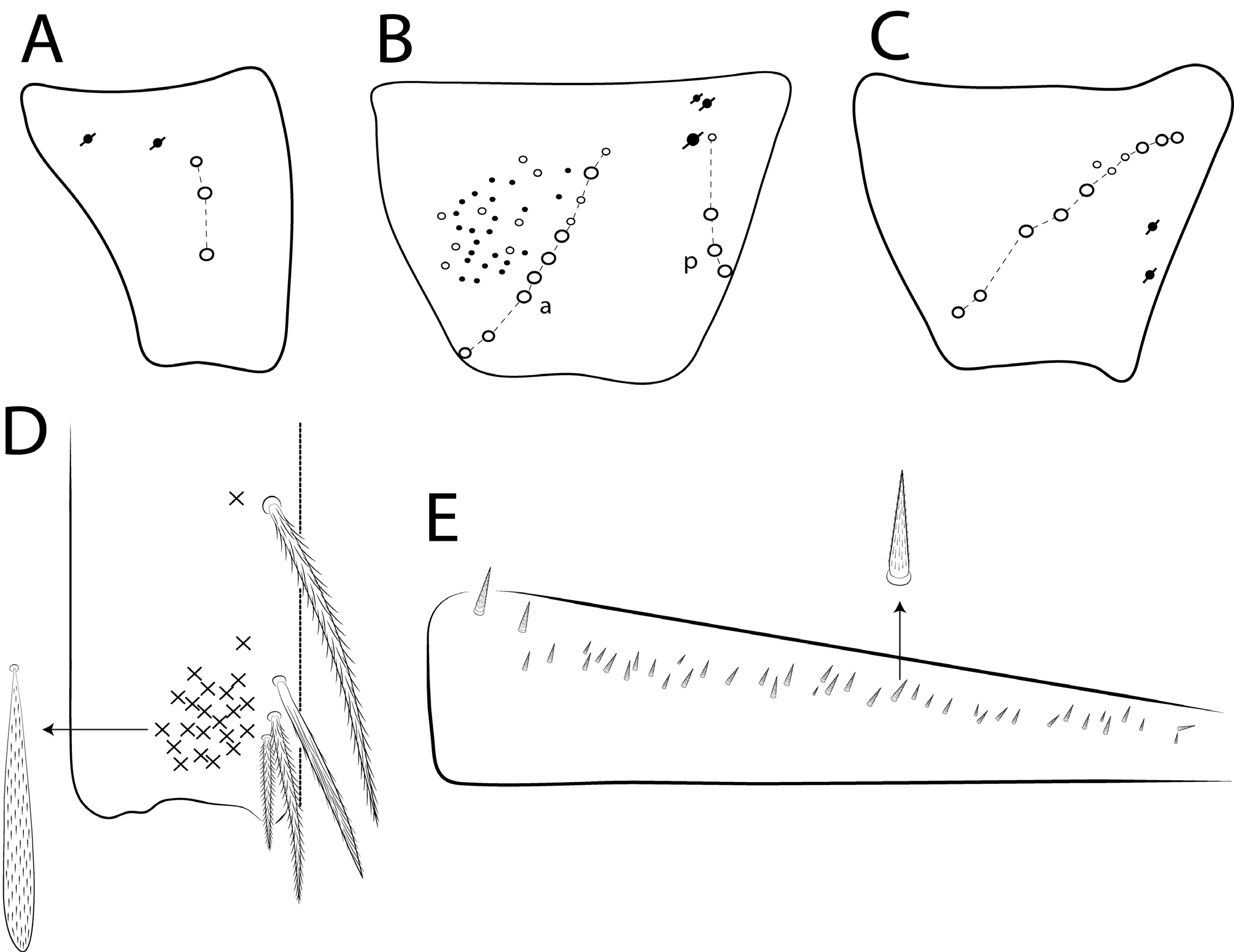
Redescription. Total length (head + trunk) of syntypes 3.95 ‒ 4.38 mm (n = 3). Ground colour yellowish with dark lateral stripes from head to base of abdomen IV, a few other marks laterally. Antennae dark, femora with a bluish-black subapical band, tibiotarsi with two dark bands, furcula light (as original description). Scales heavily ciliated, small and apically pointed on Ant I to half basal of Ant II, Ant III basally, dorsal and lateral head, thorax and abdomen dorsally, legs (except empodia), and anterior collophore, manubrium and dens. Scales heavily ciliate, elongated and apically pointed or rounded (rarely) on thorax and abdomen dorsally. Cephalic groove without surrounding scales. Head. Antennae subequal than trunk length, ratio antennae: trunk = 1: 0.88 ‒ 1.29; antennal ratio as I: II: III: IV = 1: 1.29 ‒ 1.50: 1.10 ‒ 1.15: 2.04 ‒ 2.21 (n = 3). Ant IV annulated, with an apically bilobed apical bulb with s-blunt sens of different sizes and ciliate chaetae. Ant III sense organ with 2 rods and sens of different sizes. Eyes 8 + 8, G and H smaller, with 6 interocular chaetae (q, v, s, p, r and t). Head dorsal chaetotaxy (Fig. 25 A) with 13 ‘ An’, 5 ‘ A’ (A 4 absent), 3 ‘ M’ (M 3 and M 4 i absent), 7 ‘ S’ (S 1 absent), 1 ‘ Ps’, 4 ‘ Pa’, 2 ‘ Pm’ (Pm 2 absent), 4 ‘ Pp’ (Pp 1 absent) and 1 ‘ Pe’ chaetae. Prelabral chaetae ciliated; labral formula 4 (a 1 – 2), 5 (m 0 – 2), 5 (p 0 – 2) smooth chaetae, a 1 thickest, p 0 – 2 largest. Clypeal chaetotaxy and labral papillae unclear. Labial palp with five main papillae (A ‒ E) plus one hypostomal papilla (H) with 0, 5, 0, 4, 4, 2 guard appendages, respectively, lateral process (l. p.) apically acuminate and not reaching the base of papilla E; labium with five smooth proximal chaetae (p. c.) (Figs 25 B ‒ C). Maxillary palp with smooth apical appendage (a. a.) and basal chaeta (b. c.) subtly ciliated, thickest and 1.13 larger than the apical; sublobal plate with tree smooth appendages (Fig. 25 B). Basomedian and basolateral fields with chaetae a 1 – 5, M 1, R, E, L 1 ‒ 2 ciliate, R smaller. Four postlabial ciliate chaetae (Fig. 25 B). Thorax chaetotaxy (Fig. 26 A). Th II (anterior chaetal collar omitted) series ‘ a’, ‘ m’ and ‘ p’ with 5, 6 and 11 mac respectively. Th III series ‘ a’, ‘ m’ and ‘ p’ with 3, 4 and 10 mac respectively plus 1 mac of uncertain homology. Ratio Th II: III = 1.92 ‒ 1.53: 1. Abdomen chaetotaxy (Figs 26 B ‒ C). Abd I with 3 central (m 2 ‒ 4) and 1 lateral (m 5) mac. Abd II with 3 central mac (a 2, m 3 ‒ 3 e) and 1 lateral mac (m 5), bothriotricha a 5 and m 2 with 6 accessory chaetae each. Abd III with 1 central mac (m 3) and 5 lateral mac (am 6, pm 6, m 7, p 6 and p 7), bothriotrichum m 2 with 10 accessory chaetae and bothriotricha a 5 and m 5 with about 34 accessory chaetae between them. Abd IV with 13 anteromedian mac, 6 posteromedian mac, 12 lateral mac, about 6 mes (1 lateral and 5 posterior), bothriotricha T 2 and T 4 with about 30 accessory chaetae (6 fan-shaped) between them and about 10 posterior sens (all type II), posterior mes unclear. Ratio Abd III: IV = 1: 4.06 ‒ 5.83. Legs. Subcoxa I (outer side) with 3 chaetae and 2 psp; subcoxa II with an anterior row of 10 chaetae plus about 31 chaetae anteriorly, posterior row with 4 chaetae and 3 psp; subcoxa III with one row of 10 chaetae plus 1 chaeta anteriorly and 2 posterior psp (Figs 27 A ‒ C). Ungues outer side with a pair of large laterobasal teeth; inner side with two paired basal teeth and one unpaired median tooth larger than basal. Unguiculi acuminate with serrated outer edge and one small basal tooth, other smooth edges; ratio unguis: unguiculus = 1: 0.59. Pretarsus with one minute smooth chaeta on anterior and posterior side. Tibiotarsus III distally with one inner smooth chaeta 1.18 larger than unguiculus; one outer tenent hair capitate, finely ciliate and 0.86 smaller than ungues. Collophore. Difficult to see, but with numerous anterior ciliate chaetae, 3 + 3 are mac. Furcula. Manubrium ventrally with 1 subapical elongated chaeta ciliate, distally with 2 inner ciliate chaetae, 1 scale-like chaeta and approximately 21 elongated scales (Fig. 27 D); manubrial plate (dorsally) with about 10 ciliate chaetae of different sizes, psp unclear. Basal two thirds of dens with 40 - 70 dorsal spines finely ciliate on irregular rows (Fig. 27 E). Mucro bidentate, dorsally with one basal spine reaching the apex of basal tooth (Fig. 24 E)
Cipola, Nikolas Gioia, Morais, José Wellington De, Bellini, Bruno Cavalcante (2018): New species, redescriptions and a new combination of Acanthocyrtus Handschin, 1925 and Amazhomidia Cipola & Bellini, 2016 (Collembola, Entomobryidae, Entomobryinae). Zootaxa 4387 (3): 401-435, DOI: 10.11646/zootaxa.4387.3.1
Diagnosis. Body with dark lateral stripes from proximal head to Abd IV; Ant IV with apically bilobed apical bulb; prelabral chaetae ciliate; sutural series of dorsal head with 7 mac and Gr. II ‒ III with 4 mac, S 1 mac absent; basomedian labial field without M 2 chaeta (Figs 25 A ‒ B); Th II with 22 mac, m 1 ‒ 2, m 4 i ‒ 4 p and p 4 present; Th III ‒ Abd III with 18, 4, 4 and 6 mac respectively; Abd IV with 19 median and 12 lateral mac (Fig. 26); unguiculus I ‒ III acuminate; manubrium ventrally with 3 inner apical chaetae and about 21 long scales; dens with 40 - 70 dorsal spines finely ciliate on irregular rows (Figs 27 D ‒ E).
Cipola, Nikolas Gioia, Morais, José Wellington De, Bellini, Bruno Cavalcante (2018): New species, redescriptions and a new combination of Acanthocyrtus Handschin, 1925 and Amazhomidia Cipola & Bellini, 2016 (Collembola, Entomobryidae, Entomobryinae). Zootaxa 4387 (3): 401-435, DOI: 10.11646/zootaxa.4387.3.1
Remarks. We complement the redescription of A. lineatus by Zhang el al. (2009) with some morphological characteristics as dorsal head chaetotaxy herein described for the first time (Fig. 25 A). In addition, other characteristics were observed as Th II full chaetotaxy with 22 mac in total (Fig. 26 A), including m 4 p, p 4 and p 5 (not originally represented by Zhang et al. 2009: 504, fig. 6 C). We also observed 2 more lateral mac (m 7 and p 7) on Abd III, plus 3 anteromedian and 1 posteromedian mac on Abd IV (Figs 26 B ‒ C). In general, A. lineatus resembles A. barrowensis Zhang, 2009 (in: Zhang et al. 2009) by Ant IV with apically bilobed apical bulb, sutural series of head chaetotaxy dense and Abd I ‒ III with 3 / 1, 3 / 1 and 1 / 5 (central and lateral) mac. However, A. lineatus differs from this species by head chaetotaxy with 7 mac on sutural series and 4 mac on Gr. II ‒ III (8 and 6 respectively in A. barrowensis), prelabral chaetae ciliated (smooth in A. barrowensis) and basomedian labial field without M 2 chaeta (present in A. barrowensis) (Figs 25 A ‒ B). Acanthocyrtus lineatus differs also by chaetotaxy of Th II ‒ III with 22 and 18 mac respectively (Fig. 26 A), while A. barrowensis has at least 36 mac on Th II and 14 mac on Th III. In addition, the chaetotaxy pattern on Abd IV of these species are distinct, with 13 anteromedian and 6 posteromedian mac in A. lineatus (Fig. 26 C), white A. barrowensis has 9 anteromedian mac and at least 10 posteromedian mac.
Cipola, Nikolas Gioia, Morais, José Wellington De, Bellini, Bruno Cavalcante (2018): New species, redescriptions and a new combination of Acanthocyrtus Handschin, 1925 and Amazhomidia Cipola & Bellini, 2016 (Collembola, Entomobryidae, Entomobryinae). Zootaxa 4387 (3): 401-435, DOI: 10.11646/zootaxa.4387.3.1
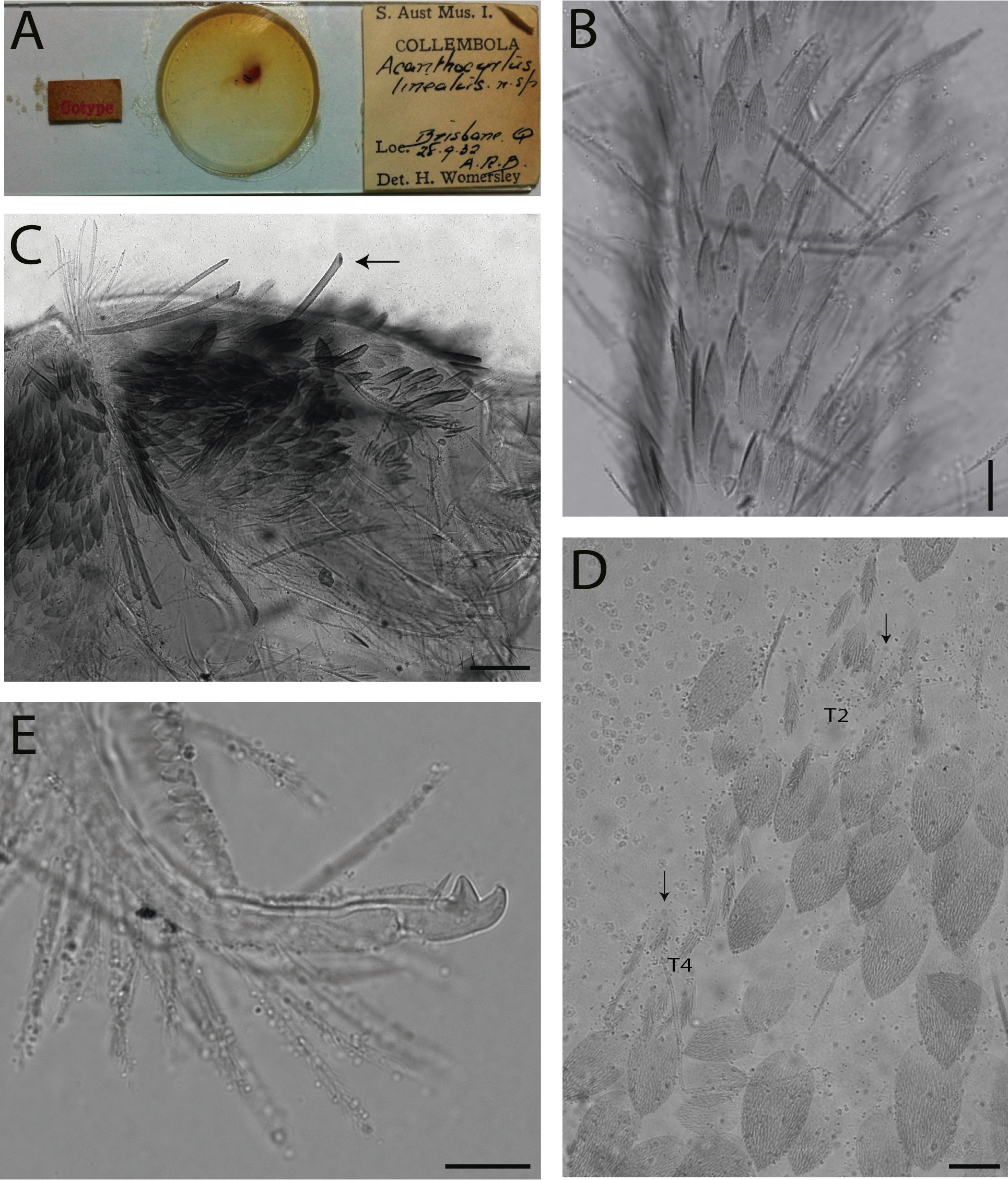
Examined type material. 3 syntypes in slides (I. 22555 / SAM): 1 male (Fig. 24 A) and 2 females.
Cipola, Nikolas Gioia, Morais, José Wellington De, Bellini, Bruno Cavalcante (2018): New species, redescriptions and a new combination of Acanthocyrtus Handschin, 1925 and Amazhomidia Cipola & Bellini, 2016 (Collembola, Entomobryidae, Entomobryinae). Zootaxa 4387 (3): 401-435, DOI: 10.11646/zootaxa.4387.3.1

Export occurrence data

Darwin Core Archive (ZIP)

CLASSIFICATION

Taxonomic Classification Tree

MULTIMEDIA

Media Files(4)

FIGURE 24A–E. Acanthocyrtus lineatus: A, SYNTYPE MALE ON SLIDE (I.22555/SAM); B, RIGhT ANT I (DORSAL VIEW); C, hEAD AND ANTERIORPART Of Th II (LATERALVIEW),ARROW INDIcATES cILIATE MAc APIcALLY fOOT-ShAPED;D, LATERAL chAETOTAXY Of AbDIV (LEfTSIDE), T2 AND T4 IS bOThRIOTRIchA,ARROWS INDIcATES AccESSORY fAN-ShAPED chAETAE; E, DISTAL DENS AND MUcRO (LATERAL VIEW).ScALE bARS: C (0.1 MM), B, D‒E (0.02 MM).

Imageimage/png© Cipola, Nikolas Gioia;Morais, José Wellington De;Bellini, Bruno CavalcanteCipola, Nikolas Gioia;Morais, José Wellington De;Bellini, Bruno Cavalcante

FIGURE 25A–C. Acanthocyrtus lineatus: hEAD; A, DORSAL cEPhALIc chAETOTAXY; B, chAETOTAXY Of MAXILLARY OUTER LObE AND SUbLObAL PLATE, PROXIMAL chAETAE Of LAbIAL PALP, bASOMEDIAN AND bASOLATERAL LAbIAL fIELDS AND ANTERIOR POSTLAbIAL chAETAE; C, LAbIAL PALP PAPILLA E (RIGhT SIDE),L.P.IS LATERAL PROcESS.

Imageimage/png© Cipola, Nikolas Gioia;Morais, José Wellington De;Bellini, Bruno CavalcanteCipola, Nikolas Gioia;Morais, José Wellington De;Bellini, Bruno Cavalcante

FIGURE 26A–C. Acanthocyrtus lineatus: DORSAL chAETOTAXY;A, Th II AND III; B, AbDI‒III; C, AbD IV.

Imageimage/png© Cipola, Nikolas Gioia;Morais, José Wellington De;Bellini, Bruno CavalcanteCipola, Nikolas Gioia;Morais, José Wellington De;Bellini, Bruno Cavalcante

FIGURE27A–E.Acanthocyrtus lineatus: A, SUbcOXA I; B, SUbcOXA II; C, SUbcOXA III (OUTER SIDE); D, MANUbRIUM VENTRO-DISTAL chAETOTAXY;E, DORSO-PROXIMAL DENS (RIGhT SIDE).

Imageimage/png© Cipola, Nikolas Gioia;Morais, José Wellington De;Bellini, Bruno CavalcanteCipola, Nikolas Gioia;Morais, José Wellington De;Bellini, Bruno Cavalcante

IMAGES

Gallery(4)

See Gallery

Occurrences with images

Source Information

New species, redescriptions and a new combination of Acanthocyrtus Handschin, 1925 and Amazhomidia Cipola & Bellini, 2016 (Collembola, Entomobryidae, Entomobryinae)

checklist

This dataset contains the digitized treatments in Plazi based on the original journal article Cipola, Nikolas Gioia, Morais, José Wellington De, Bellini, Bruno Cavalcante (2018): New species, redescriptions and a new combination of Acanthocyrtus Handschin, 1925 and Amazhomidia Cipola & Bellini, 2016 (Collembola, Entomobryidae, Entomobryinae). Zootaxa 4387 (3): 401-435, DOI: 10.11646/zootaxa.4387.3.1

Abstract

Herein one new species of Amazhomidia Cipola & Bellini from Brazilian Amazon is described and illustrated: A. thaisae sp. nov., plus one specimen no nominal due to lack of material for formal descriptionend point. Acanthocyrtus guianiensis Womersley is redescribed and transferred to Amazhomidia by presence of prelabral chaetae bifurcated, macrochaetotaxy pattern, manubrium laterally with long distal mac finely ciliate and dens ventrally unscaled. Acanthocyrtus croceus Womersley is confirmed as a junior synonymy of A. guianiensis. The juvenile description of Amazhomidia ducke is provided, and changes in chaetotaxy nomenclature are made based on them. Acanthocyrtus lineatus Womersley is redescribed based on type material and new diagnostic characters are revealed. Identification keys for both genera and a comparison for Entomobryinae genera with dental spines are provided. Amazhomidia has now three and Acanthocyrtus Handschin six valid species.

Cipola N G, Morais J W D, Bellini B C, plazi (2018). New species, redescriptions and a new combination of Acanthocyrtus Handschin, 1925 and Amazhomidia Cipola & Bellini, 2016 (Collembola, Entomobryidae, Entomobryinae). Plazi.org taxonomic treatments database. Checklist dataset https://doi.org/10.11646/zootaxa.4387.3.1 accessed via GBIF.org on 2026-06-15.

CC0Published 2/28/2018View dataset
GBIF Usage Key
141263928
Dataset Key
719ac0a1-94e1-4f6b-9301-2f88113caa87
Origin
source
Backbone Key
4640628
Taxon ID
03D84B50FFEAFFC1FF7FFD69FD1BFC9E.taxon
Last Crawled
6/10/2026
Last Interpreted
6/10/2026