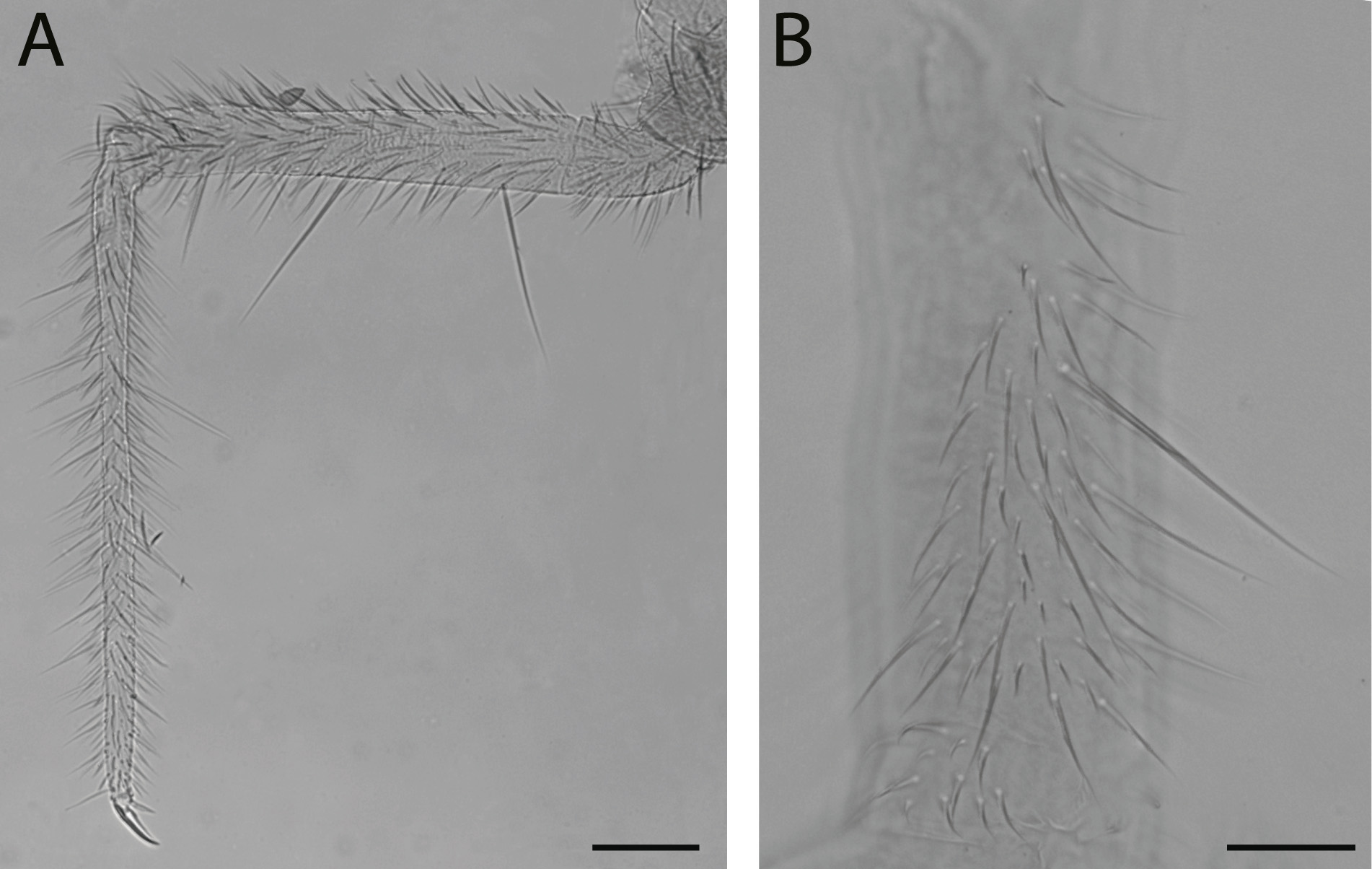
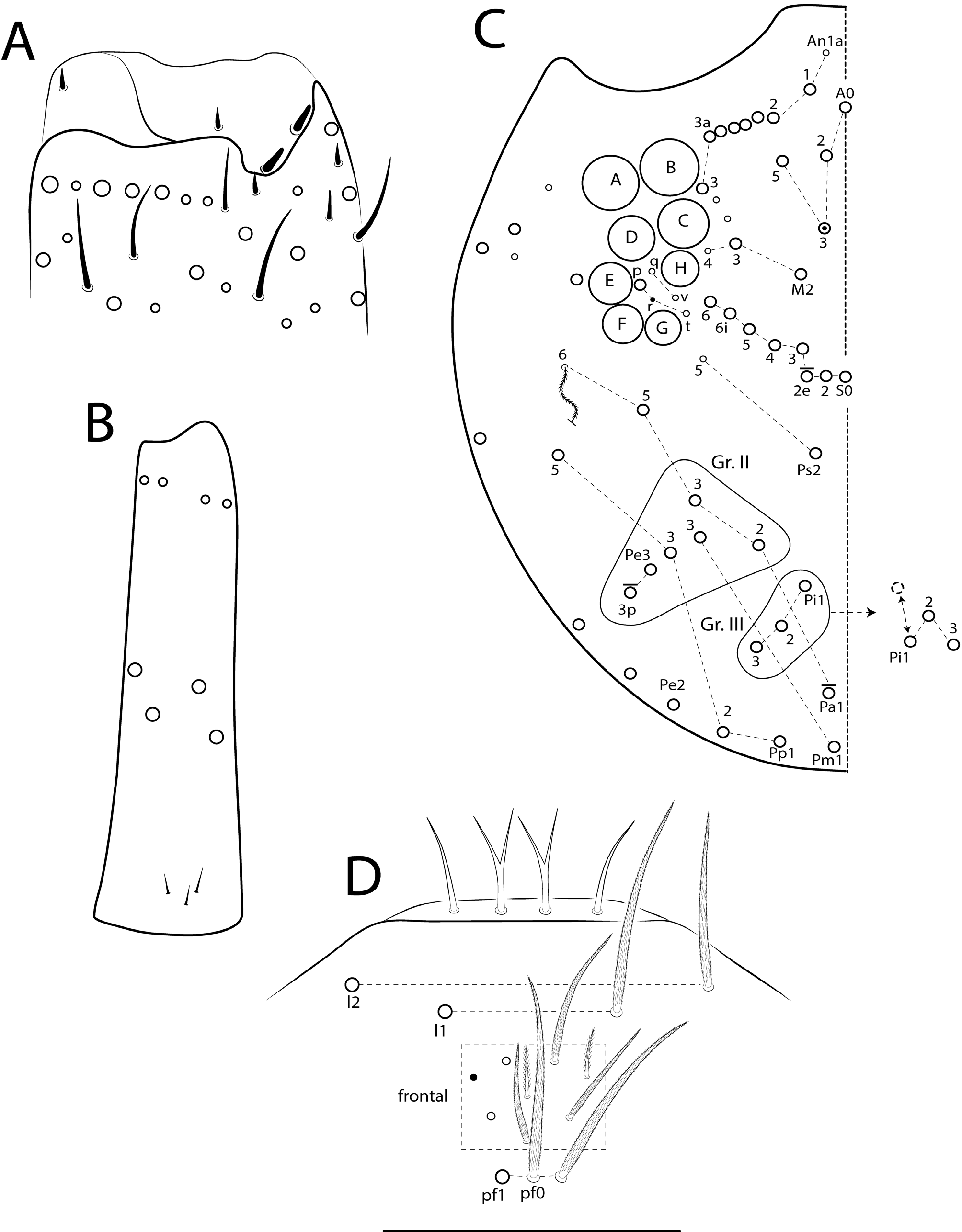
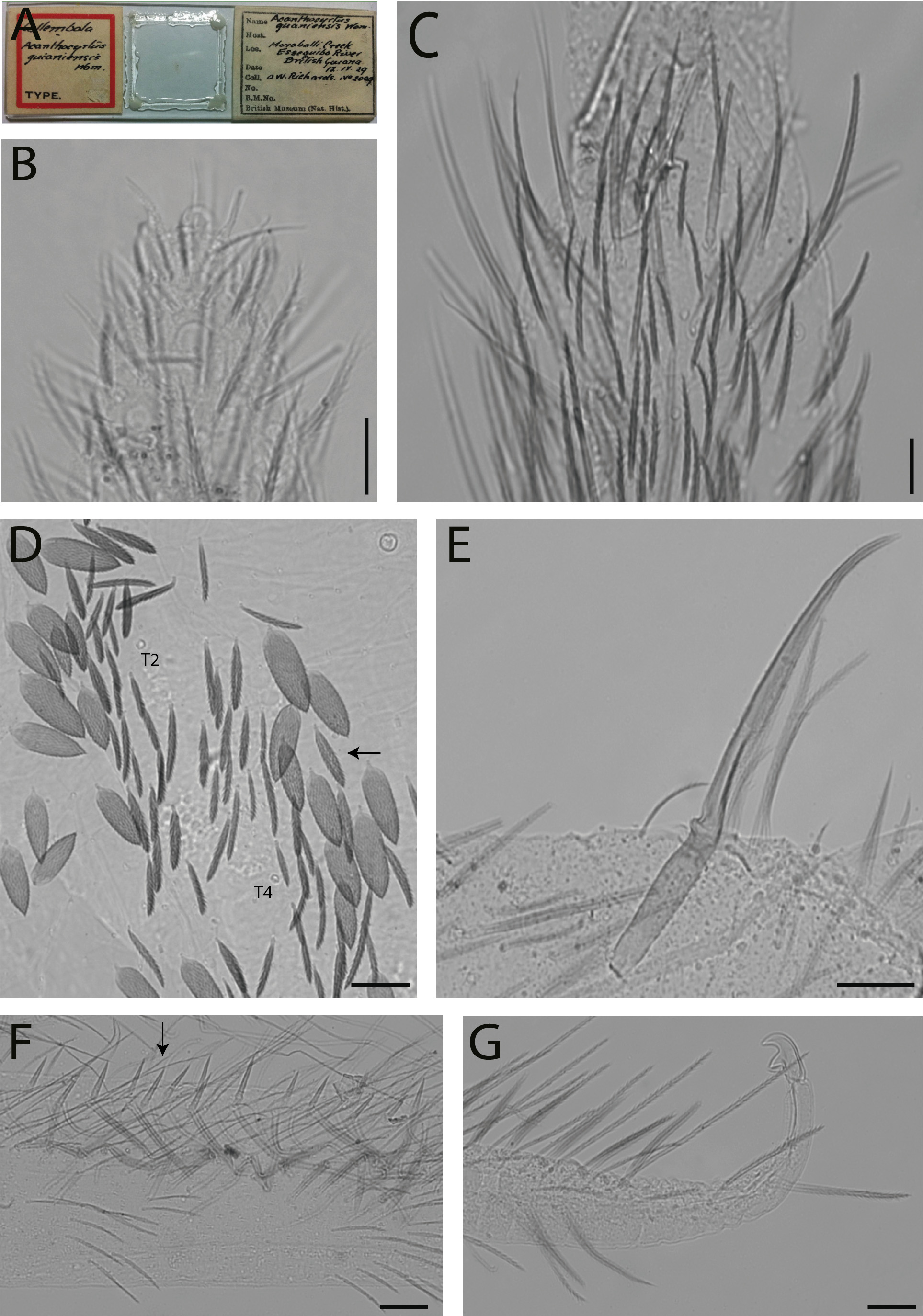
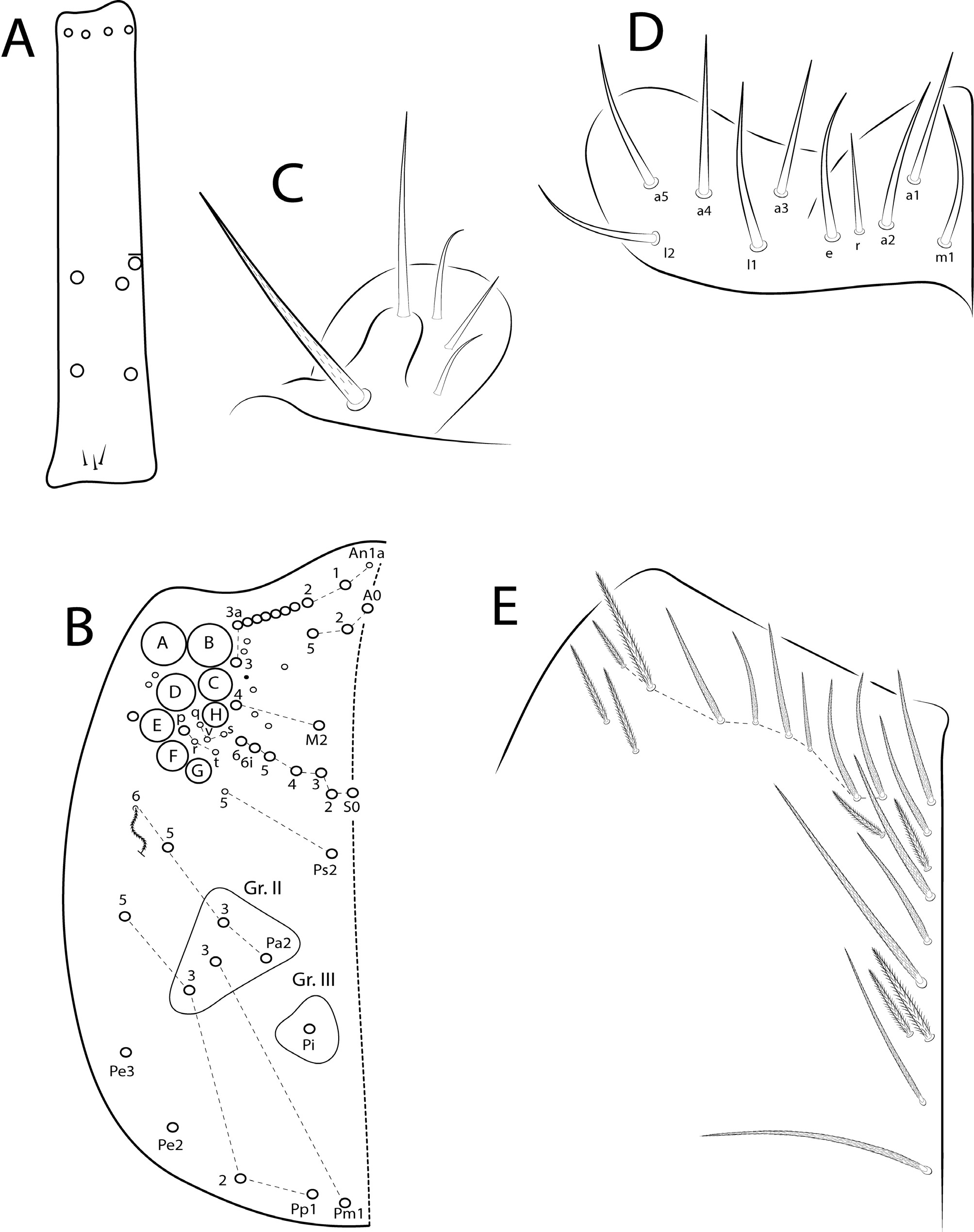
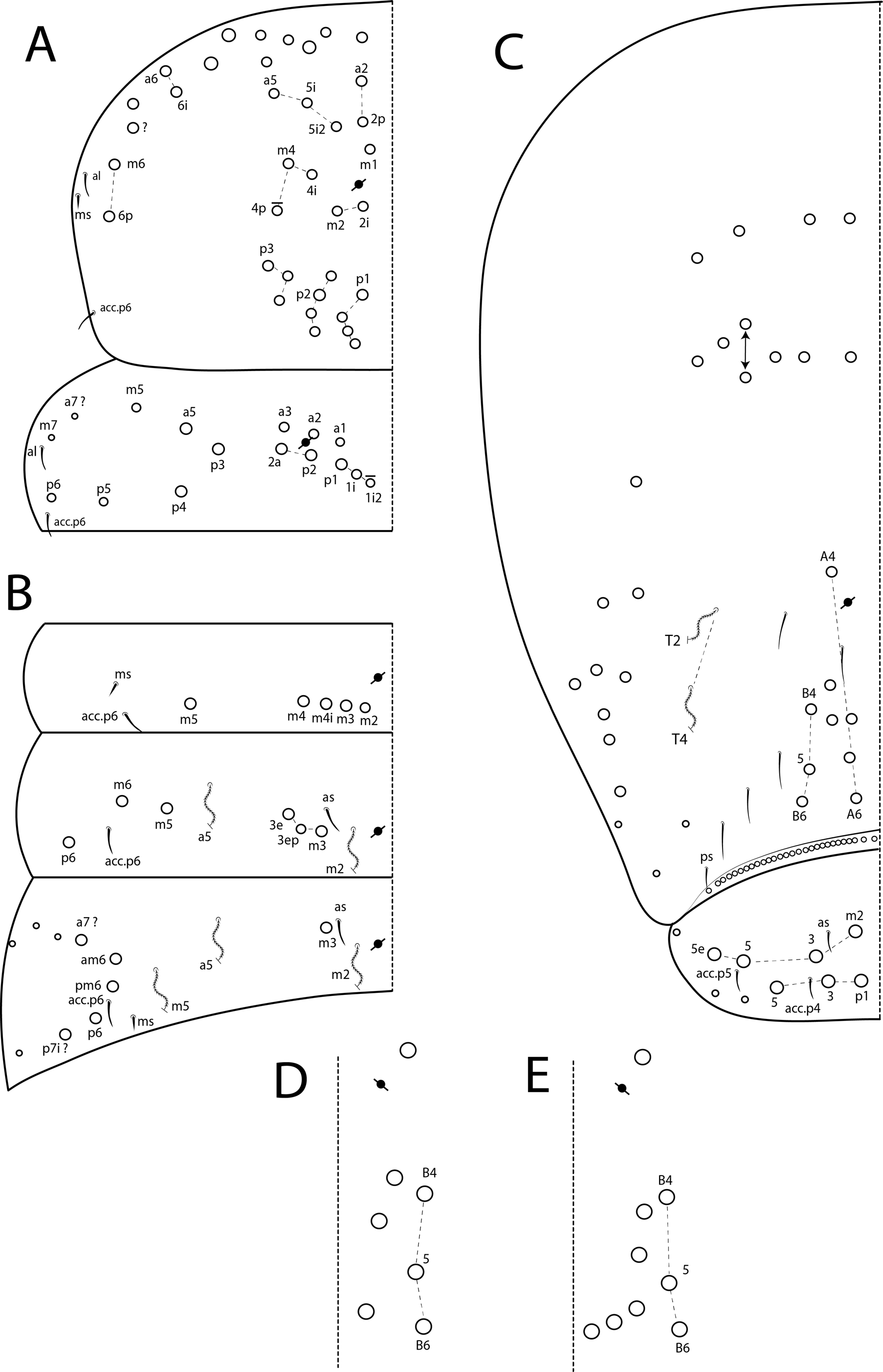
Description. Total length (head + trunk) of holotype 2.83 mm. Specimens completely dark purple, but light yellow on Ant I to IV (except apex), posterior head, medio-dorsal part of Th II and Abd I ‒ IV, all Abd VI, dentes and tibiotarsi (as original description). Scales heavily ciliated, small or elongated and apically pointed on half basal of Ant I, dorsal and lateral head, and thorax and abdomen dorsally. Legs, collophore and furcula unscaled. Head. Antennae slightly longer than trunk length, ratio antennae: trunk = 1: 0.85; antennal segments ratio as I: II: III: IV = 1: 1.44: 1.18: 2.75. Ant IV annulated on distal three quarters, with apically rounded apical bulb, s-blunt sens and ciliate chaetae (Fig. 17 B). Ant III sense organ unclear, but surrounded by long s-blunt sens, clearly and finely ciliate chaetae of different sizes; subapical scale-like chaeta apparently absent (Fig. 17 C). Ant I dorsally with 4 - 5 median mac and 3 smooth mic at base (Fig. 18 A). Eyes 8 + 8, G and H smaller, A and B larger, with 6 interocular chaetae (q, v, s, p, r and t). Head dorsal chaetotaxy (Fig. 18 B) with 11 ‘ An’, 3 ‘ A’ (A 3 absent), 2 ‘ M’ (M 1 absent), 7 ‘ S’ (S 1 and S 2 e absent), 2 ‘ Ps’, 1 ‘ Pi’ unnamed, 4 ‘ Pa’, 2 ‘ Pm’, 4 ‘ Pp’, and 2 ‘ Pe’ chaetae. Four prelabral smooth chaetae, internal pair bifurcated equally (as in Fig. 13 D); labral formula with 4 (a 1 – 2), 5 (m 0 – 2), 5 (p 0 – 2) smooth chaetae, a 1 not thickest, p 0 – 2 largest. Labral papillae absent. Lateral process (l. p.) of papilla E finger-shaped and not reaching the papilla base; labium with five smooth proximal chaetae (p. c.) (as in Figs 25 B ‒ C). Maxillary palp with smooth apical appendage (a. a.) and basal chaeta (b. c.) subtly ciliated, thicker and 1.30 longer than the apical; sublobal plate with tree smooth appendages (Fig. 18 C). Basomedian and basolateral labial fields with chaetae a 1 ‒ 5, m 1, r, e, l 1 ‒ 2 smooth, r smaller, m 2 absent (Fig. 18 D). Ventral head with numerous ciliate chaetae of different sizes, 6 anterior postlabial chaetae finely ciliate; cephalic groove with about 10 surrounding chaetae, 3 smaller median chaetae ciliate and 7 finely ciliate, 2 proximal larger, others subequal (Fig. 18 E). Thorax chaetotaxy (Figs 19 A). Th II (anterior chaetal collar omitted) series ‘ a’, ‘ m’ and ‘ p’ with 17 (10 of uncertain homology), 7 ‒ 8 and 11 mac respectively. Th III, series ‘ a’, ‘ m’ and ‘ p’ with 4, 1 and 8 ‒ 9 mac respectively. Ratio Th II: III = 2.07: 1. Abdomen chaetotaxy (Figs 17 D, 19 B ‒ E). Abd I with 4 central (m 2 ‒ 4) and 1 lateral (m 5) mac. Abd II with 3 central mac (m 3 ‒ 3 e, 3 ep) and 3 lateral mac (m 5 ‒ 6, p 6), accessory chaetae of bothriotricha missing. Abd III with 1 central mac (m 3) and 5 lateral mac (a 7?, am 6, pm 6, p 6 and p 7 i), accessory chaetae of bothriotricha missing. Abd IV with 10 anteromedian mac, 7 ‒ 9 posteromedian mac, 9 lateral mac, 3 posterior mes, about 6 posterior sens (ps type I, others type II), and approximately 28 posterior mes. Abd V, series ‘ m’ and ‘ p’ with 4 and 3 mac respectively. Ratio Abd III: IV = 1: 6.92. Legs. Subcoxa I (outer side) with 3 chaetae and 2 psp; subcoxa II with an anterior row of 9 chaetae plus numerous chaetae anteriorlly, posterior row of 6 chaetae plus 1 anterior chaeta and 2 psp; subcoxa III with one row of 7 chaetae, numerous anterior chaetae and 2 posterior psp (Figs 20 A ‒ C). Trochanteral organ with about 33 spinelike chaetae; anterior face with 4 spine-like chaetae (Fig. 20 D). Femora I ‒ III internally with 2 mac (proximal and median) and 1 distal mes finely ciliate and apically acuminate; tibiotarsi I ‒ III internally with 1 proximal mac and 1 median mes finely ciliate and apically slightly acuminate, other subequal (as in Fig. 11 A). Pretarsus with one minute smooth chaeta on anterior and posterior sides. Ungues outer side with a pair of large laterobasal teeth; inner side with 3 teeth, 2 paired basal and 1 unpaired median subequal to basal teeth, apical tooth absent. Unguiculus with inner edge subexcavate, outer edge serrated, other smooth edges; ratio unguis: unguiculus III = 1: 0.58. Tibiotarsus III distally with one inner smooth chaeta with the same size of unguiculus; outer side with tenent hair capitate, smooth and 0.77 smaller than unguis (Fig. 20 E). Collophore. Chaetotaxy not totally clear, but apparently anterior side with about 16 ciliate chaetae, distally 2 mac and 1 mes; posterior side with numerous chaetae finely ciliate, 1 unpaired chaeta medially larger, one pair distally smooth (as in Fig. 11 B); lateral flap with about 10 smooth chaetae. Furcula. Manubrium ventrally with 2 subapical and about 33 chaetae ciliate per dise; manubrial plate with 9 chaetae of different sizes and 2 psp; lateral side with 5 long distal mac finely ciliate (Figs 17 E, 20 F ‒ G). Basal two thirds of dens with 36 ‒ 44 dorsal spines thin and finely ciliate on irregular inner row; dorsal side with three irregular rows of chaetae finely ciliate, proximal chaetae larger (Figs 17 F, 20 H). Mucro bidentate with apical tooth subequal to proximal tooth, basal spine surpassing the apex of the proximal tooth (Fig. 17 G)
Cipola, Nikolas Gioia, Morais, José Wellington De, Bellini, Bruno Cavalcante (2018): New species, redescriptions and a new combination of Acanthocyrtus Handschin, 1925 and Amazhomidia Cipola & Bellini, 2016 (Collembola, Entomobryidae, Entomobryinae). Zootaxa 4387 (3): 401-435, DOI: 10.11646/zootaxa.4387.3.1