
AnimaliaNot EvaluatedacceptedspeciesAccepted
Phallusia nigra
Savigny, 1816
GBIF:141263989
0year
ABOUT
Descriptions(3)
Stations: AM 06; AM 26; AR 101; AR 453. (MNHN PHA 126)
Monniot, Françoise (2018): Ascidians collected during the Madibenthos expedition in Martinique: 1 - Phlebobranchia. Zootaxa 4387 (3): 451-472, DOI: 10.11646/zootaxa.4387.3.3
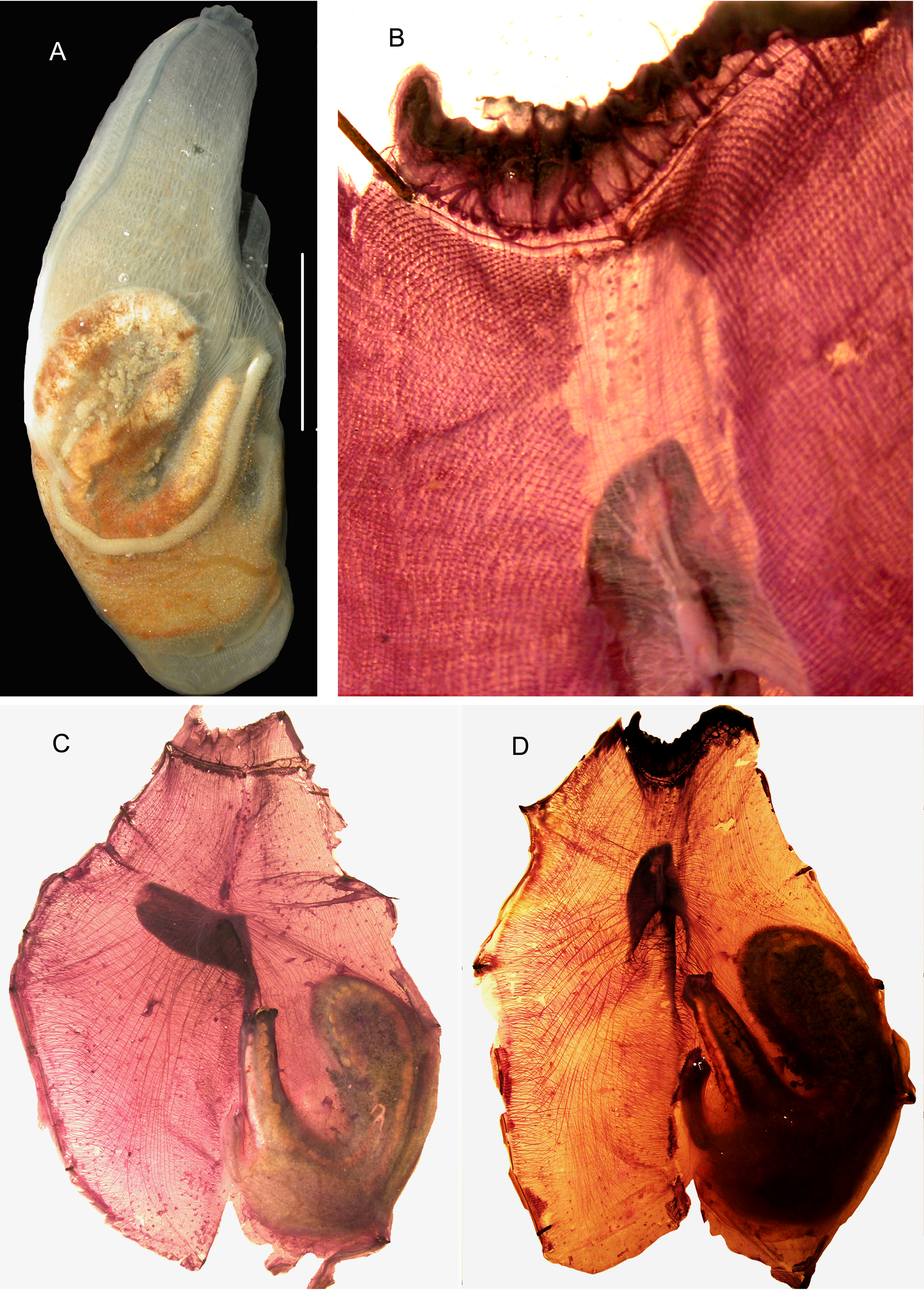
The body musculature has a constant design in all specimens (Fig. 12 C, D). On the right side the longitudinal fibres issued from the oral siphon run downwards and become slender at the body end; they are crossed by oblique fibres starting from the atrial siphon which spread in a fan in the half posterior right side of the body (Fig. 12 C, D). On the left side the longitudinal fibres of the oral siphon reach the gut level. On the right parallel transverse muscles form a band along the ventral line, they become progressively thinner and increase again in thickness when they reach the dorsal side (Fig. 12 C – D). On the left of the dorsal line a bundle of longitudinal fibres issued from the atrial siphon spread toward the intestine and reaches the space of the secondary gut loop (Fig. 12 C – D). The digestive tract occupies half of the left body side (Fig. 12 C – D). The oesophagus is narrow well marked from the olive shaped stomach. The primary gut loop is long and narrow, the secondary loop is slightly open. The intestine is not inflated. The anus has 2 lips, the internal one deeply indented. The ovary in a single mass lies in the primary gut loop. The testis vesicles are spread above both intestinal limbs. Numerous pyloric vesicles cover the whole gut.
Monniot, Françoise (2018): Ascidians collected during the Madibenthos expedition in Martinique: 1 - Phlebobranchia. Zootaxa 4387 (3): 451-472, DOI: 10.11646/zootaxa.4387.3.3
Remarks. Phallusia nigra is a very common species recorded from the tropical and subtropical Atlantic Ocean in shallow waters. It is spectacular with its tunic totally black naked and shining.
Monniot, Françoise (2018): Ascidians collected during the Madibenthos expedition in Martinique: 1 - Phlebobranchia. Zootaxa 4387 (3): 451-472, DOI: 10.11646/zootaxa.4387.3.3
Export occurrence data
Darwin Core Archive (ZIP)
CLASSIFICATION
Taxonomic Classification Tree

IMAGES