
AnimaliaNot EvaluatedacceptedspeciesAccepted
Phallusia caguayensis
(Millar & Goodbody, 1974)
GBIF:141263995
0year
ABOUT
Descriptions(1)
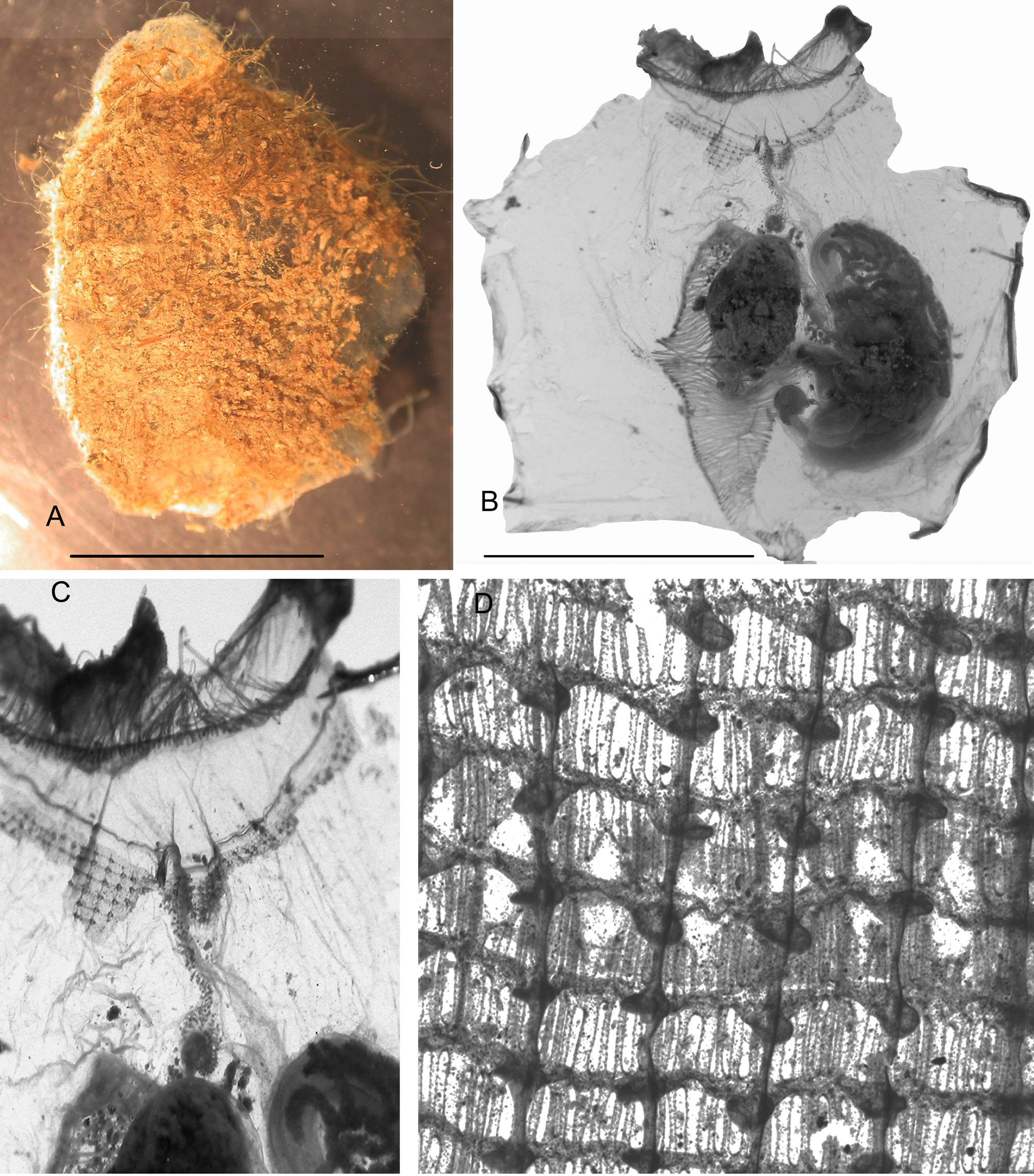
Station: AM 0 1 (MNHN P 5 PHA 125). The single specimen is oval, 2 cm long, with an apical oral siphon and an atrial siphon at mid length of the body. It is covered with thin tunic filaments and sand particles (Fig. 11 A). Out of the tunic the body is colourless except a faint yellow ring at the siphons which has quickly disappeared in formalin. The oral siphon has 10 round lobes, the atrial 6 lobes with orange ocelli between the lobes. The body wall has a much reduced musculature (Fig. 11 B). Only on the siphons there are thin short longitudinal fibres and a few circular ones at the tentacular level; while on the remaining body wall, a well delimited field of thick short transverse muscles occupies a part of the dorsal side. The fibres all stop at the same level making an elongated lozenge design from the neural ganglion, under the siphon aperture and down to the body posterior end (Fig. 11 B). There is no other musculature. There are more than a hundred crowded oral tentacles of about equal size are crowded on a rod (Fig. 11 C). The prepharyngeal groove is separated from the tentacles by a wide prepharyngeal area without papillae (Fig. 11 C). The neural ganglion is close to the atrial aperture, covered by the neural gland. The neural duct opens by very numerous holes along its whole length and ends anteriorly by a small dorsal tubercle (Fig. 11 C). The dorsal lamina begins with two blades which unite in a single rolled high blade with a smooth rim. The dorsal lamina overpasses the oesophagus on the left and reaches the branchial sac bottom. The branchial tissue (Fig 11 D) is flat with numerous longitudinal vessels. Five to 7 stigmata were counted in a mesh. There are spoon like papillae at the crossing of the longitudinal and transverse vessels; a tiny intermediate papillae is present between them (Fig. 11 D). The digestive tract occupies a large part of the left body side but does not reach the posterior body end (Fig. 11 B). After a narrow oesophagus the stomach has a few irregular internal folds. The primary gut loop is narrow. The descending intestinal limb is distended by faecal material and makes a closed secondary loop. The anus is damaged. The ovary is ramified over the primary intestinal loop. The testis vesicles are mixed with the ovary lobes. The gonoducts are alongside the rectum. All anatomical characters correspond to the original description but the new specimen is smaller. The peculiar design of the body wall musculature and the sand coated tunic isolate this species from all other Phallusia. P. caguayensis is recollected here for the first time near the type region.
Monniot, Françoise (2018): Ascidians collected during the Madibenthos expedition in Martinique: 1 - Phlebobranchia. Zootaxa 4387 (3): 451-472, DOI: 10.11646/zootaxa.4387.3.3
Export occurrence data
Darwin Core Archive (ZIP)
CLASSIFICATION
Taxonomic Classification Tree

IMAGES