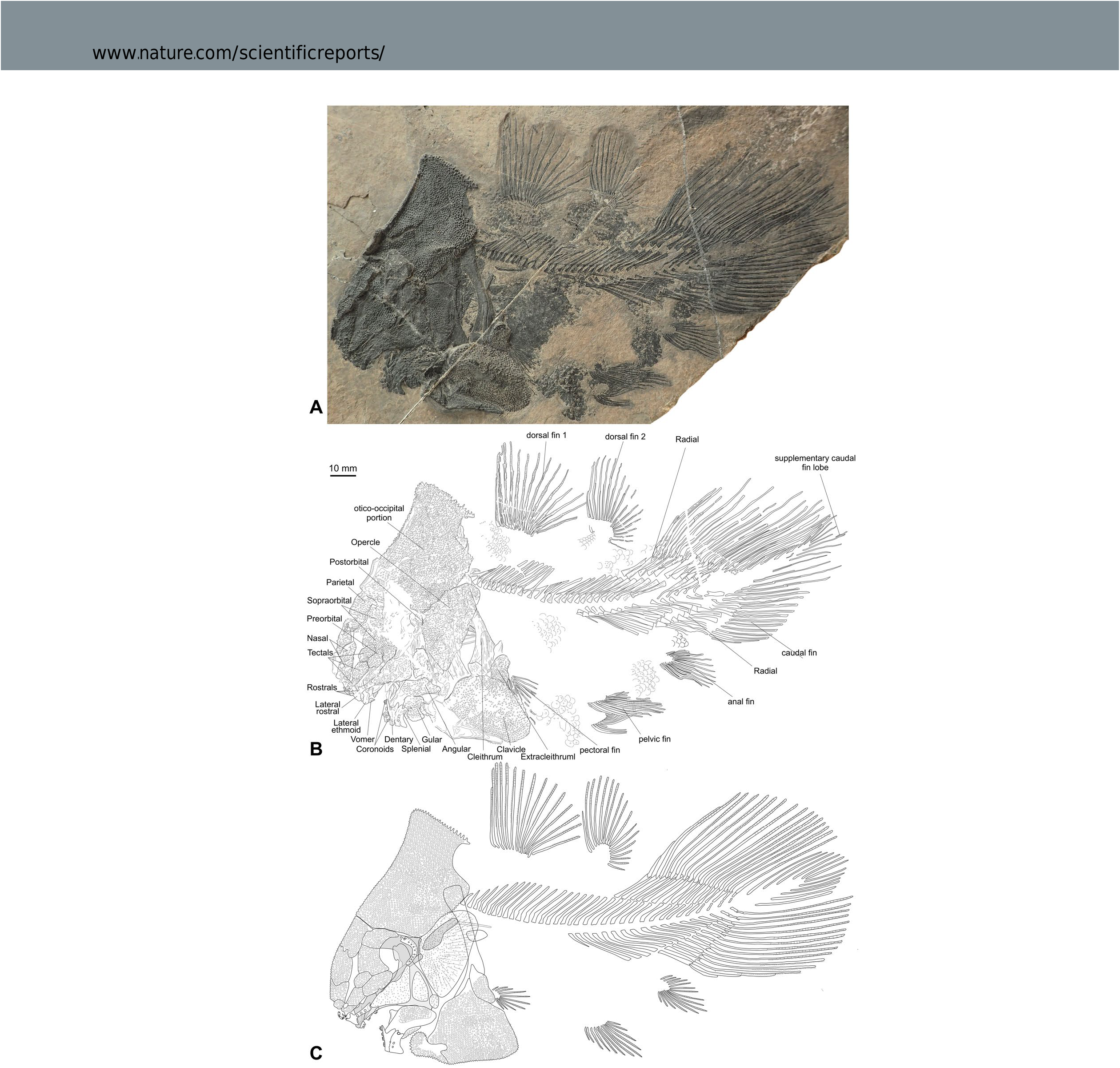
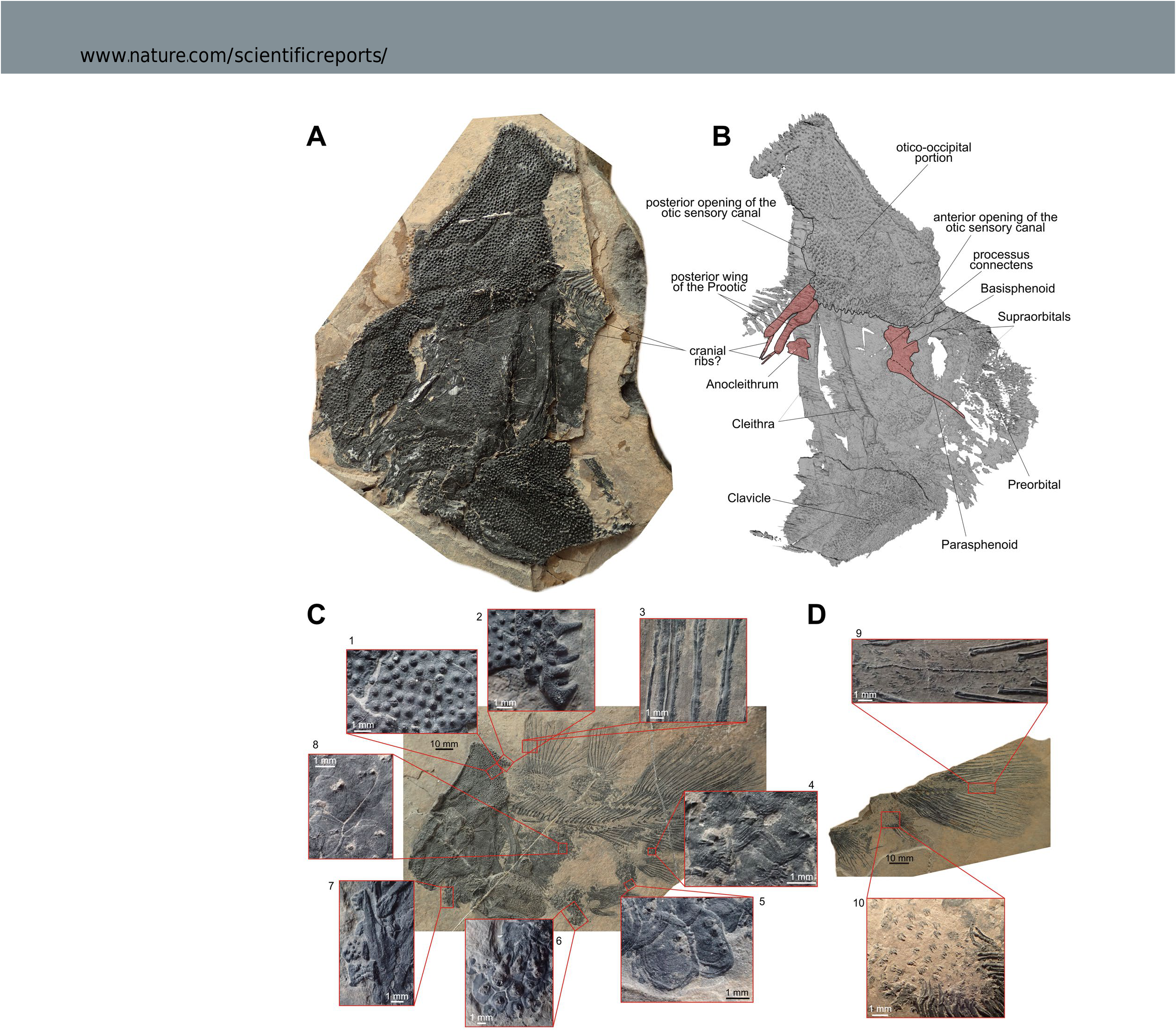
Discussion Phylogenetic relationships. At first sight, the highly-modified coelacanth Foreyia recalls basal Palaeozoic coelacanths. In particular, its general head morphology and some meristic features are reminiscent of the Carboniferous Allenypterus, such as a steep and convex profile of the anterior moiety in lateral view and a proportionally short and deep mandible. Its pectoral girdle shares superficial characters with the Devonian Miguashaia. However, a cladistic analysis places Foreyia as the sister-taxon of Ticinepomis 11, a genus recovered from the same formation at a nearby locality 12 (Figs 3 A, S 7). Both genera are nested within the latimeriids. The node supporting the Latimeria – Foreyia clade is weakly supported but Ticinepomis shares with Foreyia other characters not included in the cladistic analysis (Fig. 2 B, C). These are: 1) The postparietal shield of Ticinepomis is proportionally smaller than in Foreyia, but no sutures are visible between the postparietal and supratemporal ossifications as in Foreyia; 2) The lachrymojugal and squamosal are poorly preserved and fragmented in the holotype of T. peyeri. A possible reconstruction based on direct observation of the holotype is to regard these fragments as belonging to a single large triangular plate corresponding to the fusion of the lachrymojugal and squamosal, as in Foreyia; 3) The lower jaw of Ticinepomis is less derived than that of Foreyia. However, the dentary and the splenial of the former are both angled, reminiscent of the curved mandible of the latter; 4) The ornamentation of most of the dermal bones consists in both genera of tubercles, although in Ticinepomis they are smaller; 5) A broad dorsal extremity of the cleithrum is present in both genera; 6) A massive ornamented clavicle is present in both genera, but in a much more important proportion in Foreyia than in Ticinepomis. Heterochronic evolution and its developmental basis. Most of the shared features in Ticinepomis and Foreyia are more weakly developed in the former than in the latter genus, and they indicate a possible heterochronic evolution at the origin of Foreyia. This hypothesis is strengthened by the fact that the general coelacanth skeletal organization is not altered in Foreyia, but only relative bone sizes vary compared to the generalized coelacanths Bauplan (hypertrophied occipital and clavicular regions, comma-shaped mandible, few abdominal vertebrae and rays in paired fins, and dense covering of large tubercles on the dermal bones and denticles on the scales). Several of these features are developmentally linked in sarcopterygians and, compared with extant models, partly under the control of the same genes. In the chick embryo, the anterior most somites give rise to part of the otic capsule and the exoccipital bone (somite 1) and to the basioccipital bone (somites 2 – 4) 13. The occipital lateral plate mesoderm at the level of somites 1 – 3 gives rise to the ventromedial extremity of the clavicle in amniotes, which is regarded in part as homologous to the dermal clavicle of bony fishes 3, 4. Although numerous developmental patterning genes have a control on these features, the best candidate is the paired box gene 9, or Pax 9, widely distributed among vertebrates and present in Latimeria 14, 15 (alternative genes, such as Prrx 1 / Prrx 2, HoxD, Tbx 14 are discussed in Supplementary Information). In extant bracketing clades of coelacanths, chondrichthyans and amniotes, the embryonic expression of Pax 9 occurs at the level of the head mesoderm, of the sclerotomes (those from the first somites give rise to the occipital bones), of the postotic mesoderm (gives rise to the clavicle) and of the trunk mesoderm (gives rise to paired limbs), as well as at the level of the neural crest (give rises to odontodes) 16, 17. Pax 9 expression on the neural crest at the level of the first rhombomeres also affects the palatine and the coronoid regions in the mouse 16, two anatomical domains also modified in Foreyia. Although Pax 9 in deficient mice does no show phenotypic features directly linkable to the peculiar morphology of Foreyia, the targeted embryological tissues make this gene potentially at the origin of its heterochronic evolution (Fig. 3 D, E). Pax 9 regulates synergetically the development of the vertebral column with Pax 1. The latter has a more limited expression than Pax 9 in amniotes and has an effect on the development of the pectoral girdle, particularly on the acromion, which is a process on the scapula connecting the clavicle 18, 19. The acromion is mesodermal in origin 3, as is the hypertrophied clavicle of Foreyia. It is possible that in coelacanths the expression Pax 1 and Pax 9 are more similar between them than they are in amniotes, as it is the case in the ray-fin fish Medaka 20. In this case, both genes should be considered together in their effects on the phenotype. The search of a single genetic source is an oversimplification since we know that Pax genes work in cooperation with Hox genes 21, 22. The developmental and genetic pathways proposed here suggest that the bizarre morphology of Foreyia (Fig. 4) might be the consequence of a rapid heterochronic evolution.
Lionel Cavin, Bastien Mennecart, Christian Obrist, Loïc Costeur, Heinz Furrer (2017): Heterochronic evolution explains novel body shape in a Triassic coelacanth from Switzerland. Scientific Reports 7 (13695): 1-7, DOI: 10.1038/s41598-017-13796-0