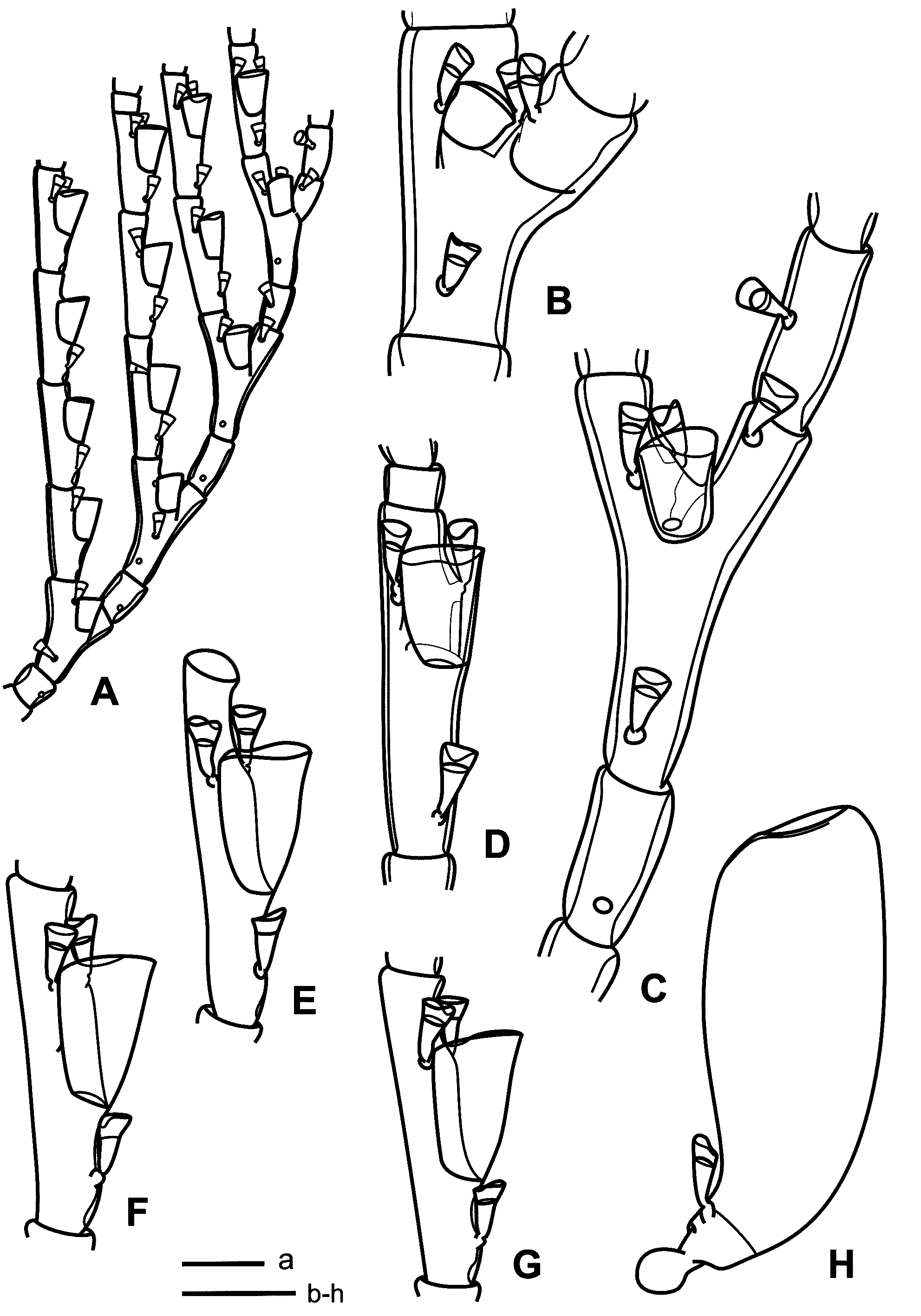
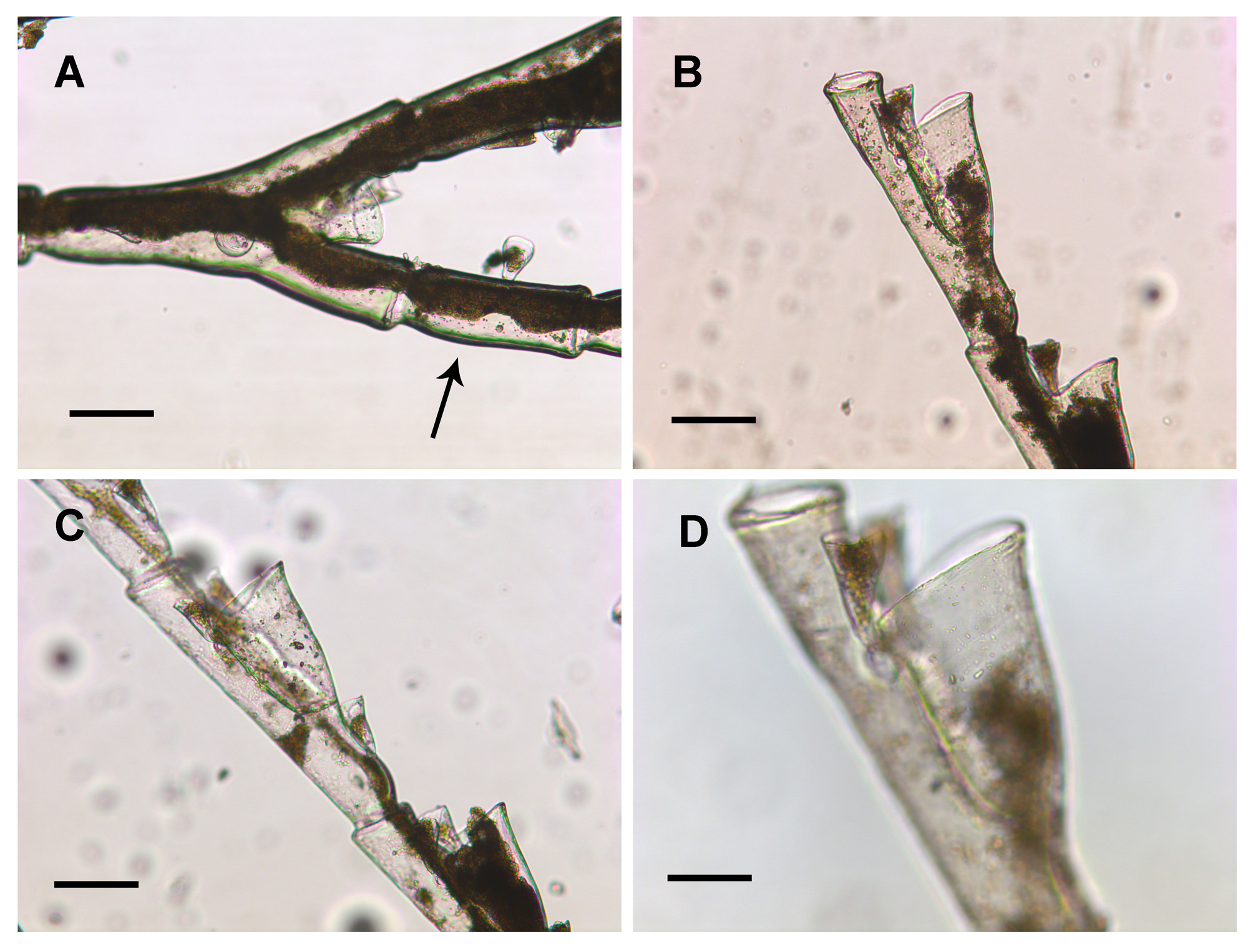
Description. Stem polysiphonic, unbranched, composed of a main aXial tube and several accompanying ones, whose number decreases distally; most distal part of stem only with main tube. Main aXial tube on one side of stem, not covered by accessory tubes for most of its length. Main tube divided into homomerous hydrothecate internodes, bearing hydrothecae and nematothecae. Secondary tubes only provided with nematothecae. Cauline internodes with a short apophysis without nematothecae (Fig. 4 B). Cauline apophyses alternately arranged, forming an angle slightly smaller than 90 ° at basal part of stem, but opening distally, being almost in one plane at distal part. Cauline internodes (Fig. 4 B) with a hydrotheca at aXil between apophysis and internode and three nematothecae: two flanking hydrothecal aperture and one infrathecal nematotheca (occasionally two). Cauline apophyses giving rise to hydrocladia, forming an acute angle with stem. A basal ahydrothecate internode, provided with one nematotheca, present between cauline apophysis and first hydrothecate hydrocladial internode (Fig. 4 A – B). Only occasionally basal ahydrothecate internode absent (in this case, cauline apophyses might be slightly longer and have a nematotheca). Hydrocladia homomerously divided into internodes (Fig. 4 A), but with a short ahydrothecate internode following hydrocladial apophyses of forked internodes (Figs 4 A, 5 A), typically provided with one nematotheca (occasionally two). Hydrocladia branched, up to fifth order (Fig. 4 A). Forked hydrocladial internodes following ahydrothecate internodes. Hydrocladial apophyses forming an acute angle with internode, and provided with one or no nematothecae (Fig. 4 A, C). Length of hydrocladial internodes roughly constant along hydrocladia. Forked hydrocladial internodes (Figs 4 C, 5 A) with an aXillary hydrotheca, two nematothecae flanking hydrothecal aperture, one infrathecal nematotheca (occasionally two), and one nematotheca on apophysis in third and / or fourth internodes (occasionally on the second too) (Fig. 4 A). Unforked hydrothecate hydrocladial internodes (Figs 4 D – G, 5 B – C) with one hydrotheca in the middle and three nematothecae: two flanking hydrothecal aperture and one infrathecal nematotheca. Hydrotheca elongate (Figs 4 D – G, 5 B – D), length increasing along hydrocladia. Adcauline wall completely adnate to internode. Abcauline wall straight. Hydrothecal aperture circular; rim even. Gonothecae inserted on small apophyses between hydrotheca and infrathecal nematotheca of hydrocladial internodes. Gonothecae elongate pear-shaped (Fig. 4 H), provided with a distal, slightly oblique, circular aperture, and a basal chamber delimited by a circular diaphragm and provided with two nematothecae. Measurements (in µm). Hydrotheca: length, 220 – 350 (1 st and 16 th unforked hydrocladial internodes, respectively), diameter at aperture, 190 – 210. Hydrocladial internodes: length, 640 – 800 (1 st and 16 th unforked hydrocladial internodes, respectively), diameter under hydrotheca, 280 – 180 (1 st and 16 th unforked hydrocladial internodes, respectively). Cauline internodes: length, 620 – 720, diameter under apophysis, 260. Gonotheca: height, 1000 – 1100, maXimum diameter, 400 – 500, diameter at aperture, 220 – 240.
Peña Cantero, Álvaro L., Marzal, Marina Fresneda (2018): Benthic hydroids (Cnidaria: Hydrozoa) from off George V Coast (East Antarctica). Zootaxa 4441 (1): 121-136, DOI: 10.11646/zootaxa.4441.1.7