AnimaliaNot EvaluatedacceptedspeciesAccepted
Pierrella plicata

Pierrella plicata

Grischenko, Gordon & Melnik, 2018

GBIF:148403704

0year

ABOUT

Descriptions(5)

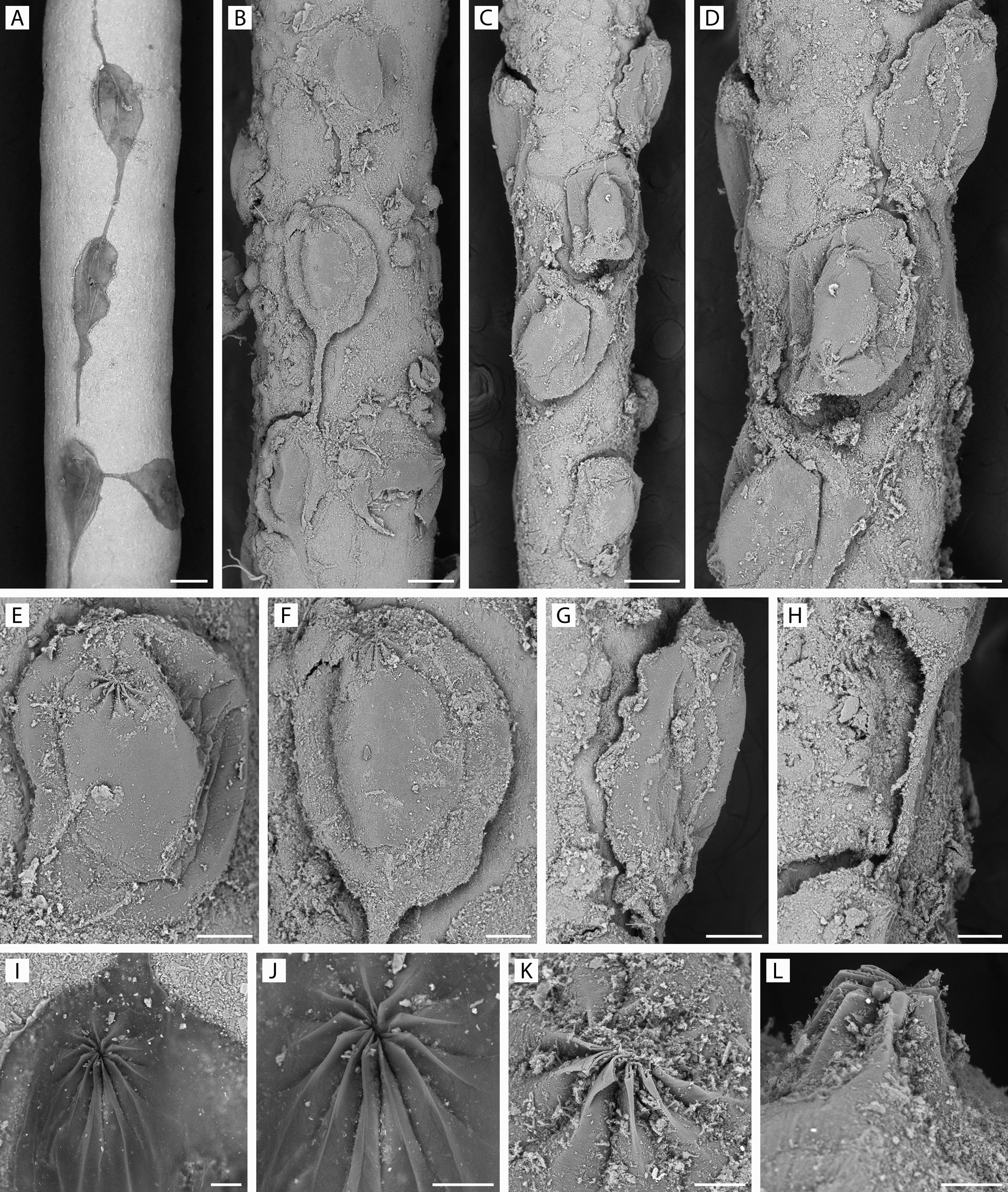
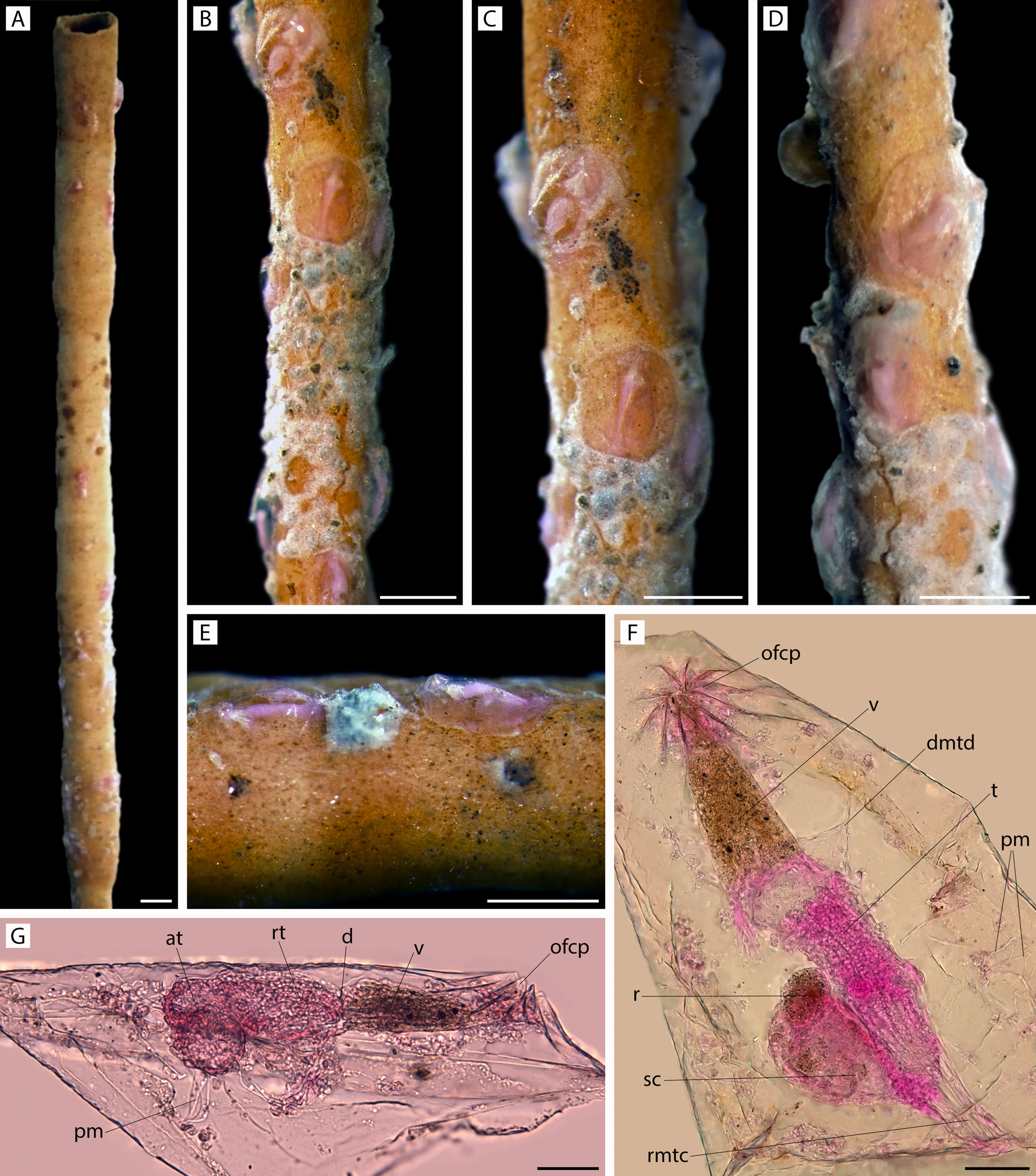
Description. Colony encrusting, uniserial, sparsely branching laterally (Figs 49 A – E, 50 A – D). Zooids large, transparent, variably claviform, either with elongate-oval dilatation and long filiform cauda of same length (Figs 49 A, 50 A, H), or pyriform to subrounded with truncate or no cauda (Figs 49 B – D, 50 C, D, E, G), in part depending on crowding of zooids on substratum, or intermediate between these morphologies (Figs 49 E, 50 B, F). Lateral branching sporadic, on one side only, at right angle to widest part of dilatation. Aperture elevated, comprising stiff radiating pleats forming stellate pattern when polypide retracted (Figs 49 F, G, 50 I – L); 8 – 11 pleats seen, each appearing as erect ridge; stellate pattern symmetrical or ridges may appear somewhat longer on proximal side of orificial mound in some zooids (Fig. 50 I, J). Zooid wall wholly transparent. Vestibule tapering distad, as long as polypide that lies proximal to it; parieto-diaphragmatic musculature comprising small narrow bundles of fibers at each proximolateral corner. Vestibule 0.084 mm long; retracted tentacle crown 0.096 – 0.141 mm long. Tentacle number not determined by sectioning; from lateral view of retracted polypide it is likely that tentacle number is 12 or fewer. Anchor point of polypide retractor muscles on proximal or proximolateral wall. No evidence of brown bodies. Ancestrular zooid not determined. Measurements (mm). Holotype, ZIRAS 1 / 50727 (Figs 49 B – E, 50 B – H, K, L): ZL 0.900 – 1.350 (1.180 ± 0.134); ZDL 0.577 – 0.825 (0.675 ± 0.078); ZDW 0.402 – 0.575 (0.475 ± 0.051); CaL 0.325 – 0.775 (0.505 ± 0.141); OrD 0.058 – 0.107 (0.083 ± 0.016); OrH 0.044 – 0.069 (0.055 ± 0.011) (n = 5).
Grischenko, Andrei V., Gordon, Dennis P., Melnik, Viacheslav P. (2018): Bryozoa (Cyclostomata and Ctenostomata) from polymetallic nodules in the Russian exploration area, Clarion - Clipperton Fracture Zone, eastern Pacific Ocean-taxon novelty and implications of mining. Zootaxa 4484 (1): 1-91, DOI: 10.11646/zootaxa.4484.1.1

Remarks. We include this new species in the otherwise monotypic genus Pierrella, previously known only as a fossil taxon from the Cretaceous (lower Campanian to lower Maastrichtian) of Wyoming and South Dakota, USA. The type species, P. larsoni, was preserved on inner shell surfaces of empty body chambers of ammonites by a process interpreted as lithoimmuration. The overall characters of P. larsoni accord with living members of Arachnidiidae in terms of colony form (adnate, uniserial, branching) and zooid shape (clavate / caudate), but the genus was able to be distinguished by its distinctive pleats (folds), eight in all, forming the orifice in the retracted state. This arrangement is unknown in any other arachnidioid, in which the orifice, when closed, has been described as a mamilla or papilla, or is somewhat elevated and squared (d'Hondt 1983). Wilson & Taylor (2013) referred to the pleats in P. larsoni as " setigerous, or pleated, collars ", but it remains to be seen if the stiff orificial folds in Pierrella are homologous with the setigerous apparatus of the introvert in vesicularioid ctenostomes. For example, in the ctenostomes studied by McKinney & Dewel (2002), all collars were " composed of membranes that appeared to have their basal attachment at the atrial sphincter (diaphragm) "; these authors distinguished four forms of collar. Notwithstanding this uncertainty, which has no bearing on the relatedness of Pierrella plicata n. sp. to P. larsoni, the similarity of these two species is compelling. They accord in every important respect — colony form, zooid shape, zooid size, and the overlapping number of stiff orificial pleats (eight in P. larsoni, 8 – 11 in P. plicata). The only differences concern budding locus (somewhat more distolateral in P. larsoni) and budding pattern (morevariable branch angles in P. larsoni), but these differences can be intrageneric. In both species, zooid length and shape vary, becoming longer and more clavate in distal colony parts. In P. plicata, a squatter zooid shape occurs where zooids are more crowded. An apparent colony origin was found in P. larsoni, giving evidence of a nearcircular ancestrula with two distolateral buds and a proximal bud. An ancestrula was not seen in P. plicata; its discovery would give more information concerning relatedness. The long temporal gap of c. 74 million years need not preclude these two species being congeneric. A perusal of the Bryozoa Home Page shows that there are quite a number of Mesozoic genera, from three orders, still present in modern seas, e. g. Arachnidium, Arachnoidella, Buskia (Ctenostomata), Nellia, Onychocella, Poricellaria, Celleporella (Cheilostomata), Microeciella, Plagioecia, Mesenteripora, Crisia (Cyclostomata) (see also Voigt 1985). Pierrella plicata n. sp. encrusts tubular arenaceous foraminiferans resembling Rhabdammina, which live at the sediment surface. The largest colonies comprised fewer than ten zooids. The proportionately very long vestibule in zooids examined in transparency and stained with Rose Bengal give evidence that, when the polypide retracts, the vestibule fills with fine sediment particles. These would be emptied from the vestibule upon the next polypide eversion.
Grischenko, Andrei V., Gordon, Dennis P., Melnik, Viacheslav P. (2018): Bryozoa (Cyclostomata and Ctenostomata) from polymetallic nodules in the Russian exploration area, Clarion - Clipperton Fracture Zone, eastern Pacific Ocean-taxon novelty and implications of mining. Zootaxa 4484 (1): 1-91, DOI: 10.11646/zootaxa.4484.1.1
Distribution. Recorded from three stations within coordinates 12.51953 – 12.91697 ° N, 128.58775 – 134.60008 ° W, at depth range 4808 – 4850 m.
Grischenko, Andrei V., Gordon, Dennis P., Melnik, Viacheslav P. (2018): Bryozoa (Cyclostomata and Ctenostomata) from polymetallic nodules in the Russian exploration area, Clarion - Clipperton Fracture Zone, eastern Pacific Ocean-taxon novelty and implications of mining. Zootaxa 4484 (1): 1-91, DOI: 10.11646/zootaxa.4484.1.1
Etymology. Latin, plicatus, folded, alluding to the form of the closed orifice.
Grischenko, Andrei V., Gordon, Dennis P., Melnik, Viacheslav P. (2018): Bryozoa (Cyclostomata and Ctenostomata) from polymetallic nodules in the Russian exploration area, Clarion - Clipperton Fracture Zone, eastern Pacific Ocean-taxon novelty and implications of mining. Zootaxa 4484 (1): 1-91, DOI: 10.11646/zootaxa.4484.1.1
Material examined. Holotype: ZIRAS 1 / 50727, colony encrusting tubular arenaceous foraminiferan, YMG R. V. Yuzhmorgeologiya cruise BIE 2000, Stn 1, 31 May 2000, 12.91697 ° N, 128.58775 ° W, 4850 m. Paratype: ZIRAS 2 / 50728, colony encrusting tubular arenaceous foraminiferan, YMG R. V. Gelendzhik cruise GLD 4 – 11, Stn 230, 4 May 2012, 12.65038 ° N, 133.29995 ° W, 4809 m. Additional material: YMG 4 – 07, Stn 139. Total specimens examined six.
Grischenko, Andrei V., Gordon, Dennis P., Melnik, Viacheslav P. (2018): Bryozoa (Cyclostomata and Ctenostomata) from polymetallic nodules in the Russian exploration area, Clarion - Clipperton Fracture Zone, eastern Pacific Ocean-taxon novelty and implications of mining. Zootaxa 4484 (1): 1-91, DOI: 10.11646/zootaxa.4484.1.1

Export occurrence data

Darwin Core Archive (ZIP)

CLASSIFICATION

Taxonomic Classification Tree

MULTIMEDIA

Media Files(2)

FIGURE 49. Pierrella plicata n. sp. A, paratype, ZIRAS 2/50728; B–E, holotype, ZIRAS 1/50727; F, G, specimen YMG4–07, Stn 139. Specimens stained in Rose Bengal. A–E, zooids on arenaceous foraminiferan tubes, varying from linear and caudate to squat and more crowded; F, G, stained zooids seen in transmitted light. Abbreviations: at, alimentary tract; d, diaphragm; dmtd, dilator muscles and tendon of diaphragm; ofcp, orifice with folded cuticular pleats; pm, parietal muscles; r, rectum; rmtc, retractor muscles of tentacle crown; rt, retracted tentacles; sc, stomach caecum; t, tentacles; v, vestibule (filled with sediment). Scale bars: A–E, 500 µm; F, G, 50 µm.

Imageimage/png© Grischenko, Andrei V.;Gordon, Dennis P.;Melnik, Viacheslav P.Grischenko, Andrei V.;Gordon, Dennis P.;Melnik, Viacheslav P.

FIGURE 50. Pierrella plicata n. sp. A, I, J, paratype, ZIRAS 2/50728; B–H, K, L, holotype, ZIRAS 1/50727. A, H, narrow, long-caudate zooids; C–E, G, squat zooids; B, F, zooids of intermediate shape; I–L, stiffly pleated orificial folds. Scale bars: A–D, 250 µm; E–H, 100 µm; I–L, 25 µm.

Imageimage/png© Grischenko, Andrei V.;Gordon, Dennis P.;Melnik, Viacheslav P.Grischenko, Andrei V.;Gordon, Dennis P.;Melnik, Viacheslav P.

IMAGES

Gallery(2)

See Gallery

Occurrences with images

Source Information

Bryozoa (Cyclostomata and Ctenostomata) from polymetallic nodules in the Russian exploration area, Clarion - Clipperton Fracture Zone, eastern Pacific Ocean-taxon novelty and implications of mining

checklist

This dataset contains the digitized treatments in Plazi based on the original journal article Grischenko, Andrei V., Gordon, Dennis P., Melnik, Viacheslav P. (2018): Bryozoa (Cyclostomata and Ctenostomata) from polymetallic nodules in the Russian exploration area, Clarion - Clipperton Fracture Zone, eastern Pacific Ocean-taxon novelty and implications of mining. Zootaxa 4484 (1): 1-91, DOI: 10.11646/zootaxa.4484.1.1

Abstract

This work describes Bryozoa of the orders Cyclostomata and Ctenostomata found associated with polymetallic nodules collected by box-coring in the eastern part of the Russian exploration area of the Clarion-Clipperton Fracture Zone (CCFZ) under contract to Yuzhmorgeologiya. Scanning electron microscopic study of 358 cyclostome colonies and 14 ctenostome colonies from 4510–5280 m depth has resulted in the recognition of two new species of Ctenostomata, and 14 new species, nine new genera and two new families of Cyclostomata; three additional species of Cyclostomata are left in open nomenclature pending the discovery of missing reproductive characters. The taxonomic novelty is thus notable. One of the new Ctenostomata represents the first living example of the previously monotypic Late Cretaceous genus Pierrella. Twelve of the new cyclostome taxa have well-developed gonozooids, indicating that embryonic cloning (polyembryony) is normal in this deep-sea environment. On the other hand, one indeterminate tubuliporine and two rectangulates have dimorphic peristomes. In the latter two cases, enough mature colonies were found to suggest that this feature is normal, and that the dimorphic zooids are possibly female—in other words, capacious incubation chambers are apparently lacking, and therefore polyembryony would also be lacking or reduced. In one of these species, evidence is presented to suggest that the ancestrular zooid can reproduce precociously. Of the species reported here, only one has previously been found outside the exploration area, highlighting both the limited knowledge we have of bryozoans in the deep Pacific and/or a fauna that is largely endemic to the nodule environment. An additional 31 species of Cheilostomata have also been discovered that will be described in a subsequent publication. Most bryozoans are macrofaunal-sized, so are both inadequately determinable and overlooked in images obtained by remotely operated vehicles; yet, with 50 species, Bryozoa is the most speciose sessile macrofaunal phylum on the nodules. Nodules constitute hard substrata in an area otherwise mostly inhospitable for Bryozoa, hence mining would lead to loss of critical habitat. Further, as suspension-feeders, bryozoans are highly susceptible to smothering by suspended sediment, and non-mined areas closely adjacent to extraction zones would likely also be affected and their associated bryozoan fauna obliterated. More data are required on the distribution of the CCFZ bryozoan species elsewhere in the east Central Pacific to determine if mining would lead to local taxon extirpation or global extinction at both low and high taxonomic levels.

Grischenko A V, Gordon D P, Melnik V P, plazi (2018). Bryozoa (Cyclostomata and Ctenostomata) from polymetallic nodules in the Russian exploration area, Clarion - Clipperton Fracture Zone, eastern Pacific Ocean-taxon novelty and implications of mining. Plazi.org taxonomic treatments database. Checklist dataset https://doi.org/10.11646/zootaxa.4484.1.1 accessed via GBIF.org on 2026-06-16.

CC0Published 9/25/2018View dataset
GBIF Usage Key
148403704
Dataset Key
74b777c9-eae0-4770-8c86-dcbb10fb06b3
Origin
source
Backbone Key
10607028
Taxon ID
521587E4567B555709EEFBCD8959FCF8.taxon
Last Crawled
6/10/2026
Last Interpreted
6/10/2026