
AnimaliaNot EvaluatedacceptedspeciesAccepted
Frontohornera frontalis

Frontohornera frontalis

Grischenko, Gordon & Melnik, 2018

GBIF:148403713

0year

ABOUT

Descriptions(5)

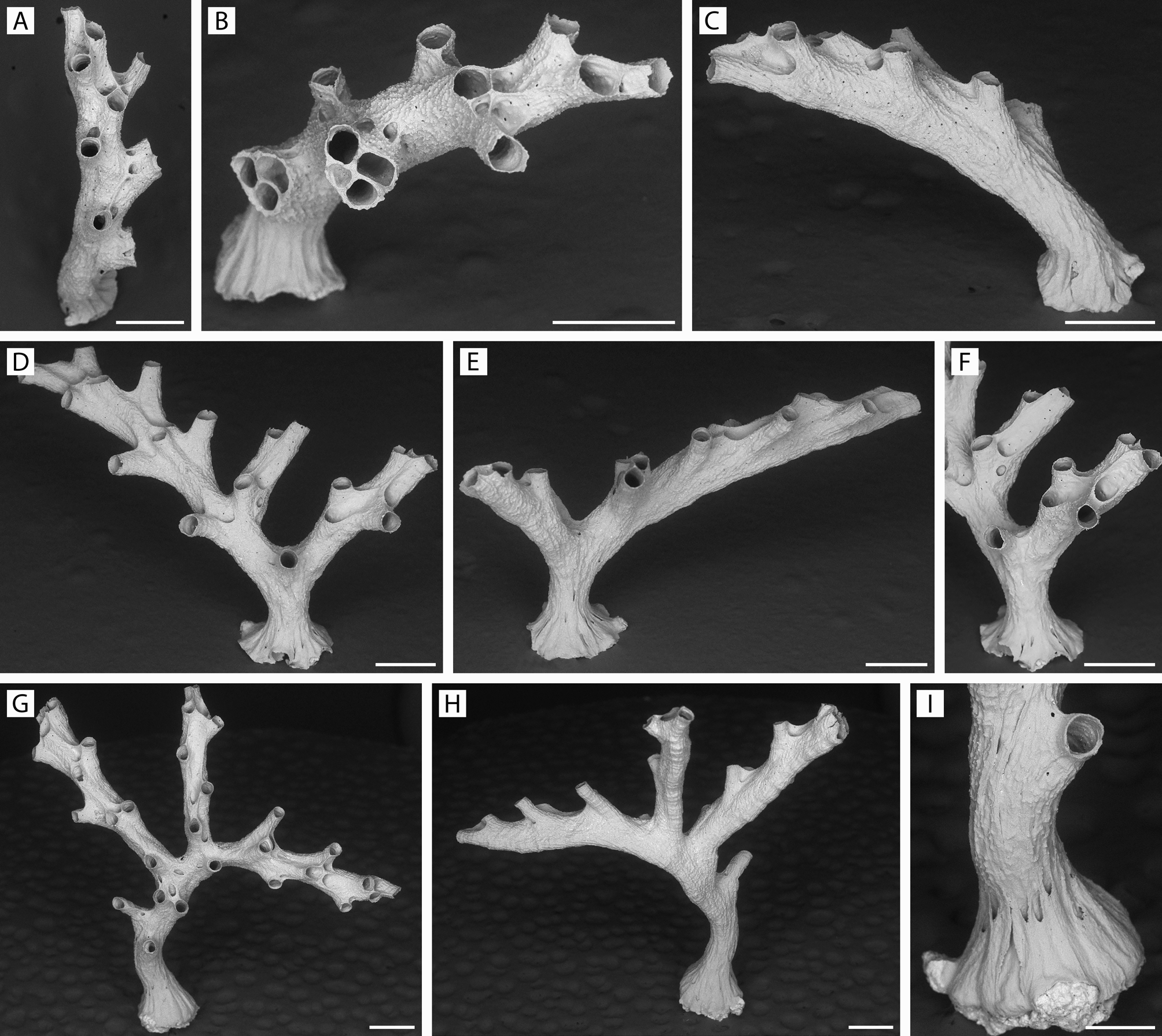
Description. Colony erect, white, to 2.81 mm high, 6.76 mm broad, dichotomously branching once in a single plane (Fig. 16 A, B), or with short additional bifurcation to produce a third, short branch near colony center (Fig. 18 G, H). Stem diameter 0.32 × 0.37 mm, widening to colony base (0.66 – 0.76 mm). With distinct frontal and abfrontal faces (Fig. 16), entire surface interior-walled, textured irregularly with minute dimples, granules, ridges and furrows (Fig. 17 A – G), with longitudinal linearities only on stem of colony; conspicuous ribbing (nervi) and grooves (sulci) lacking. Pores simple, tiny, sparse. Autozooids in 2 – 4 series, their peristomes produced frontally upwards, relatively short along frontolateral and central parts of branch, longest along abfrontolateral margin, with simple circular apertures, no apertural spines (Fig. 17 A – F, I). Peristomes somewhat dimorphic (Fig. 17 F), short and uniformly tubular with circular apertures in central face of branches, but strongly elongated, with aperture having shape of teardrop, isosceles triangle or irregular oval along branch margins. Peristome wall interiors with short, thin spinules proximal to aperture (Fig. 17 I). Cancelli most numerous on central part of branch distal to gonozooid (Figs 16 A, 17 A, E, J), otherwise sparse, shallow, of varying size. Abfrontal face of colony with outlines of autozooidal tubes (Figs 16 B, 17 G), their longitudinal contours converging proximad. Gonozooid frontally borne, adjacent to second dichotomy (Fig. 16 A), subglobular, surface like that of colony but with slightly denser prickled granules (Fig. 17 H, J, K), frontal peak and distal sides of chamber converging towards short ooeciostome that curves frontalwards (Fig. 17 H, J, K), ooeciopore transversely oval (Fig. 17 L). Ancestrular zooid not seen in isolation; earliest growth stages encountered show lowest peristome of colony (presumed ancestrular peristome), which appears to be wholly erect, though concealed within basal skirt of extrazooidal calcification (Fig. 18 G, I). Peristome of daughter zooid above it in series, but in another colony ancestrular and two daughter peristomes occur as cluster of three (Fig. 18 B). Measurements (mm). Holotype, ZIRAS 1 / 50707 (Fig. 16 A, B): ZL 0.569 – 0.763 (0.663 ± 0.071). Branch center: PeL 0.072 – 0.197 (0.122 ± 0.042); PeD 0.141 – 0.162 (0.153 ± 0.008); ApD 0.129 – 0.141 (0.137 ± 0.004). Branch margin: PeL 0.194 – 0.526 (0.374 ± 0.102); PeD 0.110 – 0.146 (0.135 ± 0.011); ApL 0.132 – 0.176 (0.156 ± 0.016) (n = 7); ApW 0.122 – 0.147 (0.132 ± 0.008) (n = 7). Gonozooid (n = 1): GZL 0.744; GZW 0.511; GZH = 0.377; OsL 0.167; OsW 0.132; OsH 0.196; OpL 0.073; OpW 0.071. Non-type specimen GLD 4 – 11, Stn 210 (Fig. 18 G – I): AnPeD 0.144 (n = 1).
Grischenko, Andrei V., Gordon, Dennis P., Melnik, Viacheslav P. (2018): Bryozoa (Cyclostomata and Ctenostomata) from polymetallic nodules in the Russian exploration area, Clarion - Clipperton Fracture Zone, eastern Pacific Ocean-taxon novelty and implications of mining. Zootaxa 4484 (1): 1-91, DOI: 10.11646/zootaxa.4484.1.1
Remarks. Frontohornera frontalis n. sp. is represented in the collection by six colonies of varying ages and sizes. Only one reproductively mature colony was encountered. All were found attached to polymetallic nodules.
Grischenko, Andrei V., Gordon, Dennis P., Melnik, Viacheslav P. (2018): Bryozoa (Cyclostomata and Ctenostomata) from polymetallic nodules in the Russian exploration area, Clarion - Clipperton Fracture Zone, eastern Pacific Ocean-taxon novelty and implications of mining. Zootaxa 4484 (1): 1-91, DOI: 10.11646/zootaxa.4484.1.1
Distribution. Recorded from six stations within coordinates 13.03353 – 14.29353 ° N, 131.87598 – 134.23457 ° W, at depth range 4815 – 5166 m.
Grischenko, Andrei V., Gordon, Dennis P., Melnik, Viacheslav P. (2018): Bryozoa (Cyclostomata and Ctenostomata) from polymetallic nodules in the Russian exploration area, Clarion - Clipperton Fracture Zone, eastern Pacific Ocean-taxon novelty and implications of mining. Zootaxa 4484 (1): 1-91, DOI: 10.11646/zootaxa.4484.1.1
Etymology. Latin, frontalis, frontal, alluding to the frontally borne gonozooid.
Grischenko, Andrei V., Gordon, Dennis P., Melnik, Viacheslav P. (2018): Bryozoa (Cyclostomata and Ctenostomata) from polymetallic nodules in the Russian exploration area, Clarion - Clipperton Fracture Zone, eastern Pacific Ocean-taxon novelty and implications of mining. Zootaxa 4484 (1): 1-91, DOI: 10.11646/zootaxa.4484.1.1
Material examined. Holotype: ZIRAS 1 / 50707, colony detached from nodule, YMG R. V. Yuzhmorgeologiya cruise YMG 4 – 13, Stn 292, 27 July 2014, 13.03353 ° N, 132.49292 ° W, 4829 m. Paratype: ZIRAS 2 / 50708, colony attached to nodule particle, YMG R. V. Gelendzhik cruise GLD 4 – 11, Stn 210, 20 April 2012, 13.35817 ° N, 133.27183 ° W, 4815 m. Additional material: YMG 4 – 07, Stn 124; GLD 4 – 11, Stn 215; YMG 4 – 14, Stns 329, 334. Total specimens examined six.
Grischenko, Andrei V., Gordon, Dennis P., Melnik, Viacheslav P. (2018): Bryozoa (Cyclostomata and Ctenostomata) from polymetallic nodules in the Russian exploration area, Clarion - Clipperton Fracture Zone, eastern Pacific Ocean-taxon novelty and implications of mining. Zootaxa 4484 (1): 1-91, DOI: 10.11646/zootaxa.4484.1.1

Export occurrence data

Darwin Core Archive (ZIP)

CLASSIFICATION

Taxonomic Classification Tree

MULTIMEDIA

Media Files(4)

FIGURE 2. Colonies of some cyclostome bryozoans, in vivo, attached to polymetallic nodules. A–E, Pandanipora helix n. gen., n. sp.: A, specimen GLD4–09, Stn 190; B, specimen GLD4–12, Stn 262; C, specimen YMG4–07, Stn 143; D, specimen YMG4–13, Stn 295; E, specimen GLD 4–11, Stn 212. F, Tubuliporina sp. indet., specimen YMG18–01, Stn 7. G, H, Abyssoecia elevata n. gen., n. sp.: G, specimen GLD4–09, Stn 196; H, specimen GLD4–09, Stn 191. I, Discantenna metallica n. sp.: specimen GLD4–11, Stn 224. J, K, Frontohornera frontalis n. gen., n. sp.: J, specimen YMG4–07, Stn 124; K, specimen GLD4–11, Stn 210. L, Alyonushka hystricosa n. gen., n. sp.: specimen GLD4–09, Stn 199. M, Calyssopora volcano n. gen., n. sp.: specimen YMG18–01, Stn 33. N, O, Anyuta anastema n. gen., n. sp.: N, specimen GLD4–09, Stn 180; O, specimen YMG4–06, Stn 71. Scale bars: 1 mm.

Imageimage/png© Grischenko, Andrei V.;Gordon, Dennis P.;Melnik, Viacheslav P.Grischenko, Andrei V.;Gordon, Dennis P.;Melnik, Viacheslav P.

FIGURE 16. Frontohornera frontalis n. gen., n. sp. Holotype specimen, ZIRAS 1/50707, respectively seen in A, frontal and B, abfrontal views. Scale bars: 1 mm.

Imageimage/png© Grischenko, Andrei V.;Gordon, Dennis P.;Melnik, Viacheslav P.Grischenko, Andrei V.;Gordon, Dennis P.;Melnik, Viacheslav P.

FIGURE 17. Frontohornera frontalis n. gen., n. sp. Holotype, ZIRAS 1/50707, showing details of morphology. A, part of branch distal to gonozooid, showing cancelli and zooidal peristomes; B, part of infertile branch with fewer cancelli; C, D, parts of infertile branch showing peristomial dimorphism; E, part of branch near gonozooid showing numerous cancelli and peristomial dimorphism; F, zooids showing peristomial and apertural dimorphism; G, abfrontal part of branch in vicinity of gonozooid; H, J, K, gonozooid profiles; I, autozooidal peristome showing interior spinules; L, ooeciostome and ooeciopore. Scale bars: A, B, D, E, G, 300 µm; C, H, J, K, 200 µm; F, 150 µm; I, 100 µm; L, 50 µm.
Imageimage/png© Grischenko, Andrei V.;Gordon, Dennis P.;Melnik, Viacheslav P.Grischenko, Andrei V.;Gordon, Dennis P.;Melnik, Viacheslav P.

FIGURE 18. Frontohornera frontalis n. gen., n. sp. Progressive stages of development of young colonies. A–C, specimen GLD4–11, Stn 215, from different angles; D–F, specimen YMG4–14, Stn 334, from different angles; G–I, specimen GLD4–11, Stn 210, in frontal and abfrontal views and a close-up of the colony base with secondary calcification. Scale bars: A–H, 500 µm; I, 250 µm.

Imageimage/png© Grischenko, Andrei V.;Gordon, Dennis P.;Melnik, Viacheslav P.Grischenko, Andrei V.;Gordon, Dennis P.;Melnik, Viacheslav P.

IMAGES

Gallery(4)

See Gallery

Occurrences with images

Source Information

Bryozoa (Cyclostomata and Ctenostomata) from polymetallic nodules in the Russian exploration area, Clarion - Clipperton Fracture Zone, eastern Pacific Ocean-taxon novelty and implications of mining

checklist

This dataset contains the digitized treatments in Plazi based on the original journal article Grischenko, Andrei V., Gordon, Dennis P., Melnik, Viacheslav P. (2018): Bryozoa (Cyclostomata and Ctenostomata) from polymetallic nodules in the Russian exploration area, Clarion - Clipperton Fracture Zone, eastern Pacific Ocean-taxon novelty and implications of mining. Zootaxa 4484 (1): 1-91, DOI: 10.11646/zootaxa.4484.1.1

Abstract

This work describes Bryozoa of the orders Cyclostomata and Ctenostomata found associated with polymetallic nodules collected by box-coring in the eastern part of the Russian exploration area of the Clarion-Clipperton Fracture Zone (CCFZ) under contract to Yuzhmorgeologiya. Scanning electron microscopic study of 358 cyclostome colonies and 14 ctenostome colonies from 4510–5280 m depth has resulted in the recognition of two new species of Ctenostomata, and 14 new species, nine new genera and two new families of Cyclostomata; three additional species of Cyclostomata are left in open nomenclature pending the discovery of missing reproductive characters. The taxonomic novelty is thus notable. One of the new Ctenostomata represents the first living example of the previously monotypic Late Cretaceous genus Pierrella. Twelve of the new cyclostome taxa have well-developed gonozooids, indicating that embryonic cloning (polyembryony) is normal in this deep-sea environment. On the other hand, one indeterminate tubuliporine and two rectangulates have dimorphic peristomes. In the latter two cases, enough mature colonies were found to suggest that this feature is normal, and that the dimorphic zooids are possibly female—in other words, capacious incubation chambers are apparently lacking, and therefore polyembryony would also be lacking or reduced. In one of these species, evidence is presented to suggest that the ancestrular zooid can reproduce precociously. Of the species reported here, only one has previously been found outside the exploration area, highlighting both the limited knowledge we have of bryozoans in the deep Pacific and/or a fauna that is largely endemic to the nodule environment. An additional 31 species of Cheilostomata have also been discovered that will be described in a subsequent publication. Most bryozoans are macrofaunal-sized, so are both inadequately determinable and overlooked in images obtained by remotely operated vehicles; yet, with 50 species, Bryozoa is the most speciose sessile macrofaunal phylum on the nodules. Nodules constitute hard substrata in an area otherwise mostly inhospitable for Bryozoa, hence mining would lead to loss of critical habitat. Further, as suspension-feeders, bryozoans are highly susceptible to smothering by suspended sediment, and non-mined areas closely adjacent to extraction zones would likely also be affected and their associated bryozoan fauna obliterated. More data are required on the distribution of the CCFZ bryozoan species elsewhere in the east Central Pacific to determine if mining would lead to local taxon extirpation or global extinction at both low and high taxonomic levels.

Grischenko A V, Gordon D P, Melnik V P, plazi (2018). Bryozoa (Cyclostomata and Ctenostomata) from polymetallic nodules in the Russian exploration area, Clarion - Clipperton Fracture Zone, eastern Pacific Ocean-taxon novelty and implications of mining. Plazi.org taxonomic treatments database. Checklist dataset https://doi.org/10.11646/zootaxa.4484.1.1 accessed via GBIF.org on 2026-06-15.

CC0Published 9/25/2018View dataset
GBIF Usage Key
148403713
Dataset Key
74b777c9-eae0-4770-8c86-dcbb10fb06b3
Origin
source
Backbone Key
10112492
Taxon ID
521587E4562E551809EEF8FA884FF85C.taxon
Last Crawled
6/10/2026
Last Interpreted
6/10/2026