AnimaliaNot EvaluatedacceptedspeciesAccepted
Calyssopora vasiformis

Calyssopora vasiformis

Grischenko, Gordon & Melnik, 2018

GBIF:148403724

0year

ABOUT

Descriptions(5)

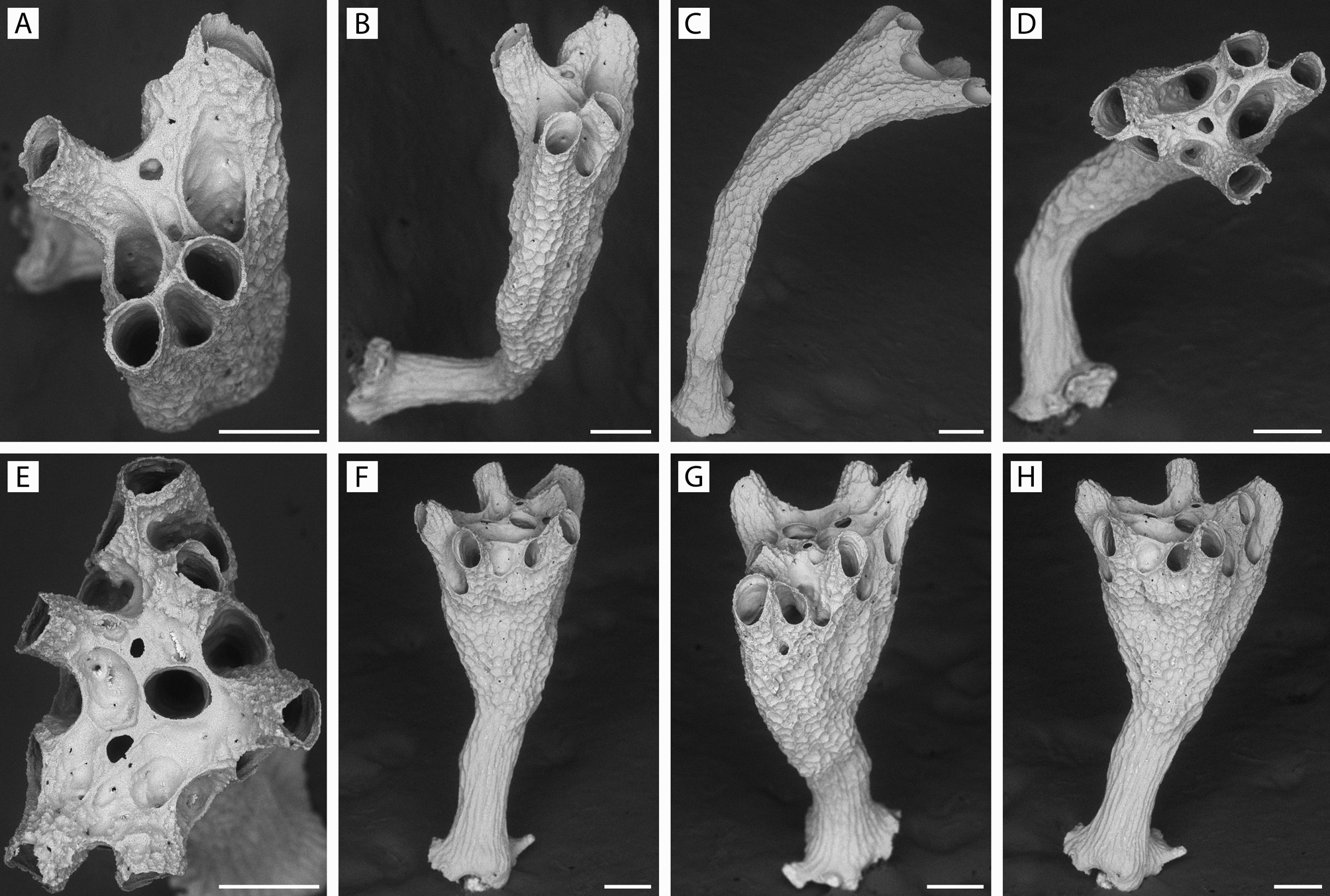
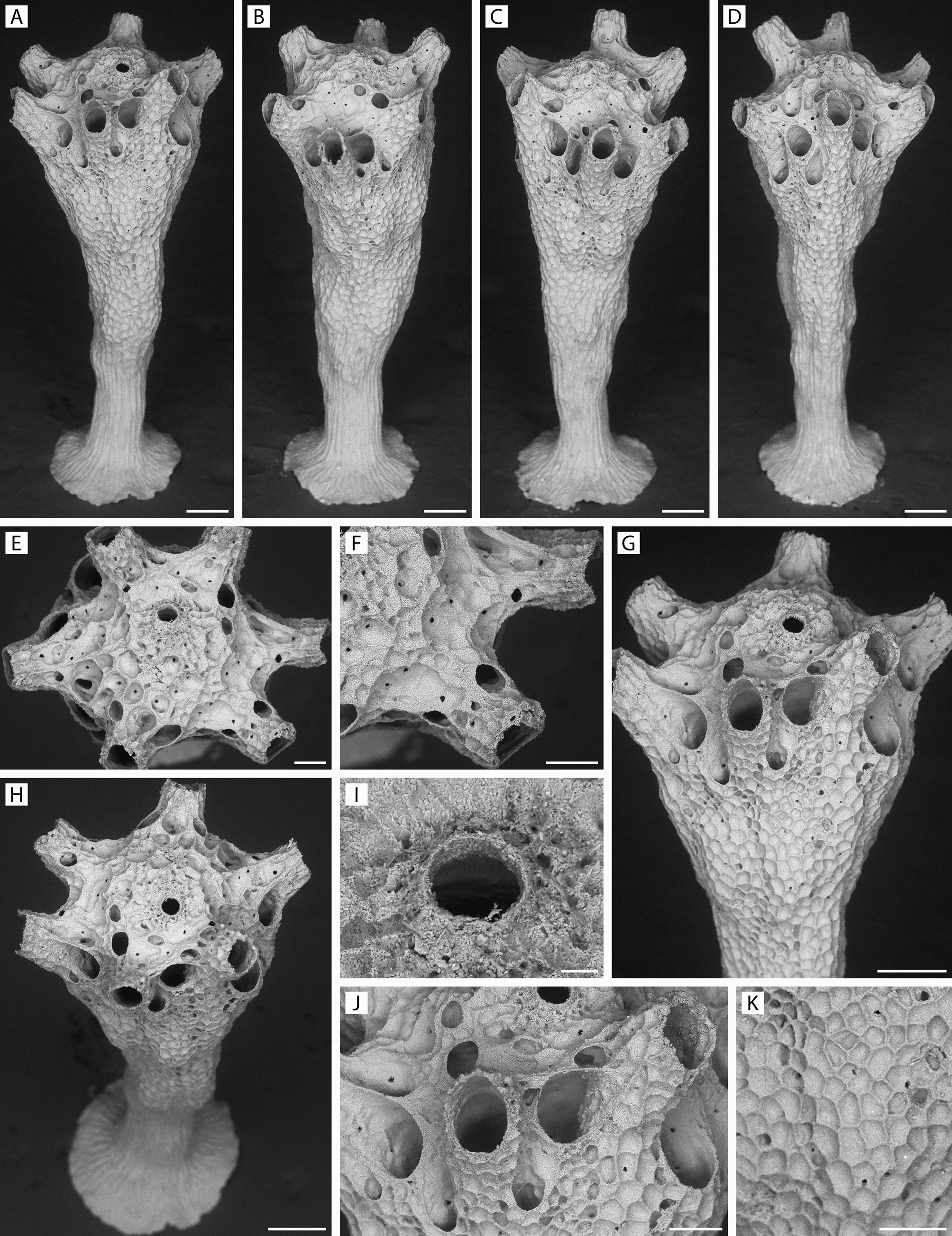
Description. Colony erect, pedunculate, with autozooidal peristomes radiating outwards around periphery of radially symmetrical capitulum, up to maximum of six peristomes in single whorl (Fig. 31 A – E, G, H), with additional non-peristomate alveolar openings below. Column longer than capitulum, attached by disk-like (Fig. 31 A – D, H) or smaller base (Fig. 32 B – D, F – H), depending on size. Colony surface malleated (Fig. 31 A – D, G) except for proximal third or half of column, which has narrow ridges and furrows; each malleation (dimple) surrounded by distinct angular ridge (Fig. 31 J, K); pores simple, very sparse (Fig. 31 G, J, K). Surface ultrastructure generally of imbricated platy crystallites or these smaller, irregularly arranged and lacking preferred growth direction. Capitulum shallowly calyciform in immature colony (Fig. 32 H), calyx center with trabeculae and alveoli (Fig. 32 A, E). Autozooidal peristomes short, in single series; apertures subrounded, facing obliquely outwards, their rims slightly irregular but entire. Inner surface of peristome tubes smooth to lightly textured, no pustules or spinules (Fig. 31 G, J). Gonozooid solitary, capacious, occupying calyx center (Fig. 31 E, H, J), weakly domed (Fig. 31 A – D, G), ooeciostome almost non-existent, with proportionally large circular ooeciopore in center (Fig. 31 I). Gonozooid surface malleated frontally, with at least one pore in each dimple, periphery of chamber alveolate, each alveolus with pore (Fig. 31 E, F, J). Ancestrula and very small colony stages not seen. Smallest colony encountered had perhaps four functioning peristomes and others developing, its center comprising small triangular shelf with small alveoli (Fig. 32 A). Measurements (mm). Holotype, ZIRAS 1 / 50717 (Fig. 31): Colony height 2.55; capitulum 1.08 × 0.85; base at substratum 0.73 × 0.66; stalk minimal diameter 0.28; ZL 0.275 – 0.325 (0.294 ± 0.019) (n = 6); PeL 0.188 – 0.238 (0.217 ± 0.020) (n = 6); PeD 0.151 – 0.178 (0.161 ± 0.009) (n = 6); ApL 0.148 – 0.173 (0.156 ± 0.009) (n = 6); ApW 0.103 – 0.125 (0.118 ± 0.008) (n = 6); OpL 0.064 (n = 1); OpW 0.061 (n = 1).
Grischenko, Andrei V., Gordon, Dennis P., Melnik, Viacheslav P. (2018): Bryozoa (Cyclostomata and Ctenostomata) from polymetallic nodules in the Russian exploration area, Clarion - Clipperton Fracture Zone, eastern Pacific Ocean-taxon novelty and implications of mining. Zootaxa 4484 (1): 1-91, DOI: 10.11646/zootaxa.4484.1.1
Remarks. The gonozooid in Calyssopora vasiformis n. sp. is similar to that in the type species C. volcano n. sp., but the colony surface is malleated, as in Rallocytus ridiculus n. gen., n. sp. (below).
Grischenko, Andrei V., Gordon, Dennis P., Melnik, Viacheslav P. (2018): Bryozoa (Cyclostomata and Ctenostomata) from polymetallic nodules in the Russian exploration area, Clarion - Clipperton Fracture Zone, eastern Pacific Ocean-taxon novelty and implications of mining. Zootaxa 4484 (1): 1-91, DOI: 10.11646/zootaxa.4484.1.1
Distribution. Recorded from three stations within coordinates 12.61497 – 13.55908 ° N, 133.04948 – 133.18555 ° W, at depth range 4806 – 4909 m.
Grischenko, Andrei V., Gordon, Dennis P., Melnik, Viacheslav P. (2018): Bryozoa (Cyclostomata and Ctenostomata) from polymetallic nodules in the Russian exploration area, Clarion - Clipperton Fracture Zone, eastern Pacific Ocean-taxon novelty and implications of mining. Zootaxa 4484 (1): 1-91, DOI: 10.11646/zootaxa.4484.1.1
Etymology. Latin, vas, vessel, and forma, shape, alluding to the form of the colony.
Grischenko, Andrei V., Gordon, Dennis P., Melnik, Viacheslav P. (2018): Bryozoa (Cyclostomata and Ctenostomata) from polymetallic nodules in the Russian exploration area, Clarion - Clipperton Fracture Zone, eastern Pacific Ocean-taxon novelty and implications of mining. Zootaxa 4484 (1): 1-91, DOI: 10.11646/zootaxa.4484.1.1
Material examined. Holotype: ZIRAS 1 / 50717, colony detached from nodule, YMG R. V. Gelendzhik cruise GLD 4 – 11, Stn 203, 17 April 2012, 13.45102 ° N, 133.17315 ° W, 4812 m. Additional material: GLD 4 – 11, Stns 201, 228. Total specimens examined three.
Grischenko, Andrei V., Gordon, Dennis P., Melnik, Viacheslav P. (2018): Bryozoa (Cyclostomata and Ctenostomata) from polymetallic nodules in the Russian exploration area, Clarion - Clipperton Fracture Zone, eastern Pacific Ocean-taxon novelty and implications of mining. Zootaxa 4484 (1): 1-91, DOI: 10.11646/zootaxa.4484.1.1

Export occurrence data

Darwin Core Archive (ZIP)

CLASSIFICATION

Taxonomic Classification Tree

MULTIMEDIA

Media Files(2)

FIGURE 31. Calyssopora vasiformis n. gen., n. sp. Holotype, ZIRAS 1/50717. A–D, rotational views of fertile colony; E, H, apical and oblique-lateral views of calyx with gonozooid; F, two autozooidal peristomes, with part of dimpled and alveolate calyx surface; G, close-up of calyx in A; I, ooeciostome and ooeciopore; J, close-up of G, with autozooidal peristomes and small alveoli; K, honeycomb-like surface malleation. Scale bars: A–D, G, H, 200 µm; E, F, J, K, 100 µm; I, 25 µm.

Imageimage/png© Grischenko, Andrei V.;Gordon, Dennis P.;Melnik, Viacheslav P.Grischenko, Andrei V.;Gordon, Dennis P.;Melnik, Viacheslav P.

FIGURE 32. Calyssopora vasiformis n. gen., n. sp. Stages of colony development. A–D, specimen GLD4–11, Stn 228, at apparent four-zooid stage with large alveoli; E–H, specimen GLD4–11, Stn 201, at a later stage, with more-developed calyx center. Scale bars: 200 µm.

Imageimage/png© Grischenko, Andrei V.;Gordon, Dennis P.;Melnik, Viacheslav P.Grischenko, Andrei V.;Gordon, Dennis P.;Melnik, Viacheslav P.

IMAGES

Gallery(2)

See Gallery

Occurrences with images

Source Information

Bryozoa (Cyclostomata and Ctenostomata) from polymetallic nodules in the Russian exploration area, Clarion - Clipperton Fracture Zone, eastern Pacific Ocean-taxon novelty and implications of mining

checklist

This dataset contains the digitized treatments in Plazi based on the original journal article Grischenko, Andrei V., Gordon, Dennis P., Melnik, Viacheslav P. (2018): Bryozoa (Cyclostomata and Ctenostomata) from polymetallic nodules in the Russian exploration area, Clarion - Clipperton Fracture Zone, eastern Pacific Ocean-taxon novelty and implications of mining. Zootaxa 4484 (1): 1-91, DOI: 10.11646/zootaxa.4484.1.1

Abstract

This work describes Bryozoa of the orders Cyclostomata and Ctenostomata found associated with polymetallic nodules collected by box-coring in the eastern part of the Russian exploration area of the Clarion-Clipperton Fracture Zone (CCFZ) under contract to Yuzhmorgeologiya. Scanning electron microscopic study of 358 cyclostome colonies and 14 ctenostome colonies from 4510–5280 m depth has resulted in the recognition of two new species of Ctenostomata, and 14 new species, nine new genera and two new families of Cyclostomata; three additional species of Cyclostomata are left in open nomenclature pending the discovery of missing reproductive characters. The taxonomic novelty is thus notable. One of the new Ctenostomata represents the first living example of the previously monotypic Late Cretaceous genus Pierrella. Twelve of the new cyclostome taxa have well-developed gonozooids, indicating that embryonic cloning (polyembryony) is normal in this deep-sea environment. On the other hand, one indeterminate tubuliporine and two rectangulates have dimorphic peristomes. In the latter two cases, enough mature colonies were found to suggest that this feature is normal, and that the dimorphic zooids are possibly female—in other words, capacious incubation chambers are apparently lacking, and therefore polyembryony would also be lacking or reduced. In one of these species, evidence is presented to suggest that the ancestrular zooid can reproduce precociously. Of the species reported here, only one has previously been found outside the exploration area, highlighting both the limited knowledge we have of bryozoans in the deep Pacific and/or a fauna that is largely endemic to the nodule environment. An additional 31 species of Cheilostomata have also been discovered that will be described in a subsequent publication. Most bryozoans are macrofaunal-sized, so are both inadequately determinable and overlooked in images obtained by remotely operated vehicles; yet, with 50 species, Bryozoa is the most speciose sessile macrofaunal phylum on the nodules. Nodules constitute hard substrata in an area otherwise mostly inhospitable for Bryozoa, hence mining would lead to loss of critical habitat. Further, as suspension-feeders, bryozoans are highly susceptible to smothering by suspended sediment, and non-mined areas closely adjacent to extraction zones would likely also be affected and their associated bryozoan fauna obliterated. More data are required on the distribution of the CCFZ bryozoan species elsewhere in the east Central Pacific to determine if mining would lead to local taxon extirpation or global extinction at both low and high taxonomic levels.

Grischenko A V, Gordon D P, Melnik V P, plazi (2018). Bryozoa (Cyclostomata and Ctenostomata) from polymetallic nodules in the Russian exploration area, Clarion - Clipperton Fracture Zone, eastern Pacific Ocean-taxon novelty and implications of mining. Plazi.org taxonomic treatments database. Checklist dataset https://doi.org/10.11646/zootaxa.4484.1.1 accessed via GBIF.org on 2026-06-14.

CC0Published 9/25/2018View dataset
GBIF Usage Key
148403724
Dataset Key
74b777c9-eae0-4770-8c86-dcbb10fb06b3
Origin
source
Backbone Key
10188813
Taxon ID
521587E4561F553509EEFC658959FA00.taxon
Last Crawled
6/10/2026
Last Interpreted
6/10/2026