
AnimaliaNot EvaluatedacceptedspeciesAccepted
Rallocytus ridiculus

Rallocytus ridiculus

Grischenko, Gordon & Melnik, 2018

GBIF:148403734

0year

ABOUT

Descriptions(5)

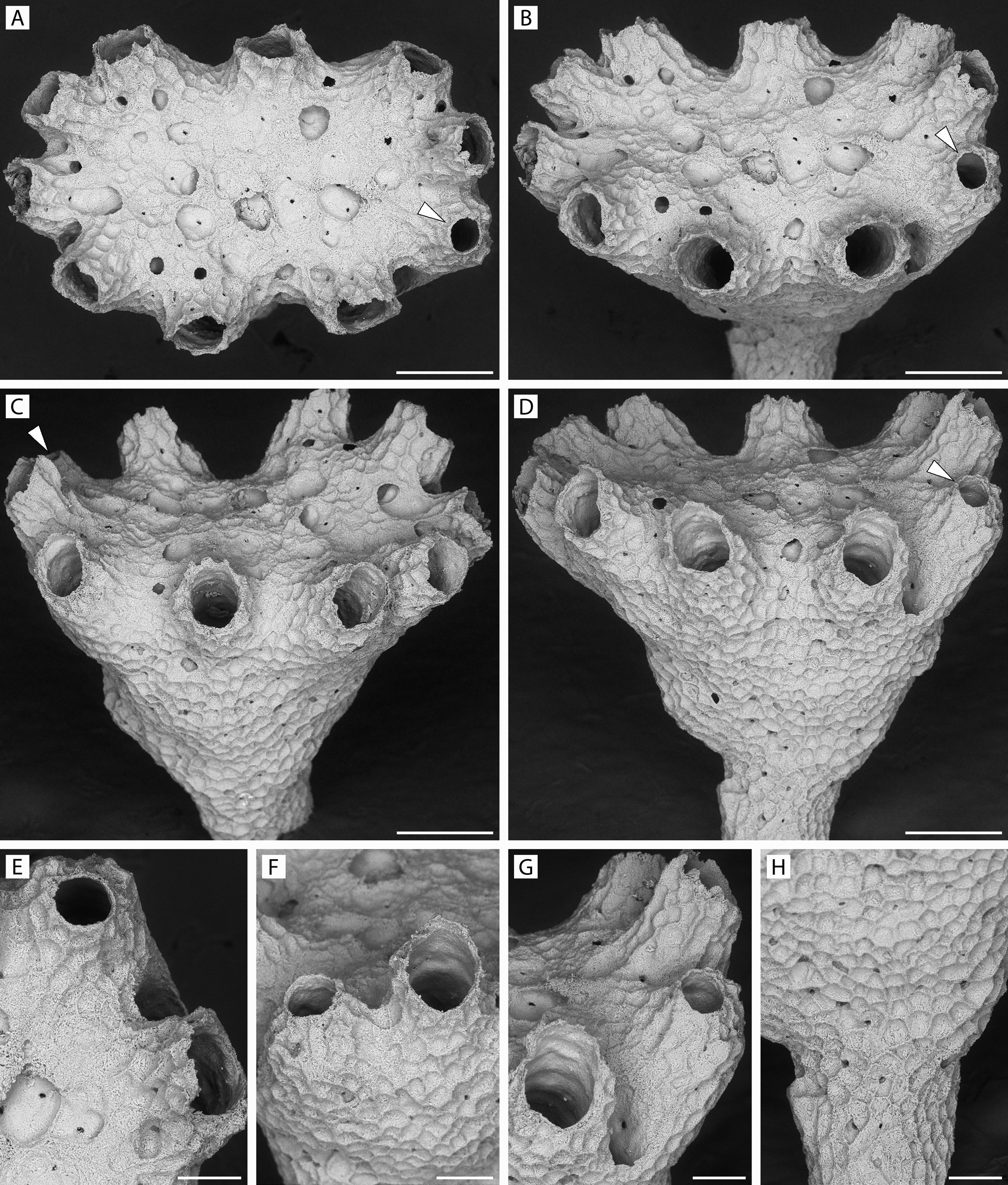
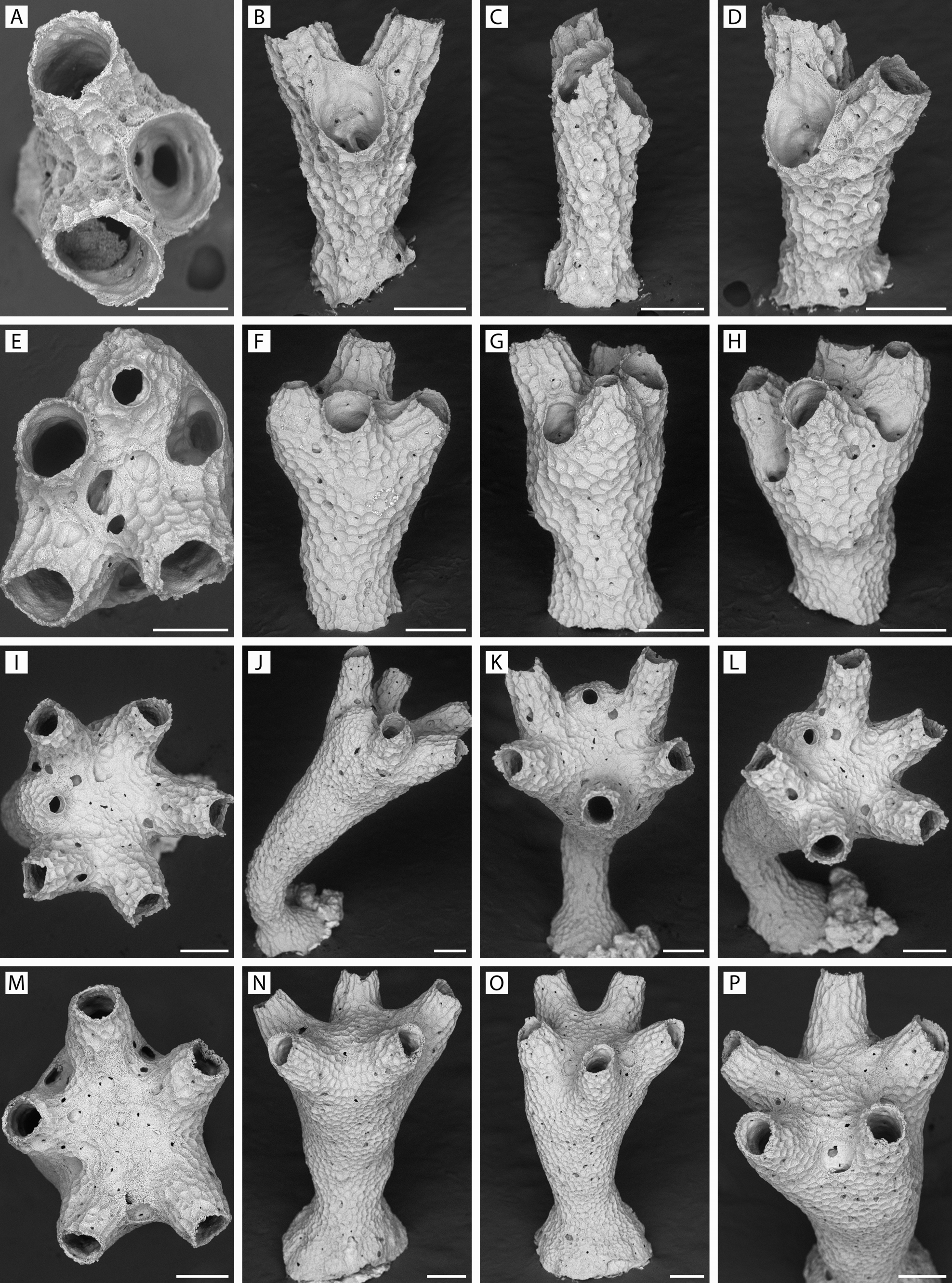
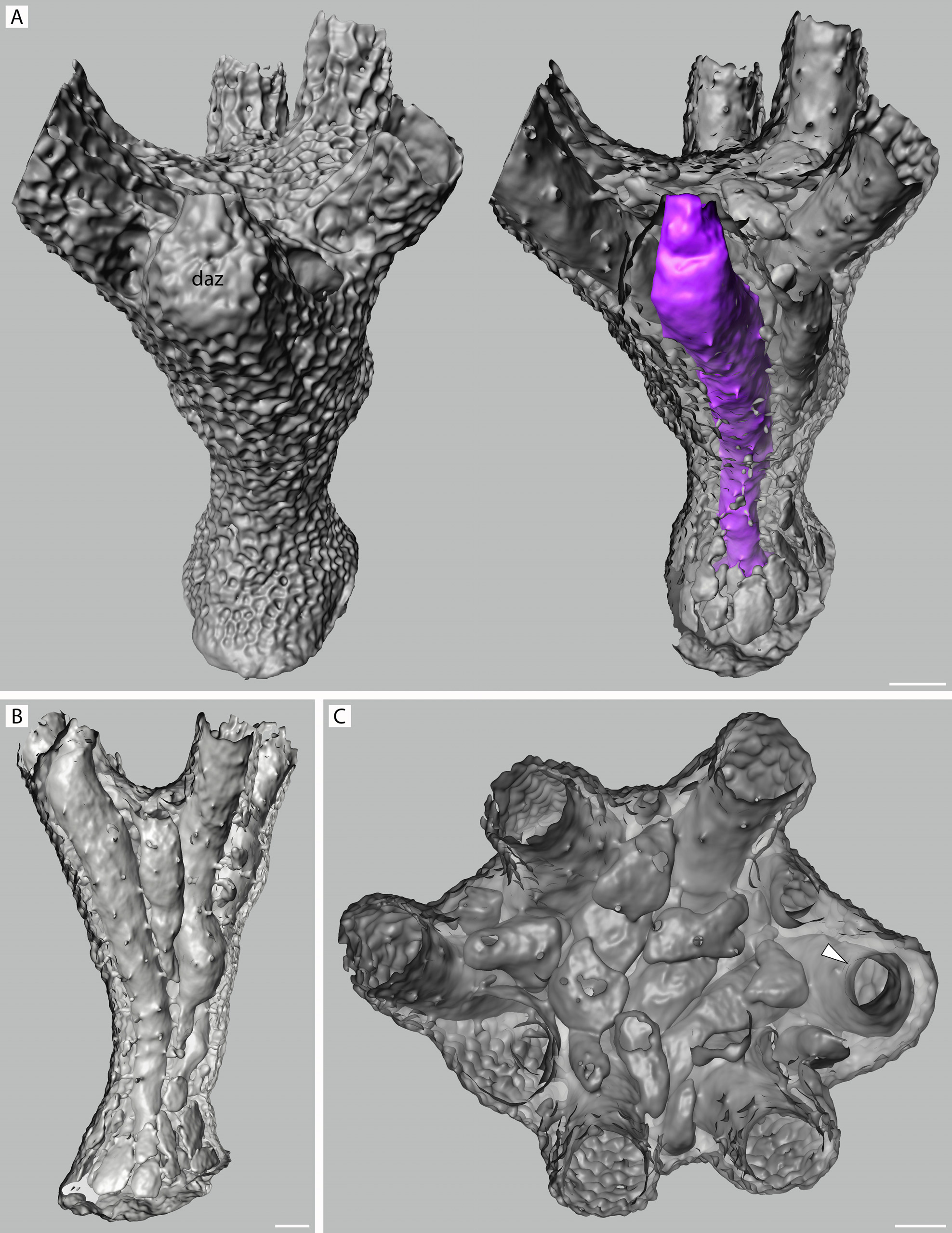
Description. Colony erect, pedunculate, with autozooidal peristomes radiating outwards around periphery of capitulum; maximum of nine autozooidal peristomes and one dimorphic peristome (Fig. 42 A – D), or seven autozooidal peristomes and two dimorphic peristomes (Fig. 43 A – C), in single uneven whorl. Column relatively short, flaring proximally to skirt-like base (Fig. 43 C), distally to wider capitulum. Entire colony surface strongly malleate, each dimple surrounded by distinct angular ridge (Figs 42 F, H, 43 D – H, 54 A); pores simple, sparse, more evident in CT scans (Fig. 54 B). Surface ultrastructure generally of imbricated platy crystallites (Fig. 43 I), in places irregularly arranged and lacking preferred growth direction. Capitulum broadly and shallowly calyciform, calyx center with few to several shallow alveoli and other smaller such openings at surface (Figs 42 A, B, 43 A); CT scans indicate these appear as flattened chambers in optical section (Fig. 54 C). Autozooidal peristomes in single subregular series, skeletal surface like that of column, with very sparse pores. Peristomial apertures mostly slightly irregular (Figs 42 A – D, 43 A – G). Inner surface of peristome tubes typically weakly corrugated, smooth to lightly textured, no pustules or spinules (Figs 42 G, 43 K). Dimorphic peristomes 1 – 2 in calyx whorl, evident from their smaller apertures, chamber size as in ordinary zooids; dimorphism sometimes pertaining to ancestrular peristome (Fig. 54 A, B). Capacious gonozooid (s) not seen. Dimorphic apertures inferred to be female, facing frontalwards (Fig. 42 A, B, D – G) or inclined towards calyx center (Fig. 43 A – G; one of the two such apertures). Dimorphic zooids seen as early as four-zooid stage colony (Fig. 44 E – L) or lacking in young colony (Fig. 44 M – P). Ancestrula not seen in isolation, but obviously erect judging from smallest (three-zooid) colony stage seen (Fig. 44 A – D), which lacks expanded base; CT scans confirm that ancestrular peristome originates from center of dome-like protoecium (Fig. 54, right image). First daughter zooid budded from ancestrular peristome soon after development to achieve two-zooid colony; third zooid develops between these (Fig. 44 A). Medium-sized colonies with central space (Fig. 44 E) filling with alveoli as capitulum expands radially (Fig. 44 E, 54 C). Measurements (mm). Holotype, ZIRAS 1 / 50723 (Fig. 42): Colony height 1.24; capitulum 1.23 × 0.88; ZL 0.440 – 0.598 (0.524 ± 0.051) (n = 9); PeL 0.085 – 0.242 (0.167 ± 0.054) (n = 9); PeD 0.163 – 0.202 (0.185 ± 0.013) (n = 9); ApL 0.118 – 0.151 (0.136 ± 0.012) (n = 9); ApW 0.113 – 0.142 (0.126 ± 0.009) (n = 9). Dimorphic zooid (n = 1): ZL 0.553; PeL 0.218; PeD 0.213; OpL 0.083; OpW 0.092.
Grischenko, Andrei V., Gordon, Dennis P., Melnik, Viacheslav P. (2018): Bryozoa (Cyclostomata and Ctenostomata) from polymetallic nodules in the Russian exploration area, Clarion - Clipperton Fracture Zone, eastern Pacific Ocean-taxon novelty and implications of mining. Zootaxa 4484 (1): 1-91, DOI: 10.11646/zootaxa.4484.1.1
Remarks. Rallocytus ridiculus n. sp. is striking for its malleated surface texture (seen also in Calyssopora vasiformis n. sp.) and the dimorphic zooids within the calyx whorl. There are significant implications attached to a potential female reproductive function for the dimorphic zooids. First, a CT scan of one mature colony in which a dimorphic peristome appears in the calyx whorl shows this zooid to be the ancestrula (Fig. 54 A – C). Can this mean that the dimorphic peristomes seen in several juvenile colonies (e. g. Fig. 44 E – H, I – L) also pertain to the ancestrula? We cannot be sure; another mature colony had two dimorphic peristomes (Fig. 43 A – E), and either one, or neither, was ancestrular. But, if so, then it would seem to pose an energetic problem for early colony development, unless the dimorphic ancestrular zooid also has a feeding polypide, as seems likely. Alternatively (or additionally), the timing of budding of the first daughter zooid (from the ancestrular peristome, not the protoecium) may be such as to ensure that at least one feeding zooid is contemporaneous with a non-feeding ancestrula. A zooid pair in Fig. 44 A indicates simultaneity of development of the first two zooids (apparent autozooids, in this case). Second, if a dimorphic peristome occurs in a juvenile colony (as in Fig. 44 E – H, I – L), how is this peristome maintained as the zooid grows upwards? Or is the modified peristomial aperture shed and regrown during polypide recycling? Such a thing has never been reported. The fact that at least one cyclostome species in this fauna has multiple brown bodies (i. e. in Pandanipora helix; Fig. 5 E) shows that polypide recycling can happen in this stable environment, so perhaps peristomial shape might be labile. Indeed, conventional gonozooids begin as normal autozooids, modifying during further growth. Third, the lack of a capacious incubation chamber in any of the numerous specimens of Rallocytus ridiculu s n. gen., n. sp. (and Anyuta anastema n. gen., n. sp.) suggests that embryonic cloning (polyembryony) might be secondarily suppressed (wholly or partly) in these taxa — the dimorphic zooid, being the same size as an ordinary autozooid, would have little volume for cloning (unlike in Cinctiporidae). If the ancestrular zooid can produce eggs precociously in R. ridiculu s, then the apparent strategy could be that of reproducing one or a few larvae early and several times therafter, instead of producing a capacious gonozooid for the delayed mass production of embryos, either during a very narrow time period or, as in Filicrisia geniculata (Jenkins et al. 2017), over an extended period of time.
Grischenko, Andrei V., Gordon, Dennis P., Melnik, Viacheslav P. (2018): Bryozoa (Cyclostomata and Ctenostomata) from polymetallic nodules in the Russian exploration area, Clarion - Clipperton Fracture Zone, eastern Pacific Ocean-taxon novelty and implications of mining. Zootaxa 4484 (1): 1-91, DOI: 10.11646/zootaxa.4484.1.1
Distribution. Recorded from 21 stations within coordinates 12.65742 – 14.41137 ° N, 129.08067 – 134.56370 ° W, at depth range 4640 – 5213 m.
Grischenko, Andrei V., Gordon, Dennis P., Melnik, Viacheslav P. (2018): Bryozoa (Cyclostomata and Ctenostomata) from polymetallic nodules in the Russian exploration area, Clarion - Clipperton Fracture Zone, eastern Pacific Ocean-taxon novelty and implications of mining. Zootaxa 4484 (1): 1-91, DOI: 10.11646/zootaxa.4484.1.1
Etymology. Latin, ridiculus, absurd, alluding to the dimorphic zooid (s), which can sometimes include / comprise the ancestrular zooid.
Grischenko, Andrei V., Gordon, Dennis P., Melnik, Viacheslav P. (2018): Bryozoa (Cyclostomata and Ctenostomata) from polymetallic nodules in the Russian exploration area, Clarion - Clipperton Fracture Zone, eastern Pacific Ocean-taxon novelty and implications of mining. Zootaxa 4484 (1): 1-91, DOI: 10.11646/zootaxa.4484.1.1
Material examined. Holotype: ZIRAS 1 / 50723, colony detached from nodule, YMG R. V. Yuzhmorgeologiya cruise YMG 4 – 06, Stn 79, 16 August 2006, 13.23973 ° N, 134.39873 ° W, 4810 m. Paratype 1: ZIRAS 2 / 50724, colony detached from nodule, YMG R. V. Yuzhmorgeologiya cruise YMG 4 – 07, Stn 130, 4 August 2007, 13.22832 ° N, 134.56370 ° W, 4830 m. Paratype 2: NIWA 127726, colony detached from nodule, YMG R. V. Yuzhmorgeologiya cruise YMG 4 – 14, Stn 359, 19 January 2016, 14.08687 ° N, 131.78558 ° W, 5122 m. Additional material: YMG 18 – 01, Stns 6, 31, 34; YMG 4 – 06, Stn 83; YMG 4 – 07, Stn 116; GLD 4 – 08, Stns 155, 159; GLD 4 – 09, Stns 173, 183, 196; GLD 4 – 11, Stns 206, 223; GLD 4 – 12, Stn 262; YMG 4 – 13, Stn 283; YMG 4 – 14, Stns 323, 328, 338, 340. Total specimens examined 23, 18 with dimorphic orifices.
Grischenko, Andrei V., Gordon, Dennis P., Melnik, Viacheslav P. (2018): Bryozoa (Cyclostomata and Ctenostomata) from polymetallic nodules in the Russian exploration area, Clarion - Clipperton Fracture Zone, eastern Pacific Ocean-taxon novelty and implications of mining. Zootaxa 4484 (1): 1-91, DOI: 10.11646/zootaxa.4484.1.1

Export occurrence data

Darwin Core Archive (ZIP)

CLASSIFICATION

Taxonomic Classification Tree

MULTIMEDIA

Media Files(5)

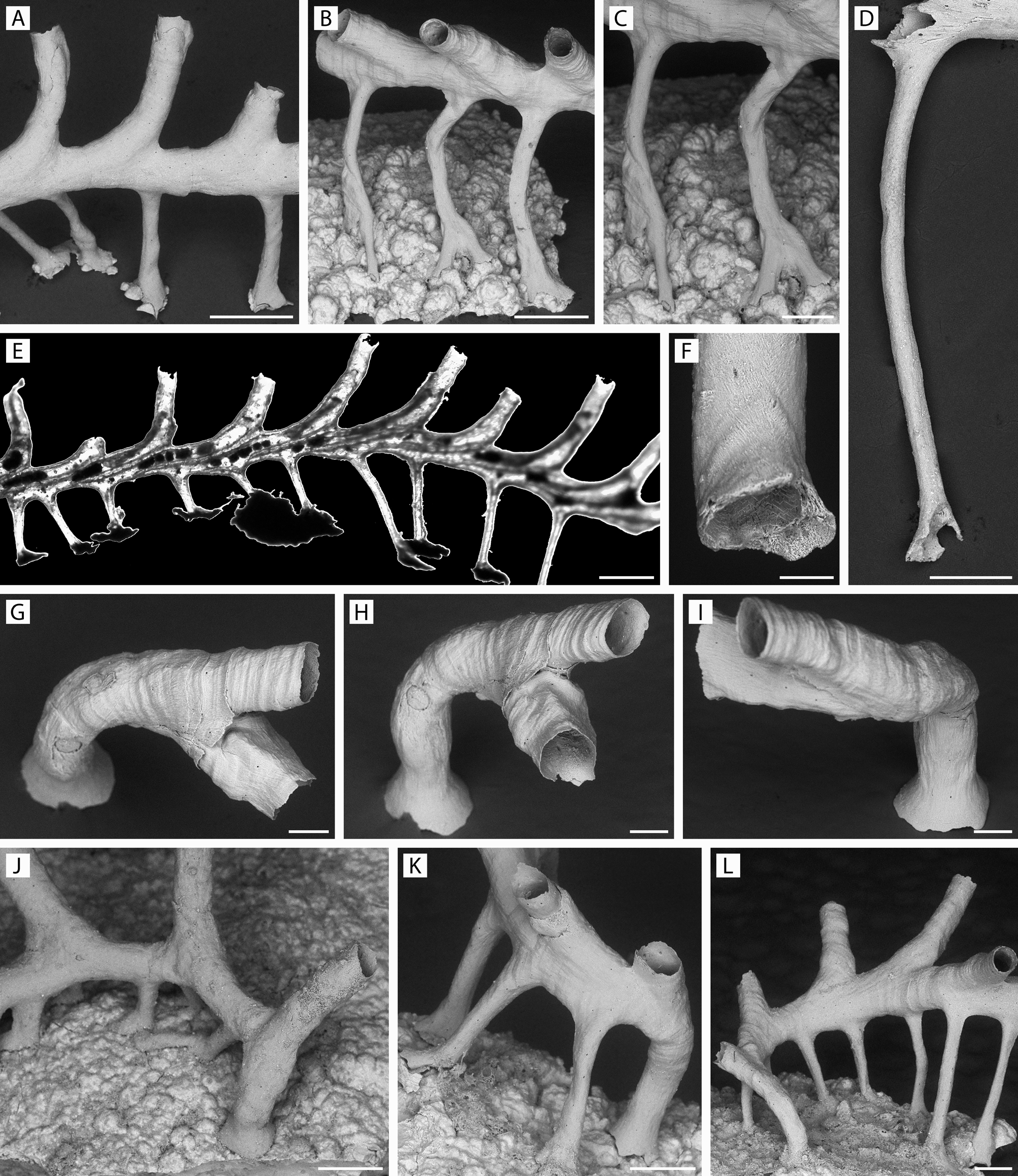
FIGURE 5. Pandanipora helix n. gen., n. sp. A, K, specimen YMG4–13, Stn 289; B, C, specimen YMG4–13, Stn 308; D, specimen YMG4–07, Stn 143; E, specimen GLD4–11, Stn 219; F, specimen YMG4–14, Stn 330; G–I, specimen YMG4–14, Stn 326; J, specimen GLD4–12, Stn 258; L, specimen YMG4–13, Stn 321. A–D, F, prop morphology: A, vertical and oblique columnar props attached to nodule by expanded tips; B, curved props attached to nodule irregularities by expanded tips with complex outlines; C, same, close-up; D, single elongated prop from its inception in the zooid basal wall to its distal expansion; E, light micrograph of colony showing successively overlapping zooids with their coelomic cavities continuing into the props with no intervening septum or pore, as well as 2–5 brown bodies located centrally to proximally in several zooids; F, prop tip showing opening towards substratum and internal surface with wedge-shaped crystallites, structurally analogous to peristome; G–I, ancestrula and daughter zooid budded from peristome; J–L, ancestrula and postancestrular zooids. Scale bars: A, B, E, 500 µm; C, D, J–L, 250 µm; F, 50 µm; G–I, 100 µm.
Imageimage/png© Grischenko, Andrei V.;Gordon, Dennis P.;Melnik, Viacheslav P.Grischenko, Andrei V.;Gordon, Dennis P.;Melnik, Viacheslav P.

FIGURE 42. Rallocytus ridiculus n. gen., n. sp. Holotype, ZIRAS 1/50723. A–D, apical and oblique-lateral rotational views of colony with single dimorphic zooid, its smaller aperture (arrowed) facing frontalwards; E–G, peristomes and apertures of dimorphic zooid and adjacent autozooids; H, malleated colony surface at junction of capitulum and column. Scale bars: A–D, 250 µm; E–H, 100 µm.

Imageimage/png© Grischenko, Andrei V.;Gordon, Dennis P.;Melnik, Viacheslav P.Grischenko, Andrei V.;Gordon, Dennis P.;Melnik, Viacheslav P.

FIGURE 43. Rallocytus ridiculus n. gen., n. sp. Paratype 1, ZIRAS 2/50724. A–D, apical and oblique views of fertile colony with two dimorphic zooids (arrowed), one with its aperture facing frontalwards, the other peristome turned slightly toward calyx center; E, F, peristomes, including a smaller frontally facing dimorphic one; G, two autozooidal peristomes with incurved dimorphic peristome between; H, base of column; I, skeletal microstructure; J, K, showing dimorphic and autozooidal apertures, respectively. Scale bars: A–C, 250 µm; D–H, 100 µm; J, K, 50 µm; I, 25 µm.
Imageimage/png© Grischenko, Andrei V.;Gordon, Dennis P.;Melnik, Viacheslav P.Grischenko, Andrei V.;Gordon, Dennis P.;Melnik, Viacheslav P.

FIGURE 44. Rallocytus ridiculus n. gen., n. sp. Progressive stages of development of ancestrulate colonies. A–D, specimen YMG4–14, Stn 340, at three-zooid stage, with no distinction among peristomes; E–H, specimen GLD4–09, Stn 183, with four functional zooids, one dimorphic; I–L, specimen GLD4–08, Stn 159, with six functional zooids, one dimorphic; M–P, specimen GLD4–11, Stn 206, five functional zooids, none dimorphic. Scale bars: A, E, 150 µm; B–D, F–P, 200 µm.
Imageimage/png© Grischenko, Andrei V.;Gordon, Dennis P.;Melnik, Viacheslav P.Grischenko, Andrei V.;Gordon, Dennis P.;Melnik, Viacheslav P.

FIGURE 54. Rallocytus ridiculus n. gen., n. sp. Micro-CT scans of paratype 2, NIWA 127726, as surface (A) and back-face isosurface renders showing colony interiors. A, surface and interior views of seven-zooid colony with dimorphic ancestrular zooid (daz) colored purple in the right-hand image; note small cluster of flattened kenozooidal chambers surrounding protoecium but absent from sides of column; B, lateral view, with entire dimorphic ancestrular zooid seen in left half; C, apical view of calyx, showing flattened kenozooidal/alveolar chambers filling center, dimorphic peristome at right indicated by arrowhead. Scale bars: 100 µm.

Imageimage/png© Grischenko, Andrei V.;Gordon, Dennis P.;Melnik, Viacheslav P.Grischenko, Andrei V.;Gordon, Dennis P.;Melnik, Viacheslav P.

IMAGES

Gallery(5)

See Gallery

Occurrences with images

Source Information

Bryozoa (Cyclostomata and Ctenostomata) from polymetallic nodules in the Russian exploration area, Clarion - Clipperton Fracture Zone, eastern Pacific Ocean-taxon novelty and implications of mining

checklist

This dataset contains the digitized treatments in Plazi based on the original journal article Grischenko, Andrei V., Gordon, Dennis P., Melnik, Viacheslav P. (2018): Bryozoa (Cyclostomata and Ctenostomata) from polymetallic nodules in the Russian exploration area, Clarion - Clipperton Fracture Zone, eastern Pacific Ocean-taxon novelty and implications of mining. Zootaxa 4484 (1): 1-91, DOI: 10.11646/zootaxa.4484.1.1

Abstract

This work describes Bryozoa of the orders Cyclostomata and Ctenostomata found associated with polymetallic nodules collected by box-coring in the eastern part of the Russian exploration area of the Clarion-Clipperton Fracture Zone (CCFZ) under contract to Yuzhmorgeologiya. Scanning electron microscopic study of 358 cyclostome colonies and 14 ctenostome colonies from 4510–5280 m depth has resulted in the recognition of two new species of Ctenostomata, and 14 new species, nine new genera and two new families of Cyclostomata; three additional species of Cyclostomata are left in open nomenclature pending the discovery of missing reproductive characters. The taxonomic novelty is thus notable. One of the new Ctenostomata represents the first living example of the previously monotypic Late Cretaceous genus Pierrella. Twelve of the new cyclostome taxa have well-developed gonozooids, indicating that embryonic cloning (polyembryony) is normal in this deep-sea environment. On the other hand, one indeterminate tubuliporine and two rectangulates have dimorphic peristomes. In the latter two cases, enough mature colonies were found to suggest that this feature is normal, and that the dimorphic zooids are possibly female—in other words, capacious incubation chambers are apparently lacking, and therefore polyembryony would also be lacking or reduced. In one of these species, evidence is presented to suggest that the ancestrular zooid can reproduce precociously. Of the species reported here, only one has previously been found outside the exploration area, highlighting both the limited knowledge we have of bryozoans in the deep Pacific and/or a fauna that is largely endemic to the nodule environment. An additional 31 species of Cheilostomata have also been discovered that will be described in a subsequent publication. Most bryozoans are macrofaunal-sized, so are both inadequately determinable and overlooked in images obtained by remotely operated vehicles; yet, with 50 species, Bryozoa is the most speciose sessile macrofaunal phylum on the nodules. Nodules constitute hard substrata in an area otherwise mostly inhospitable for Bryozoa, hence mining would lead to loss of critical habitat. Further, as suspension-feeders, bryozoans are highly susceptible to smothering by suspended sediment, and non-mined areas closely adjacent to extraction zones would likely also be affected and their associated bryozoan fauna obliterated. More data are required on the distribution of the CCFZ bryozoan species elsewhere in the east Central Pacific to determine if mining would lead to local taxon extirpation or global extinction at both low and high taxonomic levels.

Grischenko A V, Gordon D P, Melnik V P, plazi (2018). Bryozoa (Cyclostomata and Ctenostomata) from polymetallic nodules in the Russian exploration area, Clarion - Clipperton Fracture Zone, eastern Pacific Ocean-taxon novelty and implications of mining. Plazi.org taxonomic treatments database. Checklist dataset https://doi.org/10.11646/zootaxa.4484.1.1 accessed via GBIF.org on 2026-06-14.

CC0Published 9/25/2018View dataset
GBIF Usage Key
148403734
Dataset Key
74b777c9-eae0-4770-8c86-dcbb10fb06b3
Origin
source
Backbone Key
9945174
Taxon ID
521587E4560D554409EEFB41884FF9F3.taxon
Last Crawled
6/10/2026
Last Interpreted
6/10/2026