
AnimaliaNot EvaluatedacceptedspeciesAccepted
Calyssopora volcano

Calyssopora volcano

Grischenko, Gordon & Melnik, 2018

GBIF:148403738

0year

0

Synonyms

ABOUT

Descriptions(5)

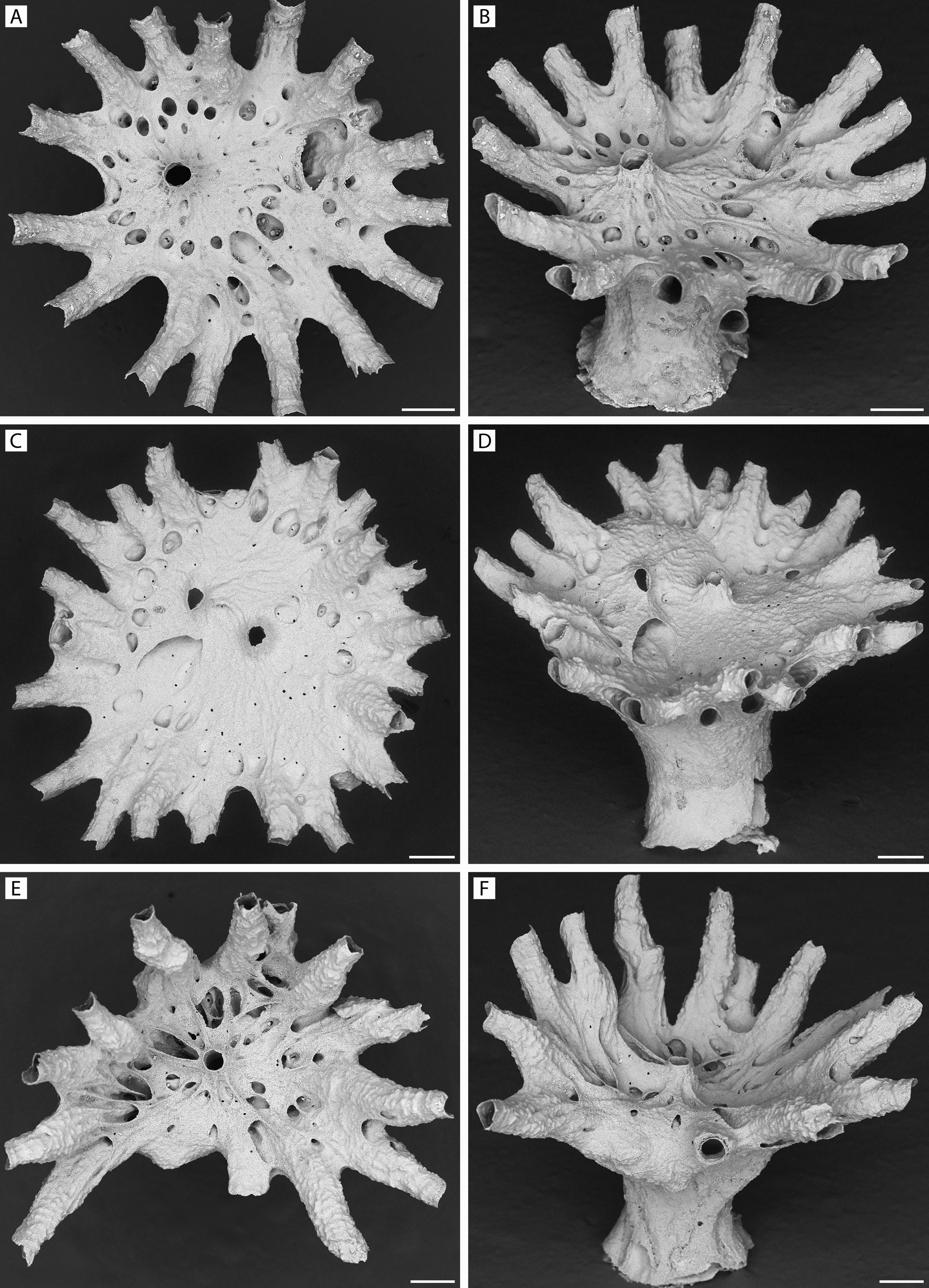
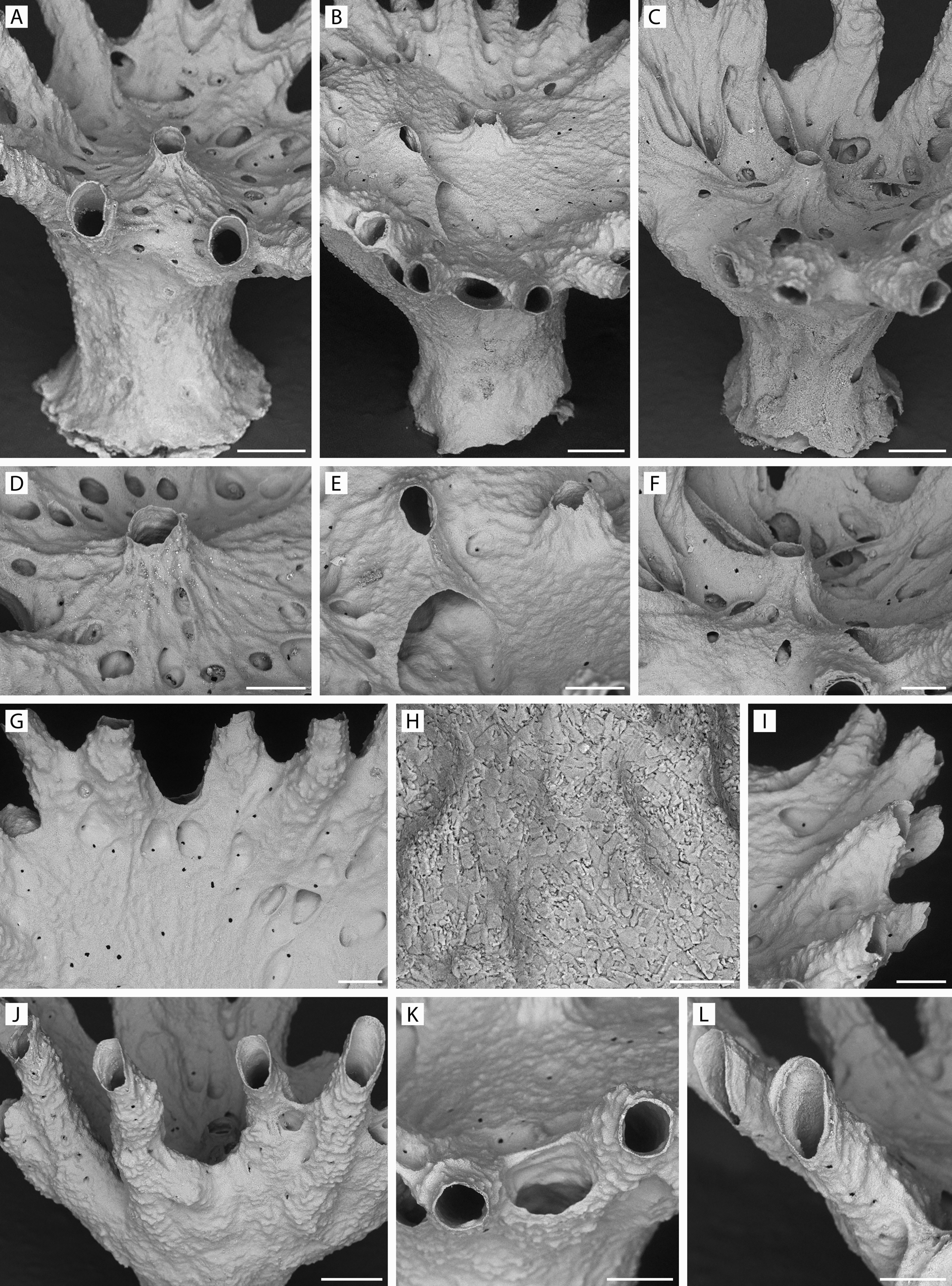
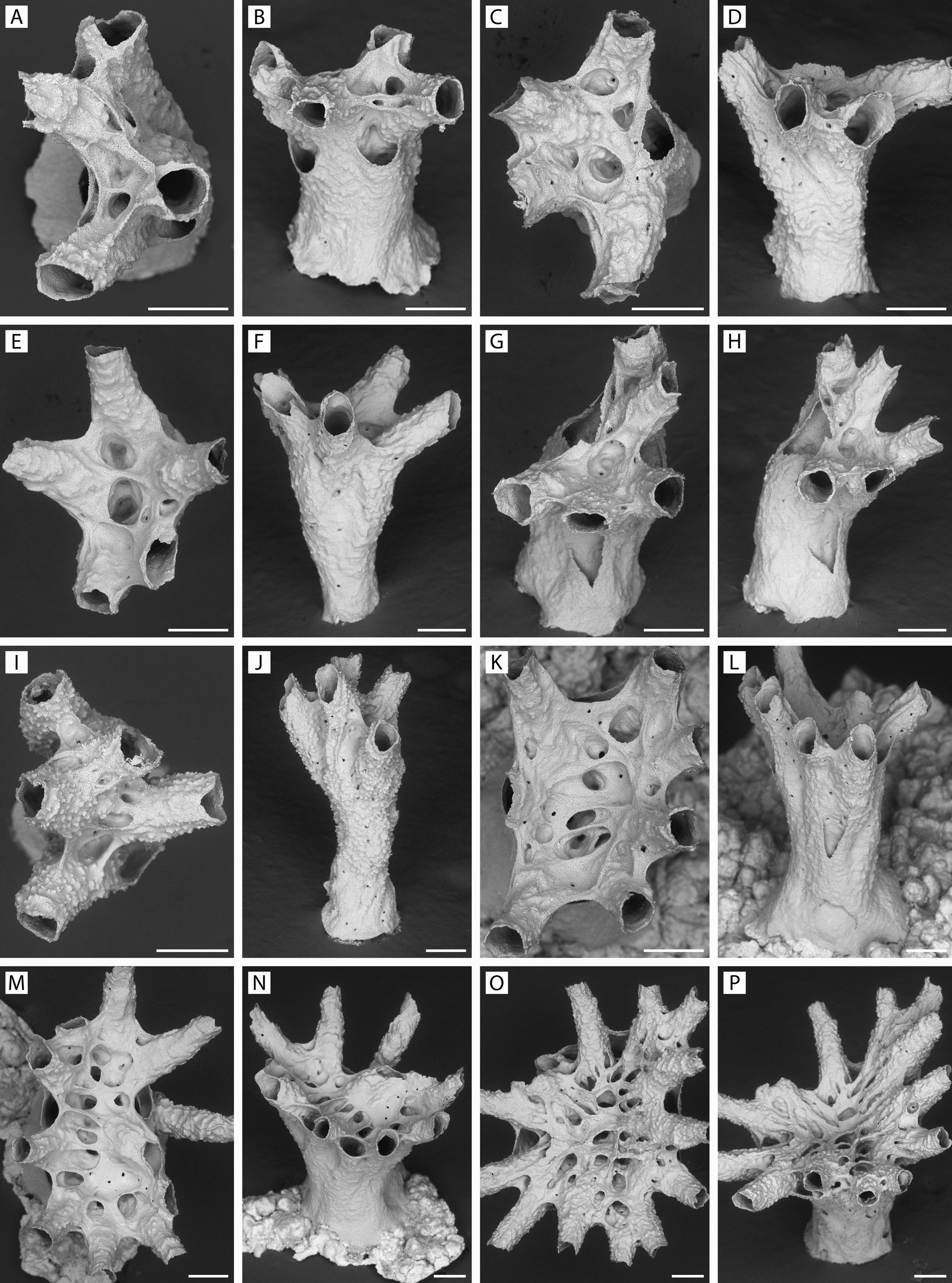
Description. Colony erect, thickly pedunculate, with autozooidal peristomes radiating outwards around periphery of capitulum (Fig. 28), up to maximum of 22 peristomes in single irregular whorl. Skeletal surface of column with weakly defined ridges and furrows, granular-tubercular (Fig. 29 A – C), with sparse pores; surface ultrastructure with irregularly arranged crystallites lacking obvious preferred growth direction (Fig. 29 H). Capitulum of submature colony infundibuliform (Fig. 30 L), bottom of funnel comprising deep alveolar chambers delimited by trabeculae (Fig. 30 O). Additional thin walls cross gaps between adjacent peristomes at colony periphery where additional autozooidal chambers develop to fill vacancies in whorl as colony expands (Figs 29 J, 30 A, I, O); some of these openings seem to represent adjacent extrazooidal spaces, their openings narrowed in mature colony (Fig. 29 B). Increasing calcification reduces openings in calyx center to expanding porous platform that serves as irregular open ‘ floor’ to gonozooid (s) (Fig. 30 O). Autozooidal peristomes in single subregular series, skeletal surface like that of column, with sparse, simple pores (Fig. 29 G) having irregular outline, tending to be in single longitudinal series on lower side (Fig. 29 L). Developing apertures slightly irregular, subrounded (Fig. 29 A, K) or having bilateral symmetry, opening obliquely outwards and downwards (Fig. 29 L). No spinules or prickles on inner surface of peristome tubes (Fig. 29 K, L). Gonozooid large and capacious (Fig. 28 A, B), 1 – 2 per mature colony (Fig. 28 C, D). Floor of gonozooid not discrete and continuous. If solo, gonozooid in center of calyx or to one side, chamber roof sloping upwards to ooeciostome (Fig. 29 A – D), resembling volcanic cone in profile, with lateral ridges and furrows and porous cancelli that are mostly on periphery of gonozooid (Fig. 29 D); ooeciopore variably elevated, subcircular to suboval (Fig. 28 A, C, E). Surface microstructure of gonozooid like that of column and zooidal peristomes, with weak imbrication of irregular crystallites (Fig. 29 H). Ancestrula not seen in isolation, but evidently erect judging from smallest (four-zooid) colony stages seen (Fig. 30 A, B). Trabeculae form in center of developing colony to support colony elevation and expansion, with extrazooidal alveolar spaces between trabeculae (Fig. 30 A, C, I, K, M, O). Measurements (mm). Holotype, ZIRAS 1 / 50714 (Fig. 28 A, B): Colony height 1.78; capitulum 2.07 × 1.98; base at substratum 0.85 × 0.93 with narrowest cross-section 0.60 × 0.64; ZL 0.591 – 0.980 (0.809 ± 0.122); PeL 0.372 – 0.597 (0.492 ± 0.069); PeD 0.137 – 0.177 (0.155 ± 0.013); ApL 0.152 – 0.185 (0.172 ± 0.011); ApW 0.128 – 0.153 (0.138 ± 0.009). Gonozooid (n = 1): GZL 0.644; GZW 0.817; OsL 0.155; OsW 0.127; OsH 0.138; OpL 0.133; OpW 0.119.
Grischenko, Andrei V., Gordon, Dennis P., Melnik, Viacheslav P. (2018): Bryozoa (Cyclostomata and Ctenostomata) from polymetallic nodules in the Russian exploration area, Clarion - Clipperton Fracture Zone, eastern Pacific Ocean-taxon novelty and implications of mining. Zootaxa 4484 (1): 1-91, DOI: 10.11646/zootaxa.4484.1.1
Remarks. Calyssopora volcano n. sp. differs from Calyssopora vasiformis n. sp. (below) in overall form and the number of peristomes, and from Calyssopora clarionensis n. sp., in having volcaniform gonozooids in which the frontal surface rises to a frontally facing ooeciostome with a crater-like ooeciopore. The gonozooid in A. clarionensis is rather more bulging than volcaniform, and the ooeciostome is strongly curved and hood-like.
Grischenko, Andrei V., Gordon, Dennis P., Melnik, Viacheslav P. (2018): Bryozoa (Cyclostomata and Ctenostomata) from polymetallic nodules in the Russian exploration area, Clarion - Clipperton Fracture Zone, eastern Pacific Ocean-taxon novelty and implications of mining. Zootaxa 4484 (1): 1-91, DOI: 10.11646/zootaxa.4484.1.1
Distribution. Recorded from 26 stations within coordinates 12.51953 – 14.16490 ° N, 129.04471 – 134.60008 ° W, at depth range 4672 – 5149 m.
Grischenko, Andrei V., Gordon, Dennis P., Melnik, Viacheslav P. (2018): Bryozoa (Cyclostomata and Ctenostomata) from polymetallic nodules in the Russian exploration area, Clarion - Clipperton Fracture Zone, eastern Pacific Ocean-taxon novelty and implications of mining. Zootaxa 4484 (1): 1-91, DOI: 10.11646/zootaxa.4484.1.1
Etymology. Anglicized spelling of the Italian vulcano, alluding to the volcano-like gonozooid with its craterlike ooeciopore; used as a noun in apposition.
Grischenko, Andrei V., Gordon, Dennis P., Melnik, Viacheslav P. (2018): Bryozoa (Cyclostomata and Ctenostomata) from polymetallic nodules in the Russian exploration area, Clarion - Clipperton Fracture Zone, eastern Pacific Ocean-taxon novelty and implications of mining. Zootaxa 4484 (1): 1-91, DOI: 10.11646/zootaxa.4484.1.1
Material examined. Holotype: ZIRAS 1 / 50714, colony attached to nodule particle, YMG R. V. Yuzhmorgeologiya cruise YMG 4 – 14, Stn 357, 18 January 2016, 14.03237 ° N, 131.74563 ° W, 5073 m. Paratype 1: ZIRAS 2 / 50715, colony attached to nodule particle, YMG R. V. Gelendzhik cruise GLD 4 – 12, Stn 251, 6 April 2013, 12.80823 ° N, 132.69682 ° W, 4837 m. Paratype 2: ZIRAS 3 / 50716, colony attached to nodule particle, YMG R. V. Yuzhmorgeologiya cruise YMG 4 – 14, Stn 325, 20 December 2015, 13.58832 ° N, 131.68838 ° W, 5031 m. Additional material: YMG 18 – 01, Stns 7, 15, 24, 33; YMG 4 – 04, Stn 57; YMG 4 – 06, Stns 70, 92, 99, 101, 103; YMG 4 – 07, Stn 139; GLD 4 – 09, Stns 173, 178, 185, 198; GLD 4 – 11, Stn 216; GLD 4 – 12, Stn 271; YMG 4 – 13, Stns 274, 283, 291, 300; YMG 4 – 14, Stns 348, 358. Total specimens examined 27.
Grischenko, Andrei V., Gordon, Dennis P., Melnik, Viacheslav P. (2018): Bryozoa (Cyclostomata and Ctenostomata) from polymetallic nodules in the Russian exploration area, Clarion - Clipperton Fracture Zone, eastern Pacific Ocean-taxon novelty and implications of mining. Zootaxa 4484 (1): 1-91, DOI: 10.11646/zootaxa.4484.1.1

Export occurrence data

Darwin Core Archive (ZIP)

CLASSIFICATION

Taxonomic Classification Tree

MULTIMEDIA

Media Files(4)

FIGURE 2. Colonies of some cyclostome bryozoans, in vivo, attached to polymetallic nodules. A–E, Pandanipora helix n. gen., n. sp.: A, specimen GLD4–09, Stn 190; B, specimen GLD4–12, Stn 262; C, specimen YMG4–07, Stn 143; D, specimen YMG4–13, Stn 295; E, specimen GLD 4–11, Stn 212. F, Tubuliporina sp. indet., specimen YMG18–01, Stn 7. G, H, Abyssoecia elevata n. gen., n. sp.: G, specimen GLD4–09, Stn 196; H, specimen GLD4–09, Stn 191. I, Discantenna metallica n. sp.: specimen GLD4–11, Stn 224. J, K, Frontohornera frontalis n. gen., n. sp.: J, specimen YMG4–07, Stn 124; K, specimen GLD4–11, Stn 210. L, Alyonushka hystricosa n. gen., n. sp.: specimen GLD4–09, Stn 199. M, Calyssopora volcano n. gen., n. sp.: specimen YMG18–01, Stn 33. N, O, Anyuta anastema n. gen., n. sp.: N, specimen GLD4–09, Stn 180; O, specimen YMG4–06, Stn 71. Scale bars: 1 mm.
Imageimage/png© Grischenko, Andrei V.;Gordon, Dennis P.;Melnik, Viacheslav P.Grischenko, Andrei V.;Gordon, Dennis P.;Melnik, Viacheslav P.

FIGURE 28. Calyssopora volcano n. gen., n. sp. A, B, holotype, ZIRAS 1/50714, with a single gonozooid; C, D, paratype 1, ZIRAS 2/50715, with two ooeciostomes and therefore two gonozooids presumed; E, F, paratype 2, ZIRAS 3/50716, with possibly newly completed gonozooid, having large alveolate spaces at left-hand periphery. Scale bars: 250 µm.
Imageimage/png© Grischenko, Andrei V.;Gordon, Dennis P.;Melnik, Viacheslav P.Grischenko, Andrei V.;Gordon, Dennis P.;Melnik, Viacheslav P.

FIGURE 29. Calyssopora volcano n. gen., n. sp. A, D, L, holotype, ZIRAS 1/50714; B, E, G–I, K, paratype 1, ZIRAS 2/ 50715; C, F, J, paratype 2, ZIRAS 3/50716. A–C, oblique profiles of fertile colonies respectively shown in Fig. 28A, B, Fig. 28B, C and Fig. 28E, F; D–F, peristome of gonozooids respectively shown in A–C; G, calyx periphery showing short autozooidal peristomes, shallow alveoli and pores; H, skeletal microstructure of slope of ooeciostome; I, peristomes in oblique profile; J, abfrontal side of peristomes; K, two autozooidal apertures with large alveolus between; L, oblique bilaterally symmetrical autozooidal apertures. Scale bars: A–C, J, 250 µm; D–G, I, K, L, 150 µm; H, 25 µm.
Imageimage/png© Grischenko, Andrei V.;Gordon, Dennis P.;Melnik, Viacheslav P.Grischenko, Andrei V.;Gordon, Dennis P.;Melnik, Viacheslav P.

FIGURE 30. Calyssopora volcano n. gen., n. sp. Progressive stages of development of ancestrular and young colonies. A, B, specimen YMG4–13, Stn 291; C, D, specimen YMG4–07, Stn 139; E, F, specimen YMG4–14, Stn 358; G, H, specimen YMG4–04, Stn 57; I, J, specimen YMG4–13, Stn 283; K, L, specimen YMG4–13, Stn 300; M, N, specimen GLD4–09, Stn 198; O, P, specimen YMG4–13, Stn 274. A, B, four-zooid stage; C–F, four–five-zooid stages; G–J, five–six-zooid stages; K–P, later submature stages with calyciform colony center adequately structured with trabeculae and alveoli to support gonozooid development. Scale bars: 200 µm.

Imageimage/png© Grischenko, Andrei V.;Gordon, Dennis P.;Melnik, Viacheslav P.Grischenko, Andrei V.;Gordon, Dennis P.;Melnik, Viacheslav P.

IMAGES

Gallery(4)

See Gallery

Occurrences with images

Source Information

Bryozoa (Cyclostomata and Ctenostomata) from polymetallic nodules in the Russian exploration area, Clarion - Clipperton Fracture Zone, eastern Pacific Ocean-taxon novelty and implications of mining

checklist

This dataset contains the digitized treatments in Plazi based on the original journal article Grischenko, Andrei V., Gordon, Dennis P., Melnik, Viacheslav P. (2018): Bryozoa (Cyclostomata and Ctenostomata) from polymetallic nodules in the Russian exploration area, Clarion - Clipperton Fracture Zone, eastern Pacific Ocean-taxon novelty and implications of mining. Zootaxa 4484 (1): 1-91, DOI: 10.11646/zootaxa.4484.1.1

Abstract

This work describes Bryozoa of the orders Cyclostomata and Ctenostomata found associated with polymetallic nodules collected by box-coring in the eastern part of the Russian exploration area of the Clarion-Clipperton Fracture Zone (CCFZ) under contract to Yuzhmorgeologiya. Scanning electron microscopic study of 358 cyclostome colonies and 14 ctenostome colonies from 4510–5280 m depth has resulted in the recognition of two new species of Ctenostomata, and 14 new species, nine new genera and two new families of Cyclostomata; three additional species of Cyclostomata are left in open nomenclature pending the discovery of missing reproductive characters. The taxonomic novelty is thus notable. One of the new Ctenostomata represents the first living example of the previously monotypic Late Cretaceous genus Pierrella. Twelve of the new cyclostome taxa have well-developed gonozooids, indicating that embryonic cloning (polyembryony) is normal in this deep-sea environment. On the other hand, one indeterminate tubuliporine and two rectangulates have dimorphic peristomes. In the latter two cases, enough mature colonies were found to suggest that this feature is normal, and that the dimorphic zooids are possibly female—in other words, capacious incubation chambers are apparently lacking, and therefore polyembryony would also be lacking or reduced. In one of these species, evidence is presented to suggest that the ancestrular zooid can reproduce precociously. Of the species reported here, only one has previously been found outside the exploration area, highlighting both the limited knowledge we have of bryozoans in the deep Pacific and/or a fauna that is largely endemic to the nodule environment. An additional 31 species of Cheilostomata have also been discovered that will be described in a subsequent publication. Most bryozoans are macrofaunal-sized, so are both inadequately determinable and overlooked in images obtained by remotely operated vehicles; yet, with 50 species, Bryozoa is the most speciose sessile macrofaunal phylum on the nodules. Nodules constitute hard substrata in an area otherwise mostly inhospitable for Bryozoa, hence mining would lead to loss of critical habitat. Further, as suspension-feeders, bryozoans are highly susceptible to smothering by suspended sediment, and non-mined areas closely adjacent to extraction zones would likely also be affected and their associated bryozoan fauna obliterated. More data are required on the distribution of the CCFZ bryozoan species elsewhere in the east Central Pacific to determine if mining would lead to local taxon extirpation or global extinction at both low and high taxonomic levels.

Grischenko A V, Gordon D P, Melnik V P, plazi (2018). Bryozoa (Cyclostomata and Ctenostomata) from polymetallic nodules in the Russian exploration area, Clarion - Clipperton Fracture Zone, eastern Pacific Ocean-taxon novelty and implications of mining. Plazi.org taxonomic treatments database. Checklist dataset https://doi.org/10.11646/zootaxa.4484.1.1 accessed via GBIF.org on 2026-06-15.

CC0Published 9/25/2018View dataset
GBIF Usage Key
148403738
Dataset Key
74b777c9-eae0-4770-8c86-dcbb10fb06b3
Origin
source
Backbone Key
9855463
Taxon ID
521587E4561E552A09EEFC16884FFC23.taxon
Last Crawled
6/10/2026
Last Interpreted
6/10/2026