
AnimaliaNot EvaluatedacceptedspeciesAccepted
Pandanipora helix

Pandanipora helix

Grischenko, Gordon & Melnik, 2018

GBIF:148403742

0year

ABOUT

Descriptions(6)

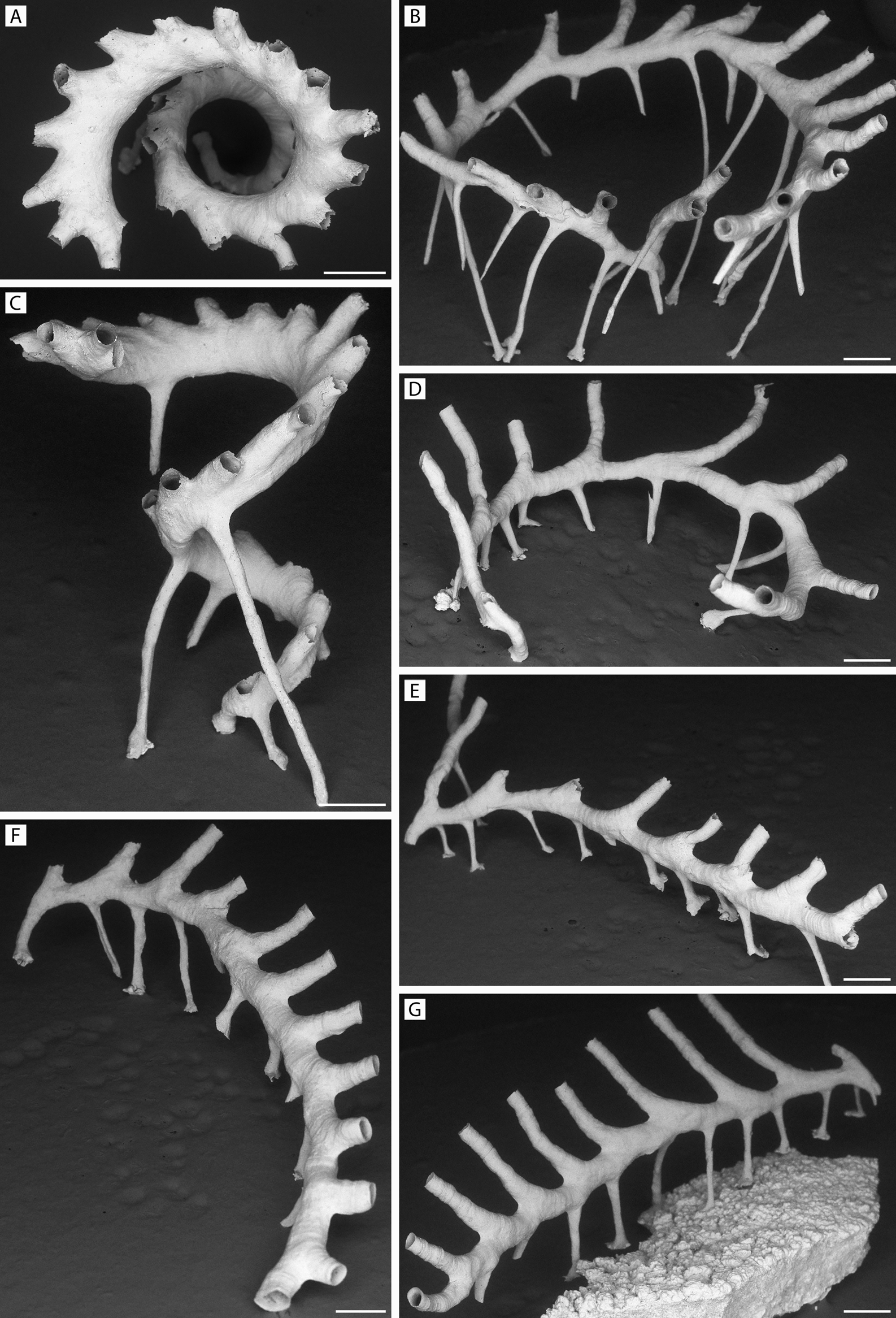
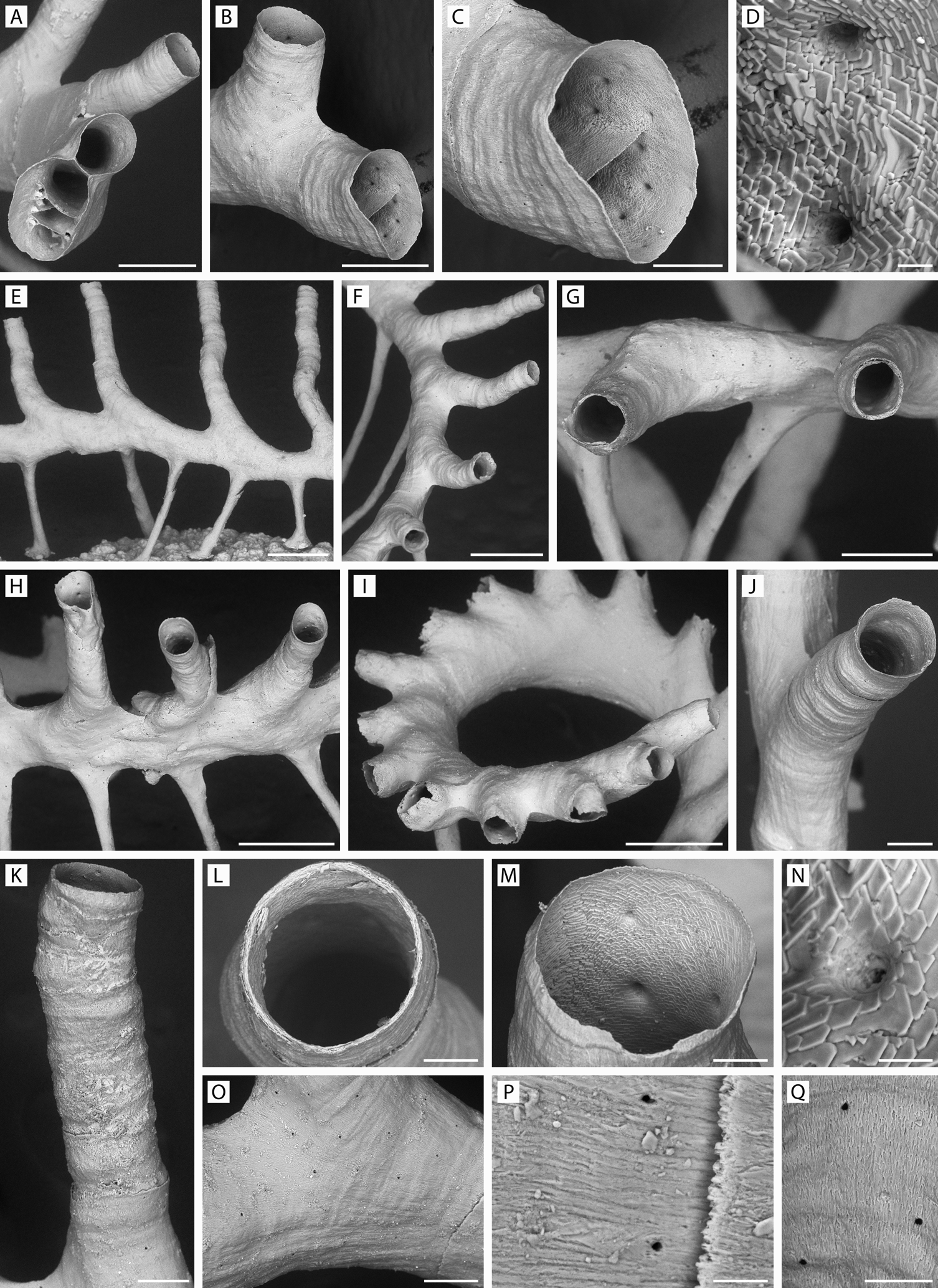
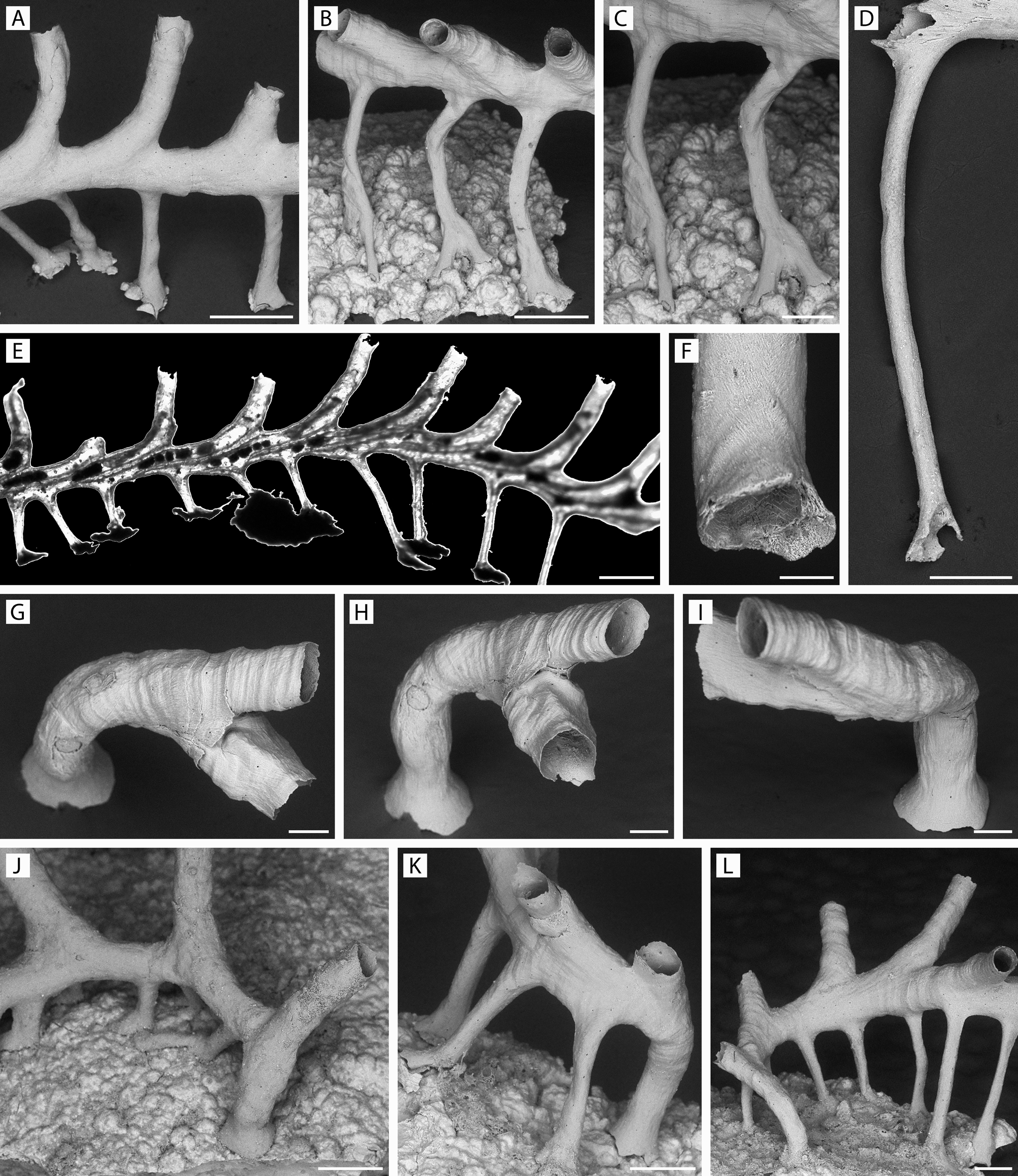
Description. Colony uniserial, semi-erect, white, comprising chain of zooids borne above solid substratum by elongated prop-like supports (Figs 2 A – E, 3 A – G), typically one (very rarely two) per zooid, body cavity of zooid continuous with that of prop (Fig. 5 E). Zooidal chain varied in disposition, either straight and more or less parallel to substratum or often ascending as open helicospiral, with up to 2.5 turns (Fig. 3 C) depending on age; many colonies have form somewhat intermediate between these extremes. Branching of uniserial stem uncommon, typically near colony origin, rarely further along stem (Fig. 3 E). Maximum colony length or diameter 12.60 mm; maximum colony height 3.74 mm. Most zooids seen in colonies ~ 24 (holotype; Fig. 3 A, C) and 26 (Fig. 2 E). Autozooids comprising proximal and distal components; axial proximal component forms part of continuous uniserial stem of colony, while distal component forms erect peristome of varying length. Frontal peristomial surface typically curving obliquely frontalwards from axial frontal surface; distal peristomial surface forming much sharper angle (up to 90 °) with frontal wall of daughter zooid. Autozooidal surface wholly gymnocystal (i. e. exterior-walled), with weak longitudinal and transverse striae or wrinkles (Figs 4 B, C, J, K), latter more apparent in zooidal peristomes; at higher magnification exterior surface made up of wall-perpendicular needle-like crystallites (Fig. 4 P, Q). Very tiny simple pseudopores occurring sparsely in zooidal walls (Fig. 4 O – Q). Peristomial opening circular, very thin-walled (Figs 4 J – M), becoming thicker through accretion of additional layers of crystallites. Interior surface of peristomes lined by distally imbricated foliated fabric of wedge-shaped crystallites (Fig. 4 N) that tend to be shorter and chunkier in proximal axial walls of zooids, especially around interior openings of pseudopores (Fig. 4 D). Zooidal axial and peristomial lengths generally similar, but can be independently variable, with peristomes slightly shorter than, or up to more than twice length of proximal axial portion of zooid (Fig. 3 G). Budding of daughter zooids achieved by development of partition from floor of parent zooid (Fig. 4 B, C) that slopes frontalwards under elevating peristomial portion, with completed parent zooids overlapping proximal portion of daughter zooids; thus parts of 2 – 3 zooidal chambers seen in transverse section of stem (Fig. 4 A). In lessattenuated colonies with tight helicospiral form, axis becomes thicker (Fig. 3 A, B) and budding sites are condensed. Prop-like supports elevate colony after its founding. These greatly variable in size and form. Some props have widened (up to three times wider than their mean diameter) bases at their points of contact with substratum. Typically, one prop per autozooid, originating near point where internal partitioning of daughter autozooid takes place (Figs 4 A, 5 E); sometimes additional prop interpolated in series (e. g. Fig. 3 G). Props can be length of peristome or very much longer and almost filiform (Fig. 3 B). Short, stumpy props that do not reach substratum appear to represent repaired broken props. Where they encounter substratum, proximal ends of props have short branches that splay out over irregularities (Fig. 5 A – C). Tiny sparse pseudopores occur in prop walls (Fig. 5 F). Gonozooid not seen. Ancestrula erect (Fig. 5 G – L). Protoecium short, rounded, squat, imperforate, broader than peristome that emerges from its dome, with scarcely any differentiation in calcification. Peristome typically bent in direction of initial colony growth. Measurements (mm). Holotype, ZIRAS 1 / 50667 (Fig. 3 A, C): Colony height 3.74, length 2.91, width 2.58 (L × W = helix in frontal view); ZL 1.373 – 1.918 (1.628 ± 0.181) (n = 8); PrL 0.458 – 2.443 (1.518 ± 0.999) (n = 3); PrD 0.120 – 0.186 (0.145 ± 0.035) (n = 3); PeL 0.243 – 0.442 (0.318 ± 0.067) (n = 8); PeD 0.177 – 0.186 (0.181 ± 0.003) (n = 4); ApL 0.170 – 0.178 (0.173 ± 0.003) (n = 4); ApW 0.162 – 0.170 (0.165 ± 0.004) (n = 4). Paratype 1, ZIRAS 2 / 50668 (Fig. 3 B): Colony height 3.39, length 6.41, width 4.88 (L × W = size of coil in frontal view); ZL 1.443 – 2.288 (1.989 ± 0.287) (n = 6); PrL 1.211 – 3.165 (2.373 ± 0.672) (n = 6); PrD 0.073 – 0.104 (0.082 ± 0.012) (n = 6); PeL 0.516 – 0.893 (0.776 ± 0.137) (n = 6); PeD 0.174 – 0.185 (0.180 ± 0.004) (n = 6); ApL 0.165 – 0.173 (0.168 ± 0.003) (n = 6); ApW 0.155 – 0.164 (0.160 ± 0.004) (n = 6). Paratype 5, ZIRAS 6 / 50672 (Fig. 3 G): Colony height 2.52, length 6.92; ZL 1.823 – 2.838 (2.261 ± 0.338) (n = 6); PrL 0.628 – 0.993 (0.834 ± 0.149) (n = 6); PrD 0.083 – 0.138 (0.108 ± 0.019) (n = 6); PeL 0.924 – 1.581 (1.214 ± 0.244) (n = 6); PeD 0.178 – 0.198 (0.190 ± 0.007) (n = 6); ApL 0.173 – 0.185 (0.180 ± 0.004) (n = 6); ApW 0.161 – 0.187 (0.174 ± 0.009) (n = 6). Non-type specimen YMG 4 – 14, Stn 326 (Fig. 5 G – I): AnPeD 0.156 (n = 1).
Grischenko, Andrei V., Gordon, Dennis P., Melnik, Viacheslav P. (2018): Bryozoa (Cyclostomata and Ctenostomata) from polymetallic nodules in the Russian exploration area, Clarion - Clipperton Fracture Zone, eastern Pacific Ocean-taxon novelty and implications of mining. Zootaxa 4484 (1): 1-91, DOI: 10.11646/zootaxa.4484.1.1
‘? Incertae sedis no. 4 ’ Harmelin & d’Hondt 1982: 13, pl. 4, figs 1 – 2; d’Hondt & Schopf 1985: 950, pl. 8, fig. 5. ‘ Cyclostome indéterminé’ d’Hondt & Schopf 1985: 949, pl. 8, fig. 3.
Grischenko, Andrei V., Gordon, Dennis P., Melnik, Viacheslav P. (2018): Bryozoa (Cyclostomata and Ctenostomata) from polymetallic nodules in the Russian exploration area, Clarion - Clipperton Fracture Zone, eastern Pacific Ocean-taxon novelty and implications of mining. Zootaxa 4484 (1): 1-91, DOI: 10.11646/zootaxa.4484.1.1
Remarks. In the collections examined for this study, Pandanipora helix n. sp. is represented by 203 colonies, which makes it all the more remarkable that not one bears a gonozooid. One possibility is that it never has gonozooids, but, among living cyclostomes, only species of Cinctiporidae unequivocally lack such structures (Boardman et al. 1992). Insofar as cinctiporids have exceptionally large autozooids, it appears likely that oogenesis and embryo formation takes place within them (see Schwaha et al. 2018). Zooidal size in Pandanipora helix n. sp. is not exceptional and there seems no reason that a peristomial gonozooid like that in Peristomatopora should not be present. Gonozooids were also notably absent from most colonies in the large collection of Antarctic cyclostomes studied by Ostrovsky & Taylor (1996) and Ostrovsky (1998 a). What is striking is that non-fertile colonies otherwise were of the same size as those bearing gonozooids, thus supporting the idea that incubation chambers will develop only if a colony is fertilized by alien sperm (Ryland 1996). In other words, sperm limitation may be a reason for the lack of gonozooids in many colonies. Experiments conducted on two cyclostome species by Jenkins et al. (2015) showed restrained female investment in the absence of mating opportunity; either the production of female zooids and progeny is much reduced in reproductive isolation, or development of gonozooids begins, but ceases further development in the absence of mating opportunity. Another possibility in Pandanipora helix is that incubation chambers are produced but are shed after release of embryos. Alternatively, gonozooids may be very fragile, and lost during the process of collection from the seafloor and subsequent processing of the polymetallic nodules. Harmelin & d’Hondt (1982) illustrated an unnamed species from 3392 – 3429 m depth off the coast of Surinam that conforms to the characters of the genus. D’Hondt & Schopf (1985) reported this same species again from 943 m off Recife and 3459 – 3783 m on the equatorial mid-Atlantic Ridge. What they interpreted as ‘ épines autozoéciales’ appear in their illustrations to be broken prop-like supports, of proportionately smaller diameter than in P. helix n. sp. Even closer to P. helix in appearance, and almost certainly conspecific, was a colony from 6065 – 6079 m in the central North Pacific north of the Hawaiian seamount chain. Based on this evidence, it appears likely that P. helix n. sp. may be fairly widespread in the abyssal north Central Pacific, with an undescribed sibling species in the abyssal tropical Atlantic. Our material shows up to five brown bodies retained in zooidal chambers (Fig. 5 E), indicating multiple regression and regeneration of polypides.
Grischenko, Andrei V., Gordon, Dennis P., Melnik, Viacheslav P. (2018): Bryozoa (Cyclostomata and Ctenostomata) from polymetallic nodules in the Russian exploration area, Clarion - Clipperton Fracture Zone, eastern Pacific Ocean-taxon novelty and implications of mining. Zootaxa 4484 (1): 1-91, DOI: 10.11646/zootaxa.4484.1.1
Distribution. Recorded from 118 stations within coordinates 12.26676 – 14.64985 ° N, 129.08802 – 134.67060 ° W, at depth range 4677 – 5280 m.
Grischenko, Andrei V., Gordon, Dennis P., Melnik, Viacheslav P. (2018): Bryozoa (Cyclostomata and Ctenostomata) from polymetallic nodules in the Russian exploration area, Clarion - Clipperton Fracture Zone, eastern Pacific Ocean-taxon novelty and implications of mining. Zootaxa 4484 (1): 1-91, DOI: 10.11646/zootaxa.4484.1.1
Etymology. Latin and Greek, helix, a coil or spiral, alluding to the common form of the colony; used as a noun in apposition.
Grischenko, Andrei V., Gordon, Dennis P., Melnik, Viacheslav P. (2018): Bryozoa (Cyclostomata and Ctenostomata) from polymetallic nodules in the Russian exploration area, Clarion - Clipperton Fracture Zone, eastern Pacific Ocean-taxon novelty and implications of mining. Zootaxa 4484 (1): 1-91, DOI: 10.11646/zootaxa.4484.1.1
Material examined. Holotype: ZIRAS 1 / 50667, colony detached from nodule, YMG R. V. Gelendzhik cruise GLD 4 – 12, Stn 238, 11 March 2013, 13.44587 ° N, 132.91008 ° W, 4772 m. Paratype 1: ZIRAS 2 / 50668, colony detached from nodule, YMG R. V. Yuzhmorgeologiya cruise YMG 4 – 04, Stn 61, 5 September 2005, 13.59717 ° N, 130.65212 ° W, 5008 m. Paratype 2: ZIRAS 3 / 50669, colony detached from nodule, YMG R. V. Gelendzhik cruise GLD 4 – 08, Stn 153, 26 July 2009, 13.15205 ° N, 133.89166 ° W, 5014 m. Paratype 3: ZIRAS 4 / 50670, colony detached from nodule, YMG R. V. Gelendzhik cruise GLD 4 – 12, Stn 259, 10 April 2013, 12.86148 ° N, 132.82182 ° W, 4910 m. Paratype 4: ZIRAS 5 / 50671, colony detached from nodule, YMG R. V. Gelendzhik cruise GLD 4 – 09, Stn 176, 24 December 2010, 12.93062 ° N, 133.56097 ° W, 4865 m. Paratype 5: ZIRAS 6 / 50672, colony attached to nodule particle, YMG R. V. Gelendzhik cruise GLD 4 – 09, Stn 190, 3 January 2011, 13.38432 ° N, 133.51833 ° W, 4838 m. Additional material: YMG 18 – 01, Stns 17, 23, 27, 32; YMG 4 – 04, Stns 52, 53, 54, 55; YMG 4 – 06, Stns 65, 68, 73, 85, 94, 96, 105, 106, 110, 114; YMG 4 – 07, Stns 116, 117, 120, 125, 134, 136, 141, 143; GLD 4 – 08, Stns 144, 145, 146, 150, 154, 155, 157, 160, 161, 164; GLD 4 – 09, Stns 165, 166, 169, 170, 173, 174, 181, 185, 193, 194, 197, 199; GLD 4 – 11, Stns 212, 214, 215, 217, 218, 219, 224, 225, 226, 227, 231, 233; GLD 4 – 12, Stns 235, 236, 245, 246, 253, 255, 258, 260, 262, 263, 264, 265, 272; YMG 4 – 13, Stns 275, 276, 282, 285, 289, 292, 293, 295, 305, 308, 310, 319, 321; YMG 4 – 14, Stns 324, 326, 328, 329, 330, 331, 332, 334, 335, 336, 338, 340, 342, 343, 346, 349, 350, 352, 354, 356, 358, 359, 361, 363, 364, 365. Total specimens examined 203.
Grischenko, Andrei V., Gordon, Dennis P., Melnik, Viacheslav P. (2018): Bryozoa (Cyclostomata and Ctenostomata) from polymetallic nodules in the Russian exploration area, Clarion - Clipperton Fracture Zone, eastern Pacific Ocean-taxon novelty and implications of mining. Zootaxa 4484 (1): 1-91, DOI: 10.11646/zootaxa.4484.1.1

Export occurrence data

Darwin Core Archive (ZIP)

CLASSIFICATION

Taxonomic Classification Tree

MULTIMEDIA

Media Files(4)

FIGURE 2. Colonies of some cyclostome bryozoans, in vivo, attached to polymetallic nodules. A–E, Pandanipora helix n. gen., n. sp.: A, specimen GLD4–09, Stn 190; B, specimen GLD4–12, Stn 262; C, specimen YMG4–07, Stn 143; D, specimen YMG4–13, Stn 295; E, specimen GLD 4–11, Stn 212. F, Tubuliporina sp. indet., specimen YMG18–01, Stn 7. G, H, Abyssoecia elevata n. gen., n. sp.: G, specimen GLD4–09, Stn 196; H, specimen GLD4–09, Stn 191. I, Discantenna metallica n. sp.: specimen GLD4–11, Stn 224. J, K, Frontohornera frontalis n. gen., n. sp.: J, specimen YMG4–07, Stn 124; K, specimen GLD4–11, Stn 210. L, Alyonushka hystricosa n. gen., n. sp.: specimen GLD4–09, Stn 199. M, Calyssopora volcano n. gen., n. sp.: specimen YMG18–01, Stn 33. N, O, Anyuta anastema n. gen., n. sp.: N, specimen GLD4–09, Stn 180; O, specimen YMG4–06, Stn 71. Scale bars: 1 mm.
Imageimage/png© Grischenko, Andrei V.;Gordon, Dennis P.;Melnik, Viacheslav P.Grischenko, Andrei V.;Gordon, Dennis P.;Melnik, Viacheslav P.

FIGURE 3. Pandanipora helix n. gen., n. sp. Holotype and paratype colonies. A, C, holotype, ZIRAS 1/50667; B, paratype 1, ZIRAS 2/50668; D, paratype 2, ZIRAS 3/50669; E, paratype 3, ZIRAS 4/50670; F, paratype 4, ZIRAS 5/50671; G, paratype 5, ZIRAS 6/50672. A, apical, and C, lateral views of the spiral holotype colony with widened apical part of axis of zooids with mostly broken, shortened peristomes and supported by rare, distanced, elongated tubular props; B, ring-like colony showing attenuated zooids with elongated, gently arcuate tubular peristomes tilted outwards, and supported by strongly elongated, slightly crooked filiform props; note one prop at lower left bifurcated near termination; D, crescentic colony showing zooids with elongated, arcuate tubular peristomes angled outwards, and supported by shortened straight props; E, colony bifurcated near point of origin showing linear chain of zooids with straight peristomes; supported by short props, some with widened terminations; F, arcuate colony with thicker zooids having widened tubular peristomes, supported by gradually shortening props; G, straight colony with greatly elongated peristomes, supported by regular series of props with expanded terminal bases, including four attached to piece of nodule. Scale bars: 500 µm.
Imageimage/png© Grischenko, Andrei V.;Gordon, Dennis P.;Melnik, Viacheslav P.Grischenko, Andrei V.;Gordon, Dennis P.;Melnik, Viacheslav P.

FIGURE 4. Pandanipora helix n. gen., n. sp. Details of morphology. A, specimen YMG4–13, Stn 289; B–D, paratype 4, ZIRAS 5/50671; E, paratype 5, ZIRAS 6/50672; F, G, Q, paratype 1, ZIRAS 2/50668; H, specimen GLD4–11, Stn 217; I, holotype, ZIRAS 1/50667; J, specimen YMG4–06, Stn 68; K, O, specimen YMG4–13, Stn 321; L, specimen YMG4–13, Stn 295; M, paratype 2, ZIRAS 3/50669; N, specimen GLD4–12, Stn 258; P, specimen GLD4–12, Stn 255. A, distal view of growing edge of colony showing early differentiation of daughter zooid and prop from the floor of the parent zooid, with chambers arranged in stacks; B, growing edge of colony showing differentiation of a daughter zooid (lower) from the floor of the parent zooid (upper); C, same, close-up; D, interior surface of developing zooid chamber showing imbricated foliated fabric of wedge-shaped crystallites and openings of pseudopores; E–I, variability of zooid size and geometry: E, elongated zooids with tall peristomes; F, part of ring-like colony; G, lateral view of same colony, two zooids near-perpendicular to plane of props; H, arcuate colony with overlapping peristome bases; I, lateral view of apical coil of spiral colony with subconnate peristome bases and shortened peristomes, most broken; J, frontolateral view of tubular peristome showing annular striae on the surface; K, lateral view of tubular peristome; L, peristomial aperture, frontal view; M, oblique view of peristomial aperture showing imbricated foliated fabric of wedge-shaped crystallites and interior openings of pseudopores; N, imbricated foliated fabric of wedge-shaped crystallites around internal opening of pseudopore; O, zooidal wall showing tiny sparse simple pseudopores; P, Q, close-up of zooidal wall showing crystallites. Scale bars: A, B, G, 250 µm; C, J, K, O, 100 µm; D, N, 10 µm; E, F, H, I, 500 µm; L, M, Q, 50 µm; P, 15 µm.
Imageimage/png© Grischenko, Andrei V.;Gordon, Dennis P.;Melnik, Viacheslav P.Grischenko, Andrei V.;Gordon, Dennis P.;Melnik, Viacheslav P.

FIGURE 5. Pandanipora helix n. gen., n. sp. A, K, specimen YMG4–13, Stn 289; B, C, specimen YMG4–13, Stn 308; D, specimen YMG4–07, Stn 143; E, specimen GLD4–11, Stn 219; F, specimen YMG4–14, Stn 330; G–I, specimen YMG4–14, Stn 326; J, specimen GLD4–12, Stn 258; L, specimen YMG4–13, Stn 321. A–D, F, prop morphology: A, vertical and oblique columnar props attached to nodule by expanded tips; B, curved props attached to nodule irregularities by expanded tips with complex outlines; C, same, close-up; D, single elongated prop from its inception in the zooid basal wall to its distal expansion; E, light micrograph of colony showing successively overlapping zooids with their coelomic cavities continuing into the props with no intervening septum or pore, as well as 2–5 brown bodies located centrally to proximally in several zooids; F, prop tip showing opening towards substratum and internal surface with wedge-shaped crystallites, structurally analogous to peristome; G–I, ancestrula and daughter zooid budded from peristome; J–L, ancestrula and postancestrular zooids. Scale bars: A, B, E, 500 µm; C, D, J–L, 250 µm; F, 50 µm; G–I, 100 µm.

Imageimage/png© Grischenko, Andrei V.;Gordon, Dennis P.;Melnik, Viacheslav P.Grischenko, Andrei V.;Gordon, Dennis P.;Melnik, Viacheslav P.

IMAGES

Gallery(4)

See Gallery

Occurrences with images

Source Information

Bryozoa (Cyclostomata and Ctenostomata) from polymetallic nodules in the Russian exploration area, Clarion - Clipperton Fracture Zone, eastern Pacific Ocean-taxon novelty and implications of mining

checklist

This dataset contains the digitized treatments in Plazi based on the original journal article Grischenko, Andrei V., Gordon, Dennis P., Melnik, Viacheslav P. (2018): Bryozoa (Cyclostomata and Ctenostomata) from polymetallic nodules in the Russian exploration area, Clarion - Clipperton Fracture Zone, eastern Pacific Ocean-taxon novelty and implications of mining. Zootaxa 4484 (1): 1-91, DOI: 10.11646/zootaxa.4484.1.1

Abstract

This work describes Bryozoa of the orders Cyclostomata and Ctenostomata found associated with polymetallic nodules collected by box-coring in the eastern part of the Russian exploration area of the Clarion-Clipperton Fracture Zone (CCFZ) under contract to Yuzhmorgeologiya. Scanning electron microscopic study of 358 cyclostome colonies and 14 ctenostome colonies from 4510–5280 m depth has resulted in the recognition of two new species of Ctenostomata, and 14 new species, nine new genera and two new families of Cyclostomata; three additional species of Cyclostomata are left in open nomenclature pending the discovery of missing reproductive characters. The taxonomic novelty is thus notable. One of the new Ctenostomata represents the first living example of the previously monotypic Late Cretaceous genus Pierrella. Twelve of the new cyclostome taxa have well-developed gonozooids, indicating that embryonic cloning (polyembryony) is normal in this deep-sea environment. On the other hand, one indeterminate tubuliporine and two rectangulates have dimorphic peristomes. In the latter two cases, enough mature colonies were found to suggest that this feature is normal, and that the dimorphic zooids are possibly female—in other words, capacious incubation chambers are apparently lacking, and therefore polyembryony would also be lacking or reduced. In one of these species, evidence is presented to suggest that the ancestrular zooid can reproduce precociously. Of the species reported here, only one has previously been found outside the exploration area, highlighting both the limited knowledge we have of bryozoans in the deep Pacific and/or a fauna that is largely endemic to the nodule environment. An additional 31 species of Cheilostomata have also been discovered that will be described in a subsequent publication. Most bryozoans are macrofaunal-sized, so are both inadequately determinable and overlooked in images obtained by remotely operated vehicles; yet, with 50 species, Bryozoa is the most speciose sessile macrofaunal phylum on the nodules. Nodules constitute hard substrata in an area otherwise mostly inhospitable for Bryozoa, hence mining would lead to loss of critical habitat. Further, as suspension-feeders, bryozoans are highly susceptible to smothering by suspended sediment, and non-mined areas closely adjacent to extraction zones would likely also be affected and their associated bryozoan fauna obliterated. More data are required on the distribution of the CCFZ bryozoan species elsewhere in the east Central Pacific to determine if mining would lead to local taxon extirpation or global extinction at both low and high taxonomic levels.

Grischenko A V, Gordon D P, Melnik V P, plazi (2018). Bryozoa (Cyclostomata and Ctenostomata) from polymetallic nodules in the Russian exploration area, Clarion - Clipperton Fracture Zone, eastern Pacific Ocean-taxon novelty and implications of mining. Plazi.org taxonomic treatments database. Checklist dataset https://doi.org/10.11646/zootaxa.4484.1.1 accessed via GBIF.org on 2026-06-15.

CC0Published 9/25/2018View dataset
GBIF Usage Key
148403742
Dataset Key
74b777c9-eae0-4770-8c86-dcbb10fb06b3
Origin
source
Backbone Key
9879260
Taxon ID
521587E4563A550909EEFCEF884EFDBB.taxon
Last Crawled
6/10/2026
Last Interpreted
6/10/2026