
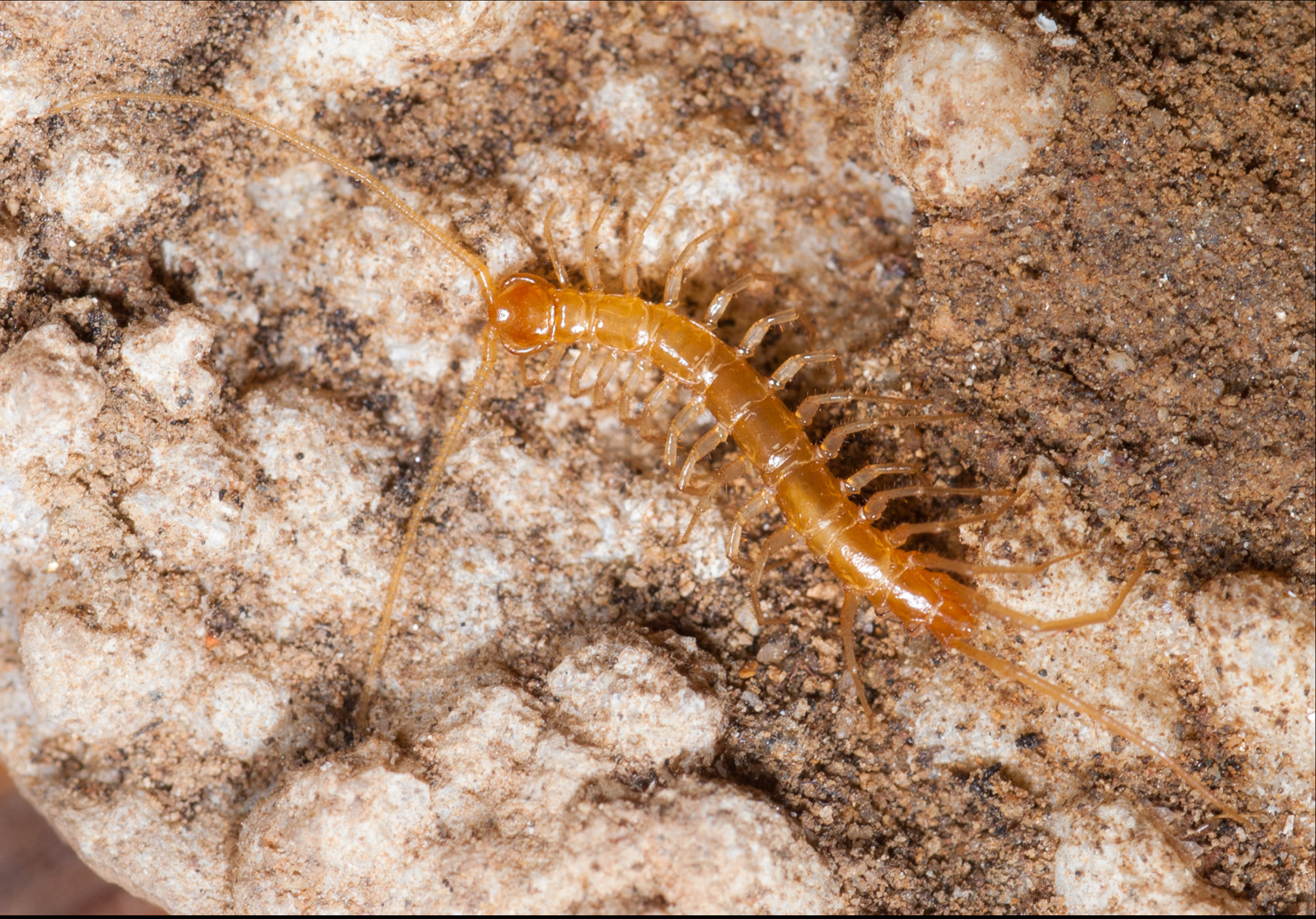
Buethobius huestoni
Williams & Hefner, 1928
GBIF:148671727
ABOUT
Descriptions(1)
Buethobius huestoni Williams & Hefner, 1928
Buethobius huestoni Williams & Hefner 1928: 139; Mercurio 2010: 44 (complete references)
The description is brief, but contains more detail than that of the following species. Nevertheless, key characters go unmentioned. Deep red in color, 10 mm long, “antennae long, more than 30 segments,” coxal pores “2, 3, 3, 2–4, 5, 5, 5.” Williams and Hefner (1928) also state: “No pigmented ocelli; a light spot which resembles a non-pigmented area.” Interestingly, the margins of the coxosternum are said to have no teeth. The descriptions by Williams and Hefner of their Buethobius species are accompanied by two crude drawings, labelled only as “ Buethobius,” without reference to either species. However, Fig. 26A shows the posterior segments of a female with 5 coxal pores on the 15th coxa, and Fig. 26B shows a male with a coxal pore formula of 2, 4, 4, 5. Since B. translucens is said to have coxal pores 2, 2, 2, 2, it seems reasonable to assume that the illustrations are of B. huestoni . However, neither illustration shows the prominent process of the 15th coxa seen in other Buethobius species. Andrew Weaver collected intensively for many years in Ohio and never encountered any species of Buethobius, though he claimed to have seen one specimen from Illinois matching the description of B. huestoni (A. A. Weaver, unpublished data; this is may be the source of the Illinois record mentioned by Mercurio [2010] since Weaver shared his unpublished notes widely), based on the inference that the species lacks coxosternal teeth. However, I found two specimens in the USNM collection labelled “ Buethobius huestoni Oxford 1928 .” On the reverse, the handwritten label says “This is what we called Buethobius huestoni n. sp. we have only 3 males so far.” The specimens, a male and a female, are in poor condition; one complete antenna has 38 segments and the pore counts conform to the range given by Williams & Hefner (1928). I could not determine with certainty if an ocellus is present, but it appears it is not. As described in 1928, the forcipular coxosterna of both specimens have a straight, even margin lacking teeth. Leg-pairs 1–12 have single-segmented tarsi; the female retains leg 13, which has an incomplete suture dividing the tarsus. Neither specimen has legpairs 14 and 15. The coxae of legpair 15 do not have a distomesal spinous process. This combination of characters is unique in both anopsobiids and henicopids, so determining the status of B. huestoni must wait for fresh collections. Heuston Woods, Oxford, Ohio, the type locality, is now a protected state park.
Export occurrence data
Darwin Core Archive (ZIP)
CLASSIFICATION
Taxonomic Classification Tree

IMAGES