
AnimaliaNot EvaluatedacceptedspeciesAccepted
Molgula citrina
Alder & Hancock, 1848
GBIF:148692781
0year
ABOUT
Descriptions(1)
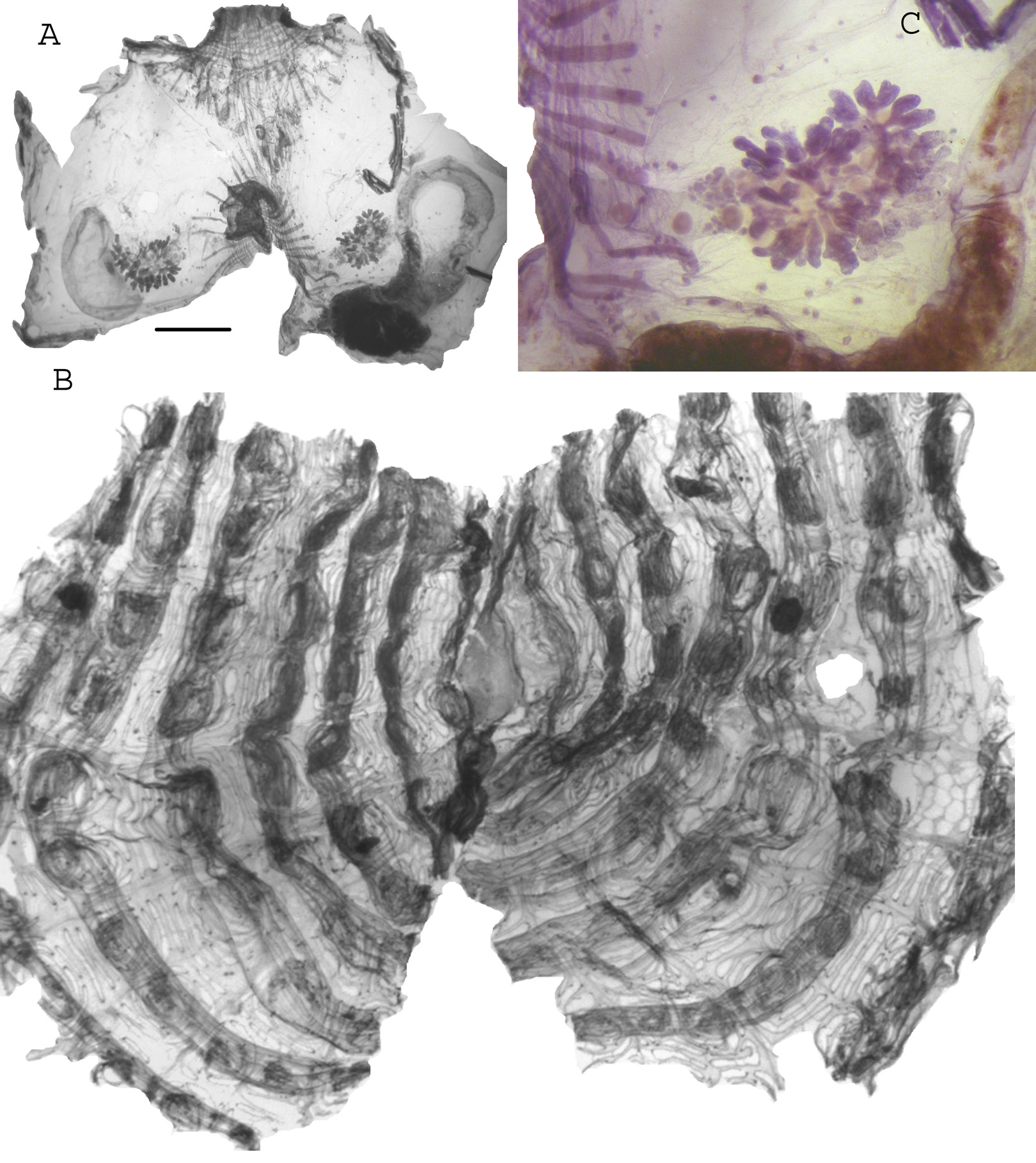
Monniot C.: 1969 and synonymy; Lambert et al 2010. Station AB 181 (MNHN S 3 MOL A 442; slide S 3. 880). The single specimen 7 mm in diameter has a thin tunic covered with sand. The body wall is thin with a musculature reduced to the siphons and short bundles radiating from each siphon (Fig. 24 A). There are 6 large oral tentacles with small ramifications of first order. The dorsal tubercle opens to the right in a C. The branchial sac has 7 folds on each side (Fig. 24 B). The formula on the right side is: E- 4 - 5 - 7 - 7 - 8 - 5 - 3 - DL. The infundibula are divided at the top of the folds. The gut forms a long open loop (Fig. 24 A). The short stomach is covered by a dark brown hepatic gland. The anus has 2 lips. The kidney is ovoid (Fig. 24 A). The gonads (Fig. 24 A), one on each side, are made of a central ovary encircled and partly covered with numerous testis vesicles. The left gonad (Fig. 24 C) lies in the secondary gut loop and the right gonad is applied against the dorsal side of the kidney (Fig. 24 A). The oviduct is long and wide (Fig. 24 C). The ducts of groups of testis vesicles join in the centre of the ovary surface to make tubes protruding into the atrial cavity, one in the right gonad and 2 on the left gonad (Fig. 24 C) in the Martinique specimen. Specimens from Sweden and the Channel have been re-examined in comparison; the samples from Roscoff, of a smaller size than arctic specimens, are the same as those from Madibenthos and their identification as M. citrina was ascertained by a genetic study (Shenkar & Swalla 2010).
Monniot, Françoise (2018): Ascidians collected during the Madibenthos expedition in Martinique 3. Stolidobranchia, Pyuridae and Molgulidae. Zootaxa 4459 (3): 401-430, DOI: 10.11646/zootaxa.4459.3.1
Export occurrence data
Darwin Core Archive (ZIP)
CLASSIFICATION
Taxonomic Classification Tree

IMAGES