
AnimaliaNot EvaluatedacceptedspeciesAccepted

Pyura munita
(Van Name, 1902)
GBIF:148692797
0year
0
Synonyms
ABOUT
Descriptions(1)
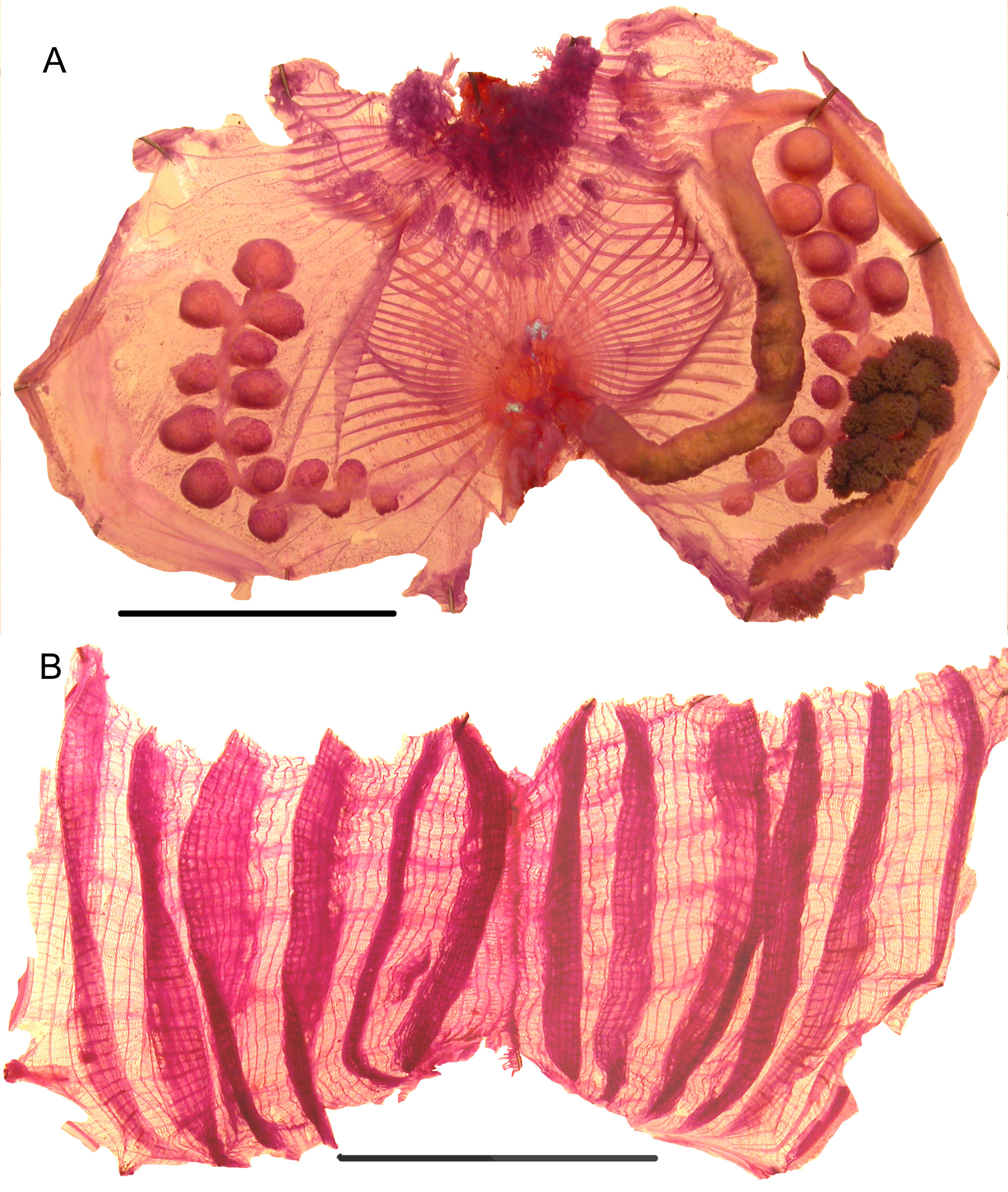
The longitudinal vessels are spaced on the folds. There are spiral stigmata at the top of the infundibula. Parastigmatic vessels are present. The digestive tract (Figs 16 B; 17 A) occupies a large part of the left body side and describes a wide loop. The intestine is isodiametric (Figs 16 B; 17 A) ending in an anus with small denticles. The hepatic gland has two different parts (Fig. 17 A): a large papillated mass at the pyloric side of the stomach and 2 smaller groups of papillae on each side of the narrow cardia. There are no endocarps on the gut. The gonads (Figs 16 B; 17 A), one on each side are made of round hermaphrodite well separated lobes alternating on each side of a longitudinal duct ending in a long papilla (Fig. 17 A). There are no endocarps on the gonads and no endocarps on the body wall. Described from the Bermuda Islands (Van Name 1902) and found again in the same region (Monniot C. 1972), P. munita is recorded now from Martinique with all characters given in the previous descriptions. Pyura millari Rodrigues, 1966 (São Paulo) with same tunic, branchial stigmata and total absence of endocarps is certainly a junior synonym of P. munita. P. munita differs from other Caribbean Pyura species with 6 branchial folds by its tunic incrusted with sand, the spinule shape and size, the total absence of endocarps and a not inflated isodiametric intestine.
Monniot, Françoise (2018): Ascidians collected during the Madibenthos expedition in Martinique 3. Stolidobranchia, Pyuridae and Molgulidae. Zootaxa 4459 (3): 401-430, DOI: 10.11646/zootaxa.4459.3.1
Export occurrence data
Darwin Core Archive (ZIP)
CLASSIFICATION
Taxonomic Classification Tree

NOMENCLATURE
Synonyms(1)
IMAGES