
AnimaliaNot EvaluatedacceptedspeciesAccepted
Pyura ocellata
Monniot F., 2016
GBIF:148692798
0year
ABOUT
Descriptions(1)
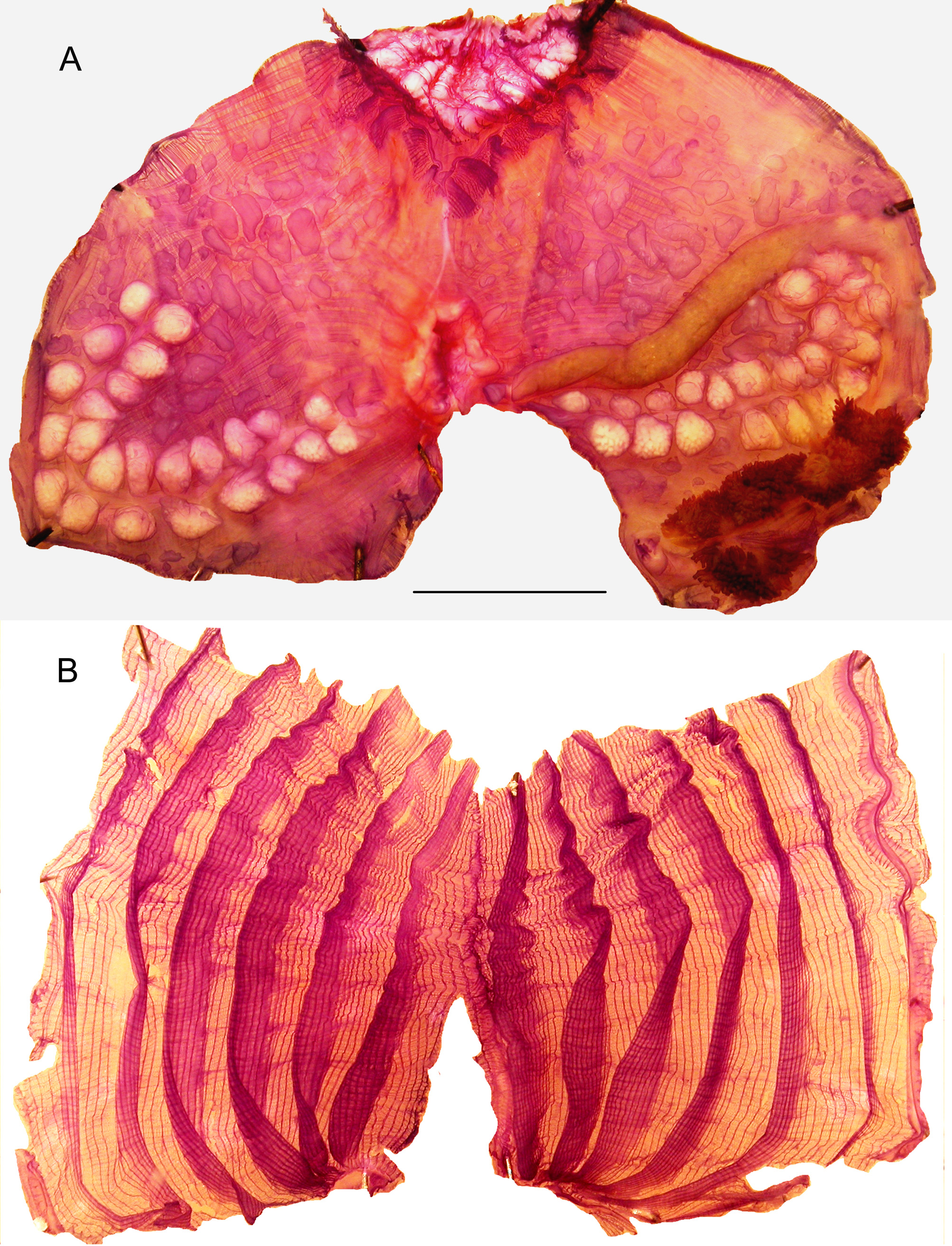
Monniot F. 2016 a Guiana Stations: AB 62, 108, 126, 150, 152, 155, 159, 165, 177, 187, 369. AD 214, 223, 234; 257. AM 20. AR 100, 103, 110, 116, 168, 180, 182, 353, 387, 469. (MNHN S 2 PYU 504) All specimens attached by their posterior side have the same ovoid shape with the oral siphon apical and the atrial at 1 / 3 of the body length. The tunic surface has a pavement of lenticular swellings on the body and tubercles on the siphons. Red in life the colour becomes brownish after fixation. No tunic spinules have been found and there are no epibionts. Extracted from the tunic the body wall is not transparent with red siphons and yellowish body. The musculature is dense (Fig. 18 A). Both siphons have a large velum with white pigment. The tentacles are thin in 3 orders of size and 2 orders of ramifications (Fig. 18 A). The prepharyngeal band is not deeply indented dorsally and contains a C-shaped dorsal tubercle anteriorly opened. The branchial sac has 6 high folds on each side (Fig. 18 B), recovering each other when not distended by dissection. The stigmata are coiled at the top of the infundibula. An example of the branchial formula on the right side is: E- 4 (12) 5 (19) 6 (26) 6 (26) 6 (22) 5 (20) 4 - DL. The stigmata are short crossed by parastigmatic vessels. The dorsal lamina is long in thin languets. The digestive tract (Fig. 18 A) occupies at least half of the left body side. The isodiametric intestine forms an opened loop and does not wear endocarps (Fig. 18 A). The digestive gland has two main parts, a brown pyloric papillated mass and two paler groups of papillae on the cardia (Fig. 18 A). The anus has a smooth rim. There is one gonad on each side. The left gonad is entirely located inside the gut loop. The right gonad, long and curved (Fig. 18 A) is close to the endostyle. The gonad lobes are numerous and pressed on each side of the gonoduct ending in a short papilla at the atrial siphon entrance. There are endocarps on the gonad lobes and on each side of the body wall (Fig. 18 A). Recorded for the second time, P. ocellata has a very constant aspect, and the same anatomy in all specimens confirms the original description. This species differs from the other West Atlantic Pyura species with 6 branchial folds by the absence of siphonal spinules and epibionts, an isodiametric intestine and endocarps on the gonads and body wall. It has in common with P. discrepans the absence of siphonal spinules, an isodiametric intestine and polycarps on the body wall but the latter differs by a different tunic with epibionts, a thin musculature and gonads with well separated lobes.
Monniot, Françoise (2018): Ascidians collected during the Madibenthos expedition in Martinique 3. Stolidobranchia, Pyuridae and Molgulidae. Zootaxa 4459 (3): 401-430, DOI: 10.11646/zootaxa.4459.3.1
Export occurrence data
Darwin Core Archive (ZIP)
CLASSIFICATION
Taxonomic Classification Tree

IMAGES