
AnimaliaNot EvaluatedacceptedspeciesAccepted

Pyura vannamei
Monniot C., 1994
GBIF:148692799
0year
ABOUT
Descriptions(1)
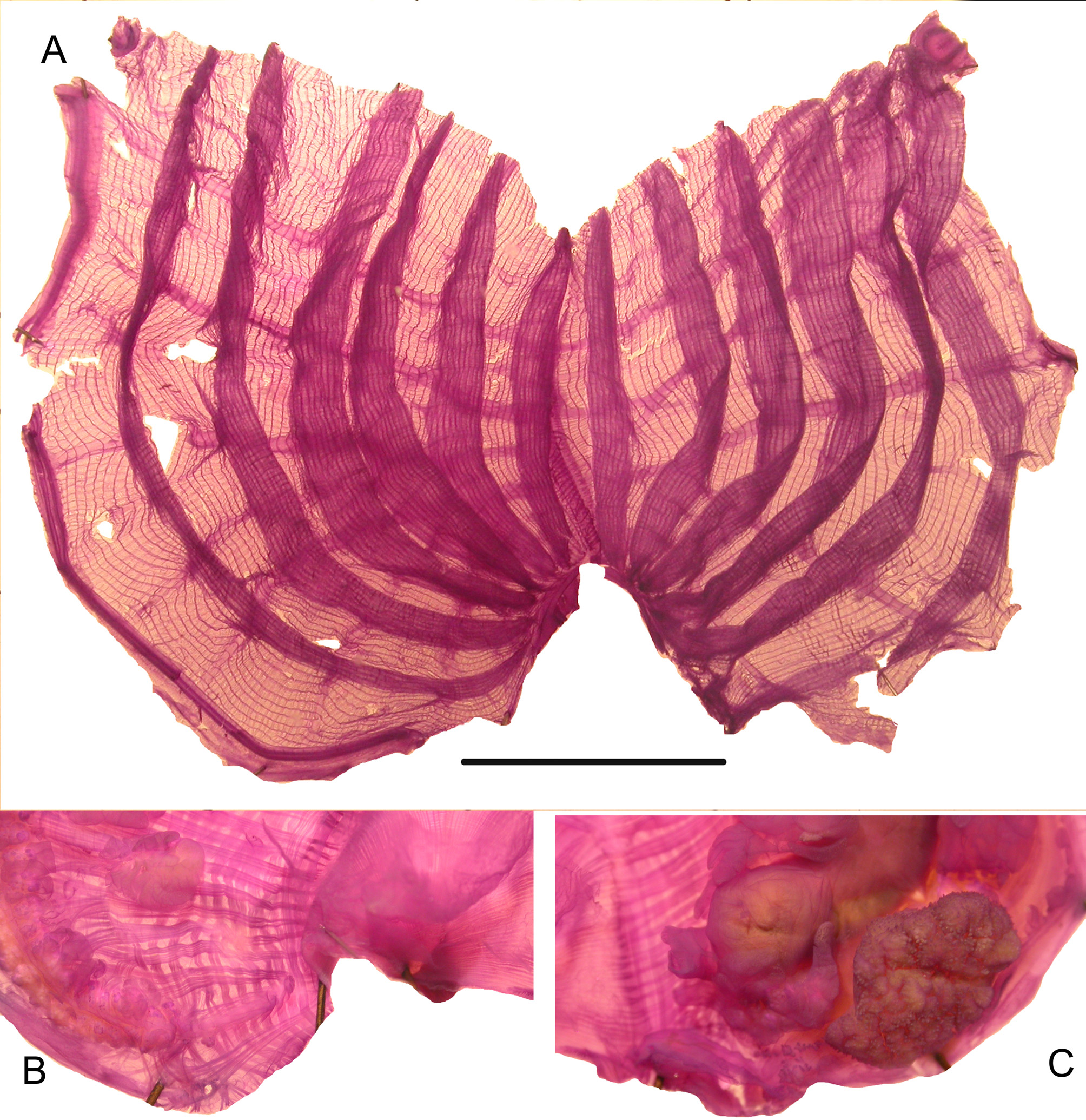
Monniot C. 1994, and synonymy; Collin et al 2005, Brazil Stations: AB 108, 155, 179, 189, 193, 301. AM 05, 07. AR 100, 101, 103, 188, 352; AR 353. (MNHN S 2 PYU 502). The body is red partly or entirely covered with epibionts (Fig. 19 B), the colour remaining some time in formalin to become brown. The well separated siphons have tunic tubercles, but no spinules have been found. The tunic surface is corrugated on the body and has a leathery consistency. Extracted from the tunic the siphons have a circular red line at the rim and a membranous velum. The musculature is complete with strong siphonal sphincters and regularly crossed and large fibres on the body (Fig. 19 A). The oral tentacles are stout with a wide base (Fig. 19 A, C) and tiny secondary branching. The prepharyngeal band forms a deep V (Fig. 19 C). The dorsal tubercle is variable, either in a U anteriorly opened or a sideways S curve with one horn inrolld (Fig. 19 A, C) The branchial sac has 6 high folds (Fig. 20 A). One formula on the right side, in a specimen 4 cm large, is: E- 8 (20) 7 (20) 7 (22) 8 (21) 7 (22) 7 (18) 2 - DL. The dorsal lamina has numerous pointed languets. The endostyle forms a short loop at its anterior end. The longitudinal vessels end in papillae against the oesophagus entrance. The digestive tract is long with an enlarged rectum (Figs 19 A, 20 C). The anus has 8 round lobes which are often rolled up (Fig. 20 C). The digestive gland is dark with a large papillated mass on the stomach and some other papillae on the oesophagus (Fig. 19 A). The external side of the gut loop is lined by numerous foliated endocarps (Fig. 19 A). There is a very long gonad on each side, the left one contained inside the gut loop. The gonad lobes are applied to each other in a dense double series and wear endocarps (Fig. 19 A). The genital papillae are joined and short (Fig. 20 B). Dorsally to the right gonad, and well separated from it, are 3 to 5 cushion like endocarps on the body wall (Fig. 19 A). There are no other endocarps elsewhere on the body wall. This species has many characters in common with P. vittata: the red colour, general body shape and size, same branchial sac, an enlarged rectum. It differs by the presence of endocarps on the body wall, absence of spinules on the siphons, the right gonad extending less anteriorly and applied against the endostyle. The geographic distribution of P. vannamei is limited to the western tropical Atlantic Ocean, but it may have been confused with P. vittata.
Monniot, Françoise (2018): Ascidians collected during the Madibenthos expedition in Martinique 3. Stolidobranchia, Pyuridae and Molgulidae. Zootaxa 4459 (3): 401-430, DOI: 10.11646/zootaxa.4459.3.1
Export occurrence data
Darwin Core Archive (ZIP)
CLASSIFICATION
Taxonomic Classification Tree

IMAGES