
AnimaliaNot EvaluatedacceptedspeciesAccepted
Bhawania goodei
Webster, 1884
GBIF:154498659
0year
ABOUT
Descriptions(5)
(Figures 3 A – K, 8, 14 E, 15 B) Type locality of the nominal species: Bermuda, Western Atlantic (Webster 1884).
Cruz-Gómez, Christopher, Bastida-Zavala, J. Rolando (2018): Chrysopetalids (Phyllodocida: Chrysopetalidae) from the southern Mexican Pacific, including a new species. Zootaxa 4521 (1): 61-88, DOI: 10.11646/zootaxa.4521.1.3
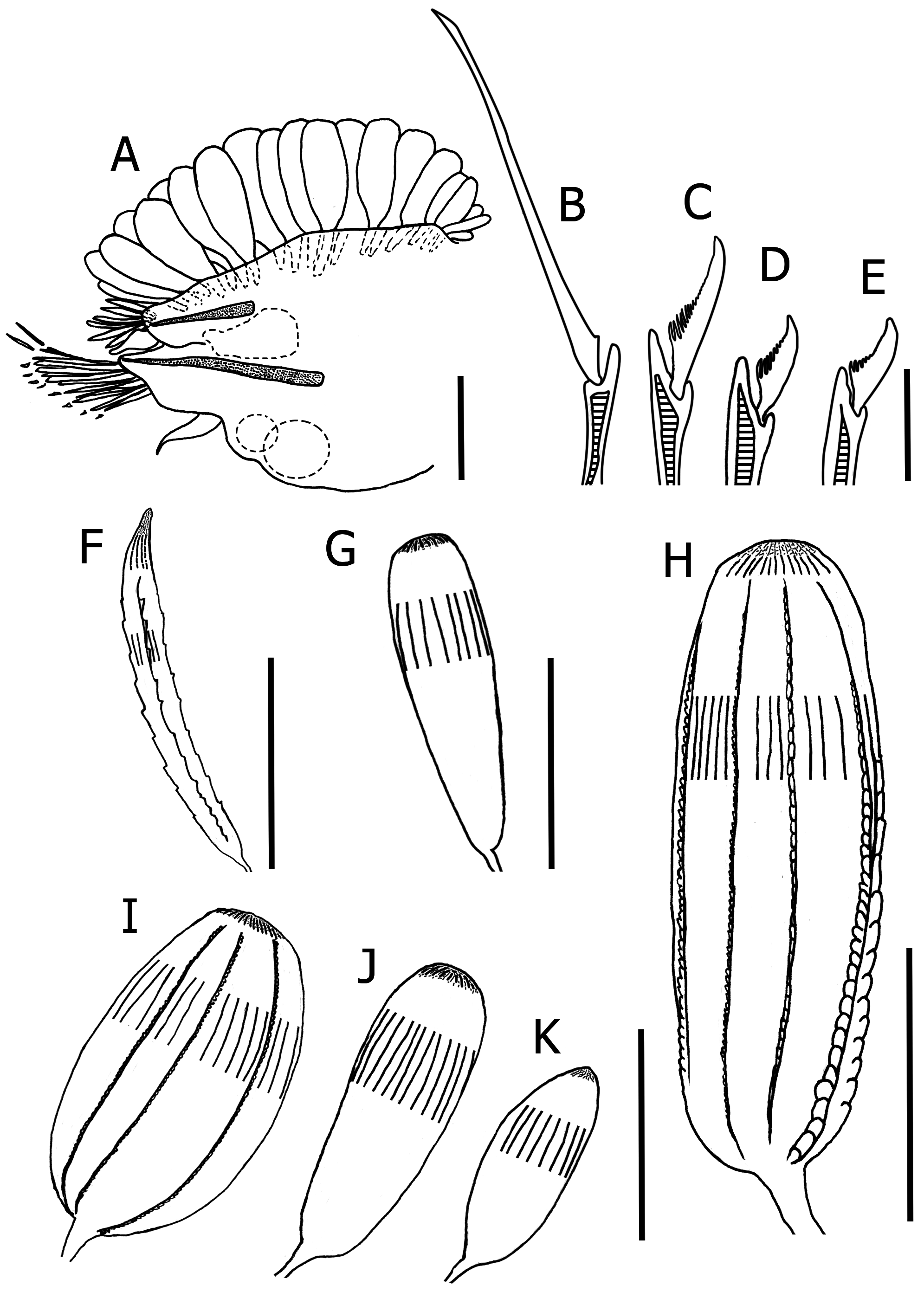
Description. Based on one incomplete specimen, 6.8 mm long, 1.2 mm wide, with only 48 anterior segments. Body rectangular and wide, first segments slightly tapered. Body pale yellow to brown. Paleae fans yellow to golden, imbricated over dorsum, covering it totally. Prostomium rounded, completely retracted among the first five anterior segments. Two lateral antennae; a median antenna inserted anterior to the prostomium. Two pairs of reddish eyes; second pair slightly larger than first pair. Nuchal fold not observed. Two cylindrical palps, only visible in ventral view. Mouth fold semicircular, inserted between second and third segment. Eversible proboscis, stylets not observed. Parapodium from the 15 th segment. Notochaetae separated in three main groups and one subgroup (Fig. 3 A). Lateral group inserted over the notoaciculum; comprising 8 – 10 slender and feather-like paleae with 5 – 7 ribs and 0 – 1 raised rib (Fig. 3 F). As subunit 1, one symmetrical palea with eight ribs (Fig. 3 G). Main group, comprising 15 symmetrical paleae with 13 – 15 ribs and three raised ribs (Fig. 3 H). Median group, comprising three, symmetrical paleae; distal paleae with 18 ribs and three raised ribs, next distal palea smaller than main paleae with 12 ribs and five raised ribs; the most proximal and smallest with eight ribs, sometimes with 1 – 2 raised ribs (Fig. 3 I – K). Neuropodium conical and larger than notopodium. Neurochaetae composed of four groups (Figs 3 B – E). Neurochaetiger with 1 – 3 superior spinigers with a long and curved slim blade, with a faintly serration basally. Midsuperior group 4 – 5 falcigers with medium length blades (1 / 3 of spiniger blade length) and serration basally. Midinferior group with 5 – 7 falcigers with medium blades (1 / 3 of spiniger blade length), serration basally. Inferior group of 2 – 4 falcigers with short and smooth blades (2 / 7 of spiniger blade length) with fine serration basally. Pygidium unknown. Habitat. Intertidal (0.5 m). On sabellariid tubes.
Cruz-Gómez, Christopher, Bastida-Zavala, J. Rolando (2018): Chrysopetalids (Phyllodocida: Chrysopetalidae) from the southern Mexican Pacific, including a new species. Zootaxa 4521 (1): 61-88, DOI: 10.11646/zootaxa.4521.1.3
Remarks. The genus Bhawania is poorly known in the Pacific coast of Mexico with only two species of this genus recorded from the region: B. goodei and B. riveti (Gravier 1908). Specially, B. goodei currently is reported as having a wide distribution which includes Asia, Africa and both American coasts (Webster 1884; Augener 1918; Monro 1933; Imajima & Hartman 1964). Bhawania goodei was described by Webster (1884) from Bermuda Island; later, Perkins (1985) redescribed the species with specimens from Florida. This species has also been recorded by Kudenov (1975, Puerto Peñasco, Sonora), Fauchald (1977, Taboga Island, Panama) and Bastida- Zavala (1993, La Paz, Baja California Sur). These records need to be thorougly checked as seems unlikely that B. goodei has traversed the Panama Canal to the Pacific coast of America. The specimen revised here agree with the redescription by Perkins (1985) except for the presence of the nuchal fold (Perkins 1985: fig. 21 A). This character was not observed since the single specimen is damaged. Gravier (1908) described briefly Bhawania riveti based on one incomplete specimen from Payta, Perú. Bhawania cf. goodei differs from Gravier’s in some features: notoaciculum in B. riveti is wide and long (Gravier 1910: pl. VII, fig. 31) while B. cf. goodei is smaller and slimmer (Fig. 3 A); regarding paleae fan, Gravier (1908) did not mention if his species presented internal raised ribs in the paleae, character present in B. cf. goodei; also the length of the paleae in B. riveti is about 1 / 3 of body width, while in B. cf. goodei is about 1 / 2 body width.
Cruz-Gómez, Christopher, Bastida-Zavala, J. Rolando (2018): Chrysopetalids (Phyllodocida: Chrysopetalidae) from the southern Mexican Pacific, including a new species. Zootaxa 4521 (1): 61-88, DOI: 10.11646/zootaxa.4521.1.3
Distribution. Southern Mexican Pacific, only known from Chacahua Bay, Oaxaca, Mexico (Fig. 8).
Cruz-Gómez, Christopher, Bastida-Zavala, J. Rolando (2018): Chrysopetalids (Phyllodocida: Chrysopetalidae) from the southern Mexican Pacific, including a new species. Zootaxa 4521 (1): 61-88, DOI: 10.11646/zootaxa.4521.1.3
Material examined. Oaxaca: UMAR-Poly 855 (mouth of Chacahua Lagoon, 15 ° 57 ’ 59 ’’ N, 97 ° 40 ’ 44 ’’ W, on tubes of sabellariids, 0.5 m, April 3, 2008, coll. J. Jarquín), 1 specimen.
Cruz-Gómez, Christopher, Bastida-Zavala, J. Rolando (2018): Chrysopetalids (Phyllodocida: Chrysopetalidae) from the southern Mexican Pacific, including a new species. Zootaxa 4521 (1): 61-88, DOI: 10.11646/zootaxa.4521.1.3
Export occurrence data
Darwin Core Archive (ZIP)
CLASSIFICATION
Taxonomic Classification Tree

MULTIMEDIA
Media Files(2)
FIGURE 3. Bhawania cf. goodei. A, parapodium middle segment; B–E, neurochaetal types; F, lateral paleae; G, subunit 1 palea; H, meddle main palea; I–K, median paleae group. Scale bars: 30 µm (BCDE), 100 µm (FGHIJK), 200 µm (A).
Imageimage/png© Cruz-Gómez, Christopher;Bastida-Zavala, J. RolandoCruz-Gómez, Christopher;Bastida-Zavala, J. Rolando
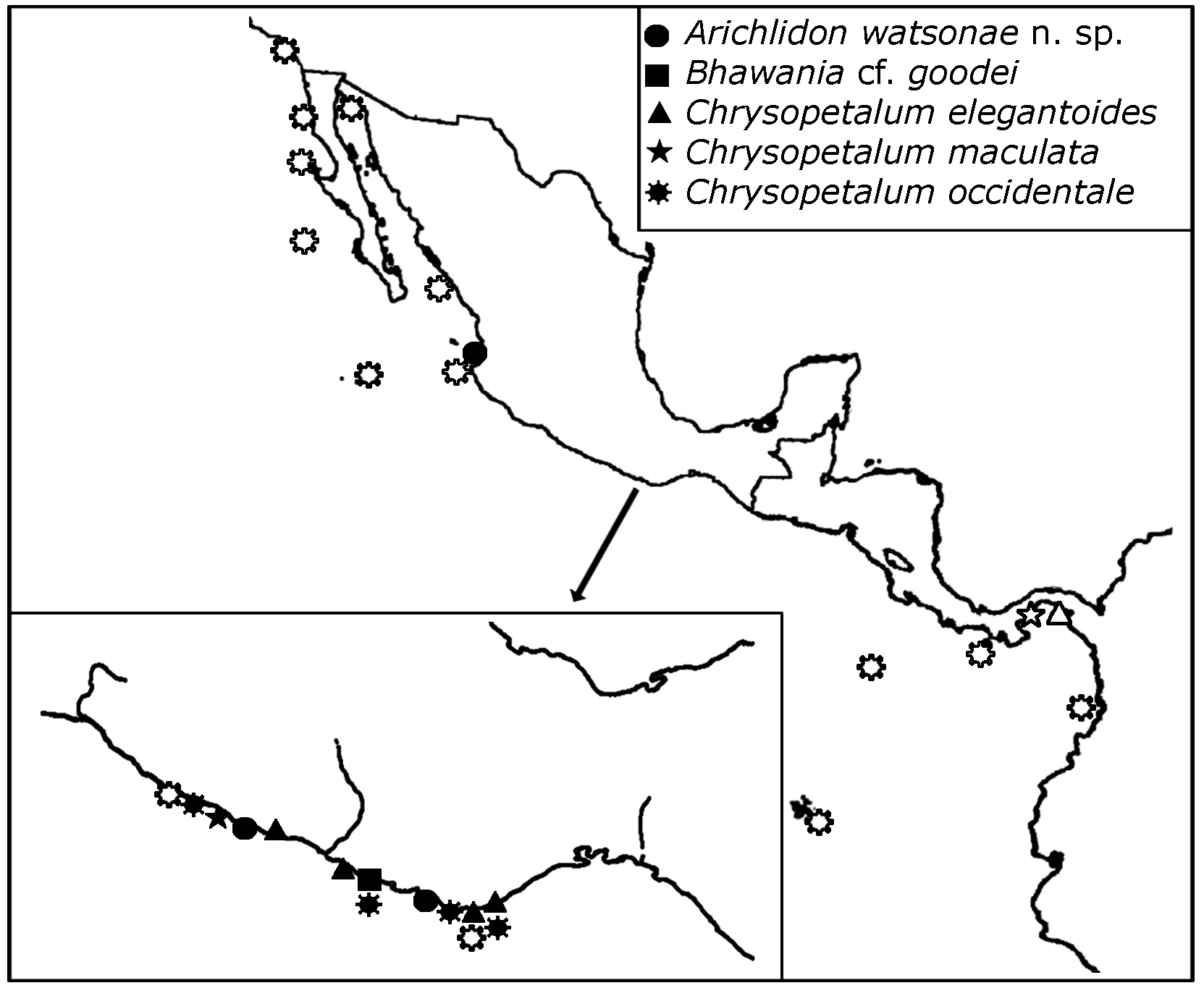
FIGURE 8. Historical and new records of Arichlidon watsonae n. sp., Bhawania cf. goodei, Chrysopetalum elegantoides, C. maculata and C. occidentale in the Tropical Eastern Pacific. Empty symbols indicate previous records.
Imageimage/png© Cruz-Gómez, Christopher;Bastida-Zavala, J. RolandoCruz-Gómez, Christopher;Bastida-Zavala, J. Rolando
IMAGES