
AnimaliaNot EvaluatedacceptedspeciesAccepted
Arichlidon watsonae

Arichlidon watsonae

Cruz-Gómez & Bastida-Zavala, 2018

GBIF:154498661

0year

ABOUT

Descriptions(6)

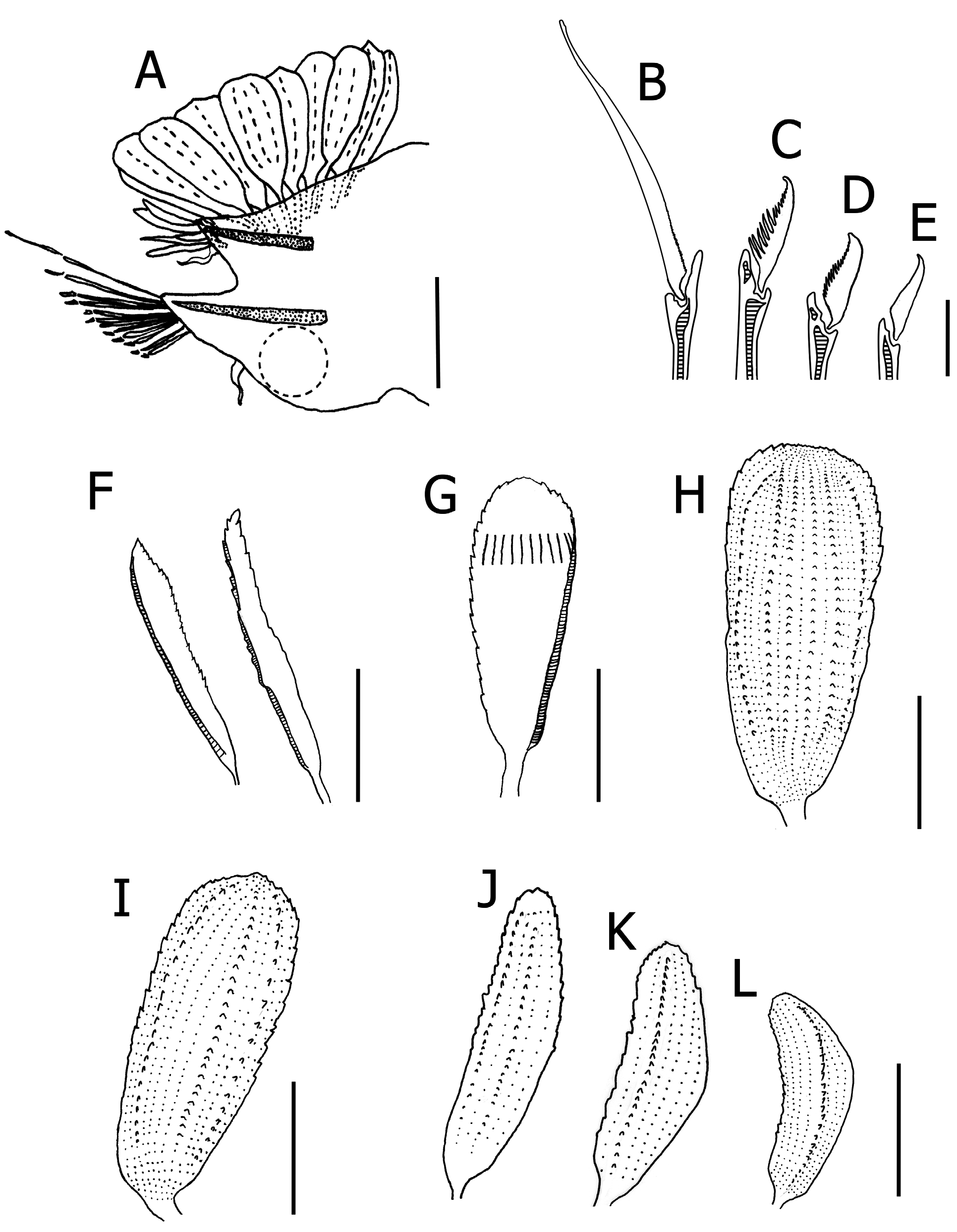
(Figures 2 A – L, 8, 14 A – D, 15 A)
Cruz-Gómez, Christopher, Bastida-Zavala, J. Rolando (2018): Chrysopetalids (Phyllodocida: Chrysopetalidae) from the southern Mexican Pacific, including a new species. Zootaxa 4521 (1): 61-88, DOI: 10.11646/zootaxa.4521.1.3
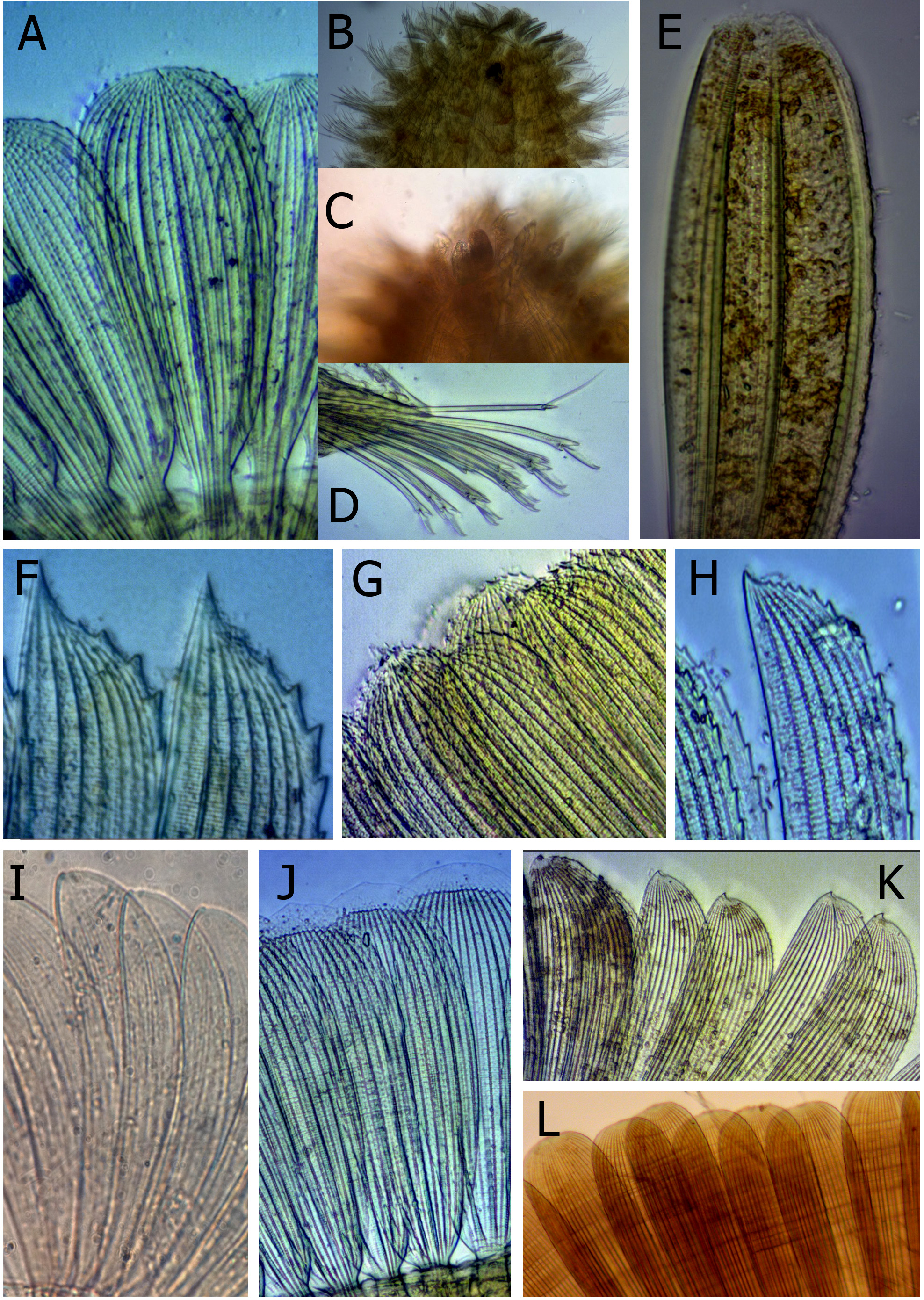
Description. Based on holotype. Complete, 7.3 mm long, 1.2 mm wide, 82 segments. Body rectangular, broad, with posterior segments slightly tapered. Body pale yellow with reddish brown spots on bases of dorsal and ventral cirri caused by eggs and oil drops. Paleae fans yellow to golden, imbricated over dorsum. Prostomium partly retracted among the first three anterior segments (Fig. 14 B). Two lateral antennae visible on anterior margin of prostomium; subulate median antenna, and slightly smaller than lateral antennae. Two pairs of violet-red eyes, partially covered by nuchal fold. Two palps almost circular, only visible in ventral view. Small and semicircular mouth fold posterior to palps; eversible proboscis with two slim and transparent stylets. Parapodium from tenth segment. Notochaetae separated in three main groups and two subgroups (Fig. 2 A). Lateral group inserted just below notoaciculum, comprising 5 – 6 slender asymmetrical paleae with 3 – 6 ribs (Fig. 2 F). As subunit 1, one symmetrical and strongly serrated palea with 8 – 12 ribs (Fig. 2 G). Main group, comprising 7 – 11 wide, symmetrical paleae with 16 – 19 ribs and 4 – 5 finely serrated raised ribs (Fig. 2 H). As subunit 2, one symmetrical and slender palea with 14 – 16 ribs and 3 – 5 raised ribs (Fig. 2 I). Median group, comprising three curved and asymmetrical paleae (Figs 2 J – K); distal palea with 10 – 11 ribs and two raised ribs, next proximal palea smaller with 8 – 9 ribs and one raised rib, and the most proximal and smallest palea (1 / 2 length of main paleae) with eight ribs and one raised rib. The smallest one not present in every segment. Surface of every paleae group covered by ornamental granules, denser in median paleae. Neuropodium large and conical. Heterogomph neurochaetae composed of four groups (Figs 2 B – E). Neurochaetiger with 1 – 2 superior spinigers with a long, slim and curved blade. First five anterior segments with only spinigers. Subsequent groups with falcigers; mid-superior group with 2 – 4 falcigers with medium length blades (2 / 3 of spiniger blade length) and basal serration; mid-inferior group with 7 – 9 falcigers with medium to short blades (1 / 2 of spiniger blade length), light serration basally; inferior group with 3 – 5 falcigers with short and smooth blades (2 / 7 of spiniger blade length), fine serration basally. All blades of falcigers ending in a terminal claw. Pygidium with a terminal ventral cone and two anal cirri from ventral view. Habitat. Intertidal to subtidal (1 – 4 m). These specimens were collected mainly from dead coral, rocks, algae, and as epibionts of bivalves and sponges.
Cruz-Gómez, Christopher, Bastida-Zavala, J. Rolando (2018): Chrysopetalids (Phyllodocida: Chrysopetalidae) from the southern Mexican Pacific, including a new species. Zootaxa 4521 (1): 61-88, DOI: 10.11646/zootaxa.4521.1.3
Remarks. The species Arichlidon watsonae n. sp. resembles to A. gathofi Watson-Russell, 2000 a, described from North Carolina, essentially in the shape of the distal end of the main paleae. Paleal shape in former species is similar to the fourth form presented by A. gathofi (see Watson-Russell 2000 a: 473, Fig. 2). However, both species have other morphological differences: Arichlidon watsonae n. sp. has faintly asymmetrical, thinner and longer lateral paleae compared to its main paleae (Fig. 2 F) while A. gathofi presents lateral paleae symmetrical, wider and 2 / 3 of the main paleae length (Watson-Russell 2000 a: 470, Fig. 3 A). Furthermore, A. watsonae n. sp. has four median paleae as maximum, while A. gathofi has 4 – 6; A. watsonae n. sp. has superior spinigers with a large manubrium and a curved blade, while A. gathofi has a short manubrium and its blade is straight (Watson-Russell 2000 a: 471, Fig. 3 C). In A. watsonae n. sp. all falcigers present a terminal claw, while in A. gathofi the falcigers have straight final tips. Additionally, A. watsonae n. sp. differs from other Arichlidon species in the size of the palps; A. watsonae n. sp. has two small, ovoid palps (Fig. 14 C), while the rest of the known species of this genus have large cylindrical palps.
Cruz-Gómez, Christopher, Bastida-Zavala, J. Rolando (2018): Chrysopetalids (Phyllodocida: Chrysopetalidae) from the southern Mexican Pacific, including a new species. Zootaxa 4521 (1): 61-88, DOI: 10.11646/zootaxa.4521.1.3
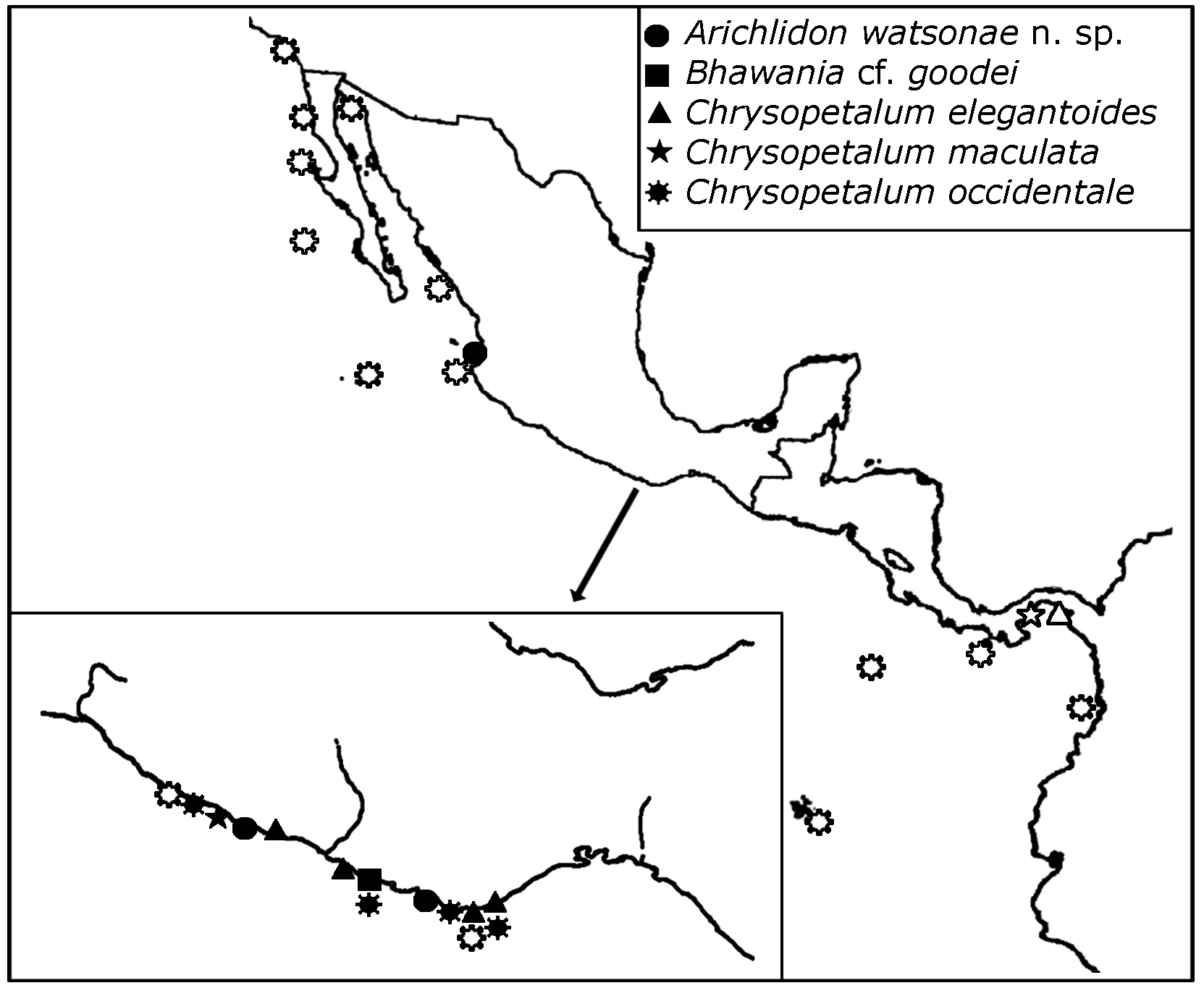
Distribution. Mexican Pacific, from La Manzanilla, Nayarit to La Tijera, Oaxaca (Fig. 8).
Cruz-Gómez, Christopher, Bastida-Zavala, J. Rolando (2018): Chrysopetalids (Phyllodocida: Chrysopetalidae) from the southern Mexican Pacific, including a new species. Zootaxa 4521 (1): 61-88, DOI: 10.11646/zootaxa.4521.1.3
Etymology. This species is named after Charlotte Watson (Museum & Art Gallery of the Northern Territory, Australia) in recognition of her important contribution to the knowledge of chrysopetalids.
Cruz-Gómez, Christopher, Bastida-Zavala, J. Rolando (2018): Chrysopetalids (Phyllodocida: Chrysopetalidae) from the southern Mexican Pacific, including a new species. Zootaxa 4521 (1): 61-88, DOI: 10.11646/zootaxa.4521.1.3
Type locality: Coral Beach, Ixtapa Island, Guerrero, Mexico. Type material. Holotype: UMAR-Poly 850, Coral Beach, 17 ° 40 ’ 36 ’’ N, 101 ° 39 ’ 22 ’’ W, Ixtapa Island, Guerrero, Mexico, southern Mexican Pacific; on dead coral, 1.5 m, September 19, 2007, coll. M. S. García- Madrigal; Paratypes: UMAR-Poly 851, three spec. from Coral Beach, same as holotype. Other material examined. Nayarit: ECOSUR-P 2938, two spec. (La Manzanilla, 20 ° 44 ’ 39 ’’ N, 105 ° 23 ’ 11 ’’ W, on rock with sponge and algae, 2 m, November 29, 2004, coll. B. Yáñez & P. Salazar). Guerrero: UMAR-Poly 852, one spec. (Manzanillo Beach, 16 ° 50 ’ 31 ’’ N, 99 ° 54 ’ 37 ’’ W, on sponge, 1 m, September 21, 2007, coll. M. S. García-Madrigal). Oaxaca: UMAR-Poly 853, eight spec. (Carrizalillo Beach, 15 ° 85 ’ 95 ’’ N, 97 ° 07 ’ 87 ’’ W, on bivalve, August 12, 2006, coll. I. Gutiérrez & N. Pedroza); UMAR-Poly 854, two spec. (La Tijera, 15 ° 68 ’ 69 ’’ N, 96 ° 44 ’ 34 ’’ W, on dead coral, 4 m, September 12, 2007, coll. J. R. Bastida-Zavala et al.).
Cruz-Gómez, Christopher, Bastida-Zavala, J. Rolando (2018): Chrysopetalids (Phyllodocida: Chrysopetalidae) from the southern Mexican Pacific, including a new species. Zootaxa 4521 (1): 61-88, DOI: 10.11646/zootaxa.4521.1.3

Export occurrence data

Darwin Core Archive (ZIP)

CLASSIFICATION

Taxonomic Classification Tree

MULTIMEDIA

Media Files(4)

FIGURE 2. Arichlidon watsonae n. sp. A, parapodium middle segment; B–E, neurochaetal types; F, lateral paleae; G, subunit 1 palea; H, middle main palea; I, subunit 2 palea; J–L, median paleae group. Scale bars: 10 µm (BCDE), 50 µm (FGHIJKL) 100 µm (A).
Imageimage/png© Cruz-Gómez, Christopher;Bastida-Zavala, J. RolandoCruz-Gómez, Christopher;Bastida-Zavala, J. Rolando

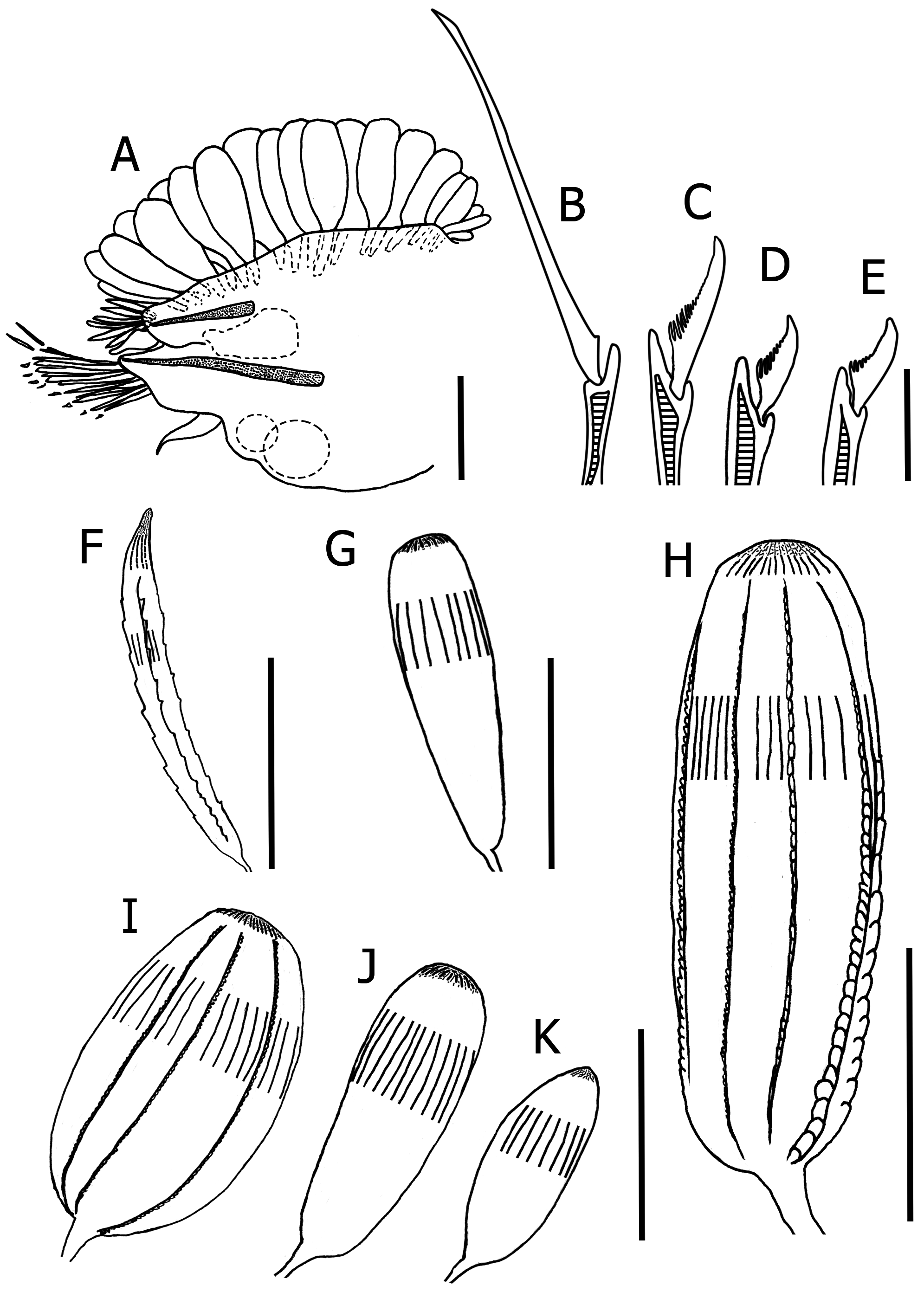
FIGURE 3. Bhawania cf. goodei. A, parapodium middle segment; B–E, neurochaetal types; F, lateral paleae; G, subunit 1 palea; H, meddle main palea; I–K, median paleae group. Scale bars: 30 µm (BCDE), 100 µm (FGHIJK), 200 µm (A).
Imageimage/png© Cruz-Gómez, Christopher;Bastida-Zavala, J. RolandoCruz-Gómez, Christopher;Bastida-Zavala, J. Rolando

FIGURE 8. Historical and new records of Arichlidon watsonae n. sp., Bhawania cf. goodei, Chrysopetalum elegantoides, C. maculata and C. occidentale in the Tropical Eastern Pacific. Empty symbols indicate previous records.
Imageimage/png© Cruz-Gómez, Christopher;Bastida-Zavala, J. RolandoCruz-Gómez, Christopher;Bastida-Zavala, J. Rolando

FIGURE 14. Arichlidon watsonae n. sp. A, detail of main paleae B, C, dorsal and ventral view of the prostomium; D, Neurochaetae. Main paleae of chrysopetalids from the southern Mexican Pacific: E, Bhawania cf. goodei; F, Chrysopetalum elegantoides; G, C. maculata; H, C. occidentale; I, Hyalopale sp.; J, Paleaequor psamathe; K, Paleanotus bellis; L, P. purpurea.

Imageimage/png© Cruz-Gómez, Christopher;Bastida-Zavala, J. RolandoCruz-Gómez, Christopher;Bastida-Zavala, J. Rolando

IMAGES

Gallery(4)

See Gallery

Occurrences with images

Source Information

Chrysopetalids (Phyllodocida: Chrysopetalidae) from the southern Mexican Pacific, including a new species

checklist

This dataset contains the digitized treatments in Plazi based on the original journal article Cruz-Gómez, Christopher, Bastida-Zavala, J. Rolando (2018): Chrysopetalids (Phyllodocida: Chrysopetalidae) from the southern Mexican Pacific, including a new species. Zootaxa 4521 (1): 61-88, DOI: 10.11646/zootaxa.4521.1.3

Abstract

The family Chrysopetalidae has been poorly studied from the Pacific coast of Mexico compared to other families. Specifically from the southern Mexican Pacific, only two species of the family have been recorded in previous studies, Chrysopetalum occidentale and Paleanotus chrysolepis. In this study 311 specimens were revised, and nine species, belonging to six genera were found. Eight of these species are new records from the southern Mexican Pacific coast: Arichlidon watsonae n. sp., Bhawania cf. goodei, Chrysopetalum elegantoides, C. maculata, Hyalopale sp., Paleaequor psamathe, Paleanotus bellis and P. purpurea. A new species is also described, Arichlidon watsonae n. sp., which is characterized by the curved tips blades of the falcigers and their small and ovoid palps. Additionally, the genera Arichlidon and Hyalopale are recorded by first time from the Tropical Eastern Pacific.

Cruz-Gómez C, Bastida-Zavala J R, plazi (2018). Chrysopetalids (Phyllodocida: Chrysopetalidae) from the southern Mexican Pacific, including a new species. Plazi.org taxonomic treatments database. Checklist dataset https://doi.org/10.11646/zootaxa.4521.1.3 accessed via GBIF.org on 2026-06-19.

CC0Published 11/13/2018View dataset
GBIF Usage Key
154498661
Dataset Key
496b64db-ed0b-43a2-bb95-8e75fcf30a7b
Origin
source
Backbone Key
10216690
Taxon ID
039187C93618FFA36199F88AD7849328.taxon
Last Crawled
6/10/2026
Last Interpreted
6/10/2026